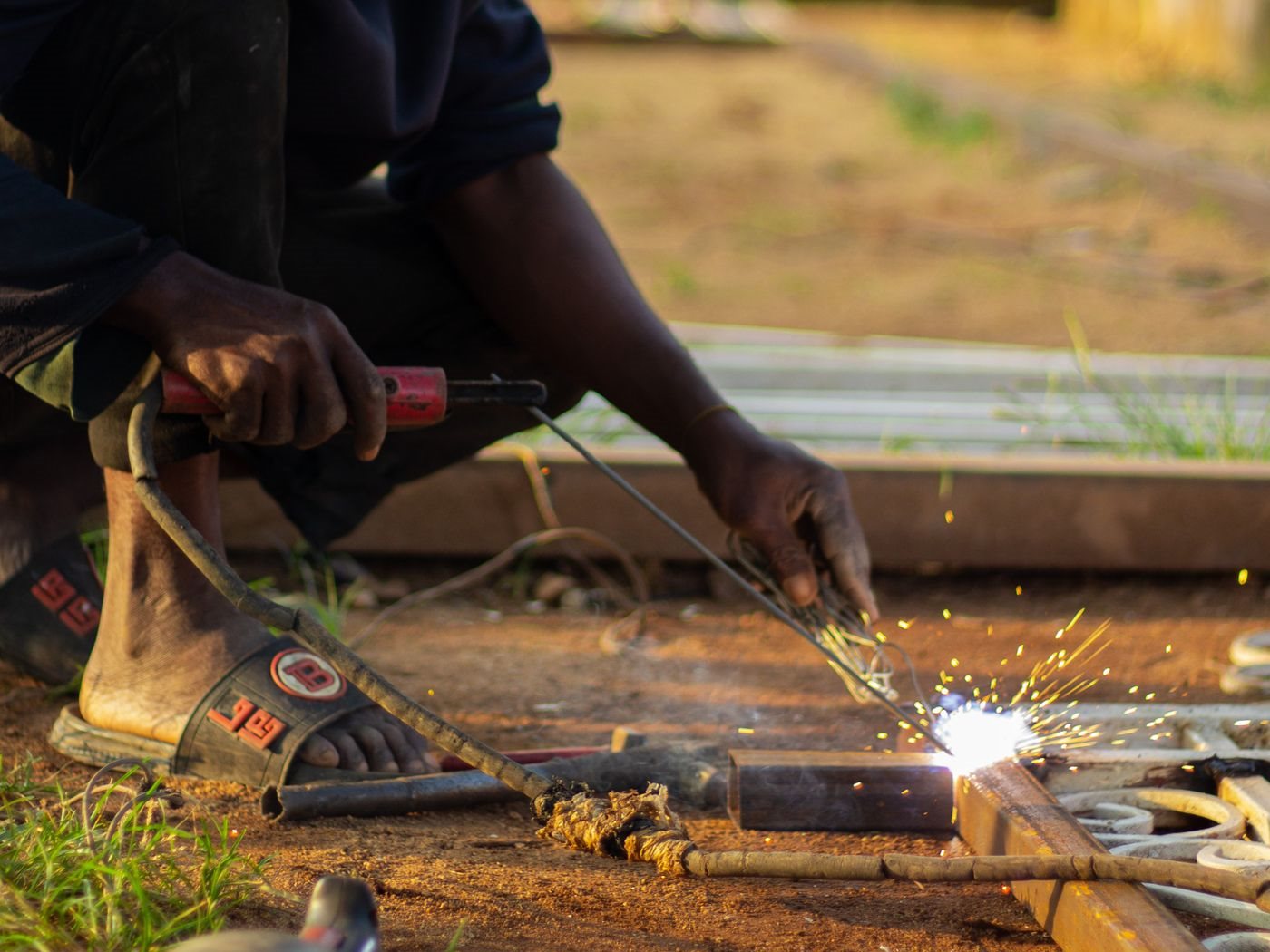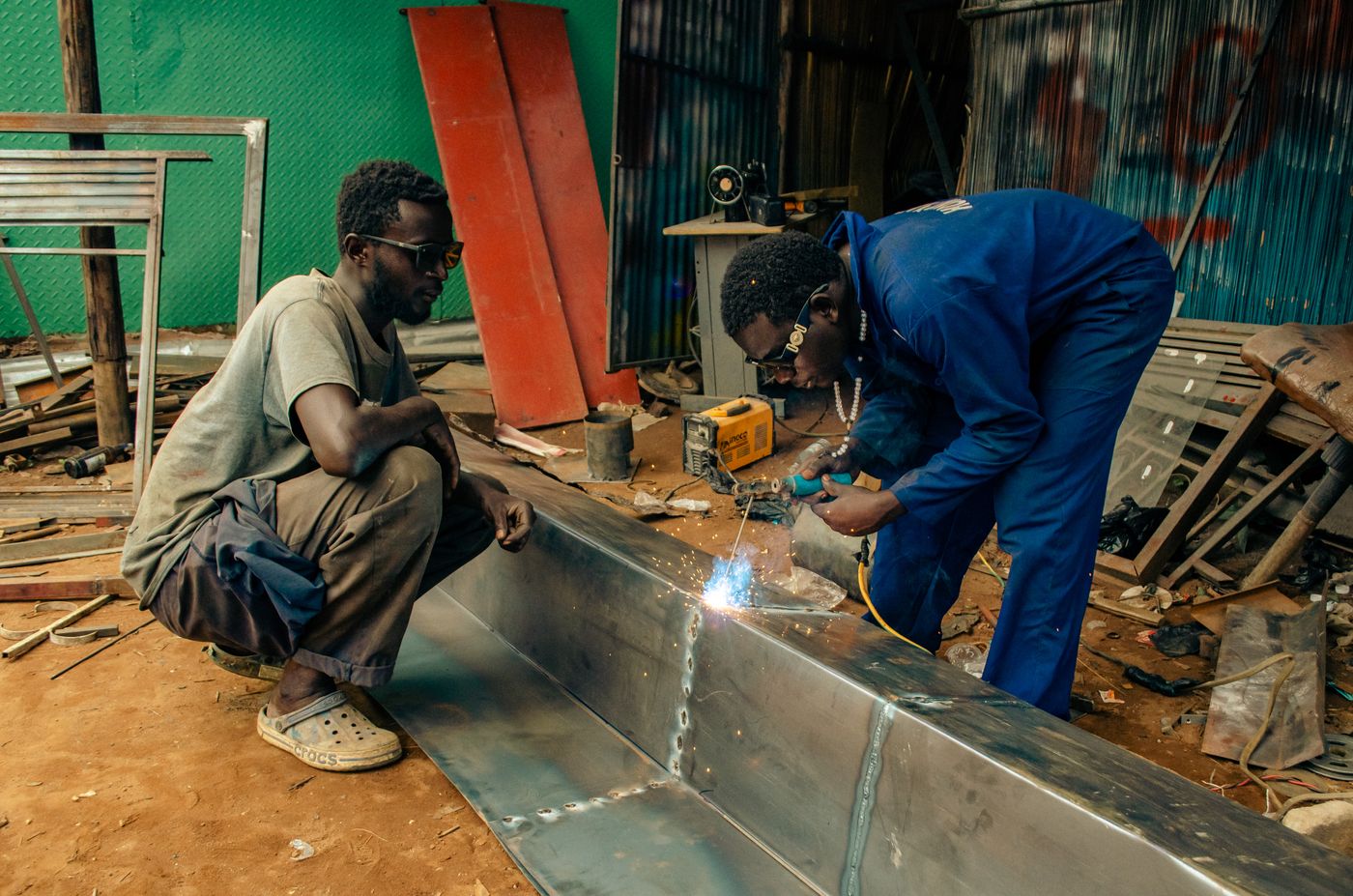
Walk down any jua kali lane in Kenya, from Kamukunji to Gikomba to the fabrication sheds outside every county town, and you will hear the same sound: the crackle of arc welding. Gates, window grills, roof trusses, wheelbarrows, poultry cages, water tank stands and posho mill frames are all built by small workshops with a welding machine, an angle grinder and a lot of skill.
For a fundi starting out, or expanding from one machine to two, the welding machine is the biggest tool decision in the workshop. Buy the wrong one and you either trip the landlord's breaker every afternoon, or you stand idle while the machine cools down, or you carry a 60 kilo transformer to every site job. Buy the right one and it works every day for years and pays for itself in jobs.
We have already compared arc and MIG welding for a rural workshop. This guide is about the buying decision itself for a small jua kali business: matching the machine to your job mix, inverter or transformer, how to read the duty cycle, what your power supply will really allow, site work, and the rest of the kit you need to earn from it.
Start With Your Job Mix
Before you look at any machine, write down the work you do in a typical month, or the work you want to win. The type of job decides the current you need, how long you weld without stopping and whether the machine has to travel.
Light fabrication. Window grills, burglar-proofing, small gates, poultry cages, shelves and furniture frames in thin box section and flat bar. Most of this is done with small diameter electrodes at modest current, in short runs.
Medium fabrication. Big double gates, steel doors, roof trusses, tank stands, trailer and cart frames. Thicker sections and longer welds mean more current and more time with the arc lit.
Repairs and site work. Fixing farm implements, posho mill frames, cracked brackets and broken hinges, often at the customer's place. Portability and the ability to run from a generator or a weak supply matter as much as output.
Sheet metal. Troughs, gutters, feeders and boxes in thin sheet. These punish too much heat, so control at low current matters more than maximum output. Our guide to sheet metal troughs and gutters covers that work.
Inverter or Transformer?
Most small arc welders sold in Kenya today are one of two types.
Transformer welders are the traditional heavy machines, often oil cooled. They are simple, tough and tolerant of rough treatment and dirty power, and a good fundi can keep one going for decades. They are also heavy, they draw high current from the supply, and they give a harsher arc that takes more skill on thin metal.
Inverter welders use electronics to convert the supply into welding current. They are much lighter and smaller for the same output, generally use the supply more efficiently, give a smoother and more stable arc, and often have features such as hot start and arc force that make striking and running rods easier. The trade-off is that electronics dislike dust, metal filings, damp and voltage spikes, and a cheap inverter can fail where an old transformer would keep going.
For a small workshop on a shared single-phase supply, and for anyone who does site work, an inverter is usually the practical choice. Look after it: keep it off the floor, away from grinding dust and rain, blow out the inside gently with dry air from time to time, and protect it from the supply surges described below.
Reading the Duty Cycle Properly
The duty cycle is the most misunderstood figure on a welding machine. It tells you what percentage of a set period, usually ten minutes, the machine can weld at a given current before it must rest to cool down. The international standard for welding power sources, IEC 60974-1, rates machines with the heating test at an ambient temperature of 40 °C, so read the figure next to that temperature if it is printed.
A machine sold as "200 amps" may only deliver 200 A for a small fraction of each ten minutes. What matters is the duty cycle at the current you use most. If you weld gates all day with mid-size electrodes, compare machines at that current. A machine with a higher duty cycle at your working current keeps you welding instead of waiting, and runs cooler, which lengthens its life.
Kenyan afternoons in a tin-roofed workshop can be hot, and a hot room shortens the duty cycle further. Give the machine space, shade and airflow, and never block its fan.
What Your Power Supply Will Really Allow
Many jua kali workshops run on a single-phase supply shared with neighbours, sometimes at the end of a long line. That supply, not the machine's maximum rating, often sets the limit on what you can weld.
Check the circuit. A welder at medium to high output can draw more current than an ordinary socket circuit is designed for. Ask a qualified electrician to confirm the machine's maximum input current, printed on its data plate, against your supply, cable size and breaker. A dedicated circuit with a proper isolator is safer than a socket and an extension reel. Our guide to extension cables and electrical safety explains why long, thin leads overheat and starve the machine.
Watch for low and unstable voltage. At the end of a weak line the voltage can sag when you strike an arc, and spike when big loads switch off. Inverter welders often list an input voltage range; a supply that falls outside it causes poor arcs, tripping or damage. Our guides to voltage fluctuations and single versus three-phase power help you judge your supply, and ask your electrician about surge protection.
Generators. For site work and outages, many fundis run a welder from a generator. The generator must be big enough for the welder's input at the current you use, with a margin, and an inverter welder may need a generator with steady voltage. Check the welder maker's advice on generator size before you buy either.
Site Work: Weight, Leads and Weather
If a good share of your income comes from fixing things at the customer's place, portability is money. A light inverter in a carry case, a pair of decent leads long enough to reach the job, a reliable earth clamp and a small generator turn a call-out into a job done in an hour. Coil leads neatly, keep the connections tight and clean, and replace damaged insulation at once.
Never weld in rain or standing on wet ground, and keep the machine dry. Damp is a shock hazard as well as a killer of electronics.
The Rest of the Kit That Earns Money
A welding machine on its own does not build a gate. The tools around it decide how fast and how neatly you work.
Cutting. An angle grinder is the most used tool in most jua kali shops; a cut-off saw gives straighter, square cuts on box section and angle in volume. Our guide to the cut-off saw versus angle grinder compares them.
Holding square. Magnetic holders and clamps hold work at true angles while you tack it. A gate that is square the first time saves hours of grinding and re-welding. See our guide to magnetic welding holders.
Electrodes. Match the rod type and diameter to the metal and thickness, and set the current within the range printed on the packet. Keep rods dry; damp rods spatter and give porous welds. Our guide to welding rod selection goes into detail.
Finishing. A clean, primed and painted gate is what the customer judges. Our guide to rust protection for welded gates covers it.
Safety Is Part of the Price of the Machine
Arc welding produces intense ultraviolet light, hot spatter, fumes and electric shock risk. Budget for protection when you budget for the machine: a welding helmet with the right shade filter for the current you use (arc welding typically needs a dark shade, around 10 or higher, so check the helmet's rating), leather gloves, a long-sleeved cotton or leather jacket, safety boots and screens to protect passers-by and apprentices from arc flash. Weld where fumes can clear, keep a fire extinguisher close, and clear rags, paint and fuel away from the work. Our guide to workshop safety and PPE lists what you need.
Your Welding Machine Buying Checklist
| Question | What to check |
|---|---|
| Job mix | Light, medium, sheet or site work; the current you use most |
| Type | Inverter for light weight and shared supplies; transformer for rough use and dirty power |
| Duty cycle | Rating at your working current, ideally at 40 °C |
| Supply | Maximum input current against your circuit, cable and breaker; input voltage range |
| Site work | Weight, carry case, lead length, generator compatibility |
| Support | Warranty, spare parts and a repair service you can reach |
| Kit and safety | Grinder, cutting, clamps, rods, helmet, gloves, jacket, screens, extinguisher |
Workshop Tools to Look At
Prices change, so we do not print them here. See each product page or the Fuga price list for current prices and stock.
| Item | Use in the workshop |
|---|---|
| Angle grinder | Cutting, grinding welds, cleaning before painting |
| Cut off saw | Straight, square cuts on box section and angle |
| Industrial drill press | Accurate holes for hinges, bolts and brackets |
| Generators | Site work and outages, sized to the welder |
| Steel measuring tape | Measuring and marking out |
Choose for the work you do most, compare duty cycles at your working current, confirm your supply with an electrician and budget for the kit and safety gear around the machine. Browse our workshop and industrial tools, or WhatsApp 0716 961 018 with your job mix and power supply and we will help you put the workshop together.
Key Takeaways
- List your job mix first: light fabrication, medium fabrication, sheet metal or site repairs decide the current and portability you need.
- Inverter welders are lighter and kinder to a shared supply; transformer welders are tougher and more tolerant of dirty power.
- Compare duty cycle at the current you actually weld at, ideally rated at 40 degrees C, not the headline maximum amps.
- Have an electrician check the machine's maximum input current against your circuit, cable and breaker, and watch for low voltage.
- For site work, size any generator to the welder's input with a margin and check the maker's advice.
- Budget for cutting tools, clamps, dry electrodes, a correctly shaded helmet, protective clothing and screens alongside the machine.
Frequently Asked Questions
Is an inverter or transformer welding machine better for a jua kali workshop?
For a small shop on a shared single-phase supply, or for anyone doing site work, an inverter is usually more practical because it is light and uses the supply efficiently. A transformer welder is heavier but very tough and tolerant of dirty power. Keep an inverter away from dust, damp and surges.
What does duty cycle mean on a welding machine?
It is the percentage of a set period, usually ten minutes, that the machine can weld at a given current before it must rest to cool. A 60 percent rating at a given current means about six minutes welding and four resting. Compare machines at the current you use most.
Can I run a welding machine from an ordinary socket?
Small machines at low current may, but at medium to high output a welder can draw more than an ordinary socket circuit is designed for. Ask a qualified electrician to check the machine's maximum input current against your circuit, cable size and breaker, and avoid long thin extension leads.
What size generator do I need for a welding machine?
It depends on the welder's input at the current you use. Choose a generator with a margin above that input, and check whether the welder maker recommends a minimum generator size or a stable voltage supply before buying either.