
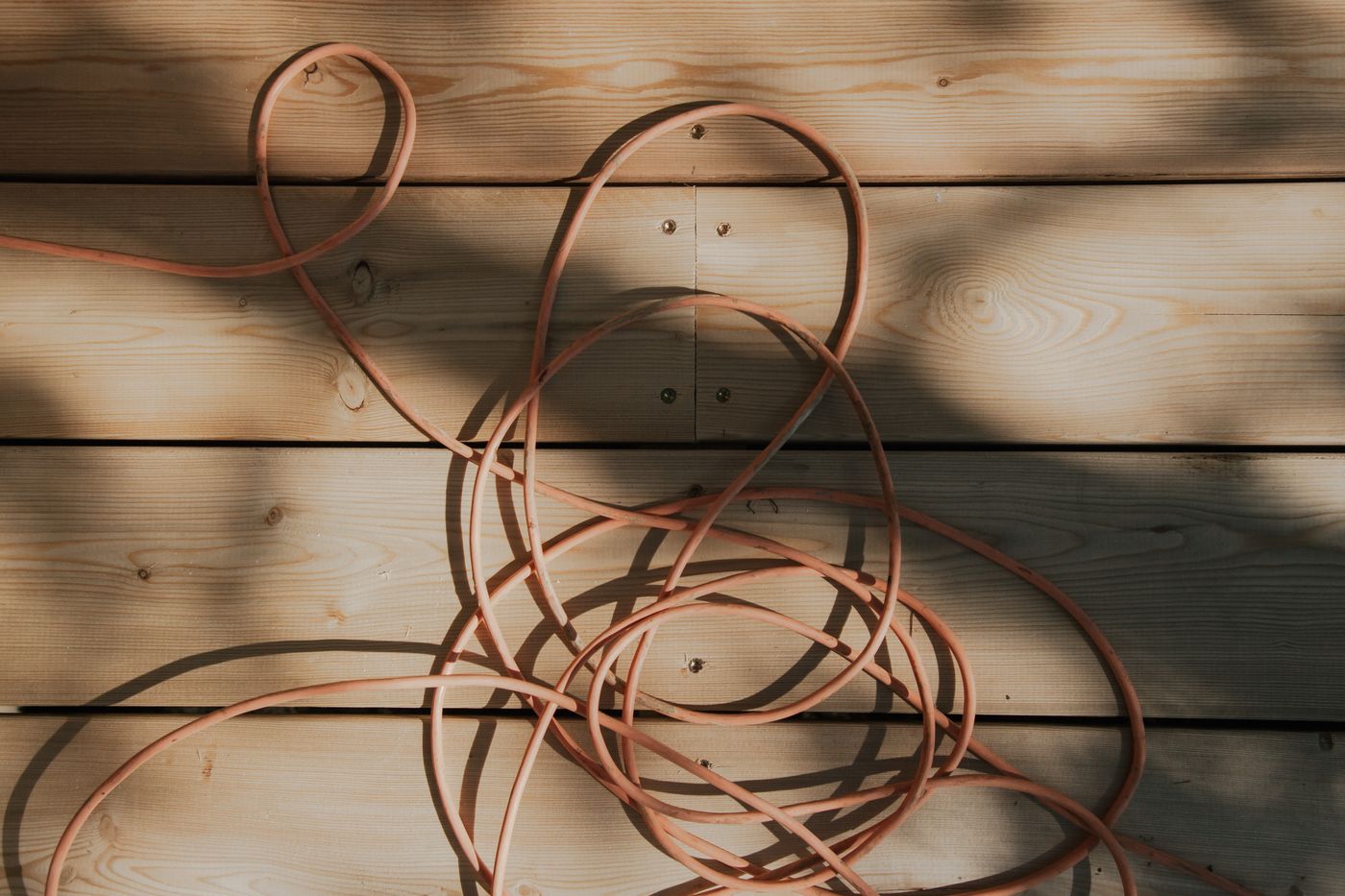
The welder is thirty metres from the nearest socket, so the fundi runs it off the orange reel from the store. He strikes an arc, the arc stutters and dies, and he tries again with a smaller rod. By the third attempt the reel is warm and the plug on the wall is warmer. He blames the welder.
The welder is fine. It is being fed through fifty metres of thin copper, most of it still on the drum, and it is getting perhaps two hundred volts at the machine instead of two hundred and forty at the wall. The lead is quietly cooking, and nobody in the yard has ever pressed the test button on an RCD, because there is no RCD.
This is the physics behind that scene and the handful of habits that separate a yard that shocks and burns from one that does not: cable size against length and load, the unwound reel, what the earth pin and the RCD each do, safe generator changeover, and water around pumps and dairies.
Why a Thin, Long Lead Starves a Welder or a Pump
Copper has resistance. Not much, but current travels down the live conductor and back along the neutral, so a 50 m lead is 100 m of copper in the circuit. The voltage lost across that copper is current multiplied by resistance, and it is lost before the tool sees it.
Resistance falls as the conductor gets thicker. Leads come with conductors of 1.0, 1.5 or 2.5 square millimetres, printed on the sheath as 3 x 1.5 mm² or similar. Halving the cross section doubles the resistance, so size and length decide the drop together, and a long thin lead is the worst of both.
Thirteen amps is the full load of a three-pin plug, about three kilowatts, and a stick welder on a heavy rod, a compressor or a 1.5 kW pump all run near that ceiling. The trouble starts at switch-on, when an induction motor draws several times its running current for a fraction of a second. Multiply that surge by the resistance of a thin lead and the voltage collapses exactly when it is needed: the pump hums, the contactor chatters, or the motor sits stalled and heating until something trips.
A welder suffers the same way. Its output depends on input voltage; starve it and the arc will not establish, the rod sticks, and the machine draws more current for the same work, heating the lead further. A machine that runs perfectly beside the socket and misbehaves at the end of a reel has a reel problem. Our guide to welding machines assumes the machine is fed properly, and a thin reel quietly breaks that assumption.
Unwind the Reel. All of It
Every ampere through copper makes heat along the whole conductor. Laid out on the ground, that heat leaves into the air as fast as it is made. Wound on a drum, each turn is wrapped by the turns beside it, the inside of the coil cannot shed heat at all, and its temperature climbs under a load the same cable would carry easily unwound.
That is why a reel's label shows two current ratings, wound and unwound, with the wound figure a fraction of the other. Ignore it and the PVC softens, the insulation between turns fuses together, and the first warning is a smell, then smoke from the drum.
The rule is simple. Any motor or heating load, welders, pumps, compressors, grinders and heaters included, runs off a fully unwound reel, even if you need ten metres of it. Lay the spare cable in a loose zigzag, because a neat coil on the floor traps heat nearly as well as the drum did.
While the reel is off the drum, look at it. A nicked sheath, a bulge where a join was taped, a plug with a cracked body or scorched pins: any of these retires the lead until it is repaired with a proper in-line connector, never insulation tape over twisted conductors. A taped joint is a resistance, a resistance is a heater, and a heater in wet grass is how leads start fires.
Plugs, Fuses and the Earth Pin That Went Missing
Kenya uses the British three-pin plug, one of the better designs in the world when used as intended. The fuse inside it protects the flex, not the appliance, so it should be the smallest size that carries the load: 3 A for lamps and chargers, 13 A for heaters, welders and motors. A 13 A fuse on a thin lamp flex will let that flex glow before it blows.
The longer pin is the earth, and it does two jobs: it opens the socket's shutters so the live pins can enter, and it connects the tool's metal body to the earth of the building. Snap it off to force a plug into a damaged socket and you lose both. The next internal fault leaves the casing live and waiting for a hand.
The habit that starts more fires than any other is the loose connection. A plug that is warm after ten minutes on a modest load has a poor contact, in its terminals or in the socket. A poor contact is a small resistance under a large current, and the heat it makes worsens the contact, which makes more heat. Stacked multi-way adaptors, two-pin plugs wedged into three-pin sockets with a matchstick in the earth hole, and sockets browned around the holes are the same fault at different stages. Replace the socket, fit a proper plug, spread the load.
Earthing and RCDs: Two Layers That Keep a Shock Survivable
These are different protections and you need both. Earthing gives fault current somewhere to go. If a live wire inside a grinder touches its metal casing, an earthed casing carries that current straight back to the supply, the current is enormous, and the fuse or MCB opens in a fraction of a second. Without the earth, the casing sits at mains voltage until someone completes the circuit.
A residual current device, or RCD, covers the case earthing does not: current leaking through something other than the earth conductor, including a person. It compares the current leaving on the live with the current returning on the neutral. If some is leaking away, the two differ, and when the difference reaches the device's rating it opens the circuit.
The rating that matters for people is 30 milliamps: small enough and fast enough that most shocks through a hand are interrupted before the heart is affected. A 100 mA or 300 mA device protects wiring against fire but is too slow and too coarse to protect a person. Fit a 30 mA RCD on every circuit feeding a socket outdoors, in a wet area or on an extension lead. If the distribution board has none, a plug-in RCD adaptor at the socket protects everything downstream of it for the price of a good pair of boots.
Two limits. An RCD does nothing against overload, which is the fuse's job, and it protects nothing upstream of itself, so an adaptor at the far end of a damaged reel protects the tool but not the reel. And it needs testing: the test button simulates a leak, and pressing it monthly is the only way to know the mechanism has not seized.
Outdoor Sockets and What the IP Code Promises
An indoor socket bolted to the outside wall of the store under a scrap of iron sheet has a life measured in rainy seasons. Outdoor and washdown gear carries an IP rating, and the two digits are worth understanding.
The first digit is protection against solids, from dust to fingers; the second is protection against water. IP44 keeps out splashes from any direction and suits a socket under a veranda. IP65 is dust tight and resists a hose jet, right for a wall socket in the open. IP66 handles powerful jets and is the sensible minimum for a parlour hosed down twice a day. IP67 survives temporary immersion and belongs on submersible pump connectors, not on a wall.
An IP rating is only true with the lid closed and the cable entry glanded. Good outdoor sockets keep their rating with a plug inserted, provided the cable leaves downward. Give every outdoor cable a drip loop, a dip below the socket before it rises, so water running along the sheath falls off instead of following the cable into the box.
Generator Changeover Without Energising the Line Outside
A generator solves a blackout and creates a new problem: two supplies wanting to feed one installation. The dangerous shortcut is a lead with a plug on both ends, pushed into a wall socket. The moment the generator starts, the free plug's pins are live at 240 V and the output flows back through the meter to the transformer, lifting the line outside your gate to a dangerous voltage. Kenya Power crews restoring supply treat that line as dead. When the grid returns, the two supplies meet out of phase and the generator loses.
The correct device is a changeover switch. It sits in one of two positions, grid or generator, with off between, and physically prevents the two from ever being connected. Manual changeovers sit next to the distribution board; automatic transfer switches do the same job unattended. Installation is a job for an EPRA licensed electrician, and the earthing matters: an RCD on the generator side only works if the generator's neutral is referenced to earth. Ask the electrician to confirm this rather than assume it.
The sequence protects the generator as much as the people. Switch the big loads off, start the set and let it settle, move the changeover to generator, then bring loads on one at a time, largest motor first. Reverse the order when the grid returns: loads off, changeover to grid, let the set run unloaded for a couple of minutes to cool, then stop it. Our guide to generator maintenance covers the service side; this is the switching side, and both matter.
Water, Pumps and Dairies
A pump house and a milking parlour are where water and electricity sit closest together on most farms. Keep the control gear high and dry. A pump starter or float switch controller mounted at knee height on the wet wall of a pump house fails in the first flood or the first careless hose. Mount it at chest height in an IP-rated enclosure, cables entering from below through glands, with a drip loop on each.
Submersible pump cable is the join people get wrong most often. The factory cable is sealed at the motor; every join you add is a place for water to enter. Extend it only with a resin-filled or heat-shrink joint kit made for immersion, never tape, and better still run the full length to the wellhead and join there in a dry box.
In the dairy, the milking machine motor and vacuum pump want a dedicated circuit from an RCD-protected breaker, IP66 sockets with lids that close on the plug, and a rule that hoses never point at electrical gear. Wet concrete and a metal stall make a near-perfect path to earth, so a leak that would tingle a hand in a dry workshop can be dangerous here. The rubber boots worn for hygiene double as insulation, but they do not replace the RCD.
The Habits That Cause Fires and Shocks
Most farm electrical accidents trace to a short list of habits, none of them expensive to break.
Running a heavy load through a coiled reel. The commonest cause of a reel fire. Unwind it, every time.
The missing earth pin and the matchstick. Both defeat the socket's shutters and remove the tool's earth. Fix the socket; do not modify the plug.
Leads across the floor and through doorways. A cable that is stepped on, driven over and trapped in a door loses its insulation slowly and invisibly. Route it overhead or along walls, and inspect it each time it is unwound.
Working live because it is quicker. Isolate at the board, not at the tool switch, and keep the lock-off in your pocket while you work. A colleague resetting a breaker is a classic accident.
Nobody has ever pressed the test button. Monthly. Put it on the same list as the generator oil check.
Reels in 1.5 and 2.5 mm², plug-in RCD adaptors, IP-rated sockets and enclosures, changeover switches and cable joint kits are all in our workshop and industrial tools range at all six branches. Bring the tool's rating plate and the distance to the socket, and we will size the lead rather than guess it.
Key Takeaways
- A long thin lead loses voltage before the tool sees it. Size the conductor for the load and the distance: 2.5 mm² for welders, pumps and compressors, and a permanent circuit past about 50 m.
- Unwind the reel fully for any motor or heating load. A coiled reel cannot shed heat, which is why the drum carries two ratings.
- The fuse in the plug protects the flex, not the tool. The earth pin opens the shutters and earths the casing; never remove it.
- Earthing lets a fault trip the breaker. A 30 mA RCD catches leakage that a breaker never sees, including through a person. Use both and press the test button monthly.
- Outdoor sockets need an IP rating that suits their exposure, IP44 under cover, IP65 in the open, IP66 in a washdown parlour, and a drip loop on every cable.
- Never connect a generator through a plug-to-plug lead. A changeover switch fitted by a licensed electrician is the only safe method, and it protects the linesmen as much as you.
- Keep pump and dairy control gear high, dry and enclosed. Join submersible cable only with an immersion-rated kit, and preferably above the water.
Frequently Asked Questions
What size extension cable do I need for a welder or a water pump?
Go by conductor size and length together, not by the plug. For anything with a motor or a welding transformer, treat 1.0 square millimetre flex as unsuitable beyond a few metres, use 1.5 square millimetre for short runs, and use 2.5 square millimetre for anything approaching 25 to 50 metres. A welder or pump on a long thin lead sees a lower voltage than the socket delivers, draws more current to compensate, and either stalls, stutters or cooks the cable. If the run is longer than about 50 metres, the honest answer is a permanent circuit in armoured cable installed by a licensed electrician.
Why must an extension reel be fully unwound before use?
A cable carrying current makes heat along its whole length. Laid out, that heat escapes into the air. Coiled on a drum, each turn is insulated by the turns around it and the heat has nowhere to go, so the inside of the coil climbs to the point where the PVC softens and the insulation fails. Reel makers print two ratings on the drum for exactly this reason, and the coiled figure is a fraction of the unwound one. Unwind the whole reel for any heating or motor load, even if you only need ten metres of it.
What does a 30 mA RCD actually do?
A residual current device compares the current going out on the live conductor with the current coming back on the neutral. In a healthy circuit they match exactly. If some current is leaking to earth instead, through a damaged cable, a wet motor or a person, the two no longer match, and when the difference reaches 30 milliamps the RCD opens the circuit within a fraction of a second. That is fast enough and low enough to keep most shocks survivable. It does not protect against overload, which is the job of the fuse or MCB, and it cannot protect anything plugged in upstream of it.
Can I plug a generator into a wall socket to power the house during a blackout?
No. A plug-to-plug lead, sometimes called a suicide lead, has exposed live pins at one end the moment the generator starts, and it back-feeds the generator's output into the incoming supply. That energises the line outside your gate while Kenya Power staff may be working on it believing it is dead, and when the grid returns the two supplies meet and the generator can be destroyed. The correct arrangement is a changeover switch, fitted by a licensed electrician, that physically prevents the grid and the generator from being connected at the same time.