
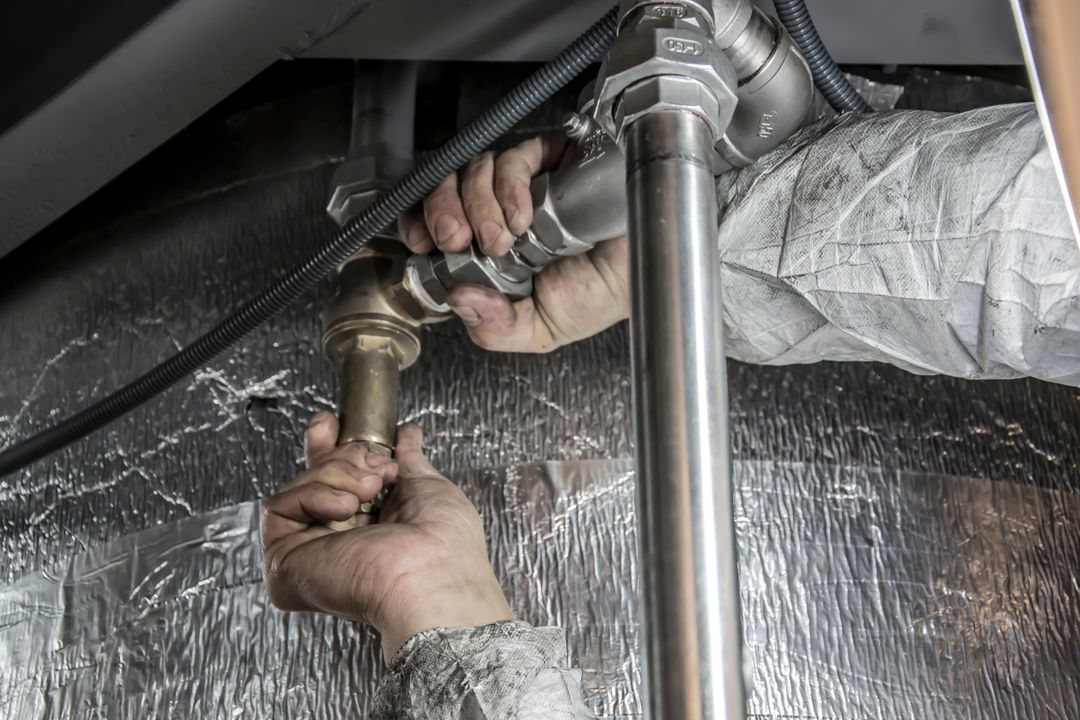
Water hammer is the pressure shock that bangs through a pipe when moving water is stopped suddenly, by a fast-closing valve, a tripped pump or a slamming check valve. Stop it by closing valves slowly, keeping water speed near 1.5 m/s, fitting a pressure tank and a soft-closing check valve, and clamping the pipe.
You have probably heard it. A gravity line runs 300 metres from a tank on the hill to the dairy, somebody shuts the ball valve at the trough in one quick flick, and the whole pipe bangs like a hammer on a gate. The pipe jumps in its clamps, the joint at the bend shivers, and a week later a thread that never leaked before starts to weep.
That bang is not noise alone. It is a pressure spike travelling through your pipe at hundreds of metres a second, and it can be several times the normal working pressure. This guide explains what causes it, how to estimate how bad it could be, how the pipe material and the length of the line change the risk, and the fixes that work, from free habits to a pressure tank. It builds on our guides to pipe sizing and friction loss and booster pumps and pressure systems, which mention water hammer but do not stop to explain it.
What Is Water Hammer and Why Does It Bang?
Water is heavy. A 300 metre line of 50 mm pipe holds hundreds of litres, and when it is flowing it has real momentum, like a loaded lorry rolling downhill. When a valve slams shut, that moving column has to stop at once. Its energy has nowhere to go, so it turns into pressure.
The pressure surge does not stay at the valve. It travels back up the pipe as a wave at close to the speed of sound in that pipe, bounces off the tank or pump, and returns, again and again, getting weaker each time. The bangs you hear are the wave hitting valves, bends and clamps as it passes. In engineering the size of the first surge is given by the Joukowsky equation: pressure rise equals water density times wave speed times the change in velocity.
That equation holds the whole story in one line. The surge grows with how fast the water was moving and with the wave speed, which depends on the pipe material. It does not depend on how pretty the valve is. It depends on how suddenly you stop the water.
How Big Can the Surge Get?
Worked out with typical wave speeds, stopping water that is moving at 1 metre a second instantly produces roughly 12 bar in a steel pipe, about 4 bar in PVC and about 3 bar in HDPE. Stiff pipe carries the wave faster and so spikes higher. Plastic pipe is much kinder per metre a second, but plastic pipe also has a lower pressure rating, so the margin is thinner than it looks.
The surge scales straight with speed. Halve the velocity and you halve the spike. That is why the speed of the water in your pipe matters as much as the valve. As a rough guide, a flow of 2 cubic metres an hour through a pipe with about 25 mm inside diameter runs at about 1.1 metres a second, while the same flow through a pipe with about 20 mm inside diameter runs at about 1.8.
Real surges are usually smaller than these worst cases, because friction, small leaks, trapped air and the stretch of the pipe all soak up energy. But the proportion holds, and the surge lands on top of the pressure already in the line. A pipe rated for 10 bar (PN10) running at 3 bar static pressure and stopped suddenly at 1.5 metres a second could in theory see about 9 bar.
Why Do Long Lines Bang and Short Ones Do Not?
A valve closing slowly is the best free protection, and what counts as slow depends on the length of the line. The surge wave travels to the far end of the pipe and back in a time equal to twice the length divided by the wave speed. If the valve takes longer than that to close, the returning wave cancels part of the spike. If the valve closes faster, you get the full surge.
| Line length | Steel (1,200 m/s) | PVC (400 m/s) | HDPE (300 m/s) |
|---|---|---|---|
| 10 m | about 0.02 s | about 0.05 s | about 0.07 s |
| 100 m | about 0.17 s | about 0.5 s | about 0.67 s |
| 300 m | about 0.5 s | about 1.5 s | about 2 s |
| 1,000 m | about 1.7 s | about 5 s | about 6.7 s |
The table shows how long a valve must take to close to avoid the full surge, calculated as two times the length divided by the wave speed, using typical wave speeds from standard references. A 10 metre pipe in the dairy barely cares how fast you shut the tap. A quarter-turn ball valve slammed shut by hand takes well under a second, which is fast enough to cause full surge on a 300 metre or 1,000 metre line, especially in plastic. A gate valve, which needs many turns, is far safer.
Where Does Water Hammer Come From on a Farm?
| Cause | What you notice | Fix |
|---|---|---|
| Quick-closing ball valve or tap on a long line | A bang along the pipe the moment you shut it | Close slowly; use a gate valve for the main isolation |
| Float valve shutting a tank or trough | A thump at the end of each fill, worse on gravity lines | Air chamber near the float valve; see float valve problems |
| Pump trips or the power fails | A bang at the check valve as the column falls back | Soft-closing check valve and a pressure tank |
| Pump starts into an empty or closed line | Spitting, shaking pipe, then a thump | Open the delivery valve slightly before starting; soft starter |
| Trapped air pockets | Gurgling, banging at high points | Air release valve at high points; bleed after filling |
| Sprinkler or zone valves closing fast | Hose or pipe jumps when a zone stops | Slow the closing; open and shut in steps |
Storms matter too. This is the season of short rains and power cuts, and a pump that loses power in the middle of a delivery stops almost instantly. The column of water in the rising main then runs back down the pipe and slams the check valve shut, the worst case for pump systems. Our guide to pump servicing and storage in the wet season covers the rest of the wet-weather checks.
How Do You Stop Water Hammer?
The fixes are listed here from cheapest to dearest. Most farms get the whole benefit from the first three.
Close valves slowly. Make it a habit and put it in the farm rules, especially for any valve at the end of a long gravity line. Where you have a ball valve on a long main, fit a gate valve beside it for slow isolation.
Cut the water speed. If a line is bangy because the flow is squeezed through a pipe that is too small, the real cure is a larger bore. Halving the velocity halves the surge, and it also cuts friction loss and pump power, as set out in our pipe sizing guide.
Add a cushion of air. A pressure tank on the pump outlet, or a simple air chamber, a vertical capped pipe stub holding a pocket of air, gives the surge somewhere to go, because air compresses and water does not. A diaphragm pressure tank keeps its air in a separate cell; a plain air chamber slowly loses its air into the water and has to be drained and refilled. Fit the tank close to the pump or to the valve causing the surge.
Use a soft-closing check valve and fit it near the pump. An ordinary swing check can close late, after the water has already started back, and slam. A spring-assisted or other soft-closing check valve shuts before the flow reverses. Our guide to pump priming and foot valves explains the other valves on the suction side.
Start and stop pumps gently. Open the delivery valve slightly before starting a pump into an empty line, and stop it with the valve partly closed. A soft starter or a variable speed drive smooths starting and stopping on larger pumps, but wiring them is a job for a licensed electrician.
Vent the air. Fit an air release valve at the high points of a long pipeline and bleed the line when you fill it. Trapped air compresses and then pushes water through at speed, which can cause surges of its own.
Does Pipe Material Change the Risk?
Plastic pipe produces a smaller surge per metre a second, because it stretches and slows the wave. It also has a lower pressure rating than steel, and repeated pressure cycles fatigue joints over time. Fused PPR joints, made with a PPR welding machine, are generally as strong as the pipe wall when well made, so choose a pressure class (PN) that leaves a wide margin, and check the rating of every fitting. Our guide to PPR plumbing on the farm covers selection and welding.
Exposed pipe jumps when a surge passes; buried or well-clamped pipe does not. Clamp pipe at bends, valves and at regular intervals as the pipe maker advises, and keep the line away from sharp edges. A short length of flexible hose can take up some movement at a pump, though it will not cure a strong surge. If you use lay-flat hose to feed sprinklers, open and close the supply valve slowly, because a hose that fills or empties suddenly whips and kinks. Our comparison of lay-flat and braided hose sets out how each behaves.
What Damage Does Water Hammer Do?
Damage is cumulative. A single bang rarely bursts a pipe, but surge after surge weakens the weakest part: threaded joints, solvent-welded joints, unions and clamps. Threads that never leaked start to weep, glued joints creep apart, and pressure switches, gauges and float valves fail early. Pump seals and diaphragms in pressure tanks suffer too.
The cost shows up slowly, which is why hammer is so often missed. A farmer replaces a leaking union, then the same union again a month later, and blames poor fittings, when the real fault is a valve that is shut too fast every evening.
If a joint keeps coming loose in the same place, or a gauge needle jumps and then settles, look for hammer before you replace the part again.
How Do You Check Whether Your Line Is at Risk?
| Check | What to look for |
|---|---|
| Listen | A bang or thump when a valve closes or the pump stops |
| Watch the pipe | Movement in the clamps; a gauge needle that jumps |
| Speed | Flow divided by pipe area stays near 1.5 m/s or lower |
| Length | Long gravity or pumped lines are the high-risk ones |
| Valves | Slow-closing valve at the end; no hand-slammed ball valves |
| Check valve | Soft-closing, near the pump |
| Cushion | Pressure tank or air chamber; air release at high points |
| Ratings | Pipe and fittings rated well above working pressure plus surge |
Water Equipment to Look At
Prices change, so we do not print them here. See each product page or the Fuga price list for current prices and stock.
| Item | Where it fits |
|---|---|
| High Pressure Water Pump | A pumped line: pair any pump with the protection described above |
| PPR Welding Machine | Making fused PPR joints for pressure plumbing |
| PVC Lay Flat Hose | Temporary delivery lines, filled and emptied slowly |
Listen to your pipes, close valves slowly, keep the water speed down, and give the surge a cushion of air. See our water equipment range, or WhatsApp 0716 961 018 with the length of your line, the pipe size and the pump, and we will help you work out what to fit.
Key Takeaways
- Water hammer is the pressure surge when moving water is stopped suddenly by a fast valve, a tripped pump or a slamming check valve.
- The surge grows with water speed, so keeping velocity near 1.5 metres a second or lower cuts it directly.
- Long lines are the risk: a valve must close slower than twice the line length divided by the wave speed to avoid the full surge.
- Close main valves slowly, count five seconds, and prefer a gate valve to a quarter-turn ball valve on long lines.
- A pressure tank or air chamber, a soft-closing check valve near the pump and air release valves at high points are the standard cures.
- Clamp pipe at bends and valves, and choose pipe and fittings with a pressure rating well above working pressure plus surge.
- Storm power cuts stop pumps instantly, so check your check valve and pressure tank before the rains peak.
Frequently Asked Questions
What causes water hammer in a farm pipeline?
It happens when moving water is stopped or redirected suddenly, most often by a fast-closing valve, a pump that trips or loses power, or a check valve that slams shut. The moving water turns into a pressure wave that travels along the pipe and bangs where it meets valves, bends and clamps.
Can water hammer burst a pipe?
A single small bang rarely does, but a strong surge on top of normal pressure can exceed the rating of pipe or fittings, and repeated surges weaken threads, glued joints and unions over time. Joints that keep leaking in the same place are a common sign.
How do I stop my pipes banging when I close a tap or valve?
Close the valve slowly, taking five seconds or more on a long line, and use a gate valve instead of a quarter-turn ball valve for main isolation. If the bang persists, check the water speed and add a pressure tank or air chamber near the valve.
Does a pressure tank prevent water hammer?
It helps a great deal, because the air cushion inside it compresses and absorbs the surge that water cannot. Fit it close to the pump or the valve causing the surge, and keep its air charge correct as the maker advises.
Is plastic pipe safer than steel for water hammer?
Plastic pipe gives a smaller surge for the same change in water speed because it is more elastic, but it also has a lower pressure rating. Pick a pressure class well above your working pressure plus surge, and still close valves slowly.


