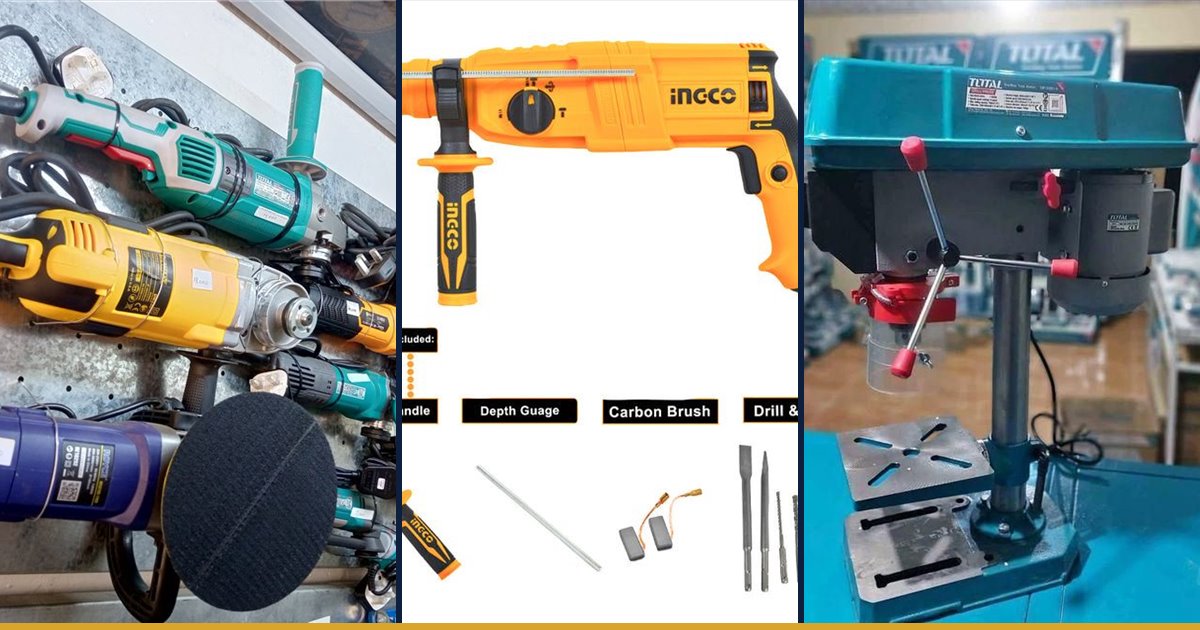
The chaff cutter arrived on Tuesday. By Wednesday afternoon the base plate was on the slab, the anchor bolts were laid out beside it, and a hammer drill was screaming into the first hole. Twenty minutes later the hole was three centimetres deep, the bit was blue at the tip, and the slab had won. The neighbour's rotary hammer finished all four holes before the kettle boiled.
Concrete is the one material on a farm or a small site that ordinary tools cannot bully. It does not cut, it does not drill in any useful sense, and it only gives way to a hard, fast blow delivered again and again. Two tools deliver that blow: the rotary hammer, which drills and lightly chisels, and the demolition breaker, which only breaks. They look alike, they are often confused, and buying the wrong one wastes money twice, once at the counter and again on the job.
This guide explains how each tool hits, what impact energy in joules actually means, the difference between SDS-Plus and SDS-Max, the three working modes, how to drill anchor holes that hold and break floors without wrecking the tool, the dust and vibration risks that are easy to ignore, and when hiring beats buying.
Three Tools, Three Ways of Hitting Concrete
A hammer drill is an ordinary drill with a pair of ridged discs behind the chuck. When you push, the discs ride over each other and the chuck judders forward and back thousands of times a minute. The blows are tiny and they depend entirely on how hard you lean. It drills small holes in block and soft concrete for wall plugs and not much more. Our guide on choosing a drill in Kenya covers where a hammer drill fits.
A rotary hammer has a piston inside driven by the motor. The piston compresses air against a second piston, which flies forward and strikes the bit. Because the blow comes from the piston and not from your arm, the tool hits just as hard whether you push or not. It also rotates the bit, so it drills, and most models can switch the rotation off so it chisels.
A demolition breaker uses the same piston action but bigger, heavier and without rotation. It exists to break: floors, walls, plaster, rock and old foundations. Handheld electric breakers run from around five kilogrammes up to thirty or more, and the biggest are worked pointing down with body weight on the handles.
Impact Energy in Joules, Explained
Rotary hammers and breakers are rated in joules, and the joule figure is the number that matters most. A joule is a unit of energy. On a hammer, it is the energy delivered by a single blow of the piston to the bit. A tool rated at a couple of joules taps; one rated around ten thumps; one rated in the tens of joules breaks concrete floors apart.
Two things follow from that. First, a bigger bit needs more energy per blow, because the blow is spread over a wider cutting edge. A small SDS-Plus tool drilling a 10 mm hole is quick, but ask it to drill a 30 mm hole and each blow is too weak to fracture the concrete under the whole edge, so it grinds and heats instead. Second, energy per blow and blows per minute are separate numbers. A high blow rate with low energy is a fast tap; a lower rate with high energy is a slow, effective thump.
Hammer drills are not rated in joules at all, because their percussion is not measured that way, and that absence tells you their place. If a job needs a joule rating, it needs a rotary hammer or a breaker.
SDS-Plus and SDS-Max: Why the Shank Sets the Limit
SDS is a shank system. The bit has grooves along its shank that lock into the chuck without a key, and the bit is free to slide back and forth so the hammer blow reaches it directly. There are two families, and they do not mix.
SDS-Plus has a 10 mm shank and is the standard on light and medium rotary hammers. It covers drill bits from about 4 mm up to the mid twenties, plus small chisels for chasing and light plaster removal. This is the family for anchor holes, cable runs and most farm and workshop drilling.
SDS-Max has an 18 mm shank and is fitted to heavy rotary hammers and many mid sized breakers. It carries large drill bits, core bits and full sized chisels, and it transfers a far bigger blow without shattering. A bit from one family will not fit the other, and adaptors that claim to bridge them cost the tool most of its energy.
Large breakers often use a plain hexagonal shank instead, in 28 mm or 30 mm sizes. Before buying chisels, check which shank your tool takes; the shank, not the brand, decides what fits. Our drill bits guide covers the bit types themselves and what each one suits.
Drill Only, Hammer Drill and Chisel: The Three Modes
Most rotary hammers have a mode selector with three positions, and learning which to use is half the skill.
- Drill only turns the bit with no hammer action. Use it with a keyed chuck adaptor for wood or steel, and for the first few millimetres of a hole in tile or plaster where hammering would shatter the surface.
- Hammer drill turns and hammers at once. This is the mode for every hole in concrete, stone and hard block.
- Chisel, sometimes marked hammer only, stops the rotation and delivers blows alone, for chasing, lifting tiles, trimming plaster and light breaking. A fourth position on many tools lets you turn the chisel to the angle you want and then lock it.
Speed matters as well as mode. Run large bits and chisels at the lower speed setting where the tool has one, because the piston delivers its full blow at any speed and a slower turn keeps the tip cooler. Use the higher setting for small bits, where a clean fast hole matters more than heat.
Better tools include a safety clutch that disengages the drive when the bit jams on rebar or a stone, so the tool does not wrench your wrist. Treat that clutch as insurance, not permission: hold the tool with both hands and the side handle fitted every single time.
Anchor Holes for Machine Bases, Tank Stands and Gates
The commonest concrete job on a farm is fixing something down: a chaff cutter, a posho mill, a pump, a water tank stand, a gate post bracket or a solar frame. The anchor pack states the hole diameter and the depth, and both must be met exactly, because an expansion anchor grips by pressing against the hole wall and an oversize hole gives it nothing to press on.
Work like this. Mark the hole, start in hammer drill mode at a slow speed until the bit bites, then let the tool run at full speed with light, steady pressure. Pushing harder does not make a rotary hammer drill faster; it only stalls the piston and heats the bit. Every few centimetres pull the bit out to clear dust, then blow and brush the finished hole clean before the anchor goes in, because a hole full of dust holds an anchor at a fraction of its strength.
- Depth. Drill a little deeper than the anchor needs so dust at the bottom does not stop it seating, and set the depth stop on the side handle rather than guessing.
- Spacing. Keep holes well in from the slab edge and well apart from each other, or the concrete between them cracks out when the anchors expand.
- Anchor type. Expansion and sleeve anchors suit sound concrete. For weak or cracked concrete a chemical resin anchor spreads the load and forgives a slightly rough hole.
Keep bits cool. A carbide tip that turns blue has lost its temper and will blunt in the next hole. Drill in short bursts, alternate two bits on a run of holes, and never quench a hot bit in water, because the sudden cooling cracks the braze that holds the tip. Let it cool in air.
Chasing, Breaking Floors and Removing Plaster
Breaking is a different discipline from drilling. The aim is to open a crack and then follow it, not to pulverise everything in front of the bit.
For plaster and render, a wide flat chisel in a rotary hammer's chisel mode lifts sheets away with little dust. For chasing a cable or pipe run, score two lines with an angle grinder and then chisel out the strip between them so the edges stay clean. For a concrete floor, a demolition breaker with a pointed chisel starts at an edge or a corner, never in the middle, and works inward, breaking off pieces the size of a hand.
Let the breaker's weight do the work and lift it a little now and then to let the chisel clear. Never lever with the chisel in the crack; that bends and snaps chisels and can twist the tool out of your hands. If the floor contains reinforcing mesh, break the concrete around the bars and cut the steel separately with a grinder or bolt cutter.
Dust, Silica, Hearing and Vibration
Concrete dust contains crystalline silica, and breathing the fine part of it over time scars the lungs. That damage is permanent, and it depends not on a single bad day but on the total dose across years. Wet the surface, use a dust extraction shroud where the tool takes one, and wear a properly fitted filtering face mask rated for fine dust, not a thin paper mask. Work outdoors or open every door and window.
Hearing goes the same way. Both tools are loud enough that regular use without protection causes permanent loss, so wear ear defenders or plugs every time, not only for long jobs. And both tools shake your hands. Hours of that vibration, over months, can damage the nerves and blood vessels in the fingers. Limit trigger time, take breaks, keep the tool sharp so it cuts rather than pounds, hold it with a relaxed grip, and prefer models with anti vibration handles. Our guide to farm and workshop safety equipment lists the kit worth owning.
- Mask: a fitted filtering face piece rated for fine dust, replaced when breathing through it gets harder.
- Ears: defenders or plugs worn from the first blow to the last.
- Eyes: impact goggles rather than open safety glasses, because chips fly upward off a chisel.
- Hands and feet: gloves with padded palms and boots with a hard toe, since a dropped breaker weighs as much as a sack of feed.
When to Hire and When to Buy
The honest test is how many days a year the tool works. A rotary hammer earns its keep on most farms because anchor holes, wall plugs and small chasing jobs come up all year, and a light SDS-Plus model is compact, easy to store and simple to look after. Look at the rotary hammer we stock as a starting point.
A demolition breaker is different. Breaking a floor or a foundation is a job that happens once in a few years for most people, and a heavy breaker sitting idle is capital doing nothing. Hire for a one off, and buy when you have regular work for it: a building contractor, a borehole crew, a workshop that does installations weekly, or a farm with several structures still to build. The demolition breaker page shows what a heavy tool looks like when the work justifies it.
- Buy a rotary hammer if you drill concrete more than a few times a year.
- Buy a breaker only when breaking work is regular; otherwise hire one for the job.
- Never buy a hammer drill for concrete work beyond small wall plugs. It will not save money.
- Buy bits with the tool so the shank matches, and buy two of the sizes you use most.
Bring the job to us before the tool. Tell us what you are fixing, breaking or chasing, how often, and into what, at any Fuga branch or on WhatsApp 0716 961 018, and we will match the tool, the shank and the bits to the work.
Key Takeaways
- A hammer drill hits as hard as you push, a rotary hammer hits as hard as its piston, and a breaker hits harder still without rotating; choose by the hardest thing you need to hit.
- The joule rating is the energy in each blow: bigger bits and chisels need more joules, and blows per minute is a separate figure that does not make up for a weak blow.
- SDS-Plus (10 mm shank) covers anchor holes and light chasing; SDS-Max (18 mm shank) carries large bits and full chisels; the two do not mix and adaptors waste the blow.
- Drill anchor holes at full speed with light pressure, clear the dust often, brush the hole clean before the anchor goes in, and let hot bits cool in air rather than water.
- Break floors from an edge inward with a pointed chisel, never lever with the bit, and cut reinforcing steel separately.
- Concrete dust carries silica, both tools damage hearing, and hours of vibration harm the hands: wet the work, wear a fitted mask and ear protection, and limit trigger time.
Frequently Asked Questions
What is the difference between a rotary hammer and a demolition breaker?
A rotary hammer drills and lightly chisels. Its piston delivers a hammer blow to the bit while the bit rotates, so it bores holes in concrete quickly and, with rotation switched off, does light chasing and plaster removal. A demolition breaker uses the same piston action but heavier and without rotation, so it only breaks: floors, walls, rock and old foundations. If the job is holes, buy a rotary hammer. If the job is breaking, hire or buy a breaker.
What does the joule rating on a rotary hammer mean?
It is the energy in each blow of the piston on the bit. Higher joules break more concrete per strike, which is what a bigger bit or a chisel needs, because the blow is spread across a wider edge. Energy per blow and blows per minute are separate figures: a high rate with low energy taps fast, while a lower rate with high energy thumps effectively. Hammer drills are not rated in joules at all, which tells you they are for small holes only.
Can I use SDS-Max bits in an SDS-Plus rotary hammer?
No. SDS-Plus has a 10 mm shank and SDS-Max an 18 mm shank, and the chucks are different sizes. Adaptors that claim to bridge them cost the tool most of its impact energy and strain the chuck, so avoid them. Buy bits and chisels for the shank your tool takes, and check the shank before buying a chisel set for a breaker, since large breakers often use a 28 mm or 30 mm hexagonal shank instead.
Can I use a rotary hammer to break a concrete floor?
A heavy SDS-Max rotary hammer in chisel mode can break thin screed, remove plaster and chase channels, but a full floor slab is breaker work. The rotary hammer's lower impact energy means slow progress, a hot tool and worn chisels, and it is not designed to be worked pointing down with body weight for hours. Hire a demolition breaker for the slab, start at an edge, and keep the rotary hammer for the anchor holes afterwards.
Should I buy or hire a demolition breaker?
Count the days a year it would work. Breaking a floor or a foundation is a once in a few years job for most farms and workshops, and a heavy breaker sitting idle is capital doing nothing, so hire for a one off. Buy when the work is regular: a contractor, a borehole crew, a workshop that does installations every week, or a farm with several structures still to build. A rotary hammer, by contrast, earns its keep on most farms.