
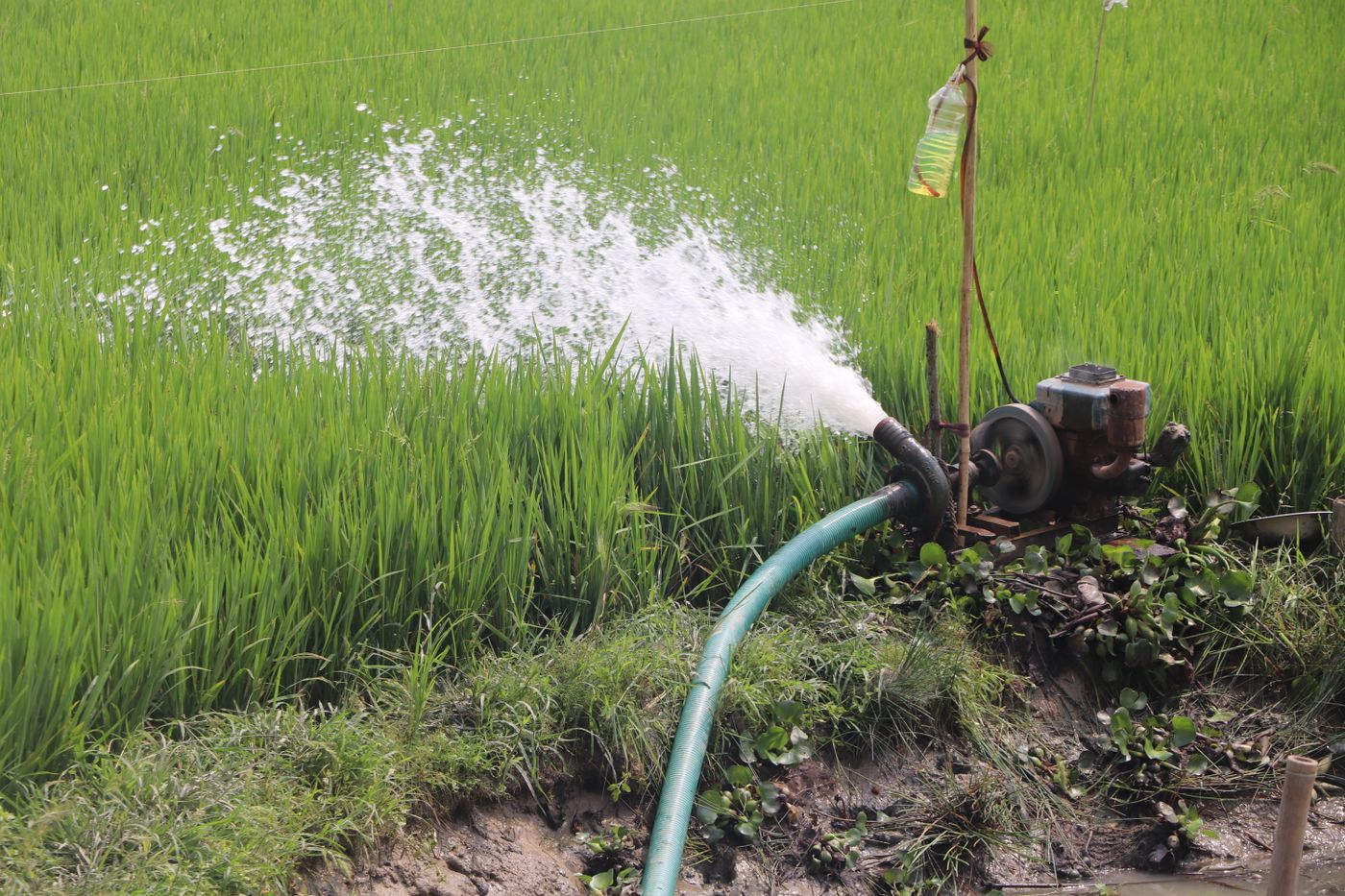
A farmer buys a pump rated for a good flow at a good head, runs one inch pipe two hundred metres to the tank, and gets a trickle. The dealer is blamed, the pump is opened up, and nothing is wrong with it. The pump is delivering exactly what the pipe allows.
That story repeats because the pump is treated as the whole system and the pipe as a way of getting water from one end to the other. In reality the pipe is a load. It consumes pressure the same way a hill does, and on a long run in small pipe it can consume more than the hill.
This article explains where that pressure goes, why undersized pipe wastes energy every hour the pump runs, how the four common pipe materials behave hydraulically, where the fittings you never counted are hiding, and then works through a one inch, one and a half inch and two inch comparison for the same run.
Friction Loss Is the Head Your Pipe Eats
Water moving along a pipe drags against the wall. The layer touching the wall barely moves, the layer next to it is slowed by that one, and so on into the middle of the bore. That drag is paid for with pressure, and pressure in a pump system is measured as head, in metres of water. Friction loss is the head a pump must produce beyond the actual height it is lifting to.
Three things set how much you lose. Length: double the run, double the loss. Speed: friction rises roughly with the square of velocity, so water moving twice as fast loses about four times the head. Diameter, which is where it gets dramatic. For a fixed flow, halving the bore quarters the cross-section, so the water must move four times faster, in a narrower pipe with more wall per litre. Put together, friction loss for a given flow scales close to the inverse fifth power of diameter.
That is worth pausing on. Going from one inch to two inch doubles the bore, and two to the fifth is thirty two, so the same flow through the bigger pipe loses something like a thirtieth of the head. Pipe sizing does not behave like most purchases, where a bit more money buys a bit more performance. One size up removes most of the problem, and two sizes up removes nearly all of it.
How Undersized Pipe Wastes Pump Power
Every centrifugal pump has a curve: at low head it delivers high flow, and as head rises flow falls, until at shut-off head it delivers nothing. Your pipework has a curve too, the system curve, which starts at the static lift and climbs as flow increases because friction rises with flow. The pump runs at the one point where the two cross.
Small pipe gives a steep system curve. The crossing point moves left, so you get less water per hour, and up, so the pump works at higher head to deliver it. The energy that went into that extra head is not stored anywhere. It leaves as turbulence and a fraction of a degree of warmth in the water, paid for in diesel or electricity.
The trap is what people do next. Seeing weak flow, they buy a bigger pump. It forces more water through the same pipe, but friction rises with the square of velocity, so much of the extra power goes into friction and only a portion into flow. The bill for that mistake arrives every month for the life of the system. The bigger pipe would have been bought once.
There is a second cost. A pump forced far from its best efficiency point runs hot and wears early. Our guide to sizing a pump by total head and flow treats friction head as one of the three terms in total head. This article is about making that term small.
HDPE, PPR, PVC and Galvanised: What Each One Does to the Water
Farmers usually compare pipe materials on price, joint method and how they survive the sun. Those matter, but each material also has a hydraulic character, set by two things: how smooth the inside wall is, and how much bore you actually get for the nominal size on the label.
HDPE (black polyethylene) is the default for long buried runs from a borehole or river pump to a tank. It comes in long coils, so a two hundred metre main might have two joints instead of forty, and every joint you do not make is friction you do not add. Its wall stays smooth because nothing scales onto plastic, and it flexes with ground movement. One thing to know: HDPE is sized by outside diameter, and the pressure class sets the wall thickness, so a higher class of the same nominal size has a noticeably smaller bore, and that bore is what the water sees.
PPR (the green or grey polypropylene pipe) is welded with a heating tool so that pipe and fitting fuse into one piece. It is the right material for pressurised lines around buildings, pump houses and dairies. Hydraulically it is as smooth as HDPE, but it is also sized by outside diameter with a thick wall, and PPR fittings tend to have a slightly reduced bore at the socket, which adds up on a main with many welded fittings. Our guide to PPR welding and farm plumbing layout covers the joint itself.
PVC pressure pipe is cheap, smooth inside and easy to solvent-weld. It goes brittle in Kenyan sun, cracks when a vehicle crosses a shallow trench, and its joints are only as good as the person who made them. It is a good choice for low pressure distribution and drainage, and a poor one for a surface run in full sun.
Galvanised steel (GI) is sized by nominal bore, so a one inch GI pipe has close to a one inch opening, which is more than a 32 mm plastic pipe gives you. It takes heat, sun, vehicles and vandals. Its problem is time: new galvanised pipe is rougher inside than plastic, and as it ages it corrodes and collects scale, so both roughness and bore get worse. A GI main that was adequate when new can be starving a tank fifteen years later while looking sound from outside.
Fittings and Elbows: The Losses Nobody Counts
Ask a farmer how long his pipe run is and he will tell you the distance to the tank. Ask how many elbows, tees, valves, reducers and unions are in the line and he will have to go and look. Yet each fitting forces the water to change direction or speed, and each one costs head.
Engineers handle this with equivalent length: every fitting is counted as a certain number of extra pipe diameters of straight pipe. Published tables put a standard 90 degree elbow in the region of thirty diameters, a tee with the flow turning into the branch at around sixty, a fully open gate valve at under ten, and a globe valve (the type with a disc that rises off a seat) at several hundred. A foot valve with a strainer is also large, and it clogs, which makes it larger still.
Three fittings sit where the loss is felt most. The first is the reducer at the pump. A pump with a two inch discharge fitted with a one inch bushing and then a one inch main is being throttled at its own outlet. Come out of the pump at full size, and reduce only further down the line where flow has been split. The second is the suction side. Any restriction before the pump is worse than the same restriction after it, because it lowers the pressure at the impeller eye and invites cavitation. Never use suction pipe smaller than the pump inlet, keep the strainer clean and off the bottom, and see our guide to submersible versus surface pumps for why that choice is really about suction.
The third is the throttling valve. A gate valve left half open to "control the flow" is doing exactly what an undersized pipe does: turning pump power into heat. If you need less flow, size the system for less flow or fit a smaller pump. Using a valve to fight a pump is a running cost you have chosen to pay forever.
A Worked Example: 1 Inch, 1.5 Inch or 2 Inch for the Same Run
Take a common farm layout. A surface pump at a river or shallow well pushes water 150 metres to a tank on a stand, with the water surface in the tank 20 metres above the pump. The farmer wants about 3 cubic metres an hour, which is 50 litres a minute and fills a 5,000 litre tank in under two hours. The line has six 90 degree elbows, two open gate valves and a foot valve, in smooth plastic pipe.
The numbers below come from the standard Hazen-Williams friction formula for smooth plastic pipe, using typical inside bores of roughly 26 mm, 40 mm and 52 mm for the three sizes, then rounded. They are illustrative: your exact figures depend on the pipe class, the real bore and the condition of the fittings. The shape of the result is what matters, and that shape does not change.
One inch. At 50 litres a minute the water moves at about 1.6 metres a second. Friction along 150 metres comes to roughly 15 metres of head, and the fittings add the best part of another metre. Total friction about 16 metres. The pump must produce 20 metres of lift plus 16 metres of friction: 36 metres.
One and a half inch. Velocity drops to about 0.7 metres a second. Friction along the run falls to roughly 2 metres, and the fittings, though physically bigger, add a small fraction of a metre. Total friction about 2 metres. The pump needs 22 metres.
Two inch. Velocity about 0.4 metres a second. Friction along the run is around half a metre and the fittings are negligible. The pump needs roughly 20.5 metres, almost all of it the real lift.
Now read the result as money. Hydraulic power is flow multiplied by head, so at the same flow the one inch system asks the pump for about 36 metres where the two inch asks for about 20: roughly three quarters more energy per cubic metre, every day, for as long as the farm exists. And in practice the one inch line does not deliver the 50 litres a minute at all. The pump slides up its curve, flow drops, and the tank takes longer to fill while the engine runs the whole time.
Between one and a half and two inch the story changes. The extra two metres of friction at one and a half inch is real but small next to the lift, so the jump to two inch buys little. This is the general pattern: the first size up from too small is enormous, the next is marginal. A useful rule for mains is to keep velocity in the region of one to one and a half metres a second and never much above two. Here, one and a half inch sits comfortably in that band and is the sensible buy. A farmer planning a second line off the same main later, or a flow of 80 to 100 litres a minute, would go to two inch now, because trenching twice costs more than the pipe.
Sizing Rules You Can Apply Tomorrow
Start from flow, not from the pump outlet size. Decide how many litres a minute the system really needs at the far end, then pick the smallest pipe that carries it below about 1.5 metres a second. Charts for that are printed in every pump manual and pipe catalogue. Size the main for the total flow and step down only after branches split off: a main feeding three sprinkler lines carries the flow of all three, and each branch carries one.
Reduce joints and count fittings: coiled HDPE on a long run, long sweep elbows, full-bore ball or gate valves rather than globe valves, and straight pipe on both sides of the pump rather than an elbow hard against the flange. Then check the real bore of the pipe you are quoted: ask for the pressure class and the inside diameter, not just "one inch" or "32 mm". Our water equipment range covers pumps, pipe, fittings and valves, and branch staff can look up the bore for a given class while you are at the counter.
Key Takeaways
- Friction loss is head the pipe consumes. It grows with length and the square of velocity, and falls close to the fifth power of diameter.
- The pump runs where its curve meets the system curve. Small pipe steepens that curve: less water at more head, paid for in fuel or power. A bigger pump wastes much of its extra power in friction; bigger pipe fixes it once.
- HDPE and PPR are smooth but sized by outside diameter, so check the inside bore for your pressure class. Galvanised is sized by bore but loses it to scale.
- Count fittings as equivalent pipe. Standard elbows are modest, tees and foot valves are large, globe valves and half-closed valves are enormous.
- In the worked example, one inch pipe nearly doubled the head required; one and a half inch removed most of that; two inch removed a little more. Design mains for one to one and a half metres a second.
Frequently Asked Questions
What is friction loss in a water pipe?
Friction loss is the pressure a pump spends pushing water along the pipe wall and through fittings. It shows up as metres of head the pump has to produce on top of the actual lift to the tank. It rises with the length of the run and with the square of the water's speed, and it falls very steeply as the pipe bore gets bigger, so a small increase in diameter removes a large share of the loss.
Does a bigger pipe reduce the pump size I need?
Often, yes. The pump has to overcome the static lift plus the friction loss. On a long run in small pipe the friction can be as large as the lift itself, which pushes you into a bigger, hungrier pump. Stepping the main up one size removes most of that friction, and the pump you then need is smaller and cheaper to run. The bigger pipe costs money once; the bigger pump costs money every hour it runs.
Which pipe is best for a farm water main in Kenya: HDPE, PPR, PVC or galvanised?
For long buried runs from a pump or borehole to a tank, HDPE is the usual choice: long coils with few joints, smooth inside, and tolerant of ground movement. PPR suits pressurised lines around buildings where you want welded joints. PVC suits low pressure distribution but is brittle in sun. Galvanised steel is strong but loses bore to rust and scale over time. Whichever you choose, check the actual inside bore for the pressure class you are buying, not just the nominal size.
How much do elbows and fittings add to friction loss?
Engineers count each fitting as an equivalent length of straight pipe. A standard 90 degree elbow behaves like roughly thirty pipe diameters, a tee with flow through the branch like sixty or more, a globe valve like several hundred, while a fully open gate or ball valve adds very little. A partly closed valve or an undersized reducer at the pump can add more than the whole run.