Every short rains season, the same thing happens on thousands of Kenyan farms. A heavy afternoon storm sends brown water racing down the murram road, along the boundary and out of the farm, and a few weeks later the same farmer is buying water by the drum for the kale beds and the cows. The water was there. It simply had nowhere to stop.
A water pan is the simplest answer: an excavated pond that catches surface runoff from a road, a compound or a bare slope and holds it for the dry months. Unlike a roof tank, a pan can hold tens or hundreds of thousands of litres for the cost of digging, close to the fields that need it.
This guide covers how to choose the site, work out how big the pan should be, build the inlet, silt trap and spillway, decide whether to line it, cut evaporation, keep it safe, and pump the water out to crops and livestock. For harvesting water off roofs into tanks, see our separate guide to rainwater harvesting; the two systems work well side by side, with the tank for the house and the pan for the farm.
Pick the Site Before You Pick Up the Jembe
Most failed pans fail because of where they were dug. A good site has four things.
A catchment that actually produces runoff. Water must flow to the pan in a normal storm, not only in a freak one. Murram roads, compacted paths, bare rocky slopes and cattle tracks shed water quickly; a grassed field soaks most of it in. Walk the farm during a heavy storm this season and watch where the water goes; that walk tells you more than any calculation.
Soil that holds water. Clay and clay loam soils seal reasonably well. Sandy, gravelly and murram soils leak, and a pan on them may empty within weeks unless it is lined. Dig a test hole about a metre deep, fill it with water, and see whether it holds overnight. If it drains away quickly, plan for a liner from the start.
A safe distance from things that can pollute it or be damaged by it. Keep the pan well away from pit latrines, septic tanks, cattle bomas and chemical mixing areas, and away from the foundations of buildings. Do not dig across a natural waterway or a seasonal stream bed; a large flood can wash out the banks.
Higher than the fields if possible. A pan placed above the vegetable plot can feed it by gravity for part of the way. A pan placed below the field means every litre must be pumped uphill, which is fine but costs fuel or a solar pump. Our guide to using a water level pipe shows how to measure the height difference between the pan site and the field before you commit.
How Big Should the Pan Be?
Sizing starts with a simple rule: one millimetre of rain falling on one square metre is one litre of water. The catch is that only a part of that water runs off; the rest soaks in, evaporates or is held in puddles. How much runs off depends on the surface, the slope and how hard it rains, so treat any figure as a rough guide and check it against what you see in the storms.
Work out the pan in three steps. First, estimate how much water you need through the dry spell: count the cows, the beds of vegetables and the number of weeks until reliable rain. Second, estimate what your catchment can deliver in a season. Third, add an allowance for evaporation and seepage, because a pan that is exactly the size of your demand will run dry early.
A pan is usually dug with sloping sides so the banks do not collapse. Because the sides slope, the volume is less than length times width times depth. The prismoidal formula gives a good answer: volume equals depth divided by six, multiplied by the top area, plus four times the area at mid depth, plus the bottom area.
In that example, a pan ten metres square and three metres deep holds about 156,000 litres when full, roughly fifteen of the common 10,000 litre plastic tanks. Now check the catchment can fill it. Suppose a murram road and compound of 2,000 square metres drain to the pan, and you assume that only a fifth of the rain runs off. A season with 300 millimetres of rain would then deliver 2,000 x 300 x 0.2, which is 120,000 litres. That pan would probably not fill in a normal season, so either enlarge the catchment with a diversion ditch or dig a smaller pan. The runoff fraction and rainfall here are illustrative assumptions; use local rainfall records and your own storm observations.
Inlet, Silt Trap and Spillway: The Three Parts People Skip
A hole in the ground is not yet a water pan. Three simple structures decide whether it lasts one season or twenty.
The inlet channel leads runoff from the road or slope to the pan. Give it a gentle, even fall so water flows without scouring a gully, and line the last few metres with stones or grass where the water speeds up. A cut-off drain along the contour above the pan can collect water from a wider area; our guide to farm drainage explains how to set the gradient so the channel does not erode.
The silt trap is a smaller pit, a metre or two across, dug in the inlet channel just before the pan. Runoff from roads carries a lot of soil. When the water slows in the trap, most of that soil drops out before reaching the pan. Without a trap, a pan can fill with silt within a few seasons and lose much of its capacity. Empty the trap with a shovel after every few heavy storms; it is far easier than desilting the whole pan.
The spillway is a deliberate low point in the bank where excess water leaves once the pan is full. Without one, water overtops the bank wherever it is lowest and can cut through it in a single night. Make the spillway wide, protect it with grass or stone, and lead the overflow safely away from buildings and neighbours' land.
Pile the excavated soil as a bank on the downhill side and compact it in layers, and plant grass on all banks to bind the soil. Keep the spoil away from the inlet side so it does not wash back in.
To Line or Not to Line
On clay soil, many unlined pans hold water well enough. On sandy or murram soil, a pan may lose water faster to seepage than to the crops, and a liner is what makes it work.
The usual liner is a heavy plastic geomembrane sheet laid over the smoothed excavation and anchored in a trench around the top of the bank. Remove stones, roots and sharp objects from the surface first, and ask the supplier whether a protective underlay is needed for your soil. The liner must be big enough to cover the floor, the sloping sides and the anchor trench, so measure along the slopes rather than across the top. Liner thickness, material and expected life vary between products; ask for the manufacturer's specification in writing and compare like with like.
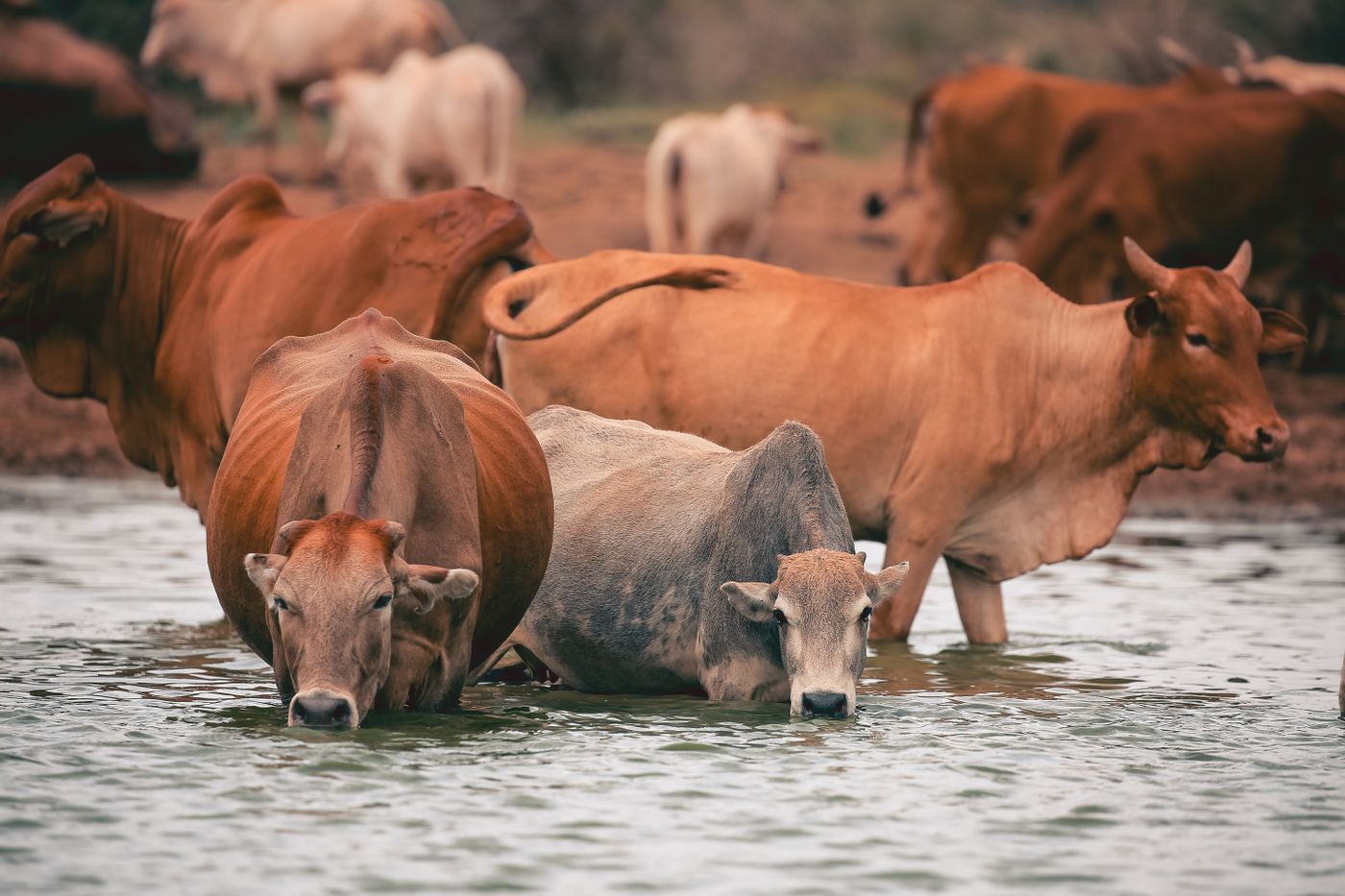
Livestock are the main enemy of a lined pan. Hooves puncture the sheet and trample the banks. Fence the pan and pump or gravity feed water to a trough outside the fence instead; our guide to cattle drinking bowls and water troughs covers the options.
Evaporation: The Silent Thief
Open water in a hot, dry, windy place can lose several millimetres of depth a day to evaporation, and that adds up over a long dry spell. The loss depends on the surface area, not the depth, which is why a deep, compact pan stores water better than a wide, shallow one of the same volume.
Practical ways to cut the loss: dig deeper rather than wider where the soil allows; plant a windbreak of trees or shrubs on the windward side, kept back from the edge so roots do not damage a liner; and consider a shade net stretched over the pan on a frame of posts and wire, which many Kenyan farmers use to reduce evaporation and keep algae down. Use the pan water before your tank water, because the pan loses some every day.
Safety, Mosquitoes and Water Quality
A water pan with steep, slippery sides is a drowning risk for children and animals. Fence it with a lockable gate, and leave a rope, a ladder of poles or a set of steps cut into one bank so that anyone who falls in can climb out.
Still water can breed mosquitoes. Keep the edges free of tall weeds, avoid shallow puddle areas around the margin, and talk to your county public health office about suitable control measures for your area. Pan water is untreated surface water. It is fine for irrigation and, with care, for livestock, but it is not safe to drink without treatment; our guide to farm water treatment explains the options.
Getting Water Out: Pumps and Pipes
Unless the pan sits above the field, you will pump. Three choices suit most farms.
A petrol engine pump moves a lot of water quickly and is portable, which suits a pan that feeds furrows, a rain gun or a large hose. A surface pump has to lift water up its suction hose, and in practice that lift is limited to a few metres, less at higher altitude; place the pump close to the water level, keep the suction hose short and airtight, and fit a strainer. Our guides to pump sizing by head and flow and to priming and foot valves cover the details.
A solar pump costs more up front but nothing to run, and suits steady daily pumping to a tank or trough. A small electric pump works where grid power reaches the pan.
Take water from just below the surface, not off the bottom where the silt sits. A simple floating intake, a strainer tied to a float so it rides a short distance below the surface, gives cleaner water and protects the pump. Lay-flat hose is a cheap way to carry pumped water to the field and rolls up after use.
Your Water Pan Checklist
| Stage | Check |
|---|---|
| Site | Runoff seen flowing here in a real storm; soil holds water in a test hole; away from latrines, bomas and buildings |
| Permission | Asked WRA and the county office whether approval is needed |
| Size | Demand, catchment and losses worked out; deep rather than wide |
| Structures | Inlet channel with gentle fall, silt trap, protected spillway |
| Banks | Spoil compacted on the downhill side and grassed |
| Liner | Needed on sandy or murram soil; surface cleared of stones and roots |
| Safety | Fence, gate, exit steps or rope; livestock drink from a trough outside |
| Abstraction | Pump close to the water, short airtight suction, floating intake |
Pumping and Digging Tools, With Prices
These prices are from the Fuga price list at the time of writing; check the site or call a branch for current prices and stock.
| Item | Stock code | Price |
|---|---|---|
| Water pump 3*3 Ram G | 6444 | KSh 16,250 |
| WATER PUMP WP 20 | 6427 | KSh 15,000 |
| Solar Water Pump 100W | Various | From KSh 20,000 |
| FLAT LAY PIPE 2' | 6224 | KSh 250 |
| SHOVEL METAL HANDLE | 6621 | KSh 400 |
| JEMBE 3LB ALLIGATOR | 6256 | KSh 450 |
| LEVEL PIPE 6MM*50M | 6288 | KSh 800 |
Watch where the water runs in this season's storms, dig where it gathers, trap the silt, give the flood a safe way out, and fence the pan. For a pump to lift the water to your crops, see the 100W solar water pump and the rest of our water and irrigation range, or WhatsApp 0716 961 018 with your pan size and the distance to the field.
Key Takeaways
- Site the pan where you have actually seen runoff flow in a storm, on soil that holds water, and well away from latrines, bomas and buildings.
- Check with the Water Resources Authority and your county office before digging, because approval rules depend on size and location.
- Size the pan from your dry season demand and what the catchment can really deliver, then allow for evaporation and seepage.
- An inlet channel, a silt trap and a protected spillway decide whether a pan lasts one season or many.
- Line pans on sandy or murram soil, dig deep rather than wide, and consider a shade net to cut evaporation.
- Fence the pan, give anyone who falls in a way out, water livestock from a trough outside the fence, and pump from just below the surface.
Frequently Asked Questions
How big should a farm water pan be?
Start from how much water you need through the dry spell, then check how much your catchment can deliver, using the rule that one millimetre of rain on one square metre is one litre, of which only part runs off. Add an allowance for evaporation and seepage. As a worked example, a pan 10 metres square at the top, 3 metres deep with sides sloping one across for one down, holds about 156,000 litres.
Do I need a liner for my water pan?
On clay soils many unlined pans hold water reasonably well. On sandy, gravelly or murram soils water seeps away quickly and a plastic geomembrane liner is usually needed. Test the soil by filling a hole about a metre deep with water and seeing whether it holds overnight.
How do I stop my water pan filling with silt?
Dig a silt trap, a smaller pit in the inlet channel just before the pan, so runoff slows and drops its soil there. Empty the trap with a shovel after heavy storms, grass the banks and the inlet channel, and keep spoil heaps away from the inlet side.
Do I need a permit to dig a water pan in Kenya?
It depends on the size of the structure and whether it is on a watercourse. Water use and storage fall under the Water Act 2016, administered by the Water Resources Authority, and larger dams may also need environmental approval. Ask your nearest WRA office or the county agriculture office before you dig.
Which pump is best for a water pan?
A petrol engine pump suits large volumes for furrows, rain guns or hoses and can be moved around. A solar pump suits steady daily pumping to a tank or trough with no fuel cost. Place a surface pump close to the water level, keep the suction hose short and airtight, and draw water from just below the surface with a floating intake.