The borehole comes in, the pump goes down, and the first water hits the tank. It looks clean. Six months later the drip lines run unevenly, the kettle has a white crust inside it, and the shirts off the line have gone the colour of weak tea. Nothing broke. The water was always like that, and nobody looked.
Water touches everything on a farm: the pump, the pipework, the emitters, the animals, the kitchen. When it carries sand, iron, hardness or microbes it rarely fails dramatically. It taxes you quietly, through blocked drippers, shortened pump life and wasted chemicals.
This guide sets out how to choose treatment from evidence: what a laboratory analysis tells you, and how to select sediment filtration, iron removal, scale control and disinfection from results rather than catalogues. Above all, why irrigation, livestock and household water are three different problems.
Borehole Water Is Not Automatically Clean Water
There is a persistent belief that groundwater is clean because rock has filtered it. Half of that is true. Soil and rock do strip out most surface contamination, which is why a properly sited and grouted borehole is usually safer than an open shallow well, as our boreholes versus shallow wells guide explains.
The other half is the problem. That same long contact dissolves minerals into the water, so groundwater carries whatever the aquifer is made of. Chemistry varies enormously between neighbouring farms, and even between two boreholes on one farm at different depths.
Contamination is possible too. A poorly grouted annulus, a soak pit or boma sited too close, or a wellhead that floods in the long rains can let surface water track down the casing. Clarity proves nothing: iron, hardness, fluoride, nitrate and bacteria are all invisible in a glass.
Test First, Buy Second: What an Analysis Actually Tells You
The most expensive mistake in farm water treatment is buying equipment before testing. A softener will not remove iron. An iron filter will not soften water. Ultraviolet light does nothing about scale. Every device targets one problem, so an untested installation is a guess you pay for twice.
A standard analysis covers physical characteristics (turbidity, colour, taste, odour, conductivity), chemical ones (pH, hardness, iron, manganese, fluoride, chloride, nitrate) and microbiological indicators such as total coliforms and E. coli, which reveal whether faecal contamination has reached the water.
Two points matter. First, only a laboratory test can determine whether water is fit to drink. No article, no salesman and no appearance in a glass can tell you that. Use an accredited laboratory and involve your county public health office, which advises on drinking water for households.
Second, sample properly or the result is worthless. Run the pump long enough to clear standing water in the column, sample where you actually draw, use the laboratory's own containers (bacteriological work needs sterile bottles) and deliver them cool and quickly. Retest after a new pump, a deepened borehole, new storage, or any shift in taste, smell or colour.
Sediment and Sand: The Barrier That Protects Everything Else
Sediment is the most common and most mechanical of water problems. Fine sand from a developing borehole, silt from a river intake, rust flakes from old galvanised pipe and debris from a roof catchment all behave alike downstream. They abrade impellers and seals, settle into tank bottoms and, above all, plug the tiny passages inside drip emitters and spray nozzles.
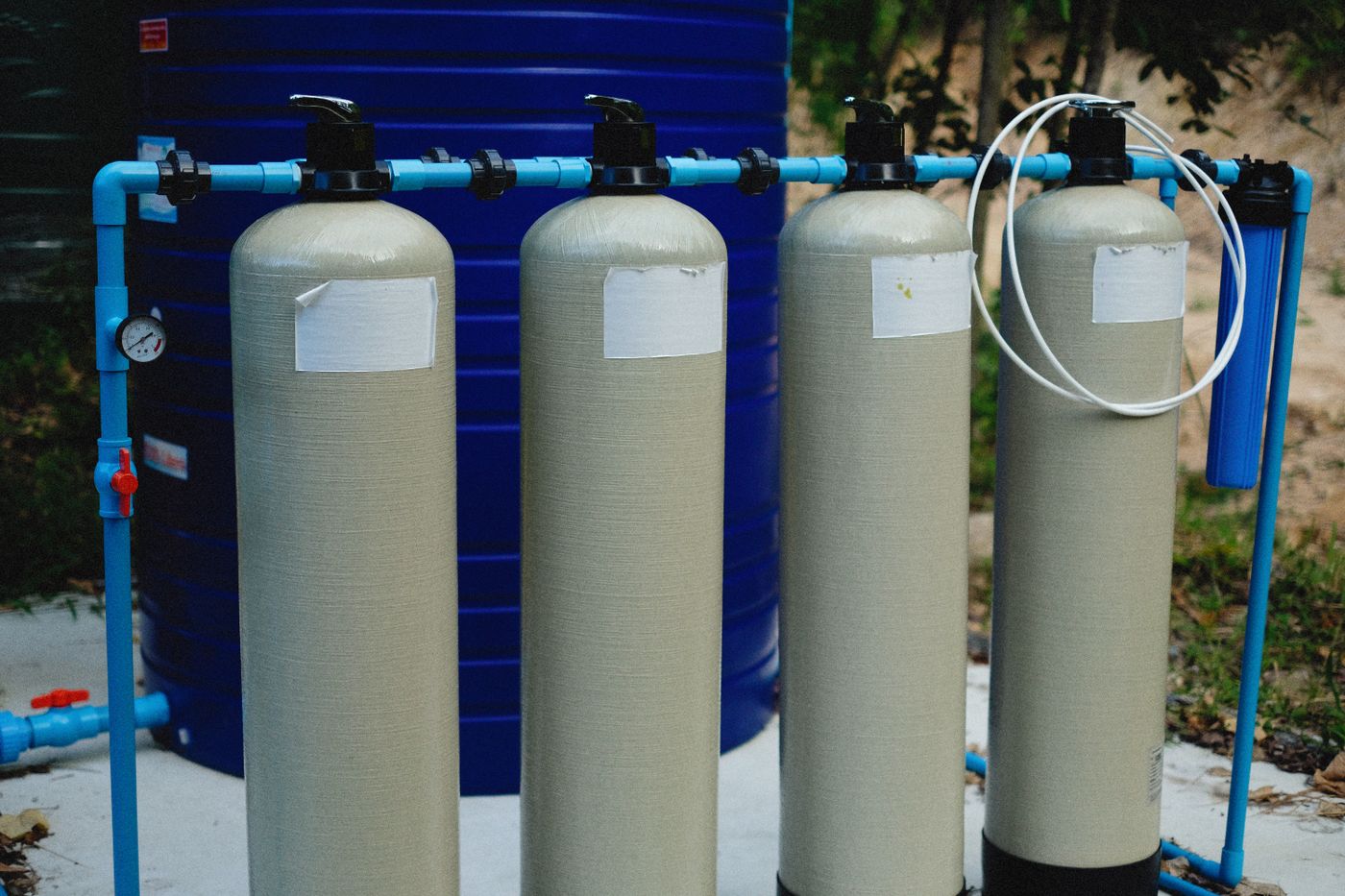
Treatment is staged, coarse to fine. A sand trap lets the heaviest particles drop out by gravity before they reach a filter. Screen and disc filters catch mid-range solids and clean easily by flushing. Media filters, pressure vessels packed with graded sand or gravel, take out much finer material and are cleaned by backwashing, which reverses flow through the bed and sends trapped dirt to drain. Cartridge filters make an excellent final polish but a poor first defence: on dirty water they clog within days.
Size each stage so the coarse one protects the fine one, and fit a pressure gauge either side of every filter. A rising difference between those readings is the only honest signal that an element needs attention.
Iron and Manganese: The Stains That Give Them Away
Iron and manganese leave the aquifer dissolved and invisible. On contact with air they oxidise and drop out of solution as solid particles, which is why the tell-tale signs appear where water meets air or sits still. Iron stains sinks, tanks, troughs and laundry orange or reddish-brown. Manganese stains darker brown or black, often as sludge in a tank bottom.
Two secondary effects hurt more than the stains. Iron feeds iron-oxidising bacteria, whose slimy biofilm blocks emitters and fouls UV lamp sleeves, and oxidation inside the pipework creates a sediment problem downstream of your filter.
The sequence is therefore deliberate: oxidise, then filter. Aeration through a cascade or venturi converts the dissolved metals into particles, a settling stage gives them time to form, and a media filter removes them; specialist oxidising media do both jobs in one vessel. The detail that decides success is that oxidation must be complete before the filter, or the iron passes through as a dissolved ion and precipitates on the clean side.
Hardness and Scale: The Slow Tax on Pumps and Drippers
Hardness is dissolved calcium and magnesium. It is not a health hazard, and it is a serious equipment hazard. Hard water leaves a white or grey crust wherever it is heated or evaporates: inside kettles and geysers, on shower heads, around tap outlets and on trough floats.
On a farm the damage is systemic. Scale narrows the bore of pipes, raising friction losses so the pump works harder for less delivered flow. It coats heating elements, which then draw more power and eventually burn out. It builds inside pump casings, seizes float valves, and forms inside drip emitter labyrinths, where the passages are already the width of a pin, so a deposit invisible to the eye halves the emitter's output.
Treatment is graded: ion exchange softening for household and hot water circuits, scale inhibitor dosing for irrigation mains, and acid or citric flushing for drip systems already carrying deposits. Where hardness is severe, the cheapest fix is often to blend in harvested rainwater, one more reason to size storage tanks generously.
Chlorination and Ultraviolet: Disinfection for Livestock and Household Use
Disinfection targets microbes and nothing else. It does nothing about sediment, iron or hardness, so it comes last, on water that is already clear.
Chlorination, dosed as sodium or calcium hypochlorite, is the workhorse for tanks and troughs. Its advantage is residual: chlorine stays in the water as it travels, protecting the tank and the pipe run downstream. Its limits are equally real. It needs contact time, it is degraded by organic matter and suspended solids, it loses strength in storage and sunlight, and it must be dosed by a competent person to a defined procedure.
Ultraviolet disinfection passes water through a chamber where a lamp inactivates microorganisms without adding anything to it. No taste, no chemical handling, and it works in seconds, which suits household points of use. Its limits: no residual protection downstream, a need for power whenever water flows, failure on cloudy water because particles shade the organisms, and a quartz sleeve that iron and hardness films will blind. UV finishes filtered water, it never replaces filtration.
For livestock, clean water is a production input: unpalatable water reduces intake, and intake drives milk yield and growth. Trough hygiene usually returns more per shilling than any device bolted onto the line.
Drip Irrigation: A Blocked Emitter Is a Filtration Failure
Drip is the most filtration-sensitive system on any farm because it trades wide passages for precision. An emitter meters water through a narrow labyrinth, and that geometry is what makes it both efficient and vulnerable. When farmers abandon drip for sprinklers, as our drip irrigation and sprinklers comparison discusses, the failure is nearly always filtration and maintenance.
Emitters block in three distinct ways, each with a different cure. Physical blockage is sand, silt and debris, cured by correctly sized screen, disc or media filtration ahead of the mainline. Biological blockage is algae, bacterial slime and iron bacteria, cured by shading open water and periodic chlorine shock treatment. Chemical blockage is scale and iron precipitate inside the emitter, cured by acid flushing and by treating the cause upstream.
Three habits prevent most of it. Filter to the fineness the emitter manufacturer specifies, not to whatever is on the shelf. Fit flush valves at the end of every lateral and open them on a schedule, so fines leave the system instead of settling in it. And when you fertigate, dissolve fertiliser fully, inject upstream of a screen and flush afterwards.
Match the Treatment to the Actual Use
The most common overspend is treating all the water to the standard of the most demanding use. Treating a whole borehole to household standard so that maize can drink it is money set on fire.
Irrigation water needs to be free of particles that block emitters and of chemistry that precipitates inside them. It does not need disinfecting for the crop's sake, although produce eaten raw makes water quality a food safety matter. Livestock water needs to be palatable, free of gross contamination and low enough in dissolved salts that animals keep drinking. Household water is the only stream that must satisfy the drinking water standard, and usually the smallest volume by far.
That asymmetry is the design opportunity. Treat the whole supply only to the level everything genuinely needs, then split the line and give the household branch its own finishing stage, at a fraction of the cost of treating every cubic metre bound for the shamba.
What It Costs, Honestly
Treatment equipment spans an enormous range, from an inline screen filter to a multi-vessel media train, so we publish indicative ranges on our price list rather than fixed figures. Where the value sits is clearer: the analysis is the cheapest line item in the project and the one that decides whether the rest of the spend is correct, and coarse filtration plus a maintenance routine protect more per shilling than any sophisticated device, because they keep it alive. Browse the water equipment range and talk to us with your results in hand.
Key Takeaways
- Clear water can still be hard, ferrous or unsafe. Groundwater dissolves whatever the aquifer is made of.
- Test before you buy. Every device targets one problem, so an untested installation is a guess you pay for twice.
- Only an accredited laboratory can determine whether water is fit to drink. Involve your county public health office.
- Filter coarse to fine: sand trap, screen or disc, media, then cartridge as a polish. Fit pressure gauges either side.
- Oxidise iron and manganese before filtering, or they precipitate on the clean side of your filter.
- Hardness is an equipment problem: it scales pipes, pumps, heaters and emitter labyrinths.
- Chlorine leaves residual protection along the line; UV adds nothing but needs clear water, power and a clean sleeve.
- Blocked emitters are a filtration or maintenance failure: filter to specification and flush laterals on a schedule.
- Split the supply and treat only the small household branch to drinking standard.
Frequently Asked Questions
Is borehole water safe to drink without treatment?
That cannot be answered by inspection, by depth, or by how clean the water looks. Whether water is fit to drink is determined by laboratory analysis of a sample from your own borehole, against the national drinking water standard, repeated periodically. Use an accredited laboratory and speak to your county public health office before drinking from a new source.
Why do my drip emitters keep blocking?
Almost always filtration or maintenance. Check that the filter matches the fineness your emitter manufacturer specifies, that laterals are flushed through end valves on a schedule, and whether you are seeing slime or crust rather than grit. Slime calls for chlorine shock treatment, crust for acid flushing.
Will a water softener remove iron from my water?
No, and buying one for that purpose is a common and expensive error. Softening exchanges calcium and magnesium ions to address hardness. Iron and manganese must be oxidised into particles and then filtered out, a different process in a different vessel. Iron also fouls softener resin, so the iron stage belongs upstream.
How much does farm water treatment equipment cost at Fuga?
It depends on your flow rate and your test results, and prices move with stock and the exchange rate. See indicative ranges on our price list, then confirm on WhatsApp at wa.me/254716961018 or call 0734263958. Bring your analysis and we will size filtration to the water you actually have.