There is a water source on almost every homestead in Kenya that nobody sizes, nobody costs and almost nobody measures. It is the roof.
In a good season an ordinary iron sheet roof sheds tens of thousands of litres. Most of it lands in a trench at the wall, softens the foundation and vanishes, while the same household buys water by the jerrycan and the same farm rations the calves through September.
Harvesting it is not complicated, but it is arithmetic. Get four numbers right (roof area, rainfall, dry spell and daily demand) and the system almost designs itself. Get them wrong and you buy a tank too small to matter or too big to ever fill.
One Millimetre on One Square Metre Is One Litre
Rainfall is measured as a depth, so one millimetre of rain falling on one square metre is exactly one litre of water. Two corrections turn that identity into a usable yield figure.
Use the plan area, not the slope. Measure the roof as a footprint seen from above, not as the distance you would walk up the sheets. Rain falls vertically, so a steep roof and a shallow roof with the same footprint intercept the same rain. Measuring along the slope is the commonest error in a first calculation and it overstates yield by a tenth or more.
Apply a runoff coefficient. Not every intercepted litre reaches the tank: some evaporates off the sheets, some overshoots the gutter, some escapes at joints. Design practice for smooth iron sheet commonly uses about 0.8 to 0.9. Tiles and rough concrete run lower. Thatch is not a harvesting surface at all, because it absorbs, it leaks and it colours the water.
So the formula is: net litres = plan area in square metres, times rainfall in millimetres, times the runoff coefficient.
A Worked Example You Can Repeat With Your Own Numbers
Take a house 12 metres by 8 metres in plan, roofed in iron sheet: a footprint of 96 square metres.
A single storm dropping 20 mm gives 96 multiplied by 20, which is 1,920 litres intercepted. At a runoff coefficient of 0.85, about 1,630 litres reach the tank from one afternoon of rain: roughly eighty 20-litre jerrycans, from a roof you already own.
Now a season. Suppose your area records 300 mm across the long rains, a figure to take from Kenya Meteorological Department records or a rain gauge at your own gate rather than from memory. That is 96 times 300 times 0.85, about 24,500 litres.
Two things fall out of that. The seasonal yield is large; the yield from any single storm is not. Those 24,500 litres arrive across perhaps fifteen or twenty events, and a tank captures only what it has empty space for on the day. That fact decides everything downstream. Repeat the sum for the cattle shed, store and poultry house.
Size the Tank Against the Dry Spell, Not the Rain
A tank is not a rain gauge but a bridge across the days when there is no rain, so the question is never how much falls; it is how long you must go without.
Work it in three steps. First, daily demand: a household of five using water carefully might plan on 40 to 60 litres per person per day, so call it 250 litres. Second, the gap to cross. Much of Kenya has two rainy seasons with a long dry stretch between them, commonly two to three months and longer in arid counties. Third, multiply.
At 250 litres a day across a 60 day gap, full supply needs 15,000 litres. Most homesteads do not build that and do not have to: a 5,000 litre tank across the same gap still gives 20 days of everything, or covers drinking and cooking throughout, which is precisely the portion you would otherwise buy.
Then check the second constraint: whether the tank can be filled at all. A roof yielding 1,630 litres per storm fills a 10,000 litre tank over six or seven storms, which a normal season supplies comfortably. A roof yielding 400 litres a storm makes the same tank an ornament.
Take the smaller answer, then buy the next size up if the price per litre is still falling. It usually is, which is why two 5,000 litre tanks are almost always worse value than one 10,000 litre tank. Compare capacities and prices on our water equipment page and the price list.
The First Flush Is the Dirtiest Water You Will Ever Collect
Between one rain and the next, a roof accumulates dust, soot, bird and bat droppings, insects, leaf litter and lichen. The first water off the roof carries all of it, and in the tank it settles as sludge, feeds bacteria and gives stored water the taste that makes a household quietly stop drinking from it.
A first flush diverter solves this with no moving parts worth mentioning. It is a capped standpipe on the downpipe that fills before water can pass on to the tank, usually with a ball float that seals the top once the column is full. A tap at the bottom drains it afterwards.
How much to divert? A working range is 0.2 to 1 litre per square metre of roof, at the top of that range where the site is dusty, tree shaded, or the gap since the last rain has been long. For the 96 square metre roof above, that is 20 to 96 litres: one or two lengths of 110 mm pipe and a tap.
Two habits separate a diverter that works from one that is decoration. Drain it after every rain, because one still full of yesterday's water diverts nothing. And screen the gutter outlet so solids never reach it.
Gutters: Sized for the Storm, Not the Average
Gutters are where most systems quietly lose their yield, for a reason easy to miss. A gutter carries the peak intensity of a downpour, not the average rainfall of the month. The heaviest ten minutes of a storm deliver water faster than a modest domestic gutter can pass it, and everything above that rate goes over the front lip onto the ground.
Size. The 100 mm (4 inch) half round profile suits a modest roof plane on a short run. Step up to 125 mm (5 inch), or add a downpipe, on large planes, long runs, and anywhere water overshoots.
Fall. The gutter must run downhill to the outlet along its whole length, with no back fall and no sag between brackets. A consistent fall of a few millimetres per metre is enough: water should always move and silt should never settle. A dead flat gutter holds standing water, breeds mosquitoes and sags into a permanent pond.
Position under the drip line. On a steep iron roof, water leaves the sheet with momentum and can fly clean over a gutter hung too low or set too far out. The front lip should sit below the roof plane extended, so fast water lands inside. A stripe of wet ground past the gutter after heavy rain is the diagnosis.
Brackets and joints. Support at roughly one metre, closer on long spans, because a gutter full of water is heavy and a sag is permanent. Seal joints: a drip is a slow leak of exactly what you are collecting.
Household, Livestock and Irrigation Are Three Different Systems
The same roof can serve all three, but the quality standard, the volume and the economics differ, and confusing them is how people end up disappointed.
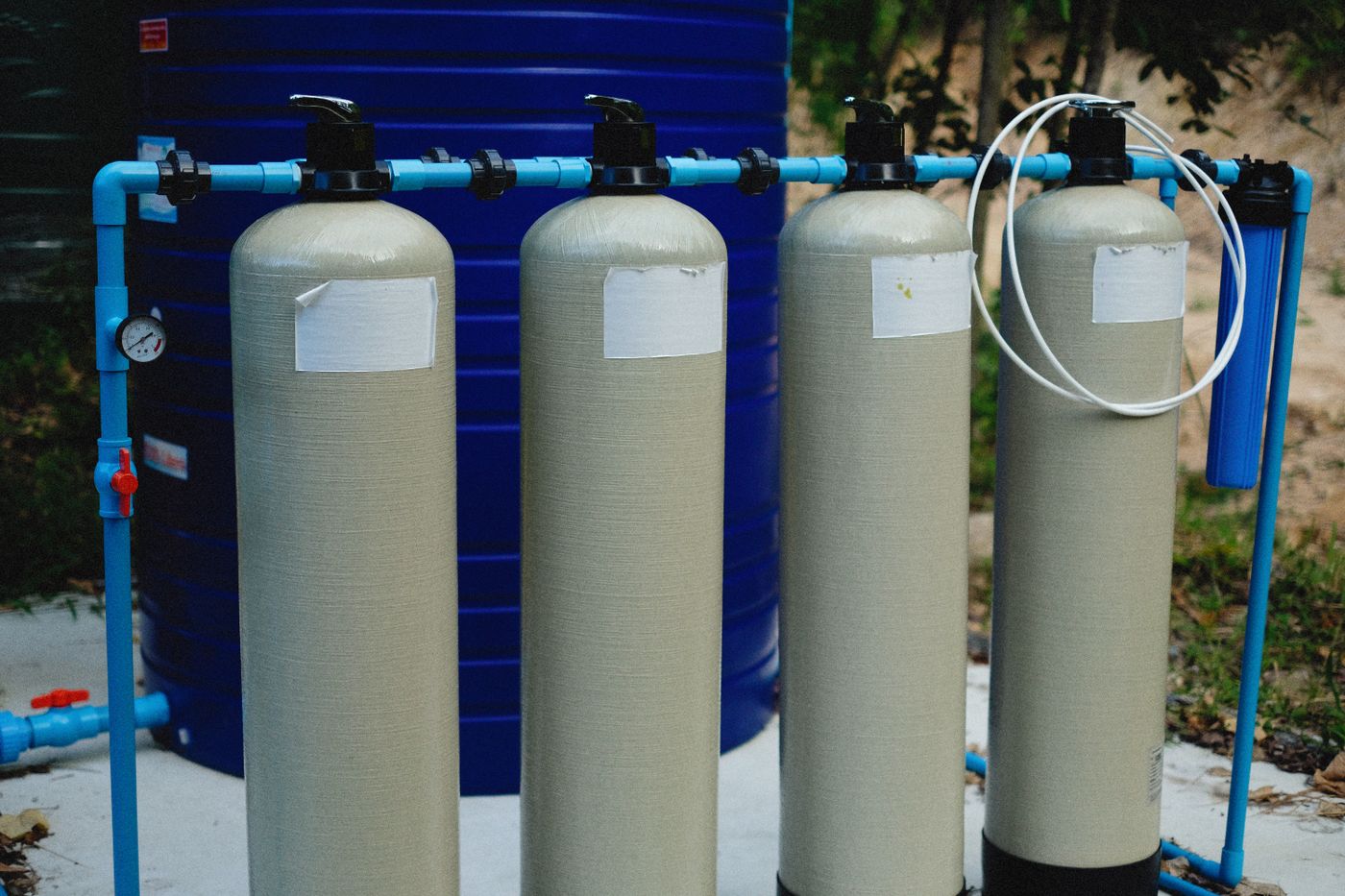
Household use is the smallest volume and the highest quality bar, so a diverter, an opaque screened tank and treatment before drinking all earn their cost here.
Livestock is the steady middle. Animals drink every day and drink more in the dry season, which is exactly when a tank is emptying. Volume binds rather than purity, though water must still be clean enough that animals drink freely: dirty or warm water depresses intake, and intake shows up in the milk record. A widely used dairy rule of thumb links demand to milk yield at several litres of water per litre of milk, so even a small herd drinks through a household sized tank in days. Size that with the rest of the dairy and livestock equipment, not with the house.
Irrigation is where the arithmetic humbles people. One millimetre of water across a hectare takes 10,000 litres, and across an eighth of an acre it still takes 500. A 240 square metre greenhouse asking for 4 mm a day needs close to 1,000 litres every day it does not rain. Harvested rainwater realistically serves a nursery, kitchen garden, greenhouse or seedling bed, not open field maize.
So rank the uses: household first, livestock second, irrigation as the beneficiary of overflow plus a larger store such as a lined pond. Distribution then matters more than the tank, which is where a pressure pump, pipe and fittings from the farm equipment range come in.
What Goes Wrong, and the Cheap Fixes
Almost every failed system fails in one of six ways, and all six are cheap to prevent.
Light and open inlets. A translucent tank grows algae, so choose an opaque one and keep the lid closed. An unscreened inlet or overflow is an invitation to mosquitoes, lizards and frogs, so fine mesh belongs on every opening.
No sludge outlet. Fines always settle. A tank with a washout at the very bottom is cleaned in minutes; one without becomes a job nobody does.
Overflow at the base, or a weak base. Pipe the overflow away into a soak pit, a banana circle or a garden, because water pooling at the plinth undermines it. And ten thousand litres weighs ten tonnes, so the base must be level, continuous and firm across the whole footprint, not just under the rim.
No maintenance rhythm. Clear gutters and screens before each rainy season, drain the diverter after each rain, and wash the tank out yearly at the end of the dry spell, when it is nearly empty anyway.
Do the arithmetic before buying anything. Four numbers and one afternoon, after which every component follows from your figures rather than from a guess.
Key Takeaways
- Net yield is plan area times rainfall in millimetres times about 0.85 for iron sheet. Measuring along the slope overstates it by a tenth or more.
- Size the tank against the dry spell: daily demand times the days you must bridge, then check the roof can refill it.
- Fit a first flush diverter of 0.2 to 1 litre per square metre of roof, and drain it after every rain or it diverts nothing.
- Gutters carry the peak of a storm, not the monthly average: consistent fall, correct position under the drip line, brackets about a metre apart.
- One millimetre over a hectare is 10,000 litres, which is why rainwater irrigates a greenhouse and not a maize field.
Frequently Asked Questions
How much water can I harvest from my roof in Kenya?
Multiply the plan area of the roof in square metres by the rainfall in millimetres, then by a runoff coefficient of about 0.85 for iron sheet. A 96 square metre roof yields roughly 1,630 litres from a 20 mm storm, and about 24,500 litres across a season delivering 300 mm. Use the footprint seen from above, never the sloping length of the sheets.
What size water tank do I need for a Kenyan home?
Size it against the dry spell rather than the rain: daily demand multiplied by the dry days you want to bridge. A household of five using about 250 litres a day and bridging 60 days needs 15,000 litres for full supply, or 5,000 litres to cover drinking and cooking. Then check your roof can refill it in a normal season.
What is a first flush diverter and do I really need one?
It is a standpipe on the downpipe that fills with the first, dirtiest water off the roof before flow passes on to the tank. That water carries dust, soot, droppings, insects and leaf litter, which otherwise becomes sludge and taste in storage. Divert 0.2 to 1 litre per square metre of roof, and drain it after every rain or it diverts nothing.
Is harvested rainwater safe to drink?
Rain is clean; what it collects from a roof is not. Water from a system with a first flush diverter, screened inlets, an opaque tank and a washout is usually clear and pleasant, but not automatically safe. For drinking, add a treatment step: boiling, a household filter or correctly dosed chlorination.
Can I irrigate my farm with harvested rainwater?
Only at a small scale. One millimetre of water across a hectare takes 10,000 litres, and a 240 square metre greenhouse asking for 4 mm a day needs close to 1,000 litres daily. Harvested rainwater realistically serves a nursery, kitchen garden, greenhouse or seedling bed, not open field maize.