The first big storm of the short rains does not usually flood a farm from the sky. It floods it from the yard. Water that fell on the roof, the track and the slope above collects into a sheet, finds the lowest door, and walks in: under the feed store, across the poultry house floor, into the greenhouse beds and down into the pit where the pump lives. By the time anyone reaches for a bucket, the damage is decided.
Standing water on a farm costs more than the mess suggests. Wet feed moulds within days. Wet litter in a poultry house turns to ammonia and disease. Seedlings drown in a waterlogged bed, tracks wash out and cut you off, and water around cables and sockets turns a wet floor into a lethal one. Almost all of it is preventable with a spade, a few lengths of pipe and an afternoon spent looking at where the water actually goes.
This guide covers the plan in the order it should be built: reading the flow, cutting it off above buildings and pens, giving trenches the fall they need, putting culverts under tracks, protecting the structures that suffer most, and, when water gets in anyway, dewatering with a submersible pump without putting anyone at risk from the electricity.
Read Where the Water Will Run
Water on a slope follows the lowest line downhill, and the more of it there is, the faster and straighter it goes. A drainage plan begins with finding those lines, and the best time is during a heavy shower or the hour after one. Walk the farm with a notebook and watch.
Between rains the ground still tells the story. Fans of silt show where water slowed and dropped its load, scoured channels show where it ran fast, and flattened grass, debris against fence posts and a tide line of mud on a wall mark how high it came. Walk uphill from each and you will find the catchment that fed it.
Three things concentrate water and deserve particular attention. A roof collects rain over its whole area and delivers it through a few downpipes or one dripping eave, so even a modest shed puts a surprising flow onto one spot. A compacted track or a hard-trodden yard sheds water rather than soaking it up, and if it runs downhill it becomes a channel. Mark each one, and mark where its water ends up.
Finish with a simple survey of levels. A line level on a string, or an A-frame level, is enough to find which way the ground falls and to mark a contour, a line of equal height, across a slope. Cut-off drains follow contours with a slight fall, so finding one matters more than any other skill here.
Cut-off Drains: Stop Water Above Buildings and Pens
A cut-off drain, also called an interceptor or diversion drain, is a trench dug across the slope on the uphill side of whatever you want to protect. Run-off coming down the slope drops into the trench and is carried sideways, along the contour with a gentle fall, to a safe outlet well away from the building. The water never arrives at the wall, so there is nothing to defend.
It is the single most effective piece of farm drainage because it deals with the water while it is still spread out and moving slowly, rather than once it has collected into a torrent at the door. The same drain protects a poultry run, a calf pen or a vegetable plot.
Site the drain a few metres uphill of the structure so that it does not undermine the foundation, and make it long enough to cover the whole width of the building plus a margin at each end. Throw the spoil on the downhill side to form a low bund that backs up the trench. On steep ground or loose soil, plant the trench with grass or lay stones in the bed so the flow does not scour it deeper with each storm.
Size follows the catchment. A drain protecting a store on a short slope can be a shallow trench a spade wide; one catching water off a long hillside or a large roof must be wider and deeper, because a drain that overtops sends the whole flow to the building in one wave. When in doubt, dig it bigger than looks necessary.
Trench Gradients: Enough Fall to Move Water, Not Enough to Scour
Water in a drain only moves if the drain falls. A level trench, or one that dips and rises along its length, holds water in the sags, silts up and breeds mosquitoes. One that falls too steeply runs fast enough to tear out its own bed. The aim is a steady, continuous fall from inlet to outlet with no low points anywhere along the run.
As a working rule, an earth drain wants a fall of at least about half a percent, half a metre of drop over a hundred metres, and one to two percent is comfortable on most farm soils; beyond that, especially in sandy or loose soil, the bed needs protection. Set the fall with a line level between pegs, then run a bucket of water down the finished trench: it should move steadily and leave no puddles.
Culverts Under Farm Tracks
Sooner or later a drain has to cross a track, and a track without a culvert becomes a dam: water backs up on the uphill side, softens the track base, then breaks through and takes the surface with it. A culvert, a pipe laid under the track so water passes beneath the traffic, solves this permanently if it is built with a few rules in mind.
- Make it bigger than the drain. It carries the drain's peak storm flow plus every leaf, stick and plastic bag the drain collects, and a blocked culvert is the same as no culvert. Between two sizes, take the larger.
- Lay it with fall in the direction of flow. A level pipe silts up from the inlet end. Give it the same steady fall as the drain feeding it.
- Cover it properly. Vehicles crush a shallow pipe. As a guide, give it at least about 300 millimetres of well compacted soil over the top, more for a larger pipe or a heavier track, and compact the fill in layers around the sides so the pipe is supported, not just buried.
- Protect both ends. Pack stones or build a small headwall at the inlet and outlet so the flow does not eat the bank around the pipe. A splash apron of stones at the outlet stops the discharge digging a hole.
- Keep the inlet clear. Check it before the season and after every big storm. A grille of bars at the inlet catches debris where you can pull it out rather than inside the pipe.
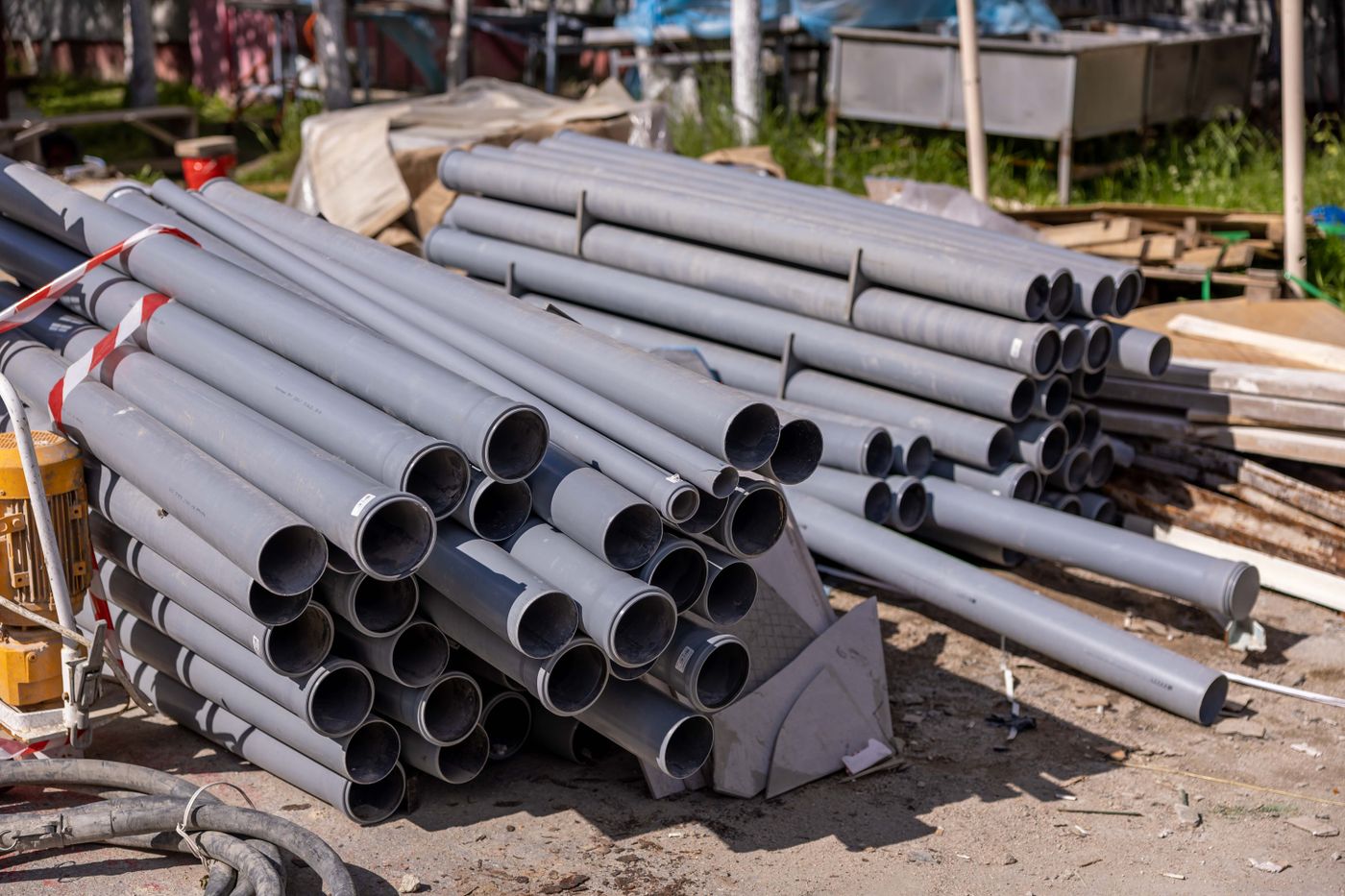
Heavy-wall PVC and concrete pipe both work for farm culverts. Thin-wall pipe meant for building drainage will not survive a loaded pickup over shallow cover, so match the pipe to the traffic and not just to the water.
Keep Water Out of Stores, Poultry Houses and Greenhouses
Some structures merely get wet. Others lose their contents. Feed stores, poultry houses, workshops and greenhouse beds top the damage list because what is inside them spoils, sickens or fails in standing water, so they deserve a second line of protection at the building as well as the cut-off drain above it.
Feed and grain stores. Raise the floor on a plinth above the surrounding ground and grade the ground away from the walls on every side. Fit gutters and downpipes and lead the water into a drain or a tank, not onto the ground beside the wall. A raised threshold at the door stops sheet flow walking in, and bags stacked on pallets stay dry even if the floor does not.
Poultry houses. Wet litter is the fastest route to ammonia, respiratory disease and coccidiosis, and most of it starts as water coming under the wall or blowing in with the rain. A drain around the outside, a floor raised above the yard and an eave wide enough to throw rain clear of the walls keep the litter dry, and a slight slope to a door stops spills pooling under the drinkers.
Greenhouses. A greenhouse roof sheds every drop that falls on it along its two long sides, so one storm dumps a large volume of water into the strip of ground beside the beds. Dig a drain along each side to catch that run-off, keep the inside paths sloping to an outlet, and site the structure off the low ground where water naturally collects. Waterlogged beds drown roots and invite root rot, and no amount of fertigation fixes a plant that cannot breathe.
Roof water is also the one flow you can turn into an asset. Guttered into a tank, it becomes dry-season water for the same poultry house or greenhouse it would otherwise have flooded; our guide on rainwater harvesting in Kenya covers sizing gutters, first-flush diverters and tanks for a farm roof.
Dewatering a Flooded Pit, Cellar or Greenhouse
Sometimes the water wins a round: a pump pit fills, a cellar floods, or a greenhouse ends up with beds under a hand's depth of water. The tool for this is a submersible pump, which sits in the water and pushes it up and out. Being under the surface, it needs no priming and cannot lose suction, which is exactly what you want when the flow is muddy and the level keeps changing; our guide on submersible versus surface pumps explains the difference.
Choose the pump for the water it will actually meet. Flood water carries mud, leaves, litter and gravel, and a clean-water submersible built for tanks and wells will clog or burn out on it. Drainage and dirty-water models pass small solids through the impeller, and the specification states the size of particle they tolerate. An electric submersible such as the Doyin electric submersible water pump covers most farm dewatering where mains or generator power is available; check its solids rating against the water you expect.
- Lower the pump on a rope, never on its cable. Hanging a pump by the cable strains the cable entry and lets water into the motor.
- Stand it clear of the mud. Put it in a sump at the lowest point, on a brick, or inside a bucket with holes in the sides that acts as a strainer. A pump sitting in silt pumps silt.
- Give the float switch room. The float switch is the tethered float that turns the pump on as the water rises and off as it falls. It must swing freely; a float jammed against a wall or a hose leaves the pump either running dry or never starting.
- Run the discharge downhill, to a place the water cannot return from. Use lay flat hose matched to the pump outlet, keep it short and straight, and lay it over the bund or the cut-off drain, not into it. A PVC lay flat hose rolls up small and stores easily for next time.
- Never let it run dry. A submersible cools itself with the water around it. Once the level drops below the intake, switch it off, or make sure the float does.
Electrical Safety When the Ground Is Wet
An electric pump, an extension cable and a flooded floor put a person, a live conductor and a path to earth in the same place at once. The device that makes this survivable is a residual current device, or RCD. It compares the current leaving on the live conductor with the current returning on the neutral, and if the two differ by a small leakage, typically 30 milliamps, it cuts the supply in a fraction of a second, before a shock through a body becomes fatal.
Run every dewatering pump through an RCD, whether at the distribution board or built into a plug-in unit at the socket, and press the test button before each use; a unit that does not trip on test is protecting nobody. If it trips repeatedly while the pump runs, the pump or the cable is leaking current: stop and find the fault rather than bypassing the RCD.
- Keep every connection high and dry. Plugs, sockets and couplers belong on a hook or a dry shelf, never on the ground where rising water can reach them.
- Route the cable off the ground. Lift it over the flooded area on posts or along a wall, away from traffic, sharp edges and the pump's own discharge.
- Use an outdoor-rated cable, fully unrolled and sized for the pump. A cable left on the reel heats up under load, and a thin cable drops the voltage the motor needs. Our guide on extension cables and electrical safety covers sizing and ratings.
- Switch off and unplug before touching the pump or entering the water. A float switch turning the pump off is not isolation. Pull the plug.
- Earth a generator as its manual directs, on dry ground, with the exhaust well away from people and animals.
A Drainage Check Before Every Rainy Season
Drainage is built once and then maintained. A month before the rains, walk the plan again: clear silt and weeds from the cut-off drains, check that every trench still falls the right way with no sags, rod the culverts and clear the inlet grilles, and make sure the gutters and downpipes discharge where they should. Then test the pump in a drum of water, check the float switch and the RCD, and coil the hose where you can find it in the dark.
Do that, and the first storm of the season becomes a check that the plan works rather than an emergency. If you need a submersible or surface pump, lay flat hose or fittings for the season, talk to any Fuga branch or WhatsApp 0716 961 018 and we will match the pump to the depth and the dirt you are dealing with.
Key Takeaways
- Walk the farm in rain or right after it and map where water arrives, where it collects and where it can leave; roofs, tracks and hard yards concentrate the flow.
- A cut-off drain dug across the slope above a building or pen is the most effective drainage on a farm, because it diverts water before it ever reaches the wall.
- Trenches need a steady, continuous fall, roughly half a percent at minimum and one to two percent on most soils, with no sags, and grass or stone lining where they would scour.
- Culverts under tracks must be bigger than the drain, laid with fall, covered with enough compacted soil to carry vehicles and protected at both ends.
- Feed stores, poultry houses, workshops and greenhouses deserve a plinth, gutters and a perimeter drain on top of the cut-off drain uphill.
- Dewater with a dirty-water submersible lowered on a rope, float switch free, discharge run well downhill, always through an RCD with every connection kept high and dry.
Frequently Asked Questions
What is a cut-off drain and where should I dig it?
A cut-off drain, also called an interceptor or diversion drain, is a trench dug across the slope on the uphill side of a building, pen or plot. Run-off drops into it and is carried sideways along the contour, with a gentle fall, to a safe outlet away from the structure. Dig it a few metres uphill so it does not undermine the foundation, make it longer than the building is wide, throw the spoil on the downhill side as a bund, and size it to the catchment above it.
How much fall does a farm drainage trench need?
Enough to keep water moving without tearing out the bed. As a working rule, an earth drain wants at least about half a percent of fall, half a metre over a hundred metres, and one to two percent is comfortable on most farm soils. Steeper than that, the trench needs grass or stone lining. The fall must be continuous from inlet to outlet with no sags, because any low point holds water, silts up and breeds mosquitoes. Check it with a line level and a bucket of water.
Can I use a normal submersible pump to empty a flooded pit?
Only if it is rated for dirty water. Flood water carries mud, leaves, litter and gravel, and a clean-water submersible built for tanks and wells will clog or burn out on it. Choose a drainage or dirty-water model whose specification states the size of solids it can pass, lower it on a rope rather than the cable, stand it clear of the silt in a sump or a holed bucket, give the float switch room to swing, and run the discharge hose well downhill.
Is it safe to run an electric pump in flood water?
It can be, with the right protection. Run the pump through a residual current device, an RCD, which cuts the supply in a fraction of a second if current leaks to earth, and press its test button before each use. Keep every plug, socket and coupler high and dry, route the cable off the ground, use an outdoor-rated cable that is fully unrolled and sized for the pump, and switch off and unplug before touching the pump or entering the water. Where no safe supply exists, a petrol surface pump on dry ground avoids a live cable in the water altogether.
How big should a culvert under a farm track be?
Bigger than the drain feeding it. A culvert has to carry the peak storm flow plus the leaves, sticks and rubbish the drain collects, and a blocked culvert is the same as no culvert, so if you are choosing between two sizes take the larger. Lay it with fall in the direction of flow, cover it with at least about 300 millimetres of well compacted soil, more for larger pipes or heavier traffic, protect both ends with stones or a headwall, and fit a grille at the inlet that you can clear by hand.