
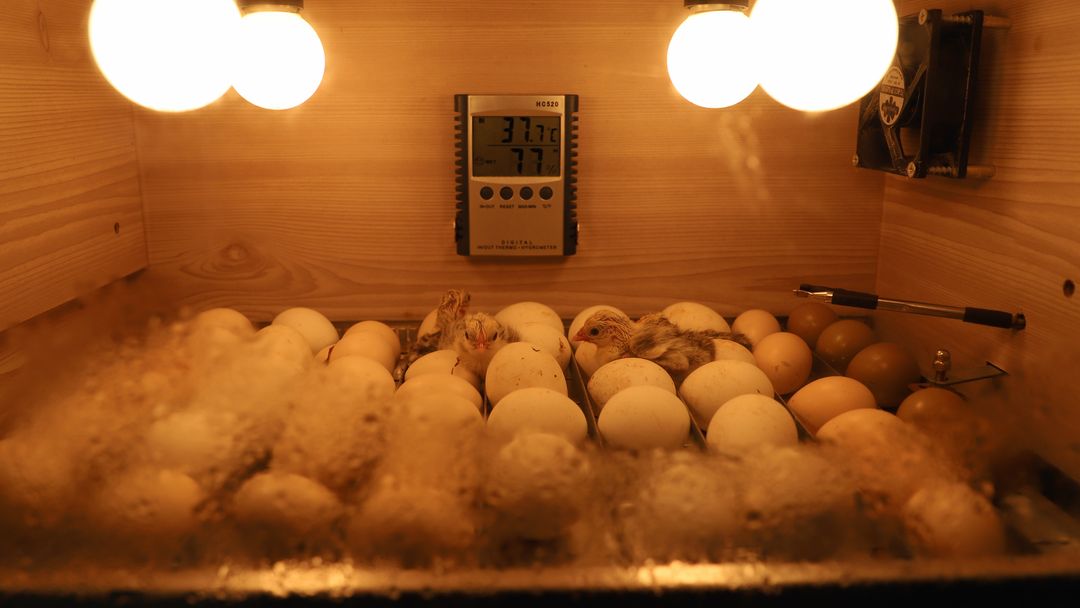
If your incubator has stopped turning the eggs, turn them by hand an odd number of times a day, at least three and ideally five, until the machine is repaired, and stop turning on day 18. If the fan has stopped, switch off at the wall, check the fan and its wiring, and watch for uneven warmth across the tray.
It is the third morning of a hatch. You lift the lid and the tray has not moved, and the marks on the eggs all face the same way. Or the tray moves but the little fan in the corner is silent, and the eggs by the heater feel warmer than those by the door. Both faults are common, both are cheap to catch early and costly to catch late, and neither shows on the temperature display.
This guide covers only these two jobs: eggs not being turned and air not moving. Humidity has its own guide in incubator humidity control, the last three days are in days 18 to 21: lockdown and hatching, and a drifting display is in calibrating the thermometer and hygrometer.
Why Does an Incubator Turn Eggs at All?
A hen turns her eggs dozens of times a day. In the egg, the yolk floats upward and the embryo sits on it. If the egg lies still, the embryo can end up stuck to the inner shell membrane, unable to take food from the albumen, and it often dies. Turning keeps the embryo moving away from the shell and helps the membranes that feed it to develop.
How much turning is enough? A 2020 study in the journal Poultry Science by Oliveira and colleagues set 960 chicken eggs and turned them 24, 12, 6 or 3 times a day at a 45 degree angle until day 18. Hatchability of fertile eggs fell steadily as turning fell: about 92 percent at 24 turns, about 86 percent at 12, about 78 percent at 6 and about 74 percent at 3. Early deaths rose as turning fell, and so did late deaths from badly positioned chicks.
Two honest cautions. This was one trial with one breeder flock, so treat the numbers as a direction, not a promise. And three to five hand turns a day is the usual advice in small-hatch guides, while the Texas A&M AgriLife Extension hatching tips say eggs should not be turned after day 18. Hand turning is a rescue method, not a match for a machine that turns every hour.
How Do You Know the Turner Has Failed?
Do not trust the display for this, because most small machines show only temperature and humidity. Draw a small X in pencil on one side of each egg and an O on the other: if the same marks face up two mornings running, the eggs have not turned. Watch the tray for a few minutes now and then, since many machines turn about once an hour. And listen: a silent machine, or a new clicking or grinding, is information.
The turner fault table
Switch off and unplug before touching anything, and keep the lid closed as much as you can.
| What you see | Likely cause | What to check first |
|---|---|---|
| Tray never moves, no sound | No power to the motor, a loose plug, a blown fuse, or a dead motor | Socket, plug and fuse; whether the display and fan still work; ask a technician to test the motor |
| Motor hums but the tray stays still | Jammed tray, a stripped or slipped gear, or a loose coupling | Eggs or debris caught under the tray; the arm or rod seated in its slot |
| Tray tilts one way only | A stuck arm, a bent rod or a limit switch that has stopped working | Rod or arm free to move both ways; a switch cleaned of dust |
Many of these faults are mechanical and visible. Anything inside the controller, the motor housing or the mains wiring is a job for a qualified person. The incubator spare parts page lists controllers, trays, motors and the parts that actually fail, and a branch can tell you what is held for your model.
How Do You Turn Eggs by Hand Without Ruining the Hatch?
The risk in hand turning is not the turning but the opening, because every time you lift the lid, heat and moisture leave. Be quick, calm and consistent. Wash and dry your hands first, since oils and dirt can block shell pores. Choose an odd number of turns, at least three and ideally five, spread across the day, so the long overnight rest falls on a different side each night.
Open the lid and turn each egg gently. For eggs lying flat, roll each a half turn so the X side goes to O and the O side to X. For a tilting tray, tilt it about 45 degrees to the other side. Handle eggs by the sides and close the lid; a turn should take a minute or two, not ten.
If humidity drops after each opening, see our humidity guide for how to hold it steady.
Can Eggs Survive If the Turner Failed for a While?
Often yes, but we cannot give a safe number of hours and have not found a published figure we trust. The Oliveira trial shows a graded loss, not a cliff: less turning means fewer chicks and more malpositioned chicks near the end. So resume hand turning at once and do not wait for the repair.
If you find the fault late, say on day 17, do not over-think it, because turning stops on day 18 for chickens anyway. A turner that fails on day 19 needs no repair before this hatch. Fix it between hatches. Other species stop turning on different days, so check the guide for your bird.
What Does the Fan Do Inside an Incubator?
Most small automatic incubators are forced-air machines. A small fan moves air past the heater and the eggs, so the temperature at every egg is close to the temperature the sensor reads. It also stirs in fresh air through the vents and carries away the carbon dioxide and moisture the eggs give off. A still-air machine has no fan and relies on warm air rising, which is why its recommended setting is higher and measured at the top of the eggs, and why the temperature differs a lot between top and bottom.
In a forced-air machine the sensor is set to a forced-air temperature, usually about 37.5 degrees Celsius. When the fan dies, the sensor still reads that figure, but the air is no longer being mixed. Warm air collects near the heater and cooler air near the walls and the door. Eggs close to the element can overheat while eggs at the far end stay cool, and the display shows a comfortable number the whole time.
How Can You Tell the Fan Has Failed?
Because the display hides it, look for secondary signs. With the lid closed you should hear a faint steady sound or feel light air movement at the vents. Silence, stuttering, or a fan that slows and stops are warning signs. A thin strip of tissue held near the vent or fan guard should flutter.
Other clues appear over a few days. Eggs near the heater feel warmer than eggs near the door, condensation forms on one side of the glass, or embryos on one side of the tray look more advanced when candled. A hatch spread over a couple of days points the same way, and our hatch rate guide shows how to read the unhatched eggs.
The best check you can do is to put a second thermometer at the far end of the tray and compare it with the first. Two readings that differ by more than a degree or so tell you the air is not being mixed, or that one thermometer is wrong. The salt and ice checks in our calibration guide tell you which.
The fan fault table
| What you see | Likely cause | What to check first |
|---|---|---|
| Fan silent, display normal | Wiring or plug fault, dead fan motor | Unplugged machine; connector at the fan; ask a technician to test it |
| Fan slow or noisy | Dust on the blades, worn bearing | Dust and debris cleared from blades (machine off and unplugged); blade spins freely by hand |
| Hot spot near the heater | Fan stopped or blocked, or airflow path covered | Fan guard clear; nothing placed in front of the fan; trays seated properly |
| Machine heats but cannot hold temperature | Controller or element fault, not the fan | Contact the supplier; do not open the controller yourself |
What Should You Do When the Fan Stops Mid Hatch?
First, do not panic and do not tear the machine apart on day 12. Unplug it, look for the obvious: a loose connector, a blade jammed by a feather or a wire, dust thick enough to slow it. If a blade is stuck, free it and test. If the fan still does not run, it is a replacement job.
Meanwhile the eggs need heat that does not cook them. If you must keep the machine running without its fan, do not guess at the setting. Put one thermometer at the end of the tray nearest the heater and another at the far end, check them every hour or two, and do not let the warm end go above the temperature in your manual. Turn the eggs by hand if the machine does not. This is a stopgap for hours, not days. If a replacement fan cannot be fitted within a day, move the eggs to a working machine of the same type, if a neighbour or a hatchery has one, rather than carry on with a failed fan.
Replacing a fan can be a low-voltage or a mains job depending on the model. If you are not sure, ask the Fuga technical team, which our product pages mention for installation and maintenance, and leave mains wiring to a licensed electrician or the supplier.
What Happens in a Power Cut, When the Turner and the Fan Stop Together?
A blackout stops the heater, fan and turner together. Keep the lid closed, since the machine holds warmth better shut. Hatchery guidance generally treats a short cooling as less harmful than overheating, and the hatch may simply run late. Turn by hand once the power has been off a few hours, and note the times on the card.
If outages are frequent where you are, a backup battery or generator is cheaper than a lost batch. The sizing steps are in our guide to backup power for incubators and milk coolers, and the starting surge of a fan or motor is the figure to watch when you size an inverter.
When Should You Stop Turning, and When Should You Stop Troubleshooting?
For chickens, turning ends on day 18 when the eggs go into lockdown, whether the machine did the turning or you did. After that the chicks are positioning themselves for hatch, and any handling does more harm than good. If your turner dies at day 19, leave it.
Stop troubleshooting and call for help in three cases: the fault is inside the controller or motor housing, it involves the mains side, or two attempts have not fixed it. Every opening of the lid costs the eggs heat and humidity, so write down what you did and when.
Your Weekly Turning and Air Check
Before each hatch, run the empty machine for a day and watch the turner through several cycles. During the hatch, look at the tray angle and the marks on the eggs every morning, listen for the fan, and write the readings on a card. Once a week, with the machine off and unplugged, clear dust from the blades and vents and check the far-end thermometer. Between hatches, check the plug, cable and fuse, and ask your branch which spares are held for your model.
Which Fuga Pages to Look At
Prices change, so we do not print them here. See each product page or the Fuga price list for current prices and stock.
| Item | Where it fits |
|---|---|
| Egg incubators in various sizes | Tabletop machines from 12 to 192 eggs with automatic turning and digital temperature and humidity, and larger broody-series machines |
| Incubator spare parts | Controllers, trays, motors and the parts that actually fail |
The habit that saves most hatches is simple: mark the eggs, look at the tray, listen for the fan, and keep a second thermometer at the far end. If something is wrong, turn by hand first and repair second. WhatsApp us on 0716 961 018 with your incubator model and what you see, and we will help you work out the next step, or visit any of our six branches. For other poultry kit, browse the range.
Key Takeaways
- Mark every egg with an X on one side and an O on the other, so a stopped turner shows up within a day.
- If the turner fails, turn by hand an odd number of times a day, at least three and ideally five, until it is repaired.
- A stopped fan hides behind a normal display: put a second thermometer at the far end of the tray and compare the two.
- Do not guess at the setting when a fan fails; watch both ends of the tray hourly and move the eggs to a working machine if you cannot fix it within a day.
- Turning stops on day 18 for chickens, so a turner that fails on day 19 does not need repairing before that hatch.
- Leave anything inside the controller, the motor housing or the mains wiring to a technician.
Frequently Asked Questions
How often should I turn eggs by hand if my incubator turner has failed?
Turn them an odd number of times a day, at least three and ideally five, spread across the day, until the machine is repaired. An odd number means the overnight rest falls on a different side each night. Mark each egg with an X and an O so you can see what has been turned.
How do I know if my incubator fan has stopped working?
The display will usually look normal, so check for sound and air movement: with the lid closed you should hear a faint steady sound or feel light air at the vents. Eggs near the heater feeling warmer than eggs near the door, or a second thermometer at the far end of the tray reading differently, are the other signs.
Can eggs still hatch if the turner stopped for a day or two?
Some will, but we cannot give you a safe number of hours. Research on chicken eggs shows hatchability falls steadily as turning falls, so start turning by hand at once and do not wait for the repair.
Should I still turn the eggs after day 18?
No. For chicken eggs, turning stops on day 18 when the eggs go into lockdown, whether a machine or you did the turning. If your turner breaks on day 19 or later, leave it and fix it between hatches.
Is it safe to open the incubator to turn eggs by hand?
Yes, if you are quick and calm. Wash and dry your hands, turn the eggs in a minute or two, and close the lid; every opening loses some heat and humidity, so keep to a fixed schedule rather than opening many extra times.


