When a hatch goes badly, almost everybody blames the incubator. Occasionally that is fair. Far more often the machine did exactly what it was told, and the batch was lost days or weeks before it ever went in, or lost in the final seventy-two hours by somebody who could not stop opening the lid.
This guide works through the causes of poor hatch rates in the order they actually occur, from the breeding flock to the moment the chick comes out, and tells you how to diagnose your own problem from what you find in the unhatched eggs. That last part is the most useful skill in incubation and almost nobody uses it.
What a Good Hatch Rate Actually Is
Two different numbers get confused, and confusing them makes diagnosis impossible.
Fertility is the percentage of eggs set that were fertile. This is entirely about your breeding flock and has nothing to do with your incubator. Good flock management gives 85 to 95 per cent.
Hatchability is the percentage of fertile eggs that produced a live chick. This is where your egg handling and your machine show up. A well-run operation achieves 80 to 90 per cent of fertile eggs.
Multiply them and a strong overall result is roughly 75 to 85 per cent of eggs set producing chicks. If you are getting 50 per cent, you need to know which of the two numbers is failing, because the fixes are completely different and unrelated. Candling at day seven tells you, and until you candle you are guessing.
Before the Egg Reaches the Machine
Most losses are already decided at this stage, and this is also the cheapest stage to fix because it costs nothing but discipline.
The breeding flock. Fertility needs roughly one cockerel to eight or ten hens. Too few and hens go unmated; too many and the cockerels fight and mate less. Cockerels over about two years old and birds that are overweight both show reduced fertility. Poor nutrition, especially of vitamin E, selenium and protein, quietly reduces fertility before it shows anywhere else.
Collection frequency. Collect at least twice a day, more in hot weather. An egg left in a nest all day on a hot Coast afternoon has already started and stopped developing, which kills it. Eggs left overnight get cold, dirty and cracked.
Selection. Set only clean, well-shaped eggs of normal size. Reject anything with a hairline crack, which you find by candling or by gently tapping two eggs together and listening for a dull rather than sharp note. Reject very large, very small, misshapen, thin-shelled and porous eggs.
Never wash hatching eggs. The shell carries a natural coating called the cuticle that blocks bacteria. Washing removes it, and worse, washing in water cooler than the egg draws bacteria inwards through the pores. If an egg is lightly soiled, wipe it dry with fine sandpaper or a dry cloth. If it is badly soiled, do not set it.
Storage. Pointed end down, at 15 to 18 degrees and moderate humidity, and set within seven days. Hatchability falls measurably for every day past a week. Never store hatching eggs in a domestic fridge, which is far too cold and too dry.
Let cold eggs warm up gradually before setting, so condensation does not form on the shell and carry bacteria into the pores.
Temperature: The Fastest Way to Lose a Batch
For a forced-air machine, 37.5 degrees is the target. The margin either side is small, and the two directions fail differently.
Too high is more dangerous than too low. Even half a degree over, sustained, accelerates development and produces early hatches with weak chicks, unabsorbed yolk sacs and deformities. A few hours at 40 degrees can kill an entire batch outright.
Too low slows development. You get a late hatch, spread over days, with chicks that are large, sticky and slow. Short cold periods are usually survivable; embryos are more tolerant of cold than heat.
The critical point is that what matters is the temperature the eggs experience, not the number on the display. Three things break that relationship: a sensor that has drifted, so the controller holds the wrong true temperature with complete confidence; poor air circulation, giving a warm top and a cool bottom in a large cabinet; and a room whose ambient temperature swings so much that the machine cannot keep up on a cold night.
Buy an independent thermometer, place it at egg level, and check it against the display regularly. Where the machine is large, check at more than one height. If the controller or sensor has failed, they are replaceable rather than terminal, and we stock incubator controllers and spares.
Humidity: The One That Depends on Where You Live
Humidity is the setting most often copied from a foreign video and most often wrong in Kenya, because ambient humidity in Kanamai and in Eldoret are not remotely the same.
The purpose of humidity control is to make the egg lose the right amount of moisture. Over the eighteen setting days an egg should lose roughly 12 per cent of its weight, forming an air cell of the correct size. Too little loss and the chick drowns in excess fluid at pipping. Too much and it is dehydrated and stuck to a dry membrane.
As a starting point, 50 to 55 per cent relative humidity during setting, rising to 65 to 75 per cent for the final three days. Then correct from evidence rather than from the internet: candle at day fourteen and look at the air cell. Too small means lower humidity; too large means raise it. Weighing a sample of eggs at set and again at day eighteen is the precise version, and serious hatcheries do exactly that.
Turning, Ventilation and Lockdown
Turning must happen from day one to day eighteen, at least three to five times a day, and an odd number of turns per day so eggs do not rest in the same position every night. Automatic turners do this hourly. Inadequate turning causes the embryo to adhere to the shell membrane and die, typically in the first week. If turning is manual, mark each egg with an X on one side and an O on the other so you can see at a glance what has been turned.
Ventilation is quietly important. Embryos take in oxygen and give off carbon dioxide through the shell, and demand rises steeply in the last week. A tightly packed machine with closed vents suffocates late embryos, which looks exactly like a mysterious day-eighteen death. Open vents progressively as the batch develops.
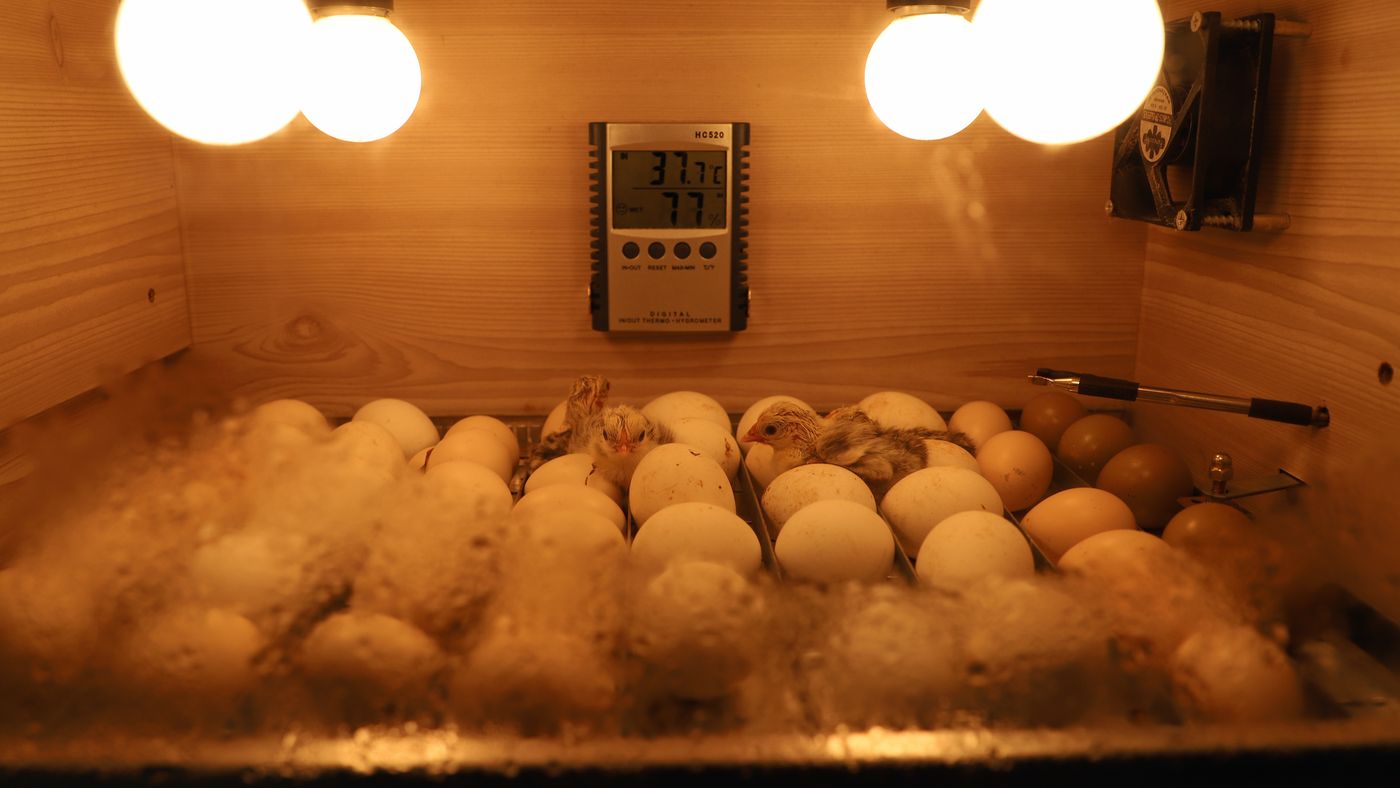
Lockdown, days nineteen to twenty-one, is where impatience destroys otherwise good batches. Stop turning, raise humidity, increase ventilation, and then leave the machine shut. Every opening drops humidity within seconds, and a chick that has pipped into suddenly dry air gets its membrane dried onto it and cannot turn to cut the shell. That is shrink-wrapping, and it is the most common late loss in Kenya. The instinct to help is the enemy. A hatch can legitimately spread over twenty-four to thirty-six hours, and chicks can stay in the machine for that long without harm because they have absorbed the yolk sac.
Diagnosing Your Own Failures: Open the Unhatched Eggs
This is the single most valuable habit in incubation and hardly anyone does it. After every hatch, break open the eggs that did not hatch and look. The stage at which development stopped names your problem.
| What you find | What it usually means |
|---|---|
| Clear, no development at all | Infertile egg, or the egg was too old or badly stored. A breeding and handling problem, not a machine problem |
| Blood ring, death in the first week | Temperature too high, rough handling, contamination, or eggs stored too long |
| Death around the middle of the term | Inadequate turning, nutritional deficiency in the breeding flock, or temperature instability |
| Fully formed chick, dead, not pipped | Usually humidity wrong through setting, poor ventilation, or a chick malpositioned in the shell |
| Pipped the shell but died before emerging | Humidity too low at lockdown, the membrane dried onto the chick, or the machine was opened during hatching |
| Hatched early, weak, unabsorbed yolk, wet navel | Temperature too high through setting |
| Hatched late, large, sticky, sluggish | Temperature too low through setting |
| Bad smell, discoloured contents | Bacterial contamination. Review egg cleanliness, washing practice and machine hygiene |
Do this for three consecutive hatches and write down what you find. The pattern will point at one or two specific causes, and you will fix in a month what guessing would not fix in a year.
Hygiene and Records
Clean and disinfect the machine after every hatch, without exception. Hatching debris is organic material in a warm humid box, which is as good a bacterial culture as anyone could design. Pay attention to the water reservoir and to the fan, where down collects.
Keep a simple record for every batch: date set, number set, source of eggs, clears at day seven, transfer count at day eighteen, hatched, and any incident such as a power cut. Nothing elaborate. After a few cycles this record is worth more than any guide, because it describes your machine, your climate and your egg supply rather than somebody else's.
When It Is Genuinely the Machine
Sometimes it is. A drifted sensor, a failing turning motor, a fan that has stopped moving air properly or an element cycling badly will all produce poor hatches no matter how good your practice. If your records show a sudden change with no change in your egg supply or handling, suspect the machine and verify it against an independent thermometer at several positions.
Most of those parts are replaceable. We stock controllers, motors, trays and spares across all six branches, and we would rather repair a machine than sell you a new one. If your hatch rates have fallen and you cannot work out why, tell us what you are finding in the unhatched eggs and we will help you read it.
Key Takeaways
- Fertility and hatchability are different numbers with completely different fixes. Candle at day seven to find out which is failing.
- A strong overall result is roughly 75 to 85 per cent of eggs set producing chicks.
- Never wash hatching eggs. Washing removes the cuticle and can draw bacteria in through the pores.
- Too hot is far more dangerous than too cold. Half a degree over, sustained, produces weak early chicks.
- Trust the air cell, not a humidity figure copied from a foreign video. Coast and highland settings genuinely differ.
- Open the unhatched eggs after every hatch. The stage at which development stopped names your problem.
Frequently Asked Questions
What is a good hatch rate?
Fertility of 85 to 95 per cent from a well managed breeding flock, and hatchability of 80 to 90 per cent of those fertile eggs from a well run machine. Multiplied together, a strong overall result is roughly 75 to 85 per cent of eggs set producing live chicks. If you are at 50 per cent, candle at day seven to establish which of the two numbers is failing.
What temperature should an egg incubator be?
37.5 degrees Celsius for a forced air machine. Too high is considerably more dangerous than too low: even half a degree over, sustained, produces early hatches with weak chicks and unabsorbed yolk sacs, and a few hours at 40 degrees can kill a whole batch. What matters is the temperature the eggs experience, so verify against an independent thermometer at egg level.
What humidity do chicken eggs need?
Around 50 to 55 per cent during the setting period and 65 to 75 per cent for the final three days, as a starting point. Then correct from evidence: candle at day 14 and look at the air cell, lowering humidity if it is too small and raising it if too large. Settings that work in the highlands are often too high on the Coast.
Why do chicks die in the shell after pipping?
Almost always humidity too low at lockdown, or the machine being opened during hatching. When a chick pips into suddenly dry air the inner membrane dries onto it and it cannot turn to cut the shell, which is what people call shrink wrapping. Raise humidity for the last three days, increase ventilation, and then leave the machine shut even though a hatch can spread over 24 to 36 hours.
How often should eggs be turned?
At least three to five times a day from day 1 to day 18, and an odd number of turns per day so eggs do not rest in the same position every night. Automatic turners typically do it hourly. Stop turning completely at day 18. Inadequate turning causes the embryo to stick to the shell membrane, usually killing it in the first week.
Why are my eggs clear at candling?
Clear eggs were infertile, which is a breeding flock problem rather than an incubator problem. Check your cockerel to hen ratio, which should be around one to eight or ten, the age and weight of your cockerels, and the flock's nutrition. It can also mean eggs were too old or badly stored: set within seven days of lay and store pointed end down at 15 to 18 degrees.
Can I still hatch a dirty egg?
Wipe lightly soiled eggs dry with fine sandpaper or a dry cloth, and do not set badly soiled ones. Never wash hatching eggs. The shell carries a natural cuticle that blocks bacteria, washing removes it, and washing in water cooler than the egg actively draws bacteria inward through the pores.