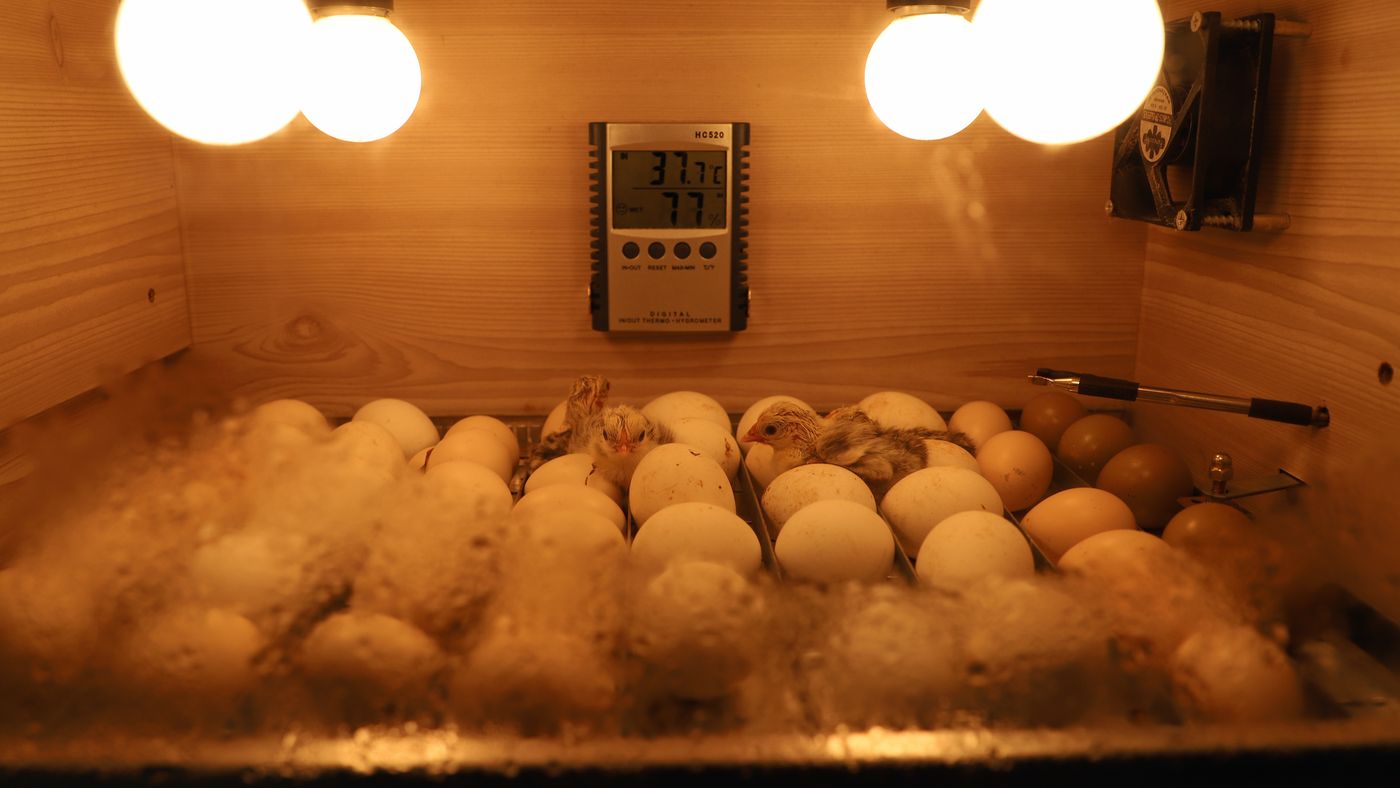
Two farmers buy the same incubator from the same shelf. One runs it in Kanamai on the Coast, the other on a ridge above Eldoret. Both set the humidity to the figure printed in the manual, hold the temperature steady, and turn the eggs on the same schedule. On day twenty one the Coast farmer opens big, wet chicks that pipped but never made it out. The highland farmer opens small, sticky chicks stuck to the shell, and a tray of eggs that pipped days too early. Same machine, same dial, opposite failures.
The dial was never the point. Humidity inside an incubator is not a number you set once and forget. It is a moisture balance you manage against the air your machine is breathing, and that air is wildly different between the humid Coast and the dry, high country of the Rift and the north. A setting that hatches beautifully in Nakuru can drown a clutch in Mombasa.
This guide explains why humidity decides a hatch as surely as temperature does, what the target ranges are for setting and for the final hatching days, and how to stop guessing by reading two things the eggs tell you directly: the air cell and the weight they lose. It also untangles wet bulb from relative humidity, covers water trays and top ups, and tackles the specific problem of humid Coast air against dry highland and arid air.
Why Humidity Decides a Hatch as Much as Temperature
Most first time hatchers obsess over temperature and treat humidity as an afterthought. Temperature sets the pace of the embryo's development, and getting it wrong is fast and obvious. Humidity does something quieter and just as decisive: it governs how much water the egg loses over the twenty one days a chicken egg takes to hatch.
An egg is a sealed water store with thousands of microscopic pores in the shell. Across incubation the embryo must lose a controlled amount of that water so that, by hatching, an air space has formed at the blunt end large enough for the chick to poke its beak into and take its first breath. Lose too little and the chick is oversized and waterlogged, with no room to turn and pip. Lose too much and it is dehydrated, shrink wrapped against the membrane, and too weak to break out.
The rate of that water loss is set almost entirely by the difference in moisture between the inside of the egg and the air around it. Drier incubator air pulls water out faster. More humid air slows the loss. That is the whole mechanism, and it is why the same humidity setting behaves so differently in different Kenyan climates. Temperature runs the clock; humidity decides whether the chick that finishes the clock can actually get out.
The one sentence that matters. Higher humidity means less moisture leaves the egg, which makes a smaller air cell. Lower humidity means more moisture leaves, which makes a larger air cell. Everything else in this article is built on that direction, so read it twice.
What Humidity Actually Controls: Moisture Loss and the Air Cell
Because humidity exists to control water loss, the honest question is not "what percent should I dial in" but "how big should the air cell be by now, and is it getting there". The air cell is the referee. It grows as the egg loses water, and its size on a given day tells you whether your humidity has been right, too high, or too low.
A chicken egg should lose roughly eleven to thirteen percent of its starting weight between setting and day eighteen, when hatching preparations begin. That loss shows up as a steadily growing air cell at the blunt end, visible when you candle. It is the standard target used by hatcheries, and it gives you something concrete to aim at instead of a humidity number that means nothing without knowing your own air.
Here is the part that trips people up. The correction is the reverse of what instinct suggests. If the air cell is too small, the egg is holding too much water, so your humidity has been too high and you must lower it to speed the loss. If the air cell is too large, the egg has lost too much water, so your humidity has been too low and you must raise it. A surprising number of guides, and shop counters, state this backwards.
You do not have to weigh anything to use this. Candling on day seven, day fourteen and day eighteen, and comparing the air cell against a drawn guide, tells you which way to move. For the full method of reading a clutch through the shell, our guide to egg candling and fertility walks through each stage.
The Target Ranges: Setting Versus Hatching
Incubation splits into two humidity regimes. From setting through to day eighteen, the egg needs to lose water at a steady, moderate rate, so you run a lower humidity. This is the setting stage, and a common target for chicken eggs is a relative humidity somewhere in the mid forties to mid fifties percent.
For the last three days, from day eighteen to hatch, the picture flips. The chick has finished its water loss and now needs a moist environment to hatch into. High humidity keeps the inner shell membrane soft so the chick can turn and cut around the shell rather than gluing itself to a leathery, dried out membrane. This is lockdown, the target jumps to roughly sixty five to seventy five percent, and it is when you stop turning the eggs and stop opening the machine.
Treat these as starting points, not commandments. The numbers are honest averages for the average room. Your job is to land on whichever version of them produces the right weight loss in your air, which is why the two stages are worth picturing side by side.
Different species shift these numbers. Duck and goose eggs want more moisture, while quail sit closer to chicken figures on a shorter clock. Avoid setting mixed species in one machine and expecting a single humidity to serve them all.
Read the Egg, Not the Dial: Weight Loss You Can Measure
The most reliable humidity instrument on a Kenyan farm is not the incubator's own display, which drifts as its sensor ages. It is a kitchen scale that reads to the gram. Weighing tells you the one thing that matters, the water the eggs are losing, as a hard number rather than a guess through the shell.
The method is simple. At setting, weigh a sample of six to ten eggs, marked or as a tray whose empty weight you know. Weigh the same sample on day seven, day fourteen and day eighteen, aiming to have lost about eleven to thirteen percent of the set weight by day eighteen, a little over half a percent per day. Ahead of that line, your air is too dry, so raise the humidity. Behind it, your air is too moist, so lower it.
Weigh, do not trust the display. A five gram error on a fifty gram egg is a full ten percent, so use a scale that reads to the gram. Weight loss is the only humidity number that cannot be faked by a tired sensor, and it is free.
It is also the fastest way to diagnose a hatch that keeps failing without an obvious cause. Chicks that are consistently wet and oversized, or consistently small and shrink wrapped, point straight at humidity before you waste time on temperature or turning. Our companion piece on why eggs fail to hatch and how to diagnose it uses exactly this kind of evidence.
Wet Bulb or Relative Humidity: The Same Thing, Two Dials
Older incubators, and many still sold in Kenya, express humidity as a wet bulb temperature rather than a percentage, which confuses people needlessly. A wet bulb thermometer is an ordinary thermometer with a wet wick over the bulb. Water evaporates from the wick and cools it, and the drier the air, the more it evaporates and the lower the reading falls. In very humid air little evaporates, so the wet bulb reading sits close to the ordinary, dry bulb temperature.
Relative humidity is that same information expressed as a percentage of how much water the air holds against the most it could hold at that temperature. The gap between the dry bulb and the wet bulb is what a humidity chart converts into a percentage. They are two dials on the same quantity. At a dry bulb of about thirty seven and a half degrees, a wet bulb near twenty eight to thirty degrees is roughly the setting humidity, and a wet bulb around thirty one to thirty two degrees is the raised hatching humidity.
Do not memorise conversions. Whichever dial your machine shows, calibrate it against reality. A saturated salt test, sealing a cup of damp table salt with a hygrometer in a bag, holds a known seventy five percent and shows how far your sensor has drifted. And whatever the dial claims, the weight of the eggs is the final word.
Water Trays, Surface Area and Sensible Top Ups
Inside the machine, humidity comes from water evaporating off a tray or channel, and the single lever that controls it is the surface area of exposed water, not the depth. A wide shallow tray raises humidity far more than a deep narrow cup holding the same litres, because evaporation happens at the surface. It is the most useful and least understood fact about incubator humidity.
To raise humidity, expose more water surface: fill more channels, add a tray, or stand a clean sponge in the water so its wet surface adds evaporating area. To lower humidity, do the opposite, exposing less surface and opening the vents a little wider so drier air moves through. Controlling humidity by the water's temperature is a distraction, since the tray quickly settles to the machine's temperature anyway.
Top up with clean, previously boiled water at close to incubation temperature, so you neither chill the eggs nor drop the running temperature while fresh water warms up. Boiled or filtered water leaves less scale on trays and sensors in hard water areas, and carries fewer bacteria into a warm, moist box. During lockdown, never let the trays run dry, because a sudden humidity crash in the final days is a classic cause of chicks that pip and then die shrink wrapped. A worn wick, tray or hygrometer probe is cheap to replace from our incubator spare parts.
Surface, not litres. If you need more humidity and the vents are already right, add evaporating surface before you add water. A soaked sponge standing in the tray can lift humidity several points because it multiplies the wet area the air can pull from.
Humid Coast Air Against Dry Highland and Arid Air
This is where a single factory setting quietly ruins hatches across the country, because Kenya's incubators run in radically different air. The incubator can add humidity by evaporating water, but it cannot easily remove humidity that the surrounding air brings in through the vents. So the ambient air sets the floor you are working from.
On the humid Coast, in Mombasa, Kilifi, Kwale and the Kanamai belt, the outside air is heavy with moisture for much of the year. Eggs there lose water slowly even with modest tray water, and the common failure is too little loss: air cells that stay too small, big waterlogged chicks that pip but cannot turn to finish, and late, messy hatches. The fix runs against instinct. You often run the setting stage drier than the manual says, sometimes with trays nearly empty and vents open a little wider, leaning on weight loss to prove the eggs are shedding water. Only for the final lockdown do you add moisture back.
In the dry highlands and the arid and semi arid north, the Rift ridges, Laikipia, and around Marsabit and Turkana, the reverse is true. The air is thin and dry, and the lower pressure at altitude makes eggs give up water even faster. The common failure is too much loss: air cells that balloon too large, small dehydrated chicks stuck to the membrane, and eggs that pip early into an oversized air space. The fix is to run the setting stage more humid than the default, with extra tray surface and vents no wider than the embryos' oxygen need requires, again checking weight loss so you do not overcorrect and stall the loss.
The Kenyan rule of thumb. On the Coast, start drier and watch the air cell is growing enough. In the dry highlands and the north, start wetter and watch the air cell is not growing too fast. In both places, let the weight of the eggs, not the map, make the final call.
Two local realities matter. Kenyan power is not perfectly steady, and an outage lets a machine cool and its humidity swing, so an incubator that holds conditions through short cuts is worth more here than a longer feature list. And the rains move your ambient humidity within a single location, so a setting that worked in a dry January may need nudging in the long rains. None of that is a reason to fear humidity. It is a reason to measure it.
A Simple Routine That Keeps Humidity Honest
You do not need laboratory discipline, only a few habits repeated every batch that turn humidity from a mystery into a managed number.
- Before setting, calibrate your hygrometer with the salt test, and note how far off it reads so you can mentally correct it.
- At setting, weigh a marked sample of eggs and write the weight on the tray card, not on a scrap you will lose.
- Fill trays to a surface area that gets you into the setting window for your climate, drier on the Coast, wetter in the highlands.
- Candle and weigh on day seven and day fourteen, compare against the air cell guide and the weight loss line, and adjust surface area or vents.
- At day eighteen, weigh one last time, confirm you are near eleven to thirteen percent, then raise humidity for lockdown and stop opening the machine.
- Keep trays topped up with warm boiled water through hatch, and never let them run dry in the final days.
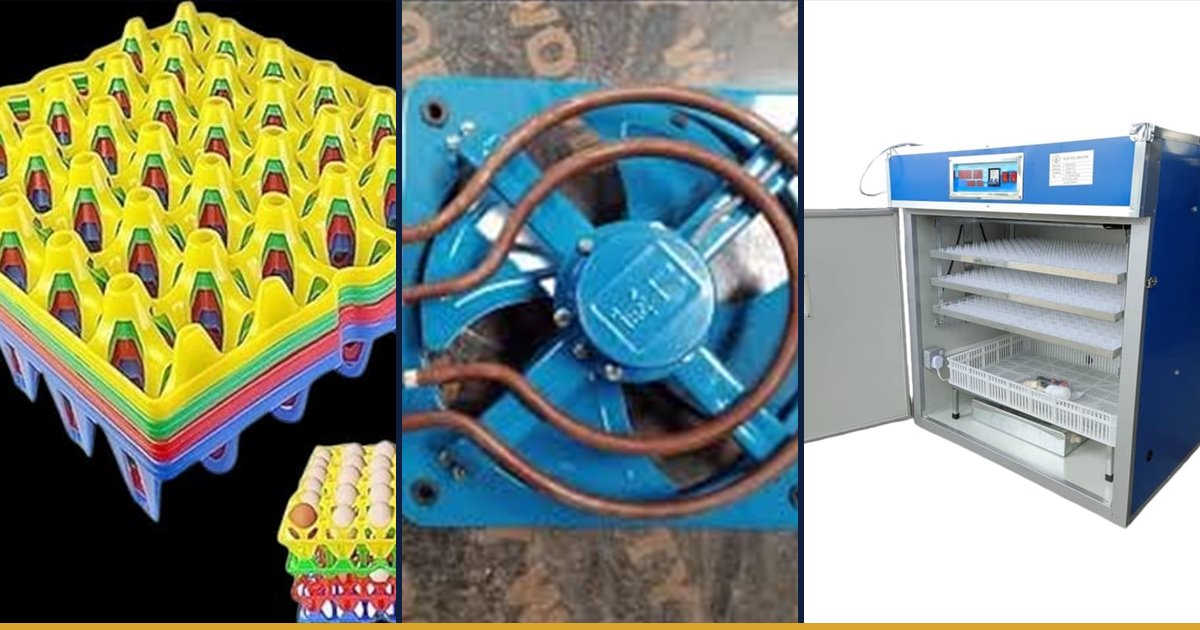
If you are still choosing a machine, or your current one cannot hold humidity through a Kenyan afternoon, it is worth looking at the range of egg incubators we stock in sizes from tabletop trays to farm scale cabinets, and checking the current price list so you can match capacity to your actual hatching plan rather than to a hopeful one.
Key Takeaways
- Humidity governs how much water an egg loses, which decides whether the finished chick can pip and get out. It matters as much as temperature.
- Higher humidity means less loss and a smaller air cell. Lower humidity means more loss and a larger air cell. If the air cell is too small, lower humidity; if too large, raise it.
- Aim to lose about eleven to thirteen percent of set weight by day eighteen. Run a lower humidity for setting and a higher one for the final hatching days.
- Weigh a sample of eggs on a gram scale rather than trusting the display, and control humidity through water surface area, not depth.
- Start drier on the humid Coast and wetter in the dry highlands and arid north, and let weight loss, not the manual, make the final call.
Frequently Asked Questions
What humidity should I set my incubator to in Kenya?
As a starting point for chicken eggs, aim for a relative humidity around the mid forties to mid fifties percent during setting, days one to eighteen, and raise it to roughly sixty five to seventy five percent for hatching, days nineteen to twenty one. Then adjust up or down until your eggs lose about eleven to thirteen percent of their set weight by day eighteen, which is the number that actually matters.
My air cell is too small. Should I raise or lower the humidity?
Lower it. A small air cell means the egg is holding too much water, so the air has been too humid and moisture is not leaving fast enough. Reduce the exposed water surface and open the vents slightly, then recheck in a couple of days. A large air cell is the opposite problem and calls for raising the humidity.
Why do my eggs hatch differently at the Coast than upcountry?
Because the surrounding air is different. Humid Coast air slows water loss, so eggs there keep too much water and give big, waterlogged chicks unless you run the setting stage drier. Dry highland and arid air, made drier still by the lower pressure at altitude, speeds water loss, so eggs lose too much and give small, shrink wrapped chicks unless you run wetter. The same dial genuinely does different things in the two climates.
What water should I use to top up the trays?
Use clean, previously boiled water at close to incubation temperature. Warm water avoids chilling the eggs or dropping the machine's running temperature, and boiling reduces both the scale that fouls sensors in hard water areas and the bacteria that thrive in a warm, moist box. Keep the trays from running dry, especially during the final three days of lockdown.
Is a hygrometer reading enough, or do I really need to weigh eggs?
Weighing is more reliable. Hygrometer sensors drift as they age and often read several points off, and even a calibrated one only tells you the air, not what the eggs are doing. A gram scale measures the actual water loss directly, which is the real target, so weighing a sample at setting, day seven, day fourteen and day eighteen beats trusting any display.
At Fuga we supply incubators across our Nairobi, Nakuru, Eldoret and Coast branches, so we sell into both the humid Coast and the dry highlands and see both failures return through the door. That is why we talk about weight loss and air cells rather than a single magic number. Bring us your climate, your machine and your last hatch result through our contact page or on WhatsApp, and we will help you set humidity for the air you run in.