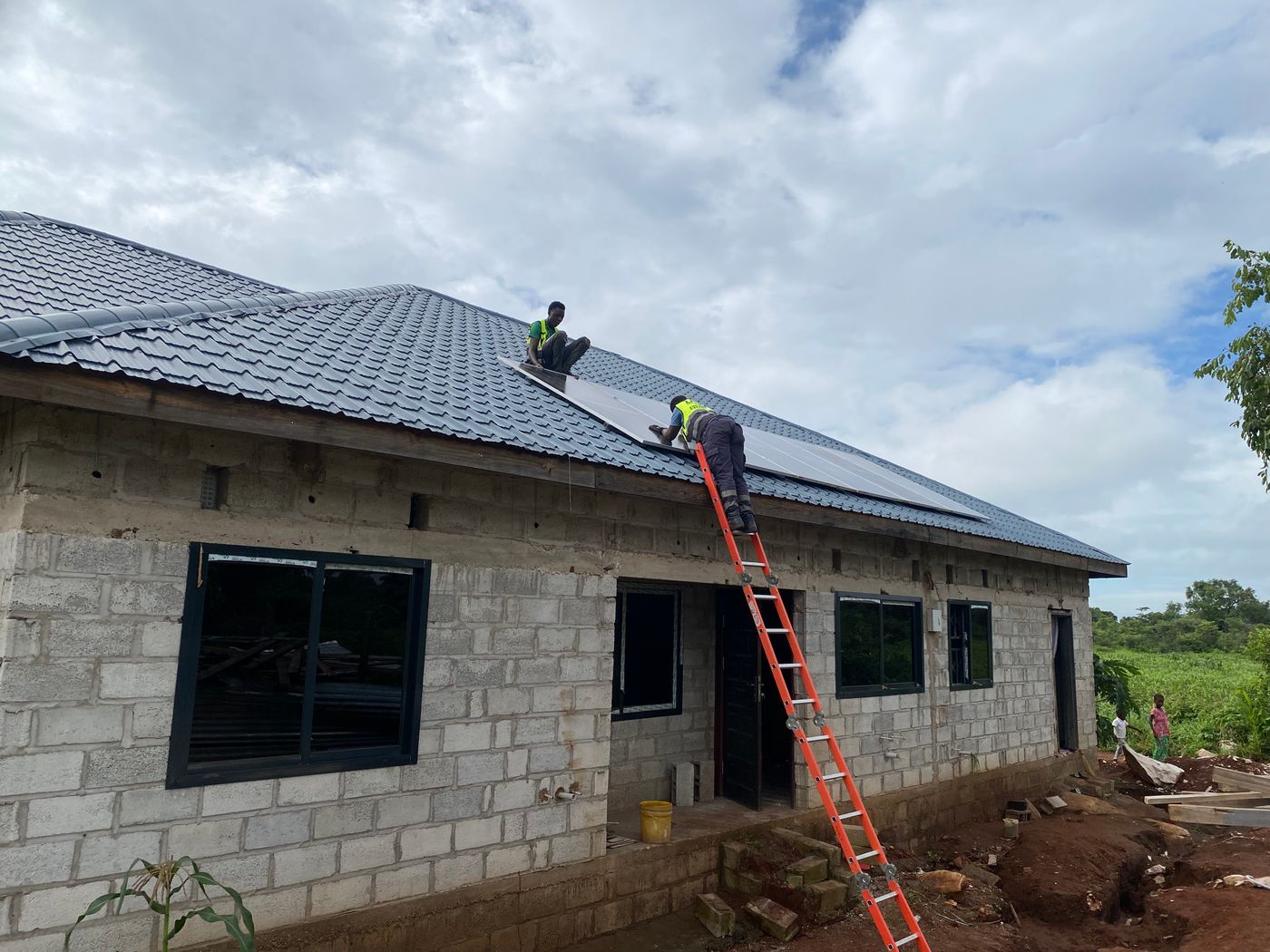
An energy audit means listing every appliance on your farm with its watts and the hours it runs each day, multiplying the two to get watt-hours, and adding them up. That total decides your battery and panels, while the biggest load you will run at one time, and the surge when a motor starts, decide your inverter. In the illustrative small dairy and poultry farm worked through below, the total comes to about 4.5 kWh a day.
Most solar disappointments on farms start with a guess: panels bought "for the house", a pump added a month later, and an inverter that trips every time the milking machine starts. An hour with a notebook before you buy avoids that.
Our guide to sizing solar panels and budgeting a system gives the general method, and our guide to sizing an inverter goes deep on VA, surge and pure sine. This article is the step in front of both: how to do the audit itself and turn the result into numbers you can take to a supplier.
Why Do an Energy Audit Before Buying Solar?
Because every part of a solar system is sized from your loads. Panels follow your daily energy, the battery follows your daily energy and how many hours you must run without sun, and the inverter follows your loads in watts. If the list is wrong, every part is wrong, and mistakes are expensive in both directions. Too small and the pump stands idle on a cloudy day; too big and money is tied up that could have bought feed.
The audit also finds waste, such as lights left on or a pump that runs three hours when one would do. Cutting load is cheaper than buying capacity, and we show the arithmetic later.
How Do I List My Appliances and Find Their Watts?
Walk the farm with a notebook and write down every electrical item: lights in each house and pen, pumps, milking machine, chiller or freezer, fans, incubator, charger points, radio, router and security lights. Include items you plan to add soon.
For each one find the power in watts. There are four reliable sources.
- The nameplate. Most appliances have a label with watts (W), or amps (A) and volts (V). For simple heating and lighting loads, watts are roughly volts multiplied by amps.
- The motor plate. Pumps and milking machines are often labelled in horsepower or kilowatts. One horsepower is about 746 watts of output, and the electrical input is higher because motors are not perfectly efficient, so take the amps and volts from the plate where you can.
- A plug-in energy meter. For appliances that plug into a socket, a cheap plug-in meter shows the watts and the energy actually used over a day.
- Your KPLC bills. If the farm is already on the grid, divide the monthly units (kWh) by 30 to get a daily average, and use it to check your total from the other methods.
Anything wired into the building, such as a large motor or a distribution board, should be measured by a licensed electrician. Do not open panels or touch live wiring yourself.
How Do I Turn Watts and Hours Into Daily kWh?
For each item, multiply the watts by the hours it runs in a typical day, and you have watt-hours (Wh). A 90 W set of lights that runs for 6 hours uses 540 Wh. Divide watt-hours by 1,000 to get kilowatt-hours (kWh), the unit KPLC charges for.
Two cautions. A compressor, such as a chiller or freezer, does not run all day, so use the fraction of time it is on (the duty cycle) rather than 24 hours. And audit your busiest normal day, not the quietest, because brooding, hatching and milking peaks use more than a quiet week.
The table below is an illustrative audit for a small dairy and poultry farm. The watts, hours and duty cycle are assumptions chosen to show the method; your appliances will differ, so replace every number with your own.
| Appliance | Watts | Hours a day | Wh a day |
|---|---|---|---|
| LED lights, 10 x 9 W | 90 | 6 | 540 |
| Water pump | 500 | 1.5 | 750 |
| Milking machine | 400 | 2 | 800 |
| Milk cooler (compressor on about 40% of the day) | 150 | 9.6 | 1,440 |
| Poultry house fan | 60 | 8 | 480 |
| Phones, radio, router | 30 | 5 | 150 |
| Security floodlight | 30 | 12 | 360 |
| Total | 4,520 (4.52 kWh) |
The cooler looks small at 150 W but is the biggest user because it works around the clock, while the 500 W pump runs only an hour and a half. Watts alone do not show where the energy goes; watts multiplied by hours do.
What Is the Difference Between Running Load and Surge Load?
Running load is what an appliance draws while it works steadily. Surge load, also called starting or inrush load, is the brief, much higher draw when a motor or compressor starts. Pumps, milking machines, chillers and chaff cutters all have motors, and a motor starting can draw several times its running current for a second or two. Nova Electric's inverter application note puts it plainly: the locked rotor current at start is "almost always considerably higher" than the continuous load, and the inverter must be sized for it.
The multiplier depends on the motor and how it starts. In this example we assume five times the running watts for each motor, which is a conservative teaching figure, not a measurement. Read your own motor plate or ask the supplier, because a small compressor may start at a lower multiple and a hard-starting pump may start at more.
Surge matters for the inverter and for nothing else. Batteries and panels do not care about a one-second spike, but an inverter whose surge rating is too low will trip or shut down each time the motor starts.
How Do I Size the Inverter From the Audit?
Work out two numbers. The first is your realistic peak running load: the most watts that will be on at the same time. The second is your worst starting surge: the biggest motor starting while everything else is already running.
In the example, if every appliance ran at once the total would be 1,260 W, but the pump and the milking machine do not need to run together. A realistic peak is milking (400 W) plus the lights (90), cooler (150), fan (60), phones (30) and floodlight (30), which is 760 W. A common rule of thumb is to add about 25 percent so the inverter is not running flat out all day, which gives 760 x 1.25 = 950 W, so a 1,000 W class inverter meets the running load.
Now the surge. If the pump starts while the lights, cooler, fan, phones and floodlight are on (360 W), the inverter must deliver about 2,500 + 360 = 2,860 W for a moment. That is well above 1,000 W. There are four ways out: choose an inverter whose surge rating covers it, fit a soft starter to the pump, choose a smaller pump, or stagger the starts so the pump never starts with other motors. Nova Electric advises against starting two motor loads at once on all but a very large inverter. Our inverter sizing guide explains how to read VA and surge ratings.
How Do I Size the Battery?
Start from your daily energy and allow for the losses and the days you want to cover. For the example:
The inverter is not perfectly efficient. Assume 90 percent, which is a typical teaching figure; your inverter's datasheet will give its real efficiency. The battery must supply 4,520 / 0.90 = 5,022 Wh a day.
Next, decide how many days of autonomy you want. One day is the minimum for a farm that must keep milk cold through a cloudy spell, and two is safer if you can afford it. Then allow for depth of discharge, the share of the battery you are willing to use. Assume 80 percent for a lithium battery, and check your battery's datasheet. For one day of autonomy the battery size is 5,022 / 0.80 = 6,278 Wh, about 6.3 kWh.
Battery size is quoted in kilowatt-hours, or in amp-hours at a stated voltage. The link is kWh = volts x amp-hours / 1,000. At 24 V, 6,278 Wh is about 262 Ah, and at 48 V it is about 131 Ah. The Fuga 100 amp lithium battery, 200 amp lithium battery and 300 amp lithium battery pages give the amp rating in the name but not the voltage or the kWh, so read the label or ask us before you do the sum. Our guide to lithium versus lead acid compares the two types.
How Do I Size the Panels?
Panels have to replace the day's energy in the hours of good sun. Kenya's daily solar radiation is commonly given as roughly 4 to 6 kWh per square metre, as the Ministry of Energy's 2008 solar and wind resource assessment is cited in Turkana County's energy plan. One kWh per square metre is called one peak sun hour, so that is 4 to 6 peak sun hours a day. We use 4.5, at the cautious end, so the system copes in the short rains. Our guide to solar output in the rainy season explains why you should not size from the best month.
Panels also lose some of what they make to heat, dust, cable resistance and mismatch. The US National Renewable Energy Laboratory's PVWatts tool uses a default system loss of 14 percent, so 86 percent of the panel's output reaches the electrical system. Add the inverter (90 percent) and battery round-trip (assume 95 percent for lithium) and the whole chain delivers about 0.90 x 0.95 x 0.86 = 0.735 of the panel energy.
Array size in watts is then daily energy / (peak sun hours x chain efficiency) = 4,520 / (4.5 x 0.735) = about 1,367 W. With a panel such as the 590 solar panel, assuming its label confirms a 590 W rating, that is 1,367 / 590 = 2.3 panels, so you would fit three, which gives 1,770 W and about 30 percent headroom for cloudy weeks and growth. Two panels would be 1,180 W and about 14 percent short on an average day.
One more check: the charge controller must handle the array. A 20 amp controller on a 24 V battery handles roughly 480 W of panels, so a 1,770 W array needs a much larger controller, or an inverter with a built-in charger. Ask your installer to match the panel voltage and current to the controller.
How Can I Shrink the Load Before I Buy?
Every watt-hour you remove saves money on all three parts. In this example every 100 Wh a day you remove saves about 100 / 3.3 = 30 W of panel, and it also shrinks the battery and sometimes the inverter. Practical savings include:
- Replace any old filament bulbs with LED lamps and switch lights off in empty houses.
- Run the pump by a timer in the sunniest hours, filling a tank once, instead of running it in short bursts all day.
- Stagger the motors so that the inverter never faces two starts at once.
What Mistakes Should I Avoid?
| Mistake | Result | Fix |
|---|---|---|
| Using hours "when it works" for compressors | Overstates the load and oversizes the system | Use the duty cycle, ideally from a plug-in meter |
| Ignoring surge | Inverter trips when a pump or chiller starts | Check the surge rating; stagger or soft-start motors |
| Auditing the quietest week | System too small for brooding, hatching or peak milk | Audit your busiest normal day |
| Sizing panels from the best month | Shortfall in the short rains | Use cautious peak sun hours, such as 4 to 4.5 |
| Skipping the losses | Battery and panels come out short | Include inverter, battery and array losses in the chain |
| No room to grow | New pump or cooler forces a rebuild | Add 10 to 20 percent for what you will buy next year |
Solar Equipment to Look At
Prices change, so we do not print them here. See each product page or the Fuga price list for current prices and stock.
| Item | Where it fits |
|---|---|
| 1000W inverter (Solar Max) | Running loads around 1,000 W; confirm the surge rating for motors |
| 1500W inverter (Solar Max) | Larger running loads; confirm the surge rating for motors |
| 590 Solar panel | Array sizing from your daily watt-hours |
| 200 amps lithium battery | Storage; check the voltage and kWh on the label |
Do the audit this week, and come to us with your appliance list, hours and any motor plates. See our solar equipment range, or WhatsApp 0716 961 018 and we will help you turn your list into a quotation, with your installer checking the final design.
Key Takeaways
- List every appliance, its watts and its hours a day; watts multiplied by hours is watt-hours, and the total is what your battery and panels must supply.
- Use the duty cycle for compressors such as milk coolers, and audit your busiest normal day, not the quietest.
- Running load and surge load are different: motors can start at several times their running watts, and the inverter must cope with the surge.
- In our illustrative small dairy and poultry farm, 4.5 kWh a day needs about 6.3 kWh of battery and about 1.4 kW of panels at 4.5 peak sun hours.
- Include losses for the inverter, battery and array, and allow 10 to 20 percent for growth.
- Cut the load first: every 100 Wh a day removed saves about 30 W of panel in the example.
Frequently Asked Questions
How do I calculate how much solar power my farm needs?
List every appliance with its watts and daily hours, multiply to get watt-hours, and add them up for your daily total. Then add inverter, battery and panel losses, divide by your peak sun hours, and you have the panel size. A licensed installer should check the final design.
What is the difference between watts and watt-hours?
Watts measure how fast an appliance uses power at a moment, and watt-hours measure how much it uses over time. A 100 W light running for 5 hours uses 500 Wh, and 1,000 Wh is 1 kWh, the unit KPLC bills.
Why does my inverter trip when the pump starts?
Motors draw much more power for a second or two when they start, and the inverter's surge rating may be lower than that peak even if its running watts are enough. Check the inverter's surge rating, stagger motor starts, or fit a soft starter.
How many peak sun hours does Kenya get?
Kenya's daily solar radiation is commonly given as about 4 to 6 kWh per square metre, which is 4 to 6 peak sun hours, with the 2008 Ministry of Energy assessment cited in Turkana County's energy plan. For cautious sizing, many installers use a figure near 4 to 4.5 so the system copes in the rains.
Should I size my solar system for the surge or the running load?
Both. Panels and batteries follow your daily energy, while the inverter must handle your peak running load and the surge of the biggest motor starting. Size the inverter on both, with a margin of about 25 percent on the running load.