
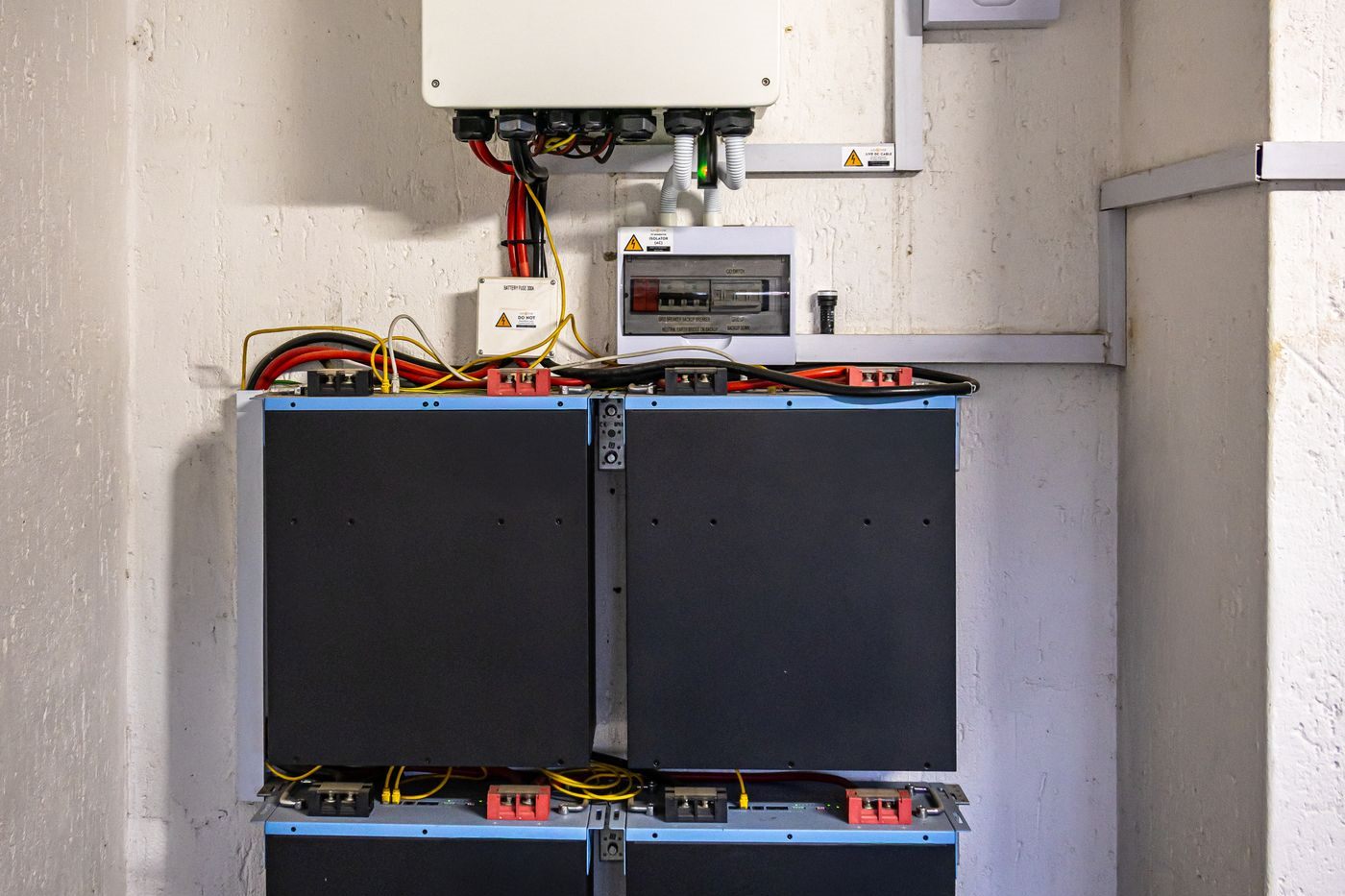
The battery is the part of a solar system that gets replaced. Panels on a Kenyan roof will still be producing in fifteen years and a decent inverter will see ten. The battery bank is the component that quietly decides whether the whole system was a good buy, and it is the one most people choose on sticker price alone.
Two chemistries compete for the job: the lead acid battery that has sat in cars, trucks and solar systems for a century, and the lithium iron phosphate battery that has taken over new installations in the last few years. Lead acid is cheaper to buy. Lithium is nearly always cheaper to own. Whether that gap matters depends entirely on what you are asking the battery to do.
This article works through the differences that actually change the outcome on a farm: how much of the nameplate you can use, how many times you can use it, how each chemistry wants to be charged, what heat and weight do to the decision, and what all of that adds up to per kilowatt-hour over the battery's life. Then it matches each chemistry to three common farm jobs: an incubator backup, a farmhouse, and a borehole pump.
A 200 Ah Battery Does Not Give You 200 Ah
Nameplate capacity is measured under conditions that flatter the battery. A lead acid battery's amp-hour rating is normally quoted at the 20 hour rate, written C20: the capacity you get by draining it slowly over twenty hours. Draw the same energy in five hours and you get noticeably less, because the chemistry inside cannot keep pace. This is the Peukert effect, and it punishes exactly the loads a farm cares about: a pump motor, a welding set, a chest freezer compressor cutting in.
The second cut is depth of discharge, usually written DoD. Lead acid plates degrade every time they are cycled deeply, so the standard advice is to use no more than about half the rated capacity if you want a reasonable service life. Take a lead acid battery to empty every night and you will be buying another within a year or two. A lithium iron phosphate battery, LiFePO4, is routinely cycled to 80 percent or more of its rating with the manufacturer's blessing.
Put the two together. A 200 Ah lead acid battery, used sensibly, delivers around 100 Ah of usable capacity, and less than that under a heavy load. A 100 Ah lithium battery delivers 80 to 90 Ah, and delivers it just as well to a pump as to a phone charger. The lithium battery with half the nameplate is, in practice, nearly the same battery.
Cycle Life Is Where the Money Actually Goes
A battery does not wear out by the year. It wears out by the cycle: one discharge and one recharge. What you are really buying is a number of cycles, and each cycle hands back a certain amount of usable energy. Multiply the two and you have the total energy the battery will deliver over its life. Divide the price by that and you have the only honest price for a battery, the cost per usable kilowatt-hour.
Lead acid batteries cycled to half their capacity every day are generally rated for some hundreds of cycles, and well maintained deep cycle types can reach into the low thousands. Lithium iron phosphate batteries are typically rated in the thousands of cycles at 80 percent depth of discharge. Cycled once a day, that is the difference between a bank that lasts two or three years and one that lasts most of a decade.
The arithmetic follows. Suppose a lead acid bank costs half what a lithium bank of the same nameplate does, but delivers a smaller usable share per cycle and a fraction of the cycles. Over the lithium battery's life you would buy the lead acid bank several times over. Before you count the labour of replacement, the water top-ups, and the day a tired lead acid bank let the incubator go cold, the cheaper battery is already the more expensive one.
The catch is that this only pays if you keep the lithium battery long enough to collect. If the system will be dismantled in two years, or the budget genuinely cannot stretch, a lead acid bank kept shallow and charged fully every day is a legitimate choice. It becomes a bad choice only when it is asked to do lithium's job.
Each Chemistry Wants a Different Kind of Charging
Lead acid charges in three stages. Bulk pushes current in at full rate until the voltage reaches a set point. Absorption then holds that voltage while the current tapers, and this is the stage that actually fills the last fifth of the battery. It takes hours. Float finishes with a trickle that holds the charge. Shorten the absorption stage and the battery never truly fills.
Under a Kenyan sky that matters in a particular way. Solar charging is at full strength for a few hours around midday. A lead acid bank drained overnight spends the morning in bulk and often has not finished absorption before the sun drops. Day after day it sits slightly under-charged, and a lead acid battery held partially charged grows lead sulphate crystals on its plates that harden and stop taking part in the reaction. This is sulphation, and it is how most solar lead acid batteries die: not from use, but from never being full.
Lithium has a flat voltage curve and accepts close to its full charging current until it is nearly full. There is no long absorption tail. It fills in the hours of good sun and it does not mind sitting at 60 percent for a week. Charging losses are lower too, because less of the incoming energy is turned into heat and gas, so the same panels put more into the battery and get more back out. Our guide to sizing and budgeting a solar array covers how many panels that takes.
Two cautions. Your charge controller or inverter must have a lithium setting, or let you set the voltages the battery maker specifies; a lead acid profile that runs equalisation charges can trip the battery's protection or shorten its life. And a lithium battery's management system, the BMS, will disconnect the battery on a fault, on low voltage or on high temperature. That is a safety feature, but an inverter that suddenly loses its battery mid-charge may need a reset to recover, so confirm the pairing before you buy either half.
Heat and Weight Change the Answer in Kenya
Battery life figures are quoted at 25 degrees. Lead acid ages faster the hotter it runs, and the rule of thumb used across the industry is that service life roughly halves for every 10 degrees above that. A lead acid bank in an iron-roofed store at the Coast, or in a Nakuru workshop that reaches 40 degrees in the afternoon, is losing life every day whether or not anyone draws power. Flooded batteries also lose water faster in heat and need topping up more often.
Lithium iron phosphate holds its cycle count better in heat, though it is not immune, and the BMS will simply refuse to charge if the cells go past their limit. Its temperature weakness is the opposite one: it must not be charged below freezing, which matters almost nowhere in Kenya outside the coldest highland nights. Either way, put the battery in the coolest, shadiest, best ventilated spot available, and never in direct sun.
Weight is the practical difference nobody quotes. A 200 Ah lead acid battery weighs somewhere around 50 to 60 kilograms; a 100 Ah lithium battery with similar usable capacity weighs a third of that or less, and one person can carry it. On a farm where the battery may live on a shelf, in a pump house, or under an incubator table, that changes what is possible. Two lithium batteries fit where four lead acid batteries would not, and mounting is far simpler.
Safety Is Different, Not Simply Better or Worse
Flooded lead acid batteries release hydrogen while charging, especially during absorption and equalisation, and hydrogen in an enclosed room is explosive. They hold sulphuric acid that spills if tipped and corrodes terminals and anything beneath them. The rules are simple: ventilate, keep them upright, keep sparks and cigarettes away, wear gloves and eye protection when topping up, and use distilled water only. Sealed AGM and gel types reduce these problems but still vent under a fault.
Lithium's safety rests on chemistry and electronics. Lithium iron phosphate is the most thermally stable lithium chemistry in common use, and it is the one you want in a farm building; the higher energy chemistries in laptops and electric cars are more energetic under abuse and have no business in a solar bank. The BMS inside a good LiFePO4 battery guards against over-charge, over-discharge, over-current and over-temperature. What it cannot guard against is a bad installation. Most battery fires in any chemistry start at undersized cables, loose terminals and missing fuses.
So the checklist is the same for both: a properly rated fuse or breaker on the battery cable close to the terminal, cables sized for the inverter's full current, terminals tightened and checked, and nothing flammable stored on or around the bank. A lithium battery with a BMS is more forgiving of user error. It is not a substitute for doing the wiring properly.
Which Battery for the Incubator, the House and the Pump
Incubator backup
An incubator is a small, steady load with a very high cost of failure: a few hours cold and the batch is compromised, as our article on solar egg incubators explains. The battery is cycled lightly most days and deeply on the day the grid fails or the clouds stay. That pattern is what lead acid handles worst: long spells of partial charge that invite sulphation, then a deep discharge when it matters. Lithium sits at any state of charge happily and delivers its full usable capacity on the bad day. For a small incubator a single 100 Ah lithium battery is usually enough, and the certainty is worth the price difference on a batch of eggs.
Farmhouse
A house cycles the battery every evening: lights, a television, phones, a fridge through the night. Daily deep cycling is where cycle life dominates the sums, and where lithium's cost per usable kilowatt-hour comes out far ahead over any span longer than a couple of years. Lead acid can still be the right answer for a very small system, a few lights and phone charging, where the bank is tiny, cycled shallowly and easy to replace. As soon as a fridge is on the system, lithium.
Borehole pump
A pump is the hardest load of the three. It draws a heavy current for a short time, and the surge when the motor starts is several times its running draw. Lead acid loses capacity under exactly that kind of draw, and the voltage sag on a tired bank can trip the inverter at the moment of start. Lithium holds its voltage under load and does not lose capacity to a fast discharge.
The better answer for most boreholes, though, is not a battery at all. Pump during the day straight from the panels into a raised tank, and let the tank be the storage, as we argue in our piece on whether solar water pumps are worth it. Keep a battery for a pump only where water must be delivered at night or the well cannot supply enough during sun hours, and then size a lithium bank for the starting surge, not the average draw.
Choosing From What Is on the Shelf
Fuga supplies lithium solar batteries alongside panels, charge controllers and hybrid inverters at all six branches, and you can browse the range on our solar equipment page. On the current price list the 100 Ah lithium battery is listed at 19,000 KSH and the 200 Ah at 35,000 KSH; prices are indicative and move with the shilling, so confirm before you travel. Lead acid batteries vary too widely in type and grade for a single figure to be useful, and any quote should state whether it is flooded, AGM or gel, and the rated cycle life at a stated depth of discharge. If the seller cannot tell you the cycle life, they are not selling you a solar battery.
When you ask for a quote, bring three numbers: the loads you want to run in watts, the hours a day you want to run them, and the days you need to survive without sun. Those decide the usable kilowatt-hours you need, and from there the chemistry question mostly answers itself.
Key Takeaways
- Compare usable capacity, not nameplate. Lead acid gives about half its rating daily; lithium iron phosphate gives 80 to 90 percent, and holds it under heavy loads.
- You are buying cycles. Multiply usable energy per cycle by rated cycles and divide the price by that. Lithium costs more to buy and far less per usable kilowatt-hour.
- Lead acid needs a long absorption charge every day and sulphates when it does not get one. Lithium fills in the good sun hours and does not mind sitting part charged.
- Heat shortens lead acid life sharply. Whichever chemistry, put the bank in the coolest, shadiest, ventilated spot you have.
- Lithium is a third of the weight for the same usable capacity, which matters on a shelf, in a pump house or under an incubator table.
- Both chemistries need a fuse close to the battery and properly sized cables. A BMS forgives mistakes; it does not replace good wiring.
- Incubator backup and any house with a fridge: lithium. A borehole pump: pump to a tank by day, and battery only where night pumping is unavoidable.
Frequently Asked Questions
Can I mix lithium and lead acid batteries in one solar system?
No. The two chemistries need different charging voltages and behave differently under load, so a mixed bank is always charged wrongly for one of them. The lead acid batteries end up chronically under-charged and sulphate, or the lithium battery is pushed past the voltages its management system allows and disconnects. If you are moving from lead acid to lithium, replace the whole bank and change the charge controller or inverter settings to the lithium profile at the same time.
Does a lithium solar battery need a special charge controller?
It needs a controller or hybrid inverter that either has a lithium setting or lets you set the bulk, absorption and float voltages by hand to the figures on the battery datasheet. A lead acid profile, particularly one that runs equalisation charges at a high voltage, can trip the battery's protection or shorten its life. Most modern MPPT controllers and hybrid inverters have a lithium option; the older basic PWM units often do not.
Why does my lead acid battery die after about a year on solar?
Almost always sulphation. A lead acid battery that is discharged at night and never quite finishes its absorption charge the next day sits partially charged, and lead sulphate crystals on the plates harden and stop taking part in the reaction. Capacity falls month by month until the battery cannot carry the night. Fixes are a bigger array so the bank finishes charging by early afternoon, shallower daily cycling, and a monthly full charge. Or a lithium battery, which does not sulphate at all.
Is a lithium solar battery safe to keep inside the house?
A lithium iron phosphate battery with a working battery management system is the safest lithium chemistry in common use and is routinely installed indoors. It does not give off hydrogen or acid the way a flooded lead acid battery does. The real risks are the same as for any battery: undersized cables, loose terminals and a missing fuse. Fit a properly rated fuse or breaker close to the battery, keep it out of direct sun and away from anything flammable, and it is a safer indoor neighbour than a lead acid bank.