
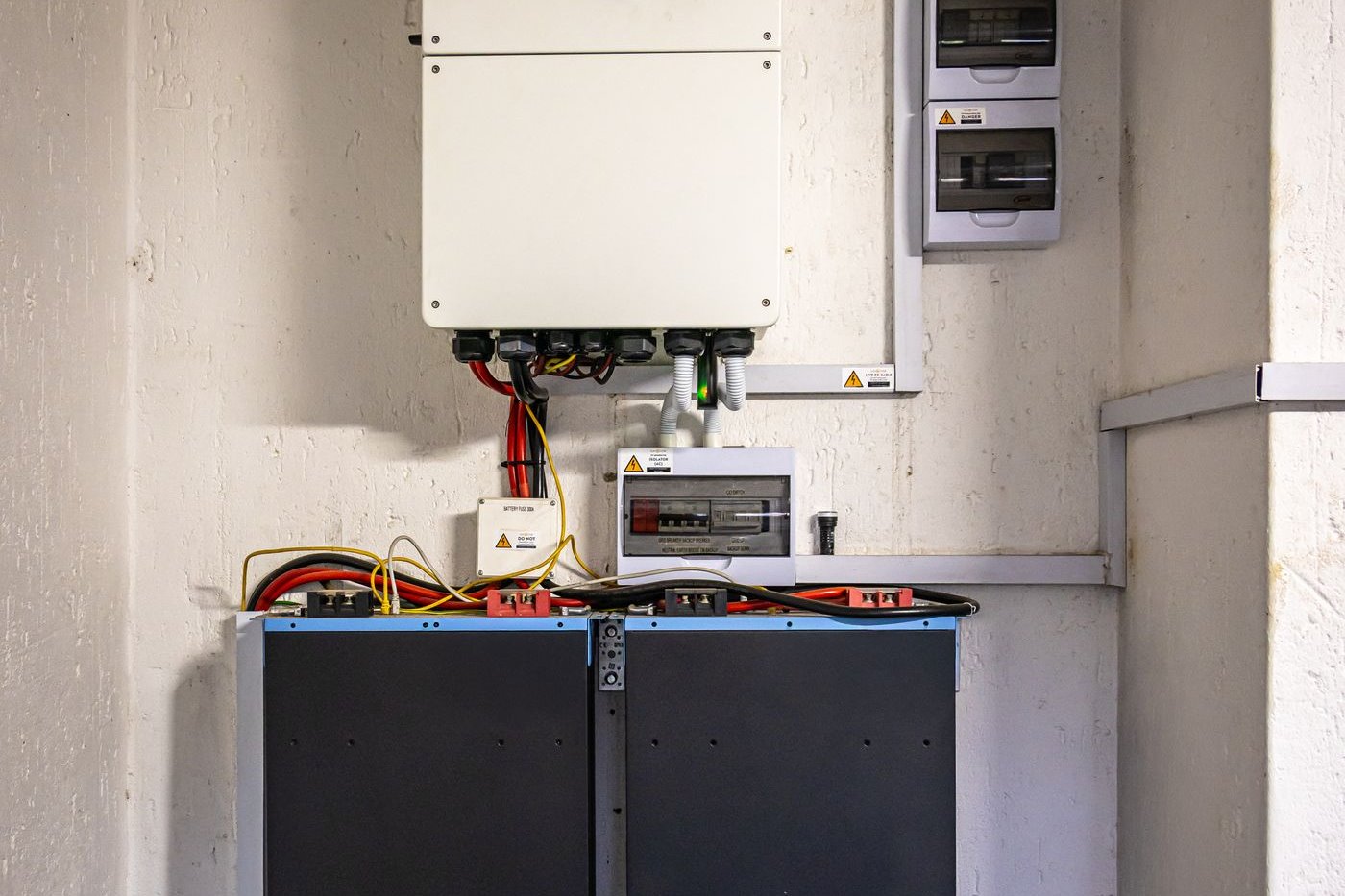
The inverter was bought for the house: lights, the television, phone chargers and the fridge. Then the workshop went up behind the store, an angle grinder was plugged into the same circuit, and the first time the pressure pump kicked in while the grinder was running, the inverter beeped, cut out and took every light in the house with it.
Nothing was faulty. The inverter did exactly what its label promised. It was sized for the watts printed on the appliances, and nobody sized it for the half second when a motor starts.
This guide works through the numbers that actually decide the size: running load against starting surge, what pure sine buys you, why a continuous rating shrinks in a hot room, how battery voltage sets the cable and the fuse, and which loads should never go on an inverter at all. It closes with a fully worked, clearly labelled illustrative example for a farmhouse with a small workshop.
Watts, VA and the Two Numbers on the Label
Every inverter carries two ratings. The continuous rating is what it can deliver all day at its reference temperature. The surge or peak rating is a larger figure it can hold for a short time, and that time varies from milliseconds to several seconds depending on the maker. A peak figure with no duration attached tells you nothing useful.
The second trap is the unit. Hybrid inverters are usually rated in kVA, and watts are VA multiplied by the power factor the maker assumes, which is commonly 0.8. So a 2 kVA unit delivers about 1,600 W, and a 1.6 kVA unit about 1,280 W. Read kVA as kW and every calculation that follows is a fifth too generous.
Running Load Is Easy. Surge Is What Trips You
A kettle, an iron or an LED lamp draws what the label says from the instant it is switched on. A motor does not. At switch-on an induction motor is stationary and draws its locked-rotor current, commonly several times its running current, until the shaft comes up to speed: a fraction of a second unloaded, noticeably longer for a pump starting against a full pipe.
On a farm, three loads carry this problem. The fridge or freezer compressor is an induction motor that starts many times a day, with a small running figure and a starting demand several times larger. The water pump is the worst offender, because it always starts under load and because a float or pressure switch decides when, not you. And the bench grinder is an induction motor too, with a heavy flywheel of stone to bring up to speed.
Angle grinders and drills are gentler: their universal motors have a softer start and a running figure close to the label, which is why a 900 W grinder rarely trips an inverter that a 500 W pump trips every evening.
The sizing rule follows from the chart. The continuous rating must cover everything that realistically runs at the same time, with a margin of about a quarter on top. The surge rating must cover everything else running plus the starting surge of the largest single motor. You count only the largest, because two motors starting in the same instant is unlikely, but a pump on an automatic switch starts when it likes, so treat its surge as something that can arrive at any moment on top of everything else.
Pure Sine or Modified Sine
Mains electricity is a smooth sine wave. A pure sine inverter reproduces it. A modified sine inverter produces a stepped approximation, which is cheaper to build and fine for lamps, resistive heaters and simple chargers.
It is not fine for motors or control boards. On a stepped waveform an induction motor runs hotter and noisier, draws more current for the same work and sometimes fails to start at all. Electronic power supplies can misbehave: incubator controllers drift, microwave ovens lose output, audio equipment hums, and some phone and laptop chargers refuse to work. Anything with a compressor, a pump or a circuit board wants pure sine.
For a farmhouse with a fridge and a pump, pure sine is not a luxury; the price difference is small next to a compressor replaced early. Check that the output is 230 to 240 V at 50 Hz to match Kenyan supply.
The Continuous Rating Shrinks in a Hot Room
The continuous rating is stated at a reference temperature, and datasheets carry a derating curve: above a certain ambient the inverter delivers less, and past its limit it throttles or shuts down on over-temperature.
The Kenyan problem is rarely the outdoor air. It is where the inverter is mounted. An iron sheet store, a closed cupboard on a sun-facing wall or a corner of the workshop can run far hotter than the shade temperature by mid-afternoon. Add the inverter's own waste heat: a unit running 2 kW at around 90 percent efficiency is dumping roughly 200 W into that room all day.
The practical answer is placement before size. Mount the inverter on a shaded interior wall with the clearances the manual asks for, never in a sealed cabinet, never directly above the batteries, and never inside the workshop itself. Grinding dust is conductive steel and the fan pulls it straight through the electronics. If the only room available is hot, buy the next size up, or treat the label rating as a fifth lower than printed when you compare it with your load.
Battery Voltage Decides the Cable, the Fuse and the Battery's Job
The AC side of the inverter is measured in watts. The DC side is measured in amps, and the arithmetic is unforgiving: DC current is watts divided by battery voltage, divided again by inverter efficiency. For the same load, a 12 V system draws four times the current of a 48 V system, and every one of those amps has to pass through cable, lugs, a fuse and the battery terminals.
At 12 V a 2,400 W load means more than 200 A. That is welding cable, a large DC breaker and a system in which every slightly loose terminal becomes a hot spot. At 48 V the same load is about 56 A and everything becomes ordinary. The rule of thumb most installers use is 12 V up to about 1 kW, 24 V from 1 to 3 kW and 48 V above that, and hybrid inverters from 3 kVA upward are mostly built for 24 or 48 V for exactly this reason.
Cable sizing then follows a fixed order. Size for current first: the inverter manual carries a table of cross-section against its maximum DC input current, and that table is the authority, not a guess. Then check voltage drop over the run, and keep the run short, ideally under two metres, with both conductors the same length. Fit the fuse or DC breaker close to the battery and size it to protect the cable, not the inverter. Use crimped copper lugs, not twisted strands under a bolt.
The battery has a power limit of its own. A lithium battery carries a battery management system, the BMS, with a maximum continuous discharge current. A 100 Ah lithium unit with a 100 A BMS limit can only supply about 1,200 W at 12 V and 2,400 W at 24 V before the BMS cuts it off, and it may refuse a surge above that no matter what the inverter can do. Check the BMS rating against the inverter's full-load and surge DC current.
What an Inverter Cannot Run, or Should Not
Welders. A 160 A stick welder at working current typically draws over 5 kVA from the supply, with a poor power factor and a sharp current spike every time the arc strikes. That means an inverter several sizes larger than the house needs and a battery bank able to push well over 100 A at 48 V. The right supply for welding is a generator, and our guide to welding machines for a rural workshop covers the supply side in detail.
Large motors. A single-phase motor above about 1.5 hp starting direct on line pushes the surge into 5 kVA territory and beyond. Posho mills, chaff cutters on 3 hp motors and large compressors belong on the grid or on a generator, and our guide to choosing a diesel generator sizes that machine the same way this one sizes the inverter.
Heating loads. An instant shower, an electric cooker or a water heater may sit within the inverter rating and still should not be on it, because it drains a battery bank in minutes. That is an energy problem, and no inverter fixes it. Three-phase equipment a single-phase inverter cannot run at all.
Worked Example: A Farmhouse and a Small Workshop
Every figure below is illustrative. Read the labels on your own appliances and the datasheet of the inverter you are considering, then repeat the arithmetic.
House. Twelve 9 W LED lamps, 108 W. Fridge, 150 W running, about 900 W starting. Television and decoder, 100 W. Phone and laptop charging, 60 W. A 0.5 hp pressure pump, 500 W running, about 2,200 W starting.
Workshop. Angle grinder, 900 W running, about 1,300 W starting. Bench grinder, 350 W running, about 1,000 W starting. Drill, 700 W running, about 900 W starting. Four LED lamps, 40 W. One tool runs at a time.
Step one, running load. House: 108 + 150 + 100 + 60 + 500 = 918 W. Workshop, one tool at a time, so take the largest: 900 + 40 = 940 W. Together, 1,858 W with everything on.
Step two, margin. 1,858 W multiplied by 1.25 is about 2,320 W continuous. At a power factor of 0.8 that is 2,900 VA, which points at a 3 kVA class unit delivering 2,400 W.
Step three, surge. Everything else running, 1,858 minus the pump's 500 W, is 1,358 W. Add the pump start of 2,200 W and the peak is about 3,560 W. A 3 kVA unit whose genuine surge is twice its continuous rating for a few seconds covers it at 4,800 W; a twenty millisecond peak figure does not.
Step four, heat. If the inverter must live in a hot store, treat the 2,400 W as roughly 1,900 to 2,000 W in the afternoon. That no longer covers the 2,320 W target. Either shade and ventilate the room properly, or move up to a 5 kVA class unit.
Step five, voltage and cable. At 48 V, 2,400 W divided by 48 and by 0.9 efficiency is about 56 A. At 24 V it is about 111 A. Choose 48 V, take the cable cross-section from the manual's table for the inverter's maximum DC current, keep the run under two metres, and fit a DC breaker at the battery sized for the cable.
Step six, battery. The BMS must supply 56 A continuously and the surge current on top. A 100 Ah lithium battery with a 100 A BMS at 48 V does that. Then size the bank's capacity separately for the hours of autonomy you want.
House only. If the workshop stays on the generator, the running load is 918 W, the margin takes it to about 1,150 W, and the surge is 418 plus 2,200, about 2,620 W. That fits a 2 kVA hybrid delivering 1,600 W, provided the pump start sits within the unit's real surge rating. On our current price list the 2 kVA hybrid inverter (Solar Max) is indicated at 30,000 KSH and the 1.6 kVA hybrid at 24,000 KSH, with the 100 Ah lithium battery at 19,000 KSH and the 200 Ah at 35,000 KSH. Adding the workshop takes you into the 3 kVA class and above, which we quote on request across our solar equipment range.
Key Takeaways
- Convert kVA to watts at the maker's power factor, usually 0.8, before comparing an inverter with your load. A 2 kVA inverter is a 1,600 W inverter.
- Continuous rating covers everything that runs at once plus a quarter margin. Surge rating covers everything else running plus the start of the largest motor, usually the pump.
- Induction motors and compressors surge several times their running watts on start. Angle grinders and drills, with universal motors, barely do.
- Pure sine is mandatory for anything with a compressor, a pump or a control board. Modified sine is for lamps and heaters only.
- The label rating assumes a cool room. A hot store or a sun-facing cupboard cuts it, so place the inverter first and size it second.
- Battery voltage sets DC current: 48 V draws a quarter of the amps of 12 V for the same load, which means thinner cable, smaller fuses and cooler terminals. Check the battery BMS can supply the surge.
- Welders, motors above about 1.5 hp, heating loads and three-phase machines belong on the generator or the grid, on a separate circuit.
Frequently Asked Questions
Is a 2 kVA inverter the same as 2,000 watts?
No. Inverters rated in kVA deliver watts equal to the VA figure multiplied by the power factor the maker assumes, which is usually 0.8. A 2 kVA inverter is therefore a 1,600 W inverter for sizing purposes, and a 1.6 kVA unit is about 1,280 W. Always convert to watts before you compare the rating with your load.
What size inverter do I need to run a fridge and a water pump?
Add up everything that runs at once, add about a quarter as margin, and that is the minimum continuous rating in watts. Then check the surge: everything else running plus the starting surge of the largest motor, usually the pump, which can briefly demand several times its running watts. That surge must sit inside the inverter's genuine surge rating for the seconds a motor takes to spin up, not a millisecond peak figure.
Can I run a welding machine on an inverter?
For practical purposes, no. A 160 A stick welder at working current typically draws over 5 kVA from the supply, with a poor power factor and sharp current spikes every time the arc strikes. That needs an inverter far larger than a farmhouse would otherwise justify, plus a battery bank able to push well over 100 A at 48 V. A generator is the right supply for welding, and the inverter should be reserved for the house and light bench tools.
Should I choose a 12 V, 24 V or 48 V inverter?
Choose by power. The DC current is the watts divided by the battery voltage and the inverter efficiency, so the same 2,400 W load draws roughly 220 A at 12 V, 110 A at 24 V and 56 A at 48 V. A widely used rule is 12 V for systems up to about 1 kW, 24 V for 1 to 3 kW and 48 V above that. Higher voltage means thinner cable, smaller fuses, cooler terminals and a battery BMS that is not running at its limit.
Why does my inverter trip in the afternoon but not at night?
Heat. The continuous rating on the label is stated at a reference temperature, and the inverter derates or shuts down on over-temperature when the air around it is hotter. An inverter in an iron sheet store or a closed cupboard on a sunny wall can be running in air well above the shade temperature, on top of its own waste heat. Move it to a shaded, ventilated interior wall with the clearances the manual asks for, keep dust out of the fan, or size up so it runs well below its limit.