A broiler farmer in Kiambu opens his house on day 35 expecting birds ready for the hotel order. Some are big and heavy. Many are not. The buyer wants birds of a steady size, and he spends the next ten days feeding the small ones at full cost, in a house that is now crowded, wet and smelling of ammonia because the October rains arrived early. By the time the last bird leaves, most of his margin has gone into feed for birds that should have been ready a week before.
What went wrong was not visible from the doorway. It started in the first week, when some chicks found the feed and water quickly and others did not, and it widened every week after that as the house filled up. A broiler flock tells you how it is doing through two numbers: what the birds weigh, and how much floor, feeder and drinker space each one has. Farmers who measure those two things every week catch problems early. Farmers who judge by eye find out at selling time.
This guide explains how to weigh a broiler flock properly, how to read the results against the growth chart for your strain, how to work out stocking density in kilogrammes per square metre rather than birds per square metre, and how to set up feeder and drinker space so the slow birds catch up instead of falling further behind. The methods below work with any strain.
Why the Weighing Scale Is the Most Useful Tool in a Broiler House
Broiler breeding companies such as Cobb and Aviagen (the company behind Ross broilers) publish performance objectives for their strains: a table of expected body weight for each day or week of age, alongside expected feed intake. The commercial broiler chicks sold in Kenya come from these and similar parent lines, and the table for your chicks is the yardstick for your flock. If your birds are tracking the table, your brooding, feeding, water and ventilation are broadly working. If they fall behind, something in the house is holding them back, and the earlier you know, the more time you have to fix it.
Eyes are poor judges of weight. Birds fluff their feathers in a cold house and look bigger than they are, and a flock can look even while hiding a large spread between heavy and light birds. Weighing also helps you sell: a farmer who knows the average and the spread a week before selling can negotiate with a hotel or butchery and plan the catch.
How to Weigh a Sample Properly
You do not need to weigh every bird. You need a fair sample, weighed the same way each time, so that one week can be compared with the next. Most broiler management guides suggest weighing a sample of birds taken from several parts of the house, and for a smallholder flock a practical sample is 50 birds, or all of them if the flock is smaller than that.
- Weigh on the same day and time each week. Pick a time, for example early morning before the main feed, and stick to it. Birds with full crops weigh more, so changing the time changes the result.
- Catch from at least three spots. Use a light frame or a few panels to pen a group near the front, the middle and the back of the house. Birds near the feeders are often the bigger ones; birds near the walls are often the smaller ones. A sample from one spot misleads you.
- Weigh every bird in the pen. Do not pick the birds you can catch easily, because those are usually the weaker ones. Weigh all the birds you have penned.
- Use a scale that suits the job. A digital hanging or platform scale with a light bucket or sack works well. Zero the scale with the empty container, put one or two birds in, read and record. If you weigh two birds at once, write down the combined weight and the count, not a guessed split.
- Record and calculate. Write down every weight, then work out the average and the spread. The spread is as important as the average.
Handle birds calmly with both hands around the body, never by one leg or the wings; rough catching causes bruising that buyers mark down. Our guide to farm weighing scales explains how to check a scale against a known weight before you rely on it, because a scale that reads 100 grammes light makes your whole flock look behind.
Reading the Numbers: Average and Uniformity
The average weight tells you whether the flock as a whole is on track. Compare it with the figure for the same age in your strain's performance objectives. A flock a little behind in a cold week is not a crisis; a flock that falls further behind week after week has a problem that needs finding.
Uniformity tells you whether the flock is growing evenly. Broiler management guides commonly measure it as the percentage of sampled birds that fall within 10 percent either side of the average. If your sample averages 1,500 grammes, count how many birds weigh between 1,350 and 1,650 grammes. The higher that percentage, the more even the flock, and the easier it is to sell all the birds in one go at a good weight.
Poor uniformity almost always points to competition: some birds are getting more feed, water or warmth than others. The usual causes are too few feeding and drinking points, feeders and drinkers set at the wrong height, cold corners in the brooder, wet litter in part of the house, and chicks from mixed sources or of mixed sizes placed together. If birds are behind and also look unwell, with poor droppings, lameness or a rise in deaths, call a vet rather than guessing; weight loss is often the first sign of disease.
Stocking Density: Count Kilogrammes, Not Just Birds
Extension guidance for naturally ventilated, open-sided broiler houses in East Africa commonly works in the range of about 8 to 10 birds per square metre at selling age, with fewer in hot areas or poorly ventilated houses. Treat that as a starting range rather than a rule, and ask your county livestock officer what suits your area and house design.
The trouble with counting birds is that a broiler multiplies its weight many times in five or six weeks, and so does the load on the floor. Professional producers therefore measure stocking density in kilogrammes of live bird per square metre. The European Union broiler welfare directive (Council Directive 2007/43/EC) sets a basic maximum of 33 kilogrammes per square metre, with higher limits only for farms meeting extra conditions. Kenya does not apply that law, but it is a useful reference point: heat, wet litter and ammonia all rise with kilogrammes on the floor.
The calculation is simple. Multiply the number of birds per square metre by the average weight. At 10 birds per square metre, birds averaging 1 kilogramme put 10 kilogrammes on each square metre. At 2.5 kilogrammes, the same birds put 25 kilogrammes on each square metre. The house has not changed; the load has more than doubled.
Use the sum backwards when you plan a batch. Decide the selling weight you are aiming for and the maximum load your house handles comfortably, then divide to get the number of birds the floor can carry at the end, not at the start. A farmer with a 50 square metre house who wants to keep the final load around 25 kilogrammes per square metre and sell at about 2.5 kilogrammes can carry about 500 birds. Placing 700 chicks into that house because there is room in week one means an overloaded house in week six.
The Short Rains Make Density Matter More
October and November bring cool nights and damp air to most broiler areas, from Kiambu and Nakuru to Uasin Gishu. Broilers drink heavily and produce wet droppings, and in a crowded house the litter cannot dry out between batches of rain. Wet litter means ammonia, breast blisters, footpad sores and the conditions coccidiosis likes. At the same time, farmers close curtains to keep birds warm and cut the airflow that would carry the moisture away.
A less crowded house copes far better. In the rains, consider placing fewer chicks than you would in the dry season, keep drinkers well adjusted so they do not drip, top up dry litter around drinkers, and open curtains on the side away from the wind for part of the day. Our guides to wet litter in the rains and poultry house ventilation go into the detail.
Feeder and Drinker Space: Where Uniformity Is Won
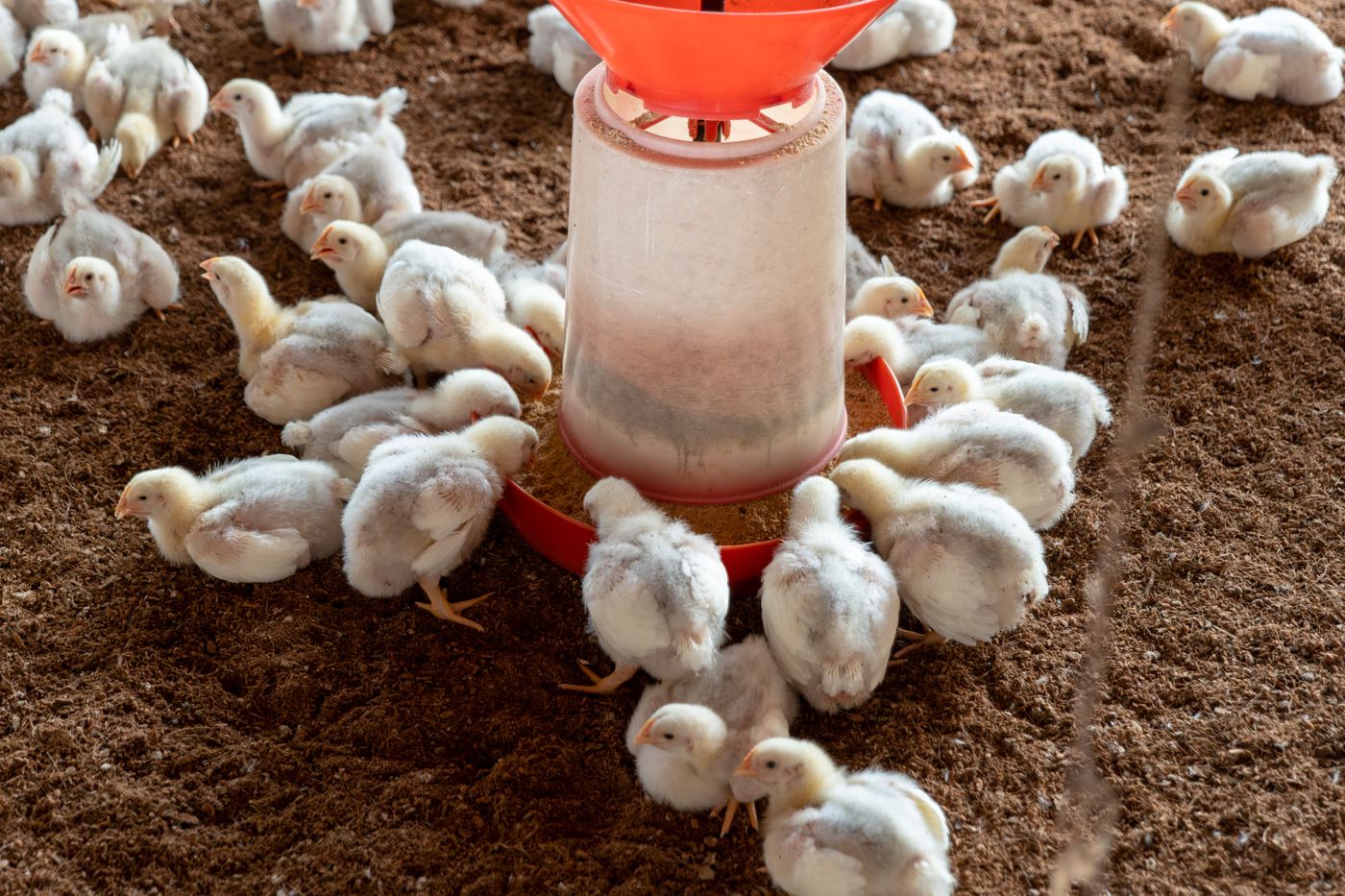
If the scale tells you the flock is uneven, look at feeding and drinking space first. Every bird needs to be able to reach feed and water without being pushed away, and as birds grow they take up more room at the feeder rim. The number of birds each feeder or drinker serves depends on its size and type, so use the maker's guidance, but the principles are constant:
- Add points as the birds grow. Start chicks on chick feeders, trays or paper, then move to larger tube or pan feeders and add more of them through the batch. A feeder line that was enough at two weeks is often too short at four.
- Spread them out. No bird should have to walk far for feed or water. Place feeders and drinkers evenly across the floor, alternating, so there are no corners where birds are far from both.
- Set the height weekly. The feeder lip and drinker rim should sit at about the height of the birds' backs. Too low and they scratch litter into the feed and spill water; too high and smaller birds cannot reach.
- Never let feeders run empty. When feed runs out, the strong birds eat first when it returns and the weak ones miss out. Steady access is what lets the small birds catch up.
- Keep water clean and flowing. Broilers drink roughly twice as much water as the feed they eat, by weight, which is a widely quoted rule in poultry guides. A dirty or slow drinker limits feed intake directly.
Our guides to poultry feeders and drinkers, nipple versus bell drinkers and cutting feed wastage cover the choices in detail.
A Simple Weekly Broiler Checklist
| Check | What good looks like | If not, look at |
|---|---|---|
| Day 7 weight | About four times day-old weight | Brooder heat, chick feeder access, water |
| Weekly average | On or near the strain chart | Feed quality, water, temperature, health |
| Uniformity | Most birds within 10 percent of the average | Feeder and drinker numbers, height, cold spots |
| Load per square metre | Planned final load not exceeded | Number of chicks placed, early partial sale |
| Litter | Dry and crumbly, not caked | Drinker leaks, airflow, density |
| Feeders and drinkers | At back height, never empty, clean | Daily routine, more points |
Equipment for Weighing and Spacing, With Prices
These prices are from the Fuga price list at the time of writing; check the site or ask a branch for current prices and stock.
| Item | Stock code | Price |
|---|---|---|
| 30KGS WEIGHING SCALE | 6527 | KSh 4,500 |
| Digital weighing scale | various | KSh 5,500 to 9,000 |
| FEEDER CHN 9KGS NEW | 6219 | KSh 520 |
| 12KG FEEDER | 6213 | KSh 750 |
| PAN FEEDER - CHN- 500MM DIA | 6311 | KSh 400 |
| DRINKERS - CHN- 10L | 6182 | KSh 420 |
| PLASSON AUTOMATIC DRINKER CHN | 6539 | KSh 1,200 |
| ADJUSTER FEEDER/DRINKER | 6117 | KSh 20 |
Weigh a fair sample every week, compare the average and the spread with your strain's chart, plan the house by kilogrammes at the end rather than chicks at the start, and add feeding and drinking points before the birds need them. For a digital weighing scale, feeders and automatic drinkers to match your flock, visit any Fuga branch, browse our livestock and poultry equipment, or WhatsApp 0716 961 018.
Key Takeaways
- Weigh a fair sample of about 50 broilers, taken from at least three parts of the house, on the same day and at the same time every week.
- Compare the average with the performance objectives for your strain, which your hatchery or chick supplier can give you; a common rule of thumb is about four times day-old weight by day 7.
- Uniformity, the share of birds within 10 percent of the average, matters as much as the average; poor uniformity usually means competition for feed, water or warmth.
- Plan stocking density in kilogrammes per square metre at selling weight, not birds per square metre at placement; the load more than doubles between 1 and 2.5 kilogramme birds.
- In the short rains, place fewer chicks, stop drinker leaks and keep air moving, because a crowded house cannot dry its litter.
- Add feeders and drinkers as birds grow, spread them evenly, set them at back height and never let them run empty.
Frequently Asked Questions
How many broilers should I weigh each week?
A practical sample for a smallholder flock is about 50 birds, or the whole flock if it is smaller. Pen groups from at least three parts of the house and weigh every bird in each pen, rather than picking the birds that are easiest to catch.
What weight should my broilers be at each age?
Use the performance objectives published by the breeder of your strain, such as Cobb or Aviagen for Ross birds; your chick supplier can give you the right table. Targets differ by strain and are updated over time, so compare your flock with the chart for the chicks you actually bought.
How many broilers can I keep per square metre?
Extension guidance for open-sided houses in East Africa commonly works around 8 to 10 birds per square metre at selling age, with fewer in hot or poorly ventilated houses. A better method is to plan the final load in kilogrammes: birds per square metre multiplied by the selling weight.
Why are some of my broilers much smaller than others?
Uneven growth usually comes from competition: too few feeders and drinkers, equipment at the wrong height, cold corners, wet litter or chicks of mixed size placed together. If small birds also look unwell or deaths rise, call a vet, because poor growth can be an early sign of disease.
What scale do I need to weigh broilers?
A digital hanging or platform scale that reads in grammes, with a light bucket or sack to hold the bird, is enough. Zero it with the empty container and check it against a known weight before the batch starts.