
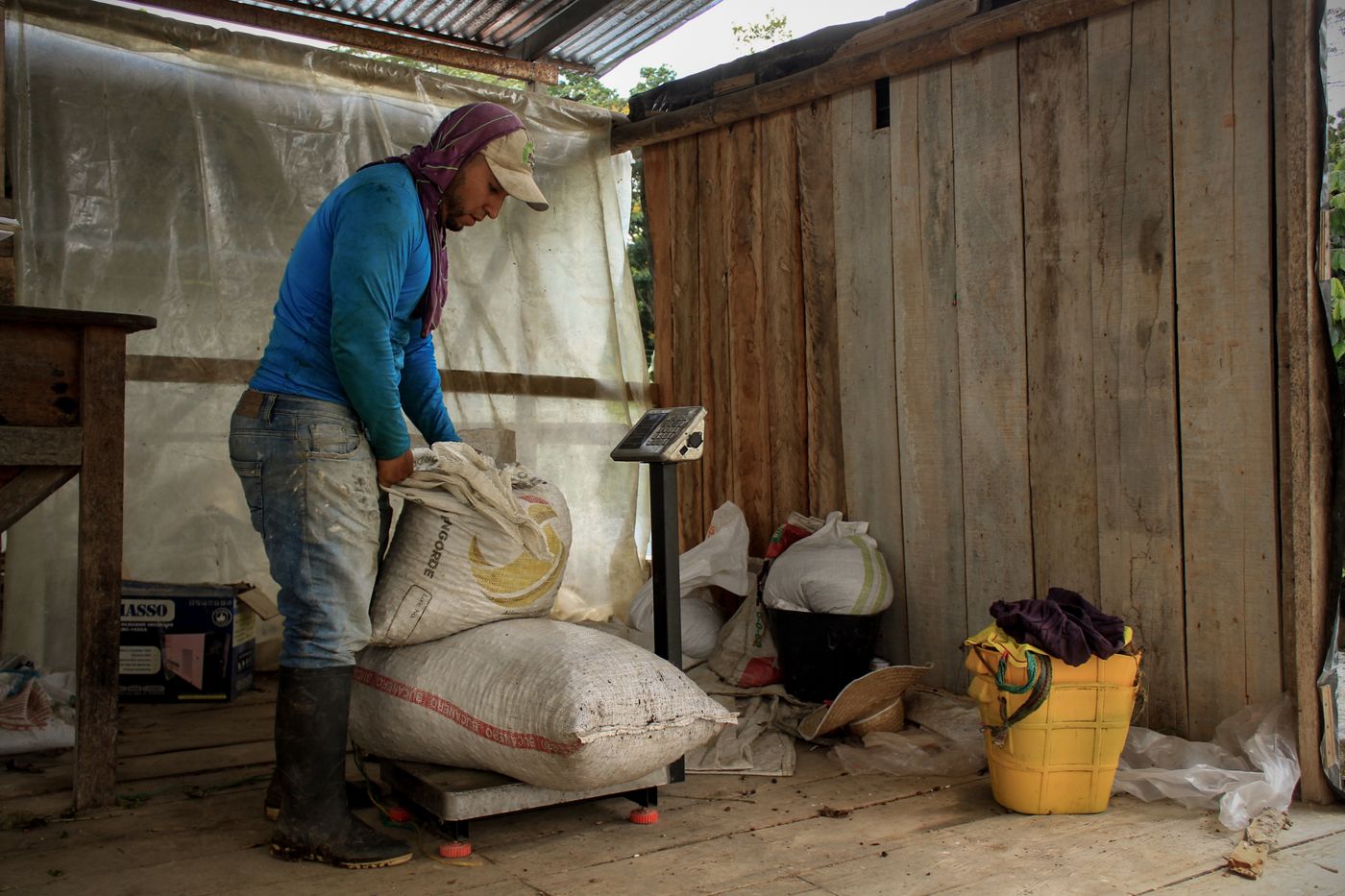
A trader's lorry pulls up at the farm gate on a Saturday morning. The scale comes off the back, the sacks go on one by one, and a number is called out for each. You count the sacks, you accept the numbers, the money changes hands. Nobody asks when the scale was last checked or what it reads with a known 50 kilograms on it.
That number is the only thing in the transaction you cannot see. You can see the sacks and you can see the cash, but the kilo itself is invisible, and whoever owns the scale owns the kilo. On maize, on milk, on a bull sold by live weight, the same quiet arithmetic runs every time: a small error, in the same direction, multiplied by everything you will ever sell.
This guide is about buying a scale that tells the truth and keeping it truthful: the three types a farm needs, why capacity and resolution pull against each other, how to check any scale in ten minutes, how to power it away from mains, and what the law expects once a scale is used to buy and sell.
Platform, Hanging and Bench: Three Scales for Three Jobs
A platform scale is a flat weighing deck with a separate indicator on a post or a cable. Sacks, crates, milk cans and calves go on the deck; the load cells under it do the measuring. This is the scale for grain at the store, produce at the collection point and anything sold by the sack. Common capacities run from 150 to 500 kilograms, and the deck must be big enough for a full sack to sit entirely on it, because a sack overhanging the edge and touching the ground is not being weighed.
A hanging scale, sold as a crane scale at higher capacities, has a hook at the top and a hook at the bottom and weighs whatever hangs between them. It needs no level floor, which is its whole advantage. Hang it from a beam, a tripod or the bucket of a loader and you can weigh a goat in a sling, a bunch of bananas, a bale of hay or a sack with a rope round its neck, on any ground. Our 500 kilogram crane scale covers the heavy end, and small spring-dial versions are common at 25 to 100 kilograms.
A bench scale is the small counter-top platform, typically 3 to 30 kilograms, reading in grams. It is not for sacks. It is for the things where a few grams matter: seed, agrochemical measured for a knapsack, feed premix, a chick weighed weekly to check growth, honey and eggs sold by weight. A farm that owns only a 300 kilogram platform and tries to weigh 500 grams of premix on it is guessing.
Mechanical scales still have a place: a spring dial cannot go flat and a beam balance has no electronics to fail. But springs stretch with age and dials cannot resolve finely, so for trade the digital load-cell scale has largely won, and it is the type the rest of this article assumes.
Capacity Sets the Ceiling, Resolution Sets the Step
Two numbers describe every scale. Capacity is the most it can weigh. Resolution, also called the division or the step, is the smallest change the display can show. The two are linked, and the link decides which scale to buy.
A digital scale does not have unlimited steps. Most commercial load-cell scales divide their capacity into a fixed number of divisions, commonly around 3,000. That is why a 30 kilogram bench scale reads in 10 gram steps, a 150 kilogram platform reads in 50 grams, a 300 kilogram platform reads in 100 grams and a 500 kilogram crane scale reads in 200 grams. Ask for more capacity and you are asking for a coarser step.
The practical rule follows: buy for the heaviest thing you routinely weigh, with some margin, and no more. A 90 kilogram bag of maize on a 150 kilogram platform uses the scale well. The same bag on a 1,000 kilogram platform is weighed in half kilo steps. Where the loads are genuinely different in size, own two scales; a platform and a bench scale together cost less than one big scale used badly.
The margin matters for a second reason. A load cell is a strain gauge on a piece of metal that bends a tiny, repeatable amount under load. Overload it past its elastic limit and it reads wrong at every weight from that day on. Dropping a full sack onto the deck produces a shock far beyond the sack's weight. Lower loads onto a scale; never throw them.
Resolution Is Not Accuracy
A display reading 89.15 kilograms looks more trustworthy than one reading 89, but the extra digits say nothing about whether either is true. Resolution is how fine the steps are. Accuracy is how close the reading is to the real mass. They are independent, and confusing them is the most common mistake a buyer makes.
Several things pull a scale away from the truth without touching its resolution. Zero drift adds or subtracts the same amount from every load. A scale on a slope reads light, because part of the load pushes sideways rather than down. A platform with one damaged load cell reads differently depending on which corner the sack sits on. A low battery makes an indicator wander before it dies. None of these changes the digits on the display.
What a Wrong Kilo Costs on Maize, Milk and Livestock
The arithmetic is dull, which is exactly why it gets ignored. The standard maize bag in Kenya is 90 kilograms. A scale reading one percent light takes 0.9 kilograms off every bag. Over a hundred bags that is 90 kilograms, one whole bag given away, and at two percent it is two bags. Nobody notices, because no single reading looks wrong and the error runs in the same direction every time.
Milk is worse, because it is sold daily. Dairies and cooperatives increasingly weigh milk rather than measure it, since a litre of milk weighs about 1.03 kilograms and a can may be under-filled or foamed. The same one percent on a farm delivering 100 litres a day is a litre a day, every day of the year. If you are already investing in cooling and hygiene to protect your milk price, it makes no sense to hand a share of it back at the weighing point.
Livestock adds a second cost. Two percent on a 400 kilogram bull sold by live weight is 8 kilograms of beef. But weight is also the input to every drench dose, feed ration and growth check, and an animal under-dosed because it was under-weighed is the one that carries resistant worms back to the herd.
And the error cuts both ways. A scale that reads heavy costs you when you buy feed and fertiliser by the kilo; one that reads light costs you when you sell. The only scale on your side is an accurate one.
Checking a Scale With a Known Mass
You do not need a laboratory. You need something whose mass you know, and ten minutes. The best known mass is a cast iron test weight, sold in 5, 10 and 20 kilogram sizes and marked with its class. Failing that, weigh a sealed bag of cement, a drum of water or a machine part on a scale you trust, ideally one carrying a current verification stamp, write the figure on it with a marker, and that is your reference. Keep it dry and do not chip it.
The routine runs in a fixed order. Level the scale on a hard surface, switch on and let it warm up, then zero it empty. Read the known mass in the centre, then at each corner in turn: a healthy platform agrees within a division at all five positions, and a corner that disagrees points to a damaged or loose load cell under it. Then stack known masses to about half and near full capacity, because a scale can be right at 20 kilograms and wrong at 200. Write the results in a book with the date.
Checking is not calibrating. Checking tells you the error. Calibrating adjusts the scale to remove it, usually through a menu on the indicator that asks for a known mass at a set fraction of capacity. That is fine on a scale used only for farm management. On a scale used for trade it is not, because the calibration is sealed by the inspector and breaking the seal voids the verification. A trade scale that fails the check goes back for re-verification rather than being adjusted by hand.
Batteries, Solar and Keeping a Scale Alive in the Field
A scale that only works next to a socket is not a farm scale. Most digital platform and crane scales run on an internal rechargeable battery, commonly a small 6 volt sealed lead-acid block with a charger built into the indicator, or on a set of dry cells. Two habits keep them working.
The first is charging before the battery is flat, not after. A sealed lead-acid battery left discharged sulphates and loses capacity permanently, so a scale stored for three months between harvests comes out dead unless it went in charged and was topped up monthly. The second is not weighing on a low battery. Readings taken after the low-voltage warning are not reliable: the scale drifts before it goes dark.
Solar closes the gap for a scale that lives at a collection point with no mains. A small panel with a charge controller keeps a 12 volt battery topped up, and the scale charges from that through an adapter matching the voltage printed on its indicator. That last point is not optional: feed 12 volts into a charge socket marked for a lower voltage and the indicator will not survive. Where a farm already runs solar for lighting or pumping, the scale simply becomes one more small load on it.
Physical care matters as much as power. Carry a platform scale with the indicator unplugged, because the connector is the weakest point on the machine. Give a field scale a sheet of plywood to stand on, keep it out of rain and direct sun, and blow dust out of the load-cell cavity rather than washing it. A crane scale must hang free: a load touching a post or swinging in wind gives a reading that changes with every gust.
When a Scale Is For Trade
Kenya's Weights and Measures Act, and the Department of Weights and Measures that enforces it, draw a line between a scale used for your own purposes and one used for trade, meaning buying or selling by weight. A scale used to check calf growth or ration feed on your own farm is your business. A scale on which you buy maize from neighbours, weigh milk from members or settle a livestock sale is a trade instrument, and the rules apply.
In general terms, a trade scale must be of an approved type, verified by an inspector against reference standards, and stamped or sealed to show it passed. Verification is repeated on a schedule, an inspector can test a scale in use at any time, and using a false or unverified scale for trade is an offence. The schedule and fees change over time, so ask your county Weights and Measures office rather than a neighbour.
Two practical points follow. Buy a proper load-cell scale of an approvable type and have it verified before the first sale, not after a dispute. And when you sell across someone else's scale, look for the stamp; a buyer weighing for trade without one is careless or worse, and either way it is your kilo on the line.
Our digital weighing scales are listed at 5,500 to 9,000 KSh depending on the model, and the 500 kilogram crane scale at 6,500 KSh. Against one bag of maize in a hundred, or a litre of milk a day, either pays for itself inside a season. Weigh the harvest honestly, store it properly, and the crop you sell is the crop you grew.
Key Takeaways
- Platform scales weigh sacks and cans on a level deck, crane scales weigh anything that can hang and need no floor, bench scales handle the grams. Most farms need two of the three.
- Capacity and resolution are tied at about 3,000 divisions, so every extra kilogram of ceiling makes the step coarser. Buy for your heaviest routine load plus margin, no more.
- Resolution is not accuracy. Fine digits say nothing about the truth; only a known mass does.
- One percent light on 90 kilogram bags gives away a bag in every hundred. On milk it is a litre a day in a hundred.
- Check with a known mass: level, zero, centre, corners, half and full, record. Corners that disagree mean a load cell. Never overload or drop loads onto one.
- Charge before flat, never weigh on a low battery, and match the charger voltage printed on the indicator when running from solar.
- A scale used to buy or sell is a trade instrument: approved type, verified, stamped, on a schedule. Look for the stamp on every scale you sell across.
Frequently Asked Questions
What size weighing scale do I need for maize sacks?
The standard maize bag in Kenya is 90 kilograms, so a platform scale of 150 to 300 kilograms capacity covers it with margin. Most digital scales divide their capacity into roughly 3,000 steps, so a 150 kilogram scale reads in 50 gram steps while a 1,000 kilogram scale reads in half kilos. Buy for the heaviest load you routinely weigh plus a margin, and make sure the deck is large enough for a full sack to sit entirely on it.
How do I know if my weighing scale is accurate?
Put a known mass on it. Use a cast iron test weight, or an object you have weighed on a scale that carries a current verification stamp and marked with its mass. Level the scale, let it warm up, zero it, then read the known mass in the centre and at each corner of the platform. All positions should agree within one division. Then stack known masses to about half and near full capacity and read again, and write the results down with the date.
Can I calibrate a digital scale myself?
Checking and calibrating are different things. Anyone can check a scale with a known mass. Calibrating adjusts the scale, usually through a menu on the indicator that asks for a known mass at a set fraction of capacity, and on a scale used only for your own farm management that is fine. On a scale used for trade the calibration is sealed by the Weights and Measures inspector, and breaking that seal voids the verification. A trade scale that fails a check should go back for re-verification rather than being adjusted by hand.
Do I need my farm scale stamped by Weights and Measures?
Only if it is used for trade, meaning buying or selling by weight. A scale used to track calf growth or measure feed on your own farm is not a trade instrument. A scale on which you buy maize from neighbours, weigh milk from members or settle a livestock sale is, and in general terms it must be of an approved type, verified by an inspector and stamped, with verification repeated on a schedule. Ask your county Weights and Measures office for the current schedule and fees.
How do I charge a digital weighing scale without mains electricity?
Most digital platform and crane scales run on a small internal rechargeable battery, often a 6 volt sealed lead-acid block, or on dry cells. Off grid, a small solar panel with a charge controller keeps a 12 volt battery topped up and the scale charges from it through an adapter that matches the voltage printed on its indicator. Never feed 12 volts into a charge socket marked for a lower voltage, and charge the scale fully before storing it, because a lead-acid battery left flat loses capacity permanently.