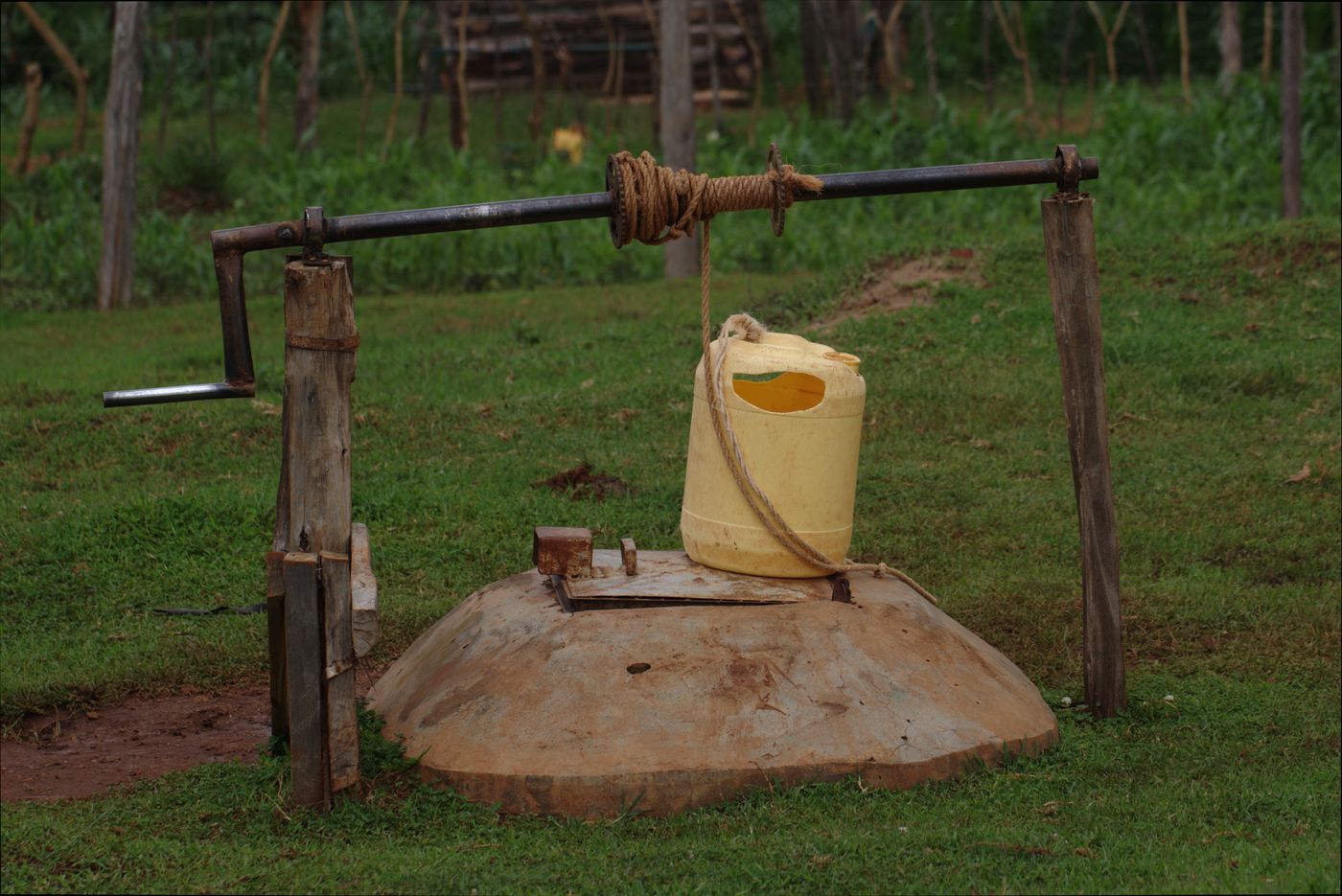
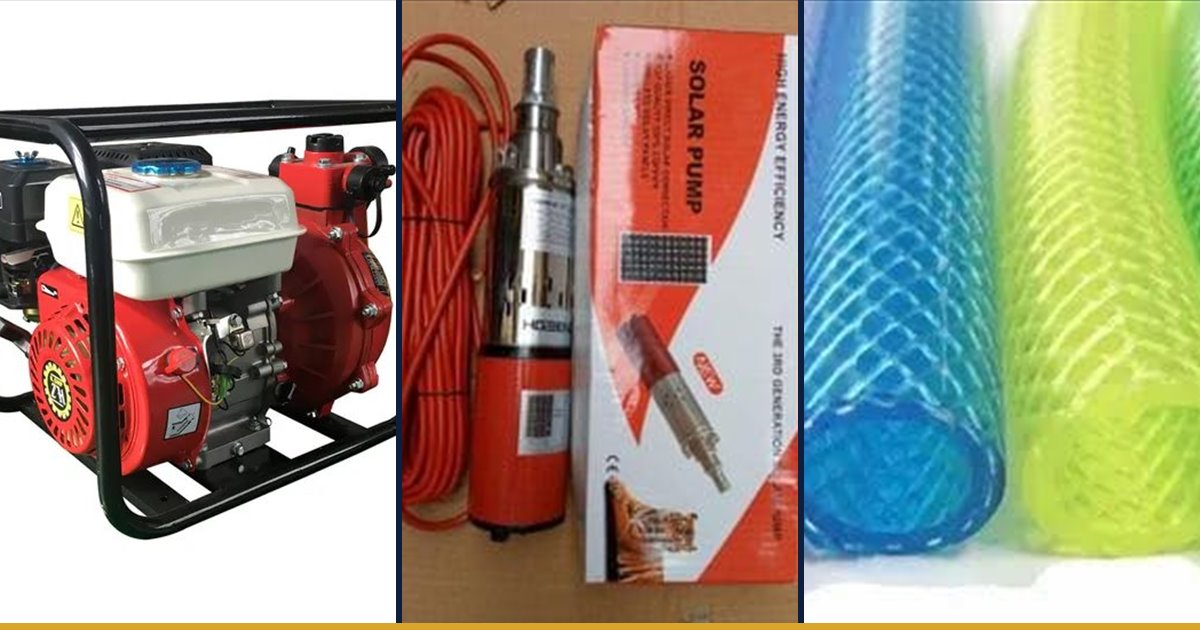
Picture a family plot with a hand-dug well, a water pan at the bottom of the slope, or a borehole where the water stands only a few metres down. Every litre that reaches the kitchen, the cows or the vegetable beds is lifted by hand, by a bucket on a rope or by a petrol pump that drinks fuel each time it runs. A small submersible solar pump replaces all of that with a sealed unit hanging in the water, a panel or two on a frame, and a tank that fills itself while the sun is up.
Small pumps reward careful matching and punish guesswork. Pick a model that cannot reach the tank at the pressure your site demands and you get a trickle. Buy far more panel than the pump can use and you have paid for nothing. Fit a battery bank that a bigger tank would have replaced, and you have bought the most expensive and shortest-lived part of the system.
This guide is for the small end of solar pumping: shallow wells, low-head boreholes and water pans, with pumps in the roughly 200 to 400 watt class. It covers how to read head and daily volume for a small pump, how many panels to put on it, why the tank should be your only storage, how the short rains change your daily output, and how to install a submersible in a shallow source so it lasts. If you are still deciding whether solar pumping makes sense at all, read our guide to whether solar water pumps are worth it in Kenya first; this article picks up where that decision has already been made.
Where a Small Submersible Solar Pump Fits
Small DC submersibles are built for modest lifts and modest volumes. They suit a hand-dug well a few metres deep, a borehole with a high standing water level, a spring box, or a water pan where the pump lifts water up a short bank to a tank on a stand. They suit domestic supply, a small dairy unit, poultry, and kitchen-garden or nursery irrigation. They do not suit a deep borehole with a long riser, or a field that needs hundreds of litres a minute through a rain gun.
Why a submersible rather than a small surface pump? A surface pump has to suck, and suction is capped by air pressure. In much of Kenya, above about 1,800 metres, a surface pump is realistically limited to around five metres of suction lift, a point covered in depth in our guide to submersible versus surface pumps. A well whose level falls from three metres in the rains to six metres in the dry season will defeat a surface pump just when it is needed most. A submersible sits in the water and pushes, so a falling water level costs it a little extra head, not its ability to work at all.
Brushless motors deserve a mention, because one of the pumps in our range is sold as brushless. A brushed DC motor passes current to the spinning part through carbon brushes that wear and eventually need replacing. A brushless motor switches the current electronically and has no brushes to wear, which is a real advantage in a sealed unit at the bottom of a well, where nobody wants to pull the pump to service it.
Head and Daily Volume: The Two Numbers That Decide the Pump
A pump is chosen by the job it must do, not by its wattage. The job has two numbers. Total head is the vertical distance from the lowest water level in the source to the top of the tank inlet, plus an allowance for friction in the pipe. Daily volume is the number of litres you need on an ordinary day, worked out from real use: people, animals and the area you irrigate. Our guide to pump sizing, head and flow shows how to measure and calculate both.
For small solar pumps there is a third number that matters more than for mains pumps: how much water the source gives up. A hand-dug well or a shallow borehole may refill slowly. If the pump draws water faster than the well recovers, the level drops to the intake and the pump runs dry. Before you buy, measure recovery. Bail or pump the well down by a known amount, note the time, and watch how long the level takes to come back. A well that recovers half a metre an hour across a one-metre-wide shaft gives about 390 litres an hour, because a one-metre circle has an area of about 0.785 square metres. That figure, not the pump's brochure, is your ceiling.
The physics of lifting water is simple and worth knowing. Lifting 1,000 litres through one metre needs about 2.7 watt-hours of energy at the water. So the energy a pump puts into the water is roughly the litres multiplied by the head, divided by 367. Lifting 2,000 litres through 15 metres needs about 82 watt-hours at the water. A small pump and motor waste a large share of the electrical energy they take in as heat and friction, so the energy drawn from the panels is several times that figure. The exact share depends on the pump, and that is why the manufacturer's curve, not a formula, settles the final choice.
A Worked Example: Panels for a 250 Watt Pump
Panels are sized to the pump, never the other way round. Start from the pump's rated input power and the voltage range its controller accepts, both printed on the pump or its controller. Then choose panels whose combined output covers that power with some headroom, wired so the voltage falls inside the controller's range.
A widely used rule of thumb is to install panel capacity of roughly 1.2 to 1.5 times the pump's rated input. The headroom exists because a panel rarely delivers its full label rating in the field. Heat lowers a panel's output, dust and bird droppings cut it further, and the sun is only overhead for part of the day. Extra panel lets the pump reach full speed earlier in the morning and hold it later into the afternoon, which lengthens the pumping day more than it raises the midday peak.
Take a pump rated at 250 watts with a controller that accepts the voltage of a 24 volt nominal panel. Using the rule of thumb, you want somewhere between 300 and 375 watts of panel. One PANEL 300W/24V sits at the bottom of that band; two PANEL 200 W/24V panels give 400 watts, slightly above it. Which is right depends on wiring. Two panels in series double the voltage, which suits a controller with a wide input range; two in parallel keep the voltage and double the current, joined with a Y connector. Read the controller's input limits before you decide, because a panel string whose open-circuit voltage exceeds the controller's maximum can destroy it on a cold, bright morning.
Keep the cable from panel to controller short and thick enough. On a long run, thin cable loses voltage before it reaches the pump, and the symptom looks exactly like a weak panel. In a small system the panel frame can usually stand close to the well, which keeps the cable run short and removes the problem.
| Item | Stock code | Price |
|---|---|---|
| SUBMERSIBLE BRUSHLESS SOLAR PUMP(210w) | 6488 | KSh 20,000 |
| SUBMERSIBLE SOLAR PUMP 250WATTS | 6407 | KSh 12,000 |
| SUBMASSIBLE 400W SOLAR MAX PUMP | 6991 | KSh 9,000 |
| Solar Water Pump 100W | No code | From KSh 20,000 |
| PANEL 200 W/24V | 6314 | KSh 11,000 |
| PANEL 300W/24V | 6315 | KSh 15,000 |
| Y-TYPE SOLAR CONNECTOR | 6723 | KSh 600 |
| PV SOLAR CABLE 6MM | 6724 | KSh 300 |
Prices are taken from our current price list and can change, so confirm before you buy. The cheapest pump on the list is not automatically the cheapest system. The right pump is the one whose curve delivers your daily volume at your head with the panel you can afford, and we will read the curves with you if you send us the head and the volume.
The Tank Is the Storage, Not a Battery
A small solar pump only runs while the sun is on the panel. You do not need water at the moment it is pumped; you need it when you open a tap. Pumping straight into a raised tank through the day, then drawing by gravity whenever you like, solves the mismatch for the price of a tank. Our article on tank stands and gravity flow explains how high to raise it for useful pressure at the taps.
Batteries are sometimes sold with small pumps so that they can run at night. For most farm and household supply this adds cost and a part that wears out, to achieve something a larger tank does for less. A battery also needs a charge controller and careful protection, while a tank needs a lid and a cleaning routine. Keep batteries for the rare case where water must be pumped at a specific hour, and size the tank for everything else.
How big a tank? A practical rule of thumb for small systems is to hold at least one and a half to two days of normal use, more if the site sees long cloudy spells. A household and a few animals using 1,000 litres a day would want a tank of 1,500 to 2,000 litres. Fit a float valve or a float switch so a full tank stops the pump or diverts the overflow back to the well rather than across the yard. For choosing the tank itself, see our guide to water storage tanks.
Sun Hours in the Short Rains: Plan for the Grey Week
The short rains, from about October into December in much of Kenya, bring mornings that start clear and afternoons that cloud over, and runs of overcast days in some areas. A solar pump's output follows the light on the panel almost directly. On a bright day the pump climbs to full speed by mid-morning and holds it past midday. Under heavy cloud it may only turn slowly, or not lift water to the tank at all, because a pump below a certain speed cannot develop enough pressure to reach the outlet.
That threshold effect is the key point. Delivered water does not fall gently with the light; below a certain light level it stops. Two things protect you. Panel headroom pushes the pump over the threshold earlier and keeps it there longer on a dull day. Tank storage carries you through the days when it barely crosses at all. Our guide to solar performance in the rainy season covers measuring your own site's output so you plan around your numbers rather than a national average.
Wash the panels when you see dust or droppings, angle the frame so rain runs off, and check for new shading as the season turns. A tree that clears the panel in January can shade it by midday in June as the sun's path shifts.
Installing in a Shallow Well or Water Pan
A small submersible is cooled by water flowing past its motor on the way to the intake. In a narrow borehole casing that happens automatically. In a wide hand-dug well or an open pan, water can drift past the motor so slowly that it overheats while fully submerged. Where the source is wide, fit a cooling sleeve, a short length of pipe around the pump that forces the incoming water past the motor, or follow the maker's instructions on minimum flow.
Hang the pump from a nylon or stainless safety rope, never by its cable or the outlet pipe alone. Set the intake well clear of the bottom so it does not draw in silt and sand, which wear a small pump quickly. In a water pan, the bottom is soft mud: suspend the pump from a float or a fixed frame so it sits in the cleaner water above. Fit dry-run protection, either a low-level sensor or a controller feature, so a falling level switches the pump off instead of burning it out.
Keep the delivery pipe sized to the flow and as short and straight as the site allows; small pumps have little pressure to spare, and friction in thin pipe can use a large part of it. Our guide to pipe sizing and friction loss shows how to check. Cover the well head so that nothing, and nobody, can fall in, and so that surface runoff in the rains does not wash contaminants into your water. For more on choosing between a shallow well and a borehole, see borehole versus shallow well.
Before You Buy: What to Bring Us
Come with four numbers and the conversation becomes short and accurate. The depth to the water at its lowest, measured in the driest month. The height from the ground to the top of the tank, including its stand. The litres you use on a normal day. And how fast the well recovers after being drawn down. With those, we can read the pump curves against your site and size the panel and tank to match. Browse the pumps on our water equipment page and the panels and accessories on solar equipment, or ask us about the 100 watt solar pump for the very smallest jobs.
Key Takeaways
- A small submersible pushes water rather than sucking it, so a well whose level falls in the dry season does not defeat it the way it defeats a surface pump at altitude.
- Choose the pump from total head, daily volume and the well's recovery rate, then read the maker's curve; wattage alone tells you little.
- Doubling the head roughly halves the daily litres from the same pump and sun, because the energy needed rises with height.
- Size panels to the pump: a common rule of thumb is 1.2 to 1.5 times the pump's rated input, wired inside the controller's voltage range.
- Store water, not electricity: a tank holding one and a half to two days of use does the job of a battery for far less.
- In the short rains output drops sharply below a light threshold, so panel headroom and tank size matter more than the midday peak.
Frequently Asked Questions
Can a small solar submersible pump work in a hand-dug well?
Yes, and it is often the best option where the water level falls more than about five metres below a surface pump in the dry season. Hang it on a safety rope with the intake clear of the bottom, fit a cooling sleeve if the well is wide so water flows past the motor, and add dry-run protection. Measure how fast the well recovers first, because a pump that outruns the well will run itself dry.
How many solar panels does a 250 watt pump need?
A common rule of thumb is panel capacity of about 1.2 to 1.5 times the pump's rated input, so roughly 300 to 375 watts for a 250 watt pump. One 300 watt panel or two 200 watt panels can cover that, depending on the voltage range the pump's controller accepts. Check the controller's maximum input voltage before wiring panels in series, and keep the cable run short and thick enough.
Do I need a battery for a solar water pump?
For most household, livestock and small irrigation supply, no. Pump into a raised tank during the day and draw water by gravity whenever you need it, including at night. A tank holding about one and a half to two days of normal use, as a rule of thumb, covers cloudy spells for far less than a battery bank, and it has no cells to wear out or replace.
Will a solar pump work during the short rains?
It will work on most days, but output falls on overcast days by more than the cloud alone suggests, because below a certain light level the pump cannot turn fast enough to lift water to the tank. Extra panel capacity keeps it above that threshold longer, and a bigger tank carries you through the grey days. Keep the panels clean and check for new shading as the season changes.
Can I put a solar submersible pump in a water pan?
Yes, with care. The bottom of a pan is soft mud, so suspend the pump from a float or a fixed frame so it draws cleaner water above the silt. Because a pan is wide, water may not flow past the motor fast enough to cool it, so use a cooling sleeve or follow the maker's minimum flow guidance. Fit dry-run protection in case the pan level falls in the dry season.