
Every farmer who has hauled jerricans, queued at a communal water point, or watched a crop wilt in a dry spell eventually asks: should I dig a well or drill a borehole? It sounds like one decision, but it is really two very different projects with different costs, permits, equipment, and risks.
Get it right and you own a water source that serves you for decades. Get it wrong and you can spend serious money on a hole that yields little, dries up when you need it most, or delivers water you cannot safely drink.
This guide covers how each option works, the hydrogeology in plain language, cost drivers, what the Water Resources Authority expects, the equipment for both, and a clear framework for choosing.
Two Very Different Holes in the Ground
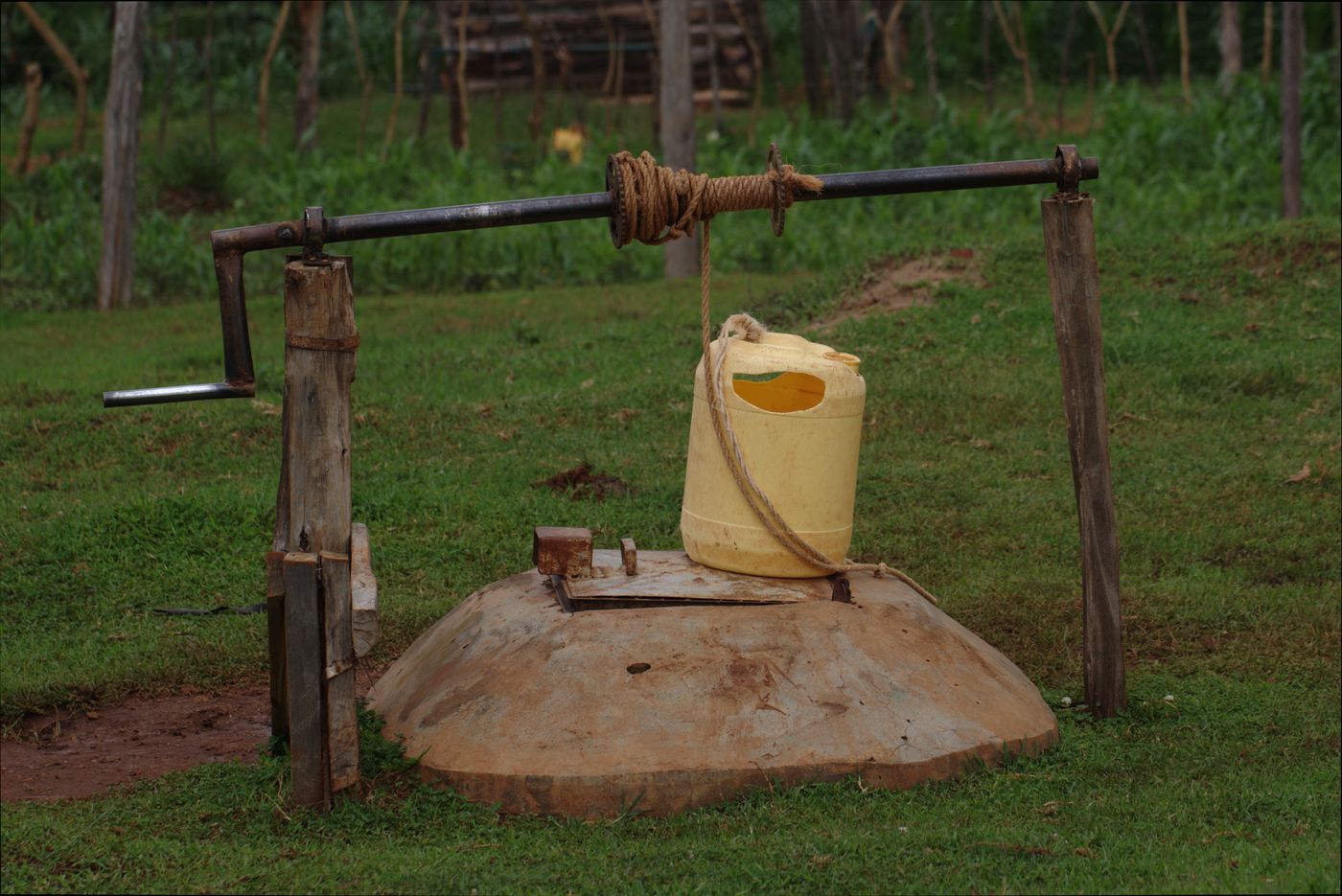
A shallow well is a wide hole, usually a metre or so across, dug by hand to the first water the ground offers, typically anywhere up to roughly thirty metres deep. The shaft is lined with concrete rings or masonry to stop collapse, capped with a slab, and fitted with a hand pump, a windlass and bucket, or a small surface pump.
A borehole is a narrow hole, typically 6 to 10 inches in diameter, drilled by a rig to reach deeper water. Kenyan boreholes commonly run from tens of metres to several hundred metres depending on local geology. The hole is lined with steel or uPVC casing, screened at the water-bearing sections, gravel-packed, and fitted with a submersible pump.
The depth difference is not a detail. It changes everything downstream: the water you reach, the pump you need, the power that pump needs, the paperwork, and the price.
Water Tables and Aquifers, in Plain Language
Underground water is not a lake waiting under your shamba. Rainwater soaks downward until it fills the tiny spaces between soil particles and rock fractures. The level below which the ground is fully saturated is the water table. A layer that holds enough water to be worth pumping is an aquifer.
A shallow well taps the first, unconfined aquifer: the one fed directly by local rain. That is why wells respond quickly to seasons. After good rains the table rises and the well recovers fast; in a long dry spell it drops and the well can slow or fail exactly when demand peaks.
A borehole usually reaches deeper aquifers that sit under layers of rock or clay. These recharge slowly over years, so they are far more stable through droughts, but they are also harder to find. That is why a hydrogeological survey, a study of your site by a qualified hydrogeologist, comes before any drilling: it estimates where water is likely to be, how deep, and in what quantity. Drilling without one is gambling with the largest cost of the project.
What Each Option Really Costs
Anyone who quotes a single national figure for a borehole is guessing. Drilling in Kenya is priced per metre, and the rate varies with region, the rock the rig must cut, mobilisation distance, and the diameter and casing class you specify. A site that hits water at 80 metres in soft formation and one that needs 250 metres through hard basalt are not the same project, even in the same county.
What you can do is understand the cost structure. A borehole budget has five layers: the survey and permits; drilling, charged per metre; casing, screening, and gravel pack; test pumping to prove the yield; and finally equipping, meaning the pump, pipes, cables, controls, tank, and tower. Many people budget for drilling and then discover equipping is a substantial second project; plan both from the start.
A shallow well is a fraction of that outlay: local digging labour, concrete rings or masonry for the lining, a cover slab, and a modest pump. That is why wells remain the backbone of homestead water in high-water-table areas such as parts of Western Kenya and the Lake Basin. The trade-off is that you can only ever reach shallow, rain-dependent water.
Permits: What the Water Resources Authority Expects
Groundwater in Kenya is a regulated public resource, and boreholes need approval from the Water Resources Authority (WRA) before drilling starts. The process typically involves a survey report by a licensed hydrogeologist, a WRA permit application, and often an environmental review under NEMA requirements. Drilling must be done by a licensed contractor, and the completed borehole is recorded.
Do not treat this as red tape. A badly sited borehole can draw down neighbouring sources, and an unpermitted one becomes a problem when you later want financing or to sell. A reputable driller will walk you through the paperwork; one who suggests skipping it is telling you about their other corners too.
Shallow wells for domestic use sit much lighter in the system, but check with your local WRA office if you plan to irrigate or sell water.
The Borehole Equipment Stack
Once a borehole is drilled and tested, equipment turns it into a water supply. The heart of the system is a submersible pump: a sealed electric pump lowered down the casing on a riser pipe so it sits below the water level and pushes water upward. Submersibles are sized against two numbers from your test pumping report: the sustainable yield, in cubic metres per hour, and the total dynamic head, the vertical lift plus pipe friction the pump must overcome. Oversize it and you can pump the hole dry and burn the motor; undersize it and your tank never fills.
Around the pump you need riser pipes, submersible cable, a control box with dry-run protection, a non-return valve, and a sealed wellhead. Then comes storage: a good borehole system pumps to an elevated tank rather than straight to taps, so the pump runs in efficient cycles and gravity keeps pressure during outages. Our guide to water storage tanks in Kenya covers sizing that side.
Power is the other big decision. Grid power works where it is reliable, diesel works anywhere but costs money every day, and solar has become the default for rural boreholes: pumping happens in daylight, the tank stores the water, and there is no fuel bill. We covered the economics in our analysis of whether solar water pumps are worth it, and stock complete kits in our solar equipment range.
The Shallow Well Equipment Stack
A shallow well can be equipped for almost any budget. The simplest option is the windlass and bucket, cheap but inviting contamination every time the rope and container touch the ground. A step up is a hand pump on a sealed slab, such as the Afridev type common across East Africa, which keeps the well closed and uses parts local technicians can service.
For powered pumping, shallow wells use surface pumps: the pump sits at the top and sucks water up a pipe. Here physics sets a hard limit. A surface pump works by creating a partial vacuum, and atmospheric pressure can only push water up about ten metres in theory, roughly seven in practice once losses are counted. No surface pump on any shelf beats that, whatever the salesman promises.
Where the dry-season level is deeper, a small submersible lowered into the lined well works excellently, and compact solar kits now serve wells at reasonable cost. Add a tank and a float switch and a hand-dug well becomes a fully automatic supply. You will find hand pumps, surface pumps, and small submersibles in our water equipment range.
Water Quality: Test Before You Drink
Depth changes quality risk, in opposite directions. Shallow wells are exposed to whatever happens on the surface around them: pit latrines, livestock bomas, and fertiliser runoff can all seep into the shallow aquifer. The widely used rule of thumb is to site a well at least thirty metres from any latrine, uphill if the ground slopes, and to seal the top of the lining so surface water cannot trickle down the shaft.
Deep borehole water is naturally filtered and usually free of bacteria, but it has had centuries to dissolve minerals out of the rock. In parts of the Rift Valley, groundwater carries high natural fluoride; elsewhere, salinity or iron can make water unpleasant or unsuitable for some uses. None of this is visible in a glass.
The answer for both is the same: test before you rely on it. Have a sample analysed by a certified water laboratory when the source is new, and again whenever taste, colour, or smell changes. Treatment, whether chlorination, filtration, or defluoridation, is only possible once you know what you are treating.
Maintenance: The Cost Nobody Budgets
A water source is not finished at commissioning. Shallow wells need the slab and lining checked yearly and the surroundings kept clean and drained; hand pump parts are cheap and any trained local technician can fit them. Boreholes need less frequent but more specialised care: submersibles run for years untouched, but when they fail the pump must be pulled up the casing, which needs equipment and know-how. Voltage and dry-run protection are the cheapest insurance you can buy, because most submersible deaths are electrical or caused by pumping a source dry. Keep your test pumping and installation records; they turn future repairs from guesswork into routine jobs.
The Decision Framework: Four Questions That Settle It
Strip away the noise and the choice comes down to four questions.
1. How deep is reliable water on your site? This is a fact about your land, not a preference. Ask neighbours what their dry-season well levels do, and get a hydrogeological opinion. If dependable water sits within twenty metres year-round, a well is on the table. If it sits at eighty metres, the decision has been made for you.
2. How much water do you need each day? A household with a kitchen garden draws far less than a dairy unit, a poultry house, or an acre of drip irrigation. Shallow wells refill only as fast as the shallow aquifer allows; a properly sited borehole sustains far higher daily abstraction.
3. What can you spend, now and later? A well is affordable now but may need supplementing later; a borehole is a heavy upfront investment that then runs cheaply, especially on solar.
4. What power do you have? No grid and no budget for solar points to a hand pump on a well. Good sun and a daily irrigation demand points strongly to a solar borehole or solar well kit.
A hybrid path exists too: many homesteads run a well now and drill a borehole later when the enterprise justifies it. The two are stages, not enemies.
Key Takeaways
- A well taps the rain-fed water table; a borehole reaches deeper, drought-stable aquifers. Depth to reliable water is the deciding fact.
- Borehole costs run per metre and vary by region, rock, and depth; start with a hydrogeological survey and compare itemised quotes, never a lump figure.
- Boreholes require Water Resources Authority approval and a licensed driller; treat the permit as protection, not red tape.
- Surface pumps cannot lift from deeper than about seven metres in practice; below that you need a submersible or deep-well hand pump.
- Test water from any new source: shallow wells for contamination, boreholes for minerals such as fluoride and salinity.
- Solar pumping pairs naturally with both options, and a storage tank turns either source into an all-day supply.
Frequently Asked Questions
How deep is a typical borehole in Kenya?
There is no single typical depth. Kenyan boreholes range from a few tens of metres to several hundred in dry or volcanic areas. Your hydrogeological survey estimates the likely depth for your site, which is why it comes before any drilling quote.
Do I need a permit to dig a shallow well at home?
Domestic wells are treated far more lightly than boreholes. For ordinary household use, requirements are minimal in most areas; if you plan to irrigate commercially or sell water, check with your local WRA office first. Boreholes always need WRA approval and a licensed driller.
Can I use a surface pump on my well?
Only if the dry-season water level is within about seven metres of the pump. Beyond that, atmospheric pressure physically cannot push water up the suction pipe, whatever the brand. For deeper levels, use a submersible or a deep-well hand pump.
What does it cost to equip a borehole or well at Fuga?
Prices depend on pump size, head, tank capacity, and whether you go solar. Confirm current prices on WhatsApp at wa.me/254716961018 or call 0734263958 with your water depth and daily demand, and we will size and quote a complete setup. You can also visit any branch in Eldoret, Nakuru, Nairobi, or the Coast.