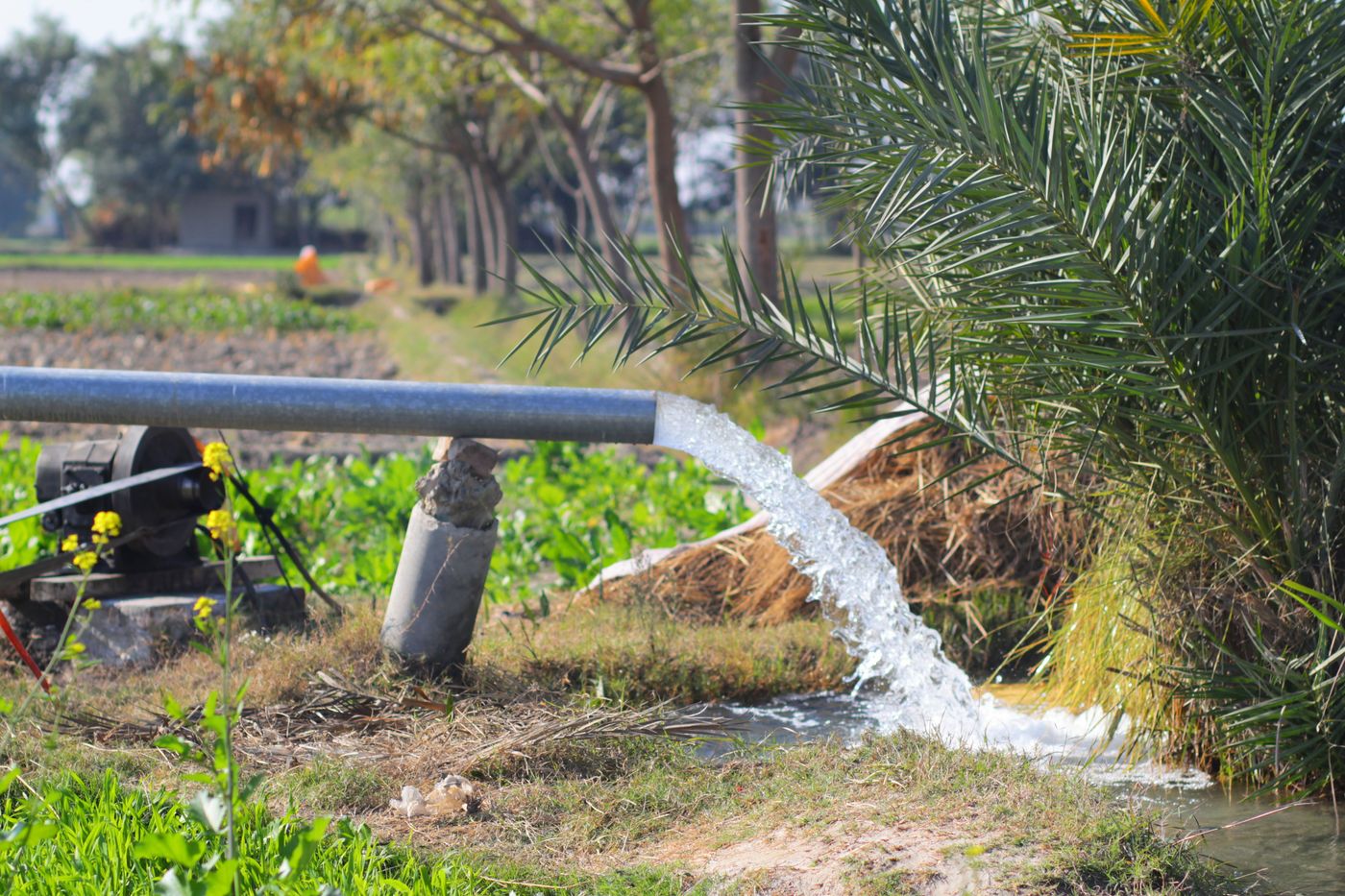
The pump is bolted to its slab beside the well, primed, running, and making all the right noises. Nothing is coming out of the delivery pipe. It worked in March. It has stopped working in September, and nobody has touched it.
The water in that well has dropped by two metres over the dry season. That is the only thing that changed, and it was enough. A surface pump does not weaken gradually as water gets deeper. It works, and then it does not.
That behaviour is the most useful thing to understand before choosing between a surface pump and a submersible. The choice is not about preference or budget: there is a hard physical ceiling on how far a surface pump can lift water to itself, and it sits lower than most people expect.
The Pump Does Not Pull. The Atmosphere Pushes.
Start with the mechanism, because everything else follows from it. A centrifugal pump does not suck water. Nothing sucks. The impeller throws water outward, leaving low pressure at its eye, and the atmosphere pressing down on the well surface pushes water up the suction pipe to fill that space.
So the atmosphere does the lifting, and it has a fixed budget. At sea level it presses at about 101 kilopascals, exactly enough to hold up a column of water 10.3 metres tall. A perfect pump attached to a perfect vacuum could not lift water higher. Motor size and brand are irrelevant to this number.
Real pumps never approach 10.3 metres, and three things eat the difference. Friction in the suction pipe, through every metre of it and every elbow and the foot valve, spends part of the budget before any lifting starts. Then vapour pressure: water at low enough pressure boils at ordinary temperature, so bubbles form at the impeller eye and collapse violently on the high pressure side. That is cavitation, it sounds like gravel going through the pump, and it eats impellers.
Third, every pump needs a minimum pressure at its inlet to avoid exactly that, quoted as net positive suction head required. Subtract all three and a good surface pump on a well built suction line works to about 6 or 7 metres. Treating seven as a target rather than a ceiling is what strands people in a dry season.
Altitude Quietly Takes Metres Off That Ceiling
The 10.3 metre figure belongs to sea level, and most Kenyan farming does not. Atmospheric pressure falls as you climb, and the lifting budget falls with it.
At Nairobi's altitude of roughly 1,800 metres, air pressure is about four fifths of its sea level value, so the theoretical ceiling drops to around 8.3 metres of water. At Eldoret, near 2,100 metres, it is about 8. Apply the same practical derating and a pump good for 7 metres at the Coast is realistically good for about 5.5 in Nairobi.
This is why one model earns a good name in Kilifi and a bad one in Molo. Nothing is wrong with the pump. The air is thinner. Above 1,800 metres, design the suction side around five metres rather than seven and the dry season will not catch you out.
Priming, Foot Valves and the Airlock in the Suction Line
A surface pump has to be full of water before it can do anything, because an impeller cannot move air. Air is compressible, so it gets squeezed and spun rather than thrown. Priming is simply filling the casing and suction line so the impeller has something solid to work on.
A foot valve holds that prime. It is a non-return valve with a strainer at the bottom of the suction pipe, and it keeps the column of water standing in the pipe when the pump stops. A pump that primed happily last month but now needs priming at every start usually has a foot valve held off its seat by grit.
The suction side must be airtight in a way the delivery side need not be. A poor joint on the delivery side leaks water out, which you can see and will fix. The same joint on the suction side draws air in, which you cannot see, and air destroys the low pressure the arrangement depends on. A pump losing prime for no visible reason is nearly always breathing through a fitting, a cracked hose or a tired gland.
Airlocks come from pipe routing. Run the suction line so it rises continuously from the water to the pump with no high point, because any hump becomes a pocket where air collects and never clears. Keep that pipe short, at least as large as the pump inlet and ideally one size larger, with as few elbows as the site allows. Each choice buys back part of a lifting budget you cannot afford to waste.
A Submersible Is Cooled by the Water It Stands In
A submersible has no suction problem because it has no suction stage. Motor and pump sit in the water and push it up the riser pipe, and pushing is something a pump can do to almost any height you are willing to pay for.
The trade is that water is not only the thing being moved, it is also the coolant. A submersible motor sheds heat into the water flowing past its shell on the way to the intake. Take the water away and nothing carries that heat off, because a sealed motor cannot use a cooling fan the way a surface motor does.
This has a consequence people miss. It is not enough for the pump to be under water; the water must move past the motor at a reasonable speed. Inside a narrow borehole casing that happens automatically, because water has nowhere else to travel. In a wide well, a dam, a river or a storage tank, water can drift up around the motor at a crawl and it overheats while fully submerged.
Dry Running Is the Failure Both Types Share
Neither pump survives running dry, but they get there differently and need different protection.
A submersible usually fails because the borehole is pumped faster than it recharges. The water level falls as pumping continues, which is called drawdown, and if the pump moves more than the borehole yields the level eventually reaches the intake. The pump then passes air and loses cooling and lubrication together, because the seals and thrust bearing are water lubricated too. The root cause is usually a pump matched to a drilling report's peak figure rather than the sustainable yield.
A surface pump fails more slowly but it still fails. Its mechanical seal, the part that stops water escaping along the shaft, is cooled and lubricated by the water it seals. Run it dry and the seal faces overheat and score, and from then on the pump weeps and loses prime.
Protection is cheap next to the pump. A float switch cuts power when the level in a well or sump drops. Electrode probes do the same in a borehole with no moving parts to jam. A dry running sensor watches for the electrical signature of a pump moving air rather than water. Run a borehole at or below its tested sustainable yield and let the probe be the backstop. All of it costs less than one rewind plus one retrieval.
What It Costs to Install, and What It Costs to Get Back Out
On the day of purchase the surface pump is both the cheaper machine and the cheaper installation. It sits on a slab or plinth, bolted down, with a suction pipe into the water and a delivery pipe out. One person fits it in a morning and one person can carry it to a workshop.
A submersible is a system rather than a machine. The real cost includes riser pipe to the setting depth, submersible rated cable over that whole length, a safety rope, clips every few metres, a well head and a control box with the right capacitor and overload for that motor. Past a certain depth you also need a tripod and winch or a rig to lower it.
Retrieval is where the difference lives. Pulling a submersible means bringing every metre of that string back up joint by joint, with the pump and the water in the pipe hanging on it. It is a planned job with people and equipment, and any fault requiring it carries that cost, including the ones that turn out to be a bad cable splice.
That asymmetry should shape what you buy: better cable, splices and safety rope are cheap insurance against a retrieval that finds nothing wrong with the pump.
Which Pump Can Be Fixed in Your Nearest Town
Repairability looks different from a farm three hours from a city than it does across a supplier's counter. A surface pump can be diagnosed by a person standing next to it: you hear it cavitate, feel it run hot, see the weep from a dying seal.
Its wearing parts are the mechanical seal, impeller, bearings and, on a single phase unit, the run capacitor, and a competent local fundi can change all of them from stocked items. A petrol or diesel surface pump goes further, because its engine belongs to the same family that runs generators and welders in every town.
A submersible gives you nothing to look at. Diagnosis happens with instruments at the control box: measuring insulation resistance to separate a motor fault from a damaged cable, comparing running current with the nameplate, testing the capacitor. That is a genuine skill and it is not evenly distributed, and a rewind cannot start until the pump is out of the hole.
None of this makes the submersible the weaker choice. It has fewer things to go wrong, no prime to lose and no suction line to leak, and a well installed one runs for years untouched. But on a remote site, a common model from a brand with spares in the country beats a cheaper unit nobody stocks parts for.
Choosing, in Four Questions
Work down the list and stop at the first yes.
Is the source a borehole? Then it is a submersible, whatever the depth. The casing is too narrow, and almost always too deep, to be served any other way.
At its lowest seasonal level, is the water more than about six metres below where the pump would sit? Then it is a submersible, or you move the pump down toward the water instead. A lower plinth is often the cheapest fix available.
Is it a tank, river, dam or shallow well inside that six metres? A surface pump is the better tool: cheaper, easier to service and simple to lift off at season's end.
Are you boosting pressure from a full tank rather than lifting from a source? That is surface pump territory, and the suction limit barely applies, because the tank feeds the pump under positive head.
One middle case is worth knowing. A jet pump uses a venturi assembly near the water to extend effective suction depth past the plain atmospheric limit while keeping the motor at the surface where you can reach it. It is less efficient than a submersible, but it is a real option.
The other half of the job is matching the pump to the height and volume your site needs, which our guide to sizing a pump by total head and flow rate works through. Both families, plus pipe, foot valves and float switches, are in our water equipment range with figures on the price list.
Key Takeaways
- A surface pump does not pull water. Atmospheric pressure pushes it up the suction pipe, and that pressure runs out at 10.3 metres of water column at sea level.
- Friction, vapour pressure and the pump's own inlet requirement take the realistic suction limit down to about 6 or 7 metres, and to roughly 5.5 metres at Nairobi's altitude.
- Size the suction side on the lowest water level of the driest month, not on the level you can see today.
- A submersible is cooled and lubricated by the water it pumps, so it must stay submerged, and outside a narrow borehole casing it needs a flow sleeve to force water past the motor.
- A float switch or level probe costs a fraction of one rewind plus one retrieval, and retrieval is the hidden cost that makes good cable and splices worth paying for.
Frequently Asked Questions
Can a surface pump draw water from a borehole?
Almost never. A surface pump lifts water to itself using atmospheric pressure, which runs out at about 10.3 metres of water column at sea level and gives a practical working limit near 6 or 7 metres. Boreholes are almost always deeper than that, and the casing is too narrow for anything other than a submersible. If your source is a borehole, the pump belongs in the hole.
How deep can a surface pump lift water?
The theoretical maximum at sea level is 10.3 metres, because that is the height of a water column atmospheric pressure can support. Pipe friction, the vapour pressure of water and the pump's own suction requirement take the realistic figure down to about 6 or 7 metres. At Nairobi's altitude the air is thinner, so the theoretical figure falls to roughly 8.3 metres and the practical one to about 5.5.
Why does my water pump keep losing its prime?
Either the foot valve is leaking back, usually because grit is holding it off its seat, or air is being drawn in somewhere on the suction side. A bad joint on the delivery side leaks water out where you can see it, but the same joint on the suction side quietly draws air in and destroys the vacuum the pump depends on. A high point in the suction pipe can also trap an airlock that will never clear.
What happens if a submersible pump runs dry?
The water it is pumping is also its coolant and its lubricant, so losing water means losing both at once. A sealed submersible motor cannot shed heat into air the way a surface motor's fan does, so damage follows within minutes rather than hours. A float switch, electrode probes or a dry running sensor costs a fraction of a motor rewind plus the cost of pulling the pump out of the hole.
Is a submersible pump better than a surface pump?
Neither is better in general. A submersible wins wherever the water sits more than about six metres below the pump, because a surface pump physically cannot reach it. A surface pump wins on tanks, rivers, dams and shallow wells inside that limit, because it costs less, installs in a morning, can be lifted off for service and can be repaired by a local fundi with stocked parts.