
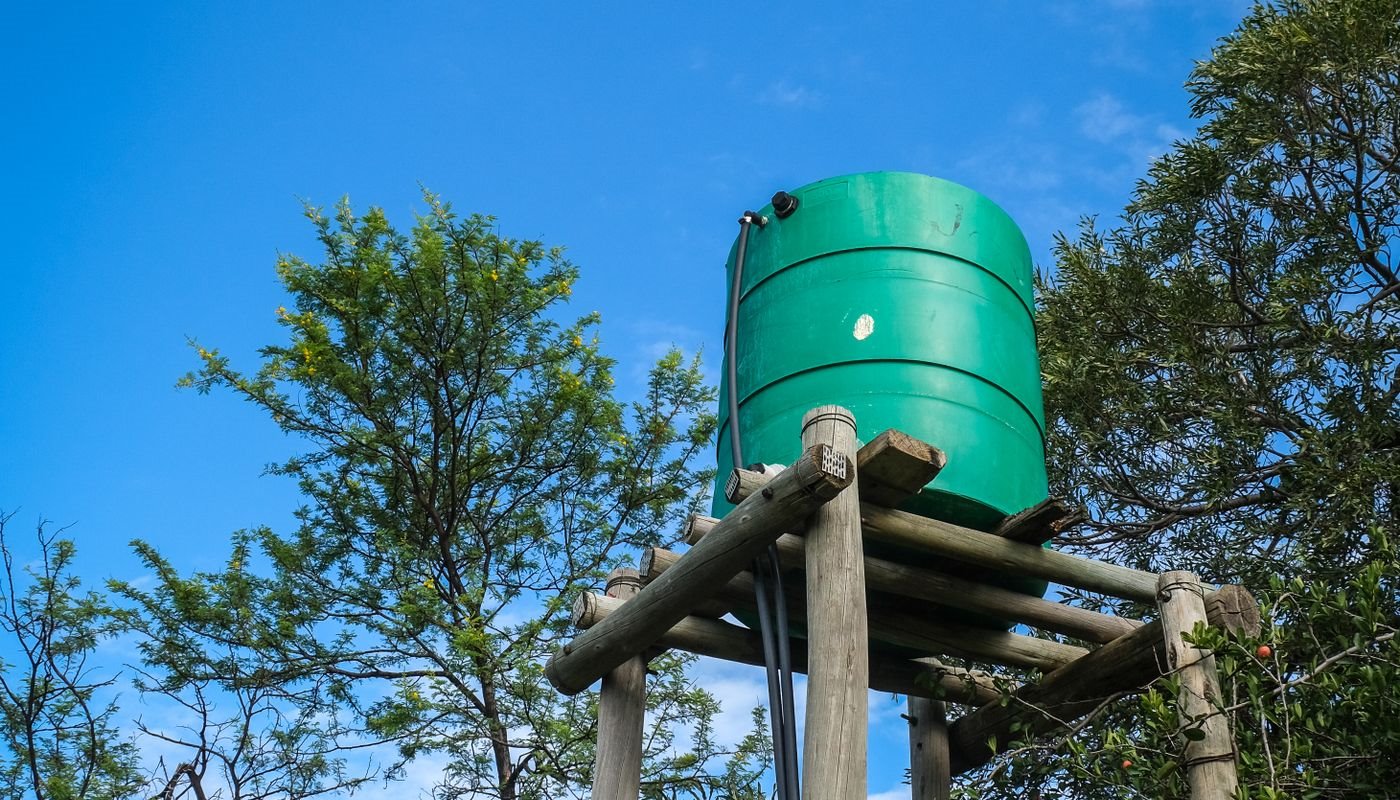
The tank arrived on a lorry, the fundi set it on a ring of blocks beside the house, and the borehole filled it by evening. Then somebody turned on the shower. Water reached the head as a trickle, the instant heater never switched on, and out in the shamba the drip line wetted the first ten metres of the row and gave up.
Nothing is broken. A tank on the ground is storage, and storage is not supply. The pressure at any tap comes from height, and a tank whose water surface sits lower than the shower head has no height to give.
This article is about the structure that fixes that: the stand. How tall it needs to be, what it must carry (a full 5,000 litre tank is five tonnes), what to build it from, what goes under it, what wind does to it, and the plumbing on top. It ends with when a small booster pump is the better buy than a taller stand.
Ten Metres for One Bar: What Height Actually Buys
Static pressure in a gravity system depends on one measurement: the vertical distance from the water surface in the tank down to the outlet. Ten metres of that drop gives roughly one bar. One metre gives about 0.1 bar. Nothing else, not the size of the tank, not the length of pipe, not the diameter of the outlet, adds anything to that figure.
The measurement is not from the ground and not from the tank base. It is from the water surface, which falls as the tank empties. A two metre tall tank full to the brim gives about 0.2 bar more than the same tank nearly empty. Design for the empty case, because that is the pressure you will have on the morning the tank is low and everybody wants a shower.
Now put real numbers on a Kenyan single storey house. A shower head sits close to two metres above the floor. A tank base at three metres, on a modest stand, leaves about one metre between the base of a nearly empty tank and the shower head: roughly 0.1 bar. Raise the base to five metres and that becomes three metres of head, about 0.3 bar, three times the pressure from two extra metres of steel.
Why a Ground Tank Cannot Run a Shower or a Drip Line
A tank on the ground puts the water surface roughly two metres above the floor when full and at floor level when empty. A shower head is at two metres. For most of the tank's contents, the head is negative: the water has to climb to reach the outlet, and it will not.
Kitchen taps at waist height still run, which is why people blame the plumbing. The kitchen tap is a metre below the water surface and the shower is not.
Drip irrigation fails for a related reason. Emitters are designed around a working pressure, stated on the datasheet. Ordinary drip tape and non-compensating emitters run at a fraction of a bar and deliver evenly only when every emitter sees close to that figure. Pressure-compensating emitters, the kind that give equal flow along a long line, need a minimum pressure before their diaphragm does anything at all. Below it they behave like plain holes.
Kits sold specifically for gravity drip get round this with short lines, large-orifice emitters and a tank raised one to two metres on a small stand. Feed a standard drip line meant for a pumped system from a tank on blocks and you get exactly what the opening of this article describes: the near end floods and the far end stays dry.
A Full Tank Is a Serious Load
Water weighs one kilogramme per litre. A full 5,000 litre tank is therefore five tonnes of water, plus the tank itself. A 10,000 litre tank is ten tonnes. This is the number most stands are not designed for, because the person welding the stand has only ever lifted the tank empty.
That load has to travel somewhere. On a four-legged stand, five tonnes becomes 1.25 tonnes per leg, pushing into the ground through whatever sits under it. A 300 by 300 millimetre steel base plate has an area of 0.09 square metres, so the pressure under it is about 14 tonnes per square metre. A 900 by 900 millimetre concrete pad spreads the same load over nine times the area, roughly 1.5 tonnes per square metre. That is the whole reason footings exist.
Two other loads are easy to forget: water surging sideways as the tank fills or empties quickly, and the lever effect of a tall, top-heavy object, which multiplies any lean at the footings into a large movement at the tank.
One rule applies to every stand: a plastic tank needs continuous, flat support under its entire base. Polyethylene is not stiff. Set a full tank on four beams or a ring of blocks and the unsupported base bulges down between them, the wall stretches, and the tank eventually splits along a fold. The top of the stand must be a deck: welded steel plate, close-spaced timber, or a concrete slab. Our guide to water storage tanks covers the material side.
Steel, Concrete or Timber
Timber stands are the cheapest and the most limited. They suit small tanks, from a few hundred litres up to around a thousand, raised a metre or two for a gravity drip kit or a poultry house. Use pressure treated posts set in the ground like fence strainers, brace every face diagonally, and deck the top fully. Termites and rot work at the ground line, so inspect there every year. A timber stand under two tonnes or more of water is a gamble.
Welded steel is the default for elevated household and farm tanks. It is strong for its weight, quick to fabricate, and can be built to five or six metres without becoming a civil engineering project. It is also the material most often built badly. A good steel stand has legs of angle iron or rectangular hollow section sized for the tank, diagonal bracing on all four faces and at every lift, a horizontal ring at the top, a full plate or close-bar deck, and base plates drilled for anchor bolts. A stand with legs and a top frame and nothing between is a hinge waiting for wind.
Steel dies at the base plate, where it sits wet against concrete, and at any weld left unpainted. Galvanising is best, a zinc-rich primer and topcoat is acceptable, and either must be renewed at the base every couple of years. At the Coast, salt air shortens all of that.
Concrete or masonry stands are permanent. Reinforced concrete columns tied by a ring beam and topped with a slab, or a solid masonry drum, carry any tank you can buy, do not rust, do not burn and do not interest termites. They cost more up front, take weeks rather than days, and cannot be moved or raised later. For a large tank that will sit in one place for twenty years, or any tank at the Coast, they are usually the right answer. For a tank you may relocate as the farm changes, steel is.
Foundations: Where Stands Actually Fail
A stand rarely fails in the steel. It fails in the ground. One footing settles a few centimetres more than the others, the stand leans, the load shifts to one side, and the bracing there is suddenly doing a job it was never sized for.
Kenyan soils make this worse than it needs to be. Black cotton soil, common across much of the country, swells when wet and shrinks when dry, so a footing sitting in it moves with each season. Loose fill and recently disturbed ground under a new compound settle under load. Rock and firm murram behave well.
Dig each footing down to firm, undisturbed ground, or through the black cotton layer to what lies below it. Pour a pad large enough to bring the bearing pressure down, keep its top above ground level so water does not pool against the leg, and cast in the anchor bolts before the concrete sets. Level the four pads against each other with a water level or a laser, because a stand built on uneven pads is leaning from the day it is bolted down.
Wind, and the Empty Tank Problem
Wind pushes sideways on the tank and the stand, and the force rises with the square of the wind speed: double the wind and the push quadruples. A tall stand turns that push into a lever, so the gust that barely troubles a tank at two metres is working hard to overturn one at six.
The dangerous moment is when the tank is empty. A full tank resists overturning with its own weight. An empty plastic tank weighs almost nothing and presents the same face to the wind, so the anchor bolts are the only thing holding the stand down, and a strap over the tank is the only thing holding the tank on the deck. Every dry season somebody finds their empty tank in the neighbour's field.
Keep the base wide. A stand whose base is much narrower than a third of its height is a tower, and a tower needs a proper design, not a fundi's judgement.
Overflow and Float Valves: The Plumbing on Top
Elevated tanks need two things at the top that ground tanks get away without. The first is an overflow. When the tank fills past its inlet, water has to go somewhere, and if that somewhere is over the rim it lands on the footings. An overflow pipe should be at least as large as the inlet, fitted just below the rim, screened against mosquitoes, and piped well away from the stand, ideally into a soakaway or a second tank.
The second is a way to stop the fill. From a mains or gravity supply, a float valve on the inlet does this on its own: the float rises with the water, closes the valve at the set level, and reopens as the tank draws down. Fit one rated for the inlet pressure, because a low-pressure float valve weeps against mains.
From a pump, a float valve alone is a mistake. When the valve closes, the pump keeps running against a shut outlet, churning the same water, heating it, and cooking its own seals. Pair the pump with a float switch in the tank, wired to cut the pump when the tank is full and restart it at a lower level. The float valve then becomes a backup rather than the control.
Raising the tank also raises the head the filling pump must overcome. A pump that just managed to fill a tank on the ground may run out of lift with the tank five metres higher, so check its curve before the stand goes up.
When a Small Booster Beats a Taller Stand
Every metre you add to a stand is roughly 0.1 bar, for the rest of the stand's life, with no motor and no bill. That makes height the cheapest pressure available, right up to the point where the stand becomes a tower and the cost of steel, footings, bracing and wind design climbs faster than the pressure it delivers.
A booster pump takes water from a low tank and pushes it to the taps at whatever pressure you set. Paired with a pressure tank so that it does not start and stop on every cupful, it gives an instant shower or a washing machine the pressure they were designed for, from a tank sitting on the ground. The trade is electricity, a pump to service, and dependence on the power being on when the shower is wanted.
The practical split runs like this. On a single storey house with the tank on a low stand and room to build, add height: two or three extra metres usually solves a weak shower, and costs less than the pump plus the electrician. Where you need a full bar or more, where the tank must feed an upper floor or already sits on the roof, or where there is no ground to build on, fit a booster. Small booster pumps start from 3,000 KSH on our price list, and pumps, tanks, float valves and fittings are all in water equipment.
Many farms sensibly do both: a modest stand for the gravity supply that keeps the drinkers and the kitchen running through a power cut, and a booster on the house line for the shower. The pump is then a convenience, not a dependency. For the pump side of that setup, read booster pumps and household pressure.
Key Takeaways
- Pressure comes from the vertical drop between the water surface and the outlet, at roughly 0.1 bar per metre. Design for the tank nearly empty.
- A tank on the ground has its water surface below the shower head for most of its contents, and cannot run pressurised drip designed for a pump.
- A full 5,000 litre tank is five tonnes. Spread it through braced legs onto concrete pad footings dug to firm ground, and deck the top fully under a plastic tank.
- Timber for small tanks only. Steel for most elevated tanks, braced on every face and bolted down. Concrete where the tank is large, permanent, or at the Coast.
- Stands fail at the footings, not in the steel. Fill a new tank in stages, and remember wind is worst with the tank empty: anchor the stand and strap the tank.
- Fit an overflow piped away from the footings. Use a float valve on a mains fill, and a float switch on a pump fill so the pump never runs against a closed valve.
- Add height for small gains on a single storey house. Fit a booster with a pressure tank for a full bar or more, an upper floor, or when there is nowhere higher to go.
Frequently Asked Questions
How high should a water tank stand be for a shower?
Measure from the water surface down to the shower head, not from the ground. Ten metres of vertical drop gives roughly one bar, so each metre gives about 0.1 bar. A shower head sits close to two metres above the floor, so a tank base only three metres up gives about a metre of head when the tank is nearly empty, roughly 0.1 bar. Take the minimum pressure printed on the shower and work back to the height that delivers it with the tank nearly empty.
How much does a full 5,000 litre water tank weigh?
Water weighs one kilogramme per litre, so 5,000 litres is five tonnes before you add the tank itself. Spread over four legs that is 1.25 tonnes per leg, and on a small steel base plate that concentrates into a bearing pressure far higher than most Kenyan soils will carry without settling. Every stand for a tank of this size needs proper concrete footings under each leg and a continuous flat platform under the whole base of the tank.
Is a steel, concrete or timber tank stand better?
Timber suits only small tanks, up to about a thousand litres, with pressure treated posts, full bracing and a solid deck. Welded steel is the usual answer for elevated tanks because it is strong for its weight, can be built tall and can be moved, but it must be braced on every face, bolted to footings and protected from rust at the base plates. Concrete or masonry stands are permanent, immune to rust and termites, and the best choice at the Coast or where the tank will never move.
Do I need a float valve on an elevated tank?
If the tank fills from a mains or gravity supply, a float valve on the inlet stops the fill automatically and prevents overflow. If a pump fills the tank, a float valve alone is dangerous because the pump keeps running against a closed valve and overheats. Pair the pump with a float switch that cuts its power when the tank is full. Fit an overflow pipe in every case, at least as large as the inlet, discharging well away from the stand footings.