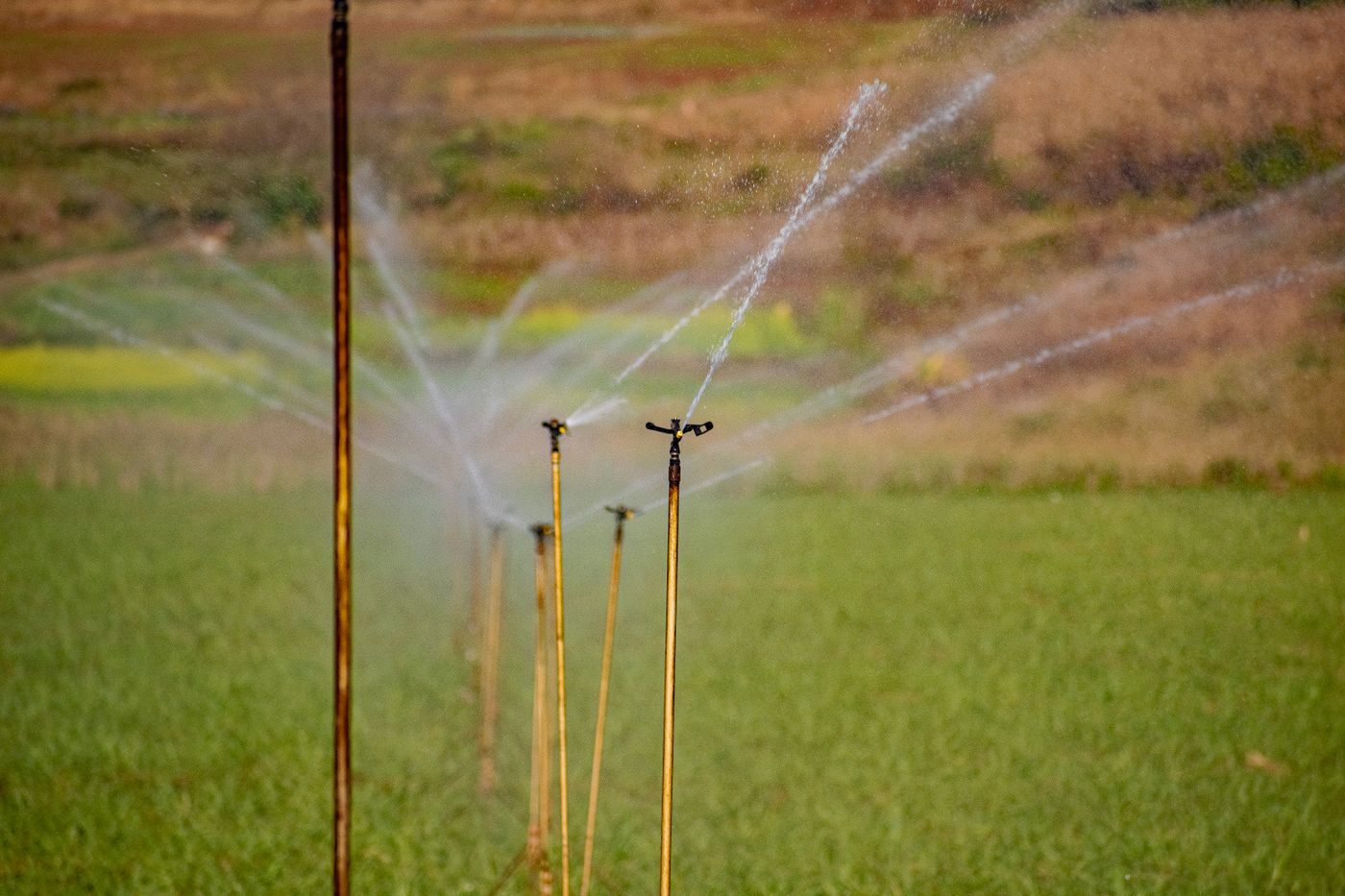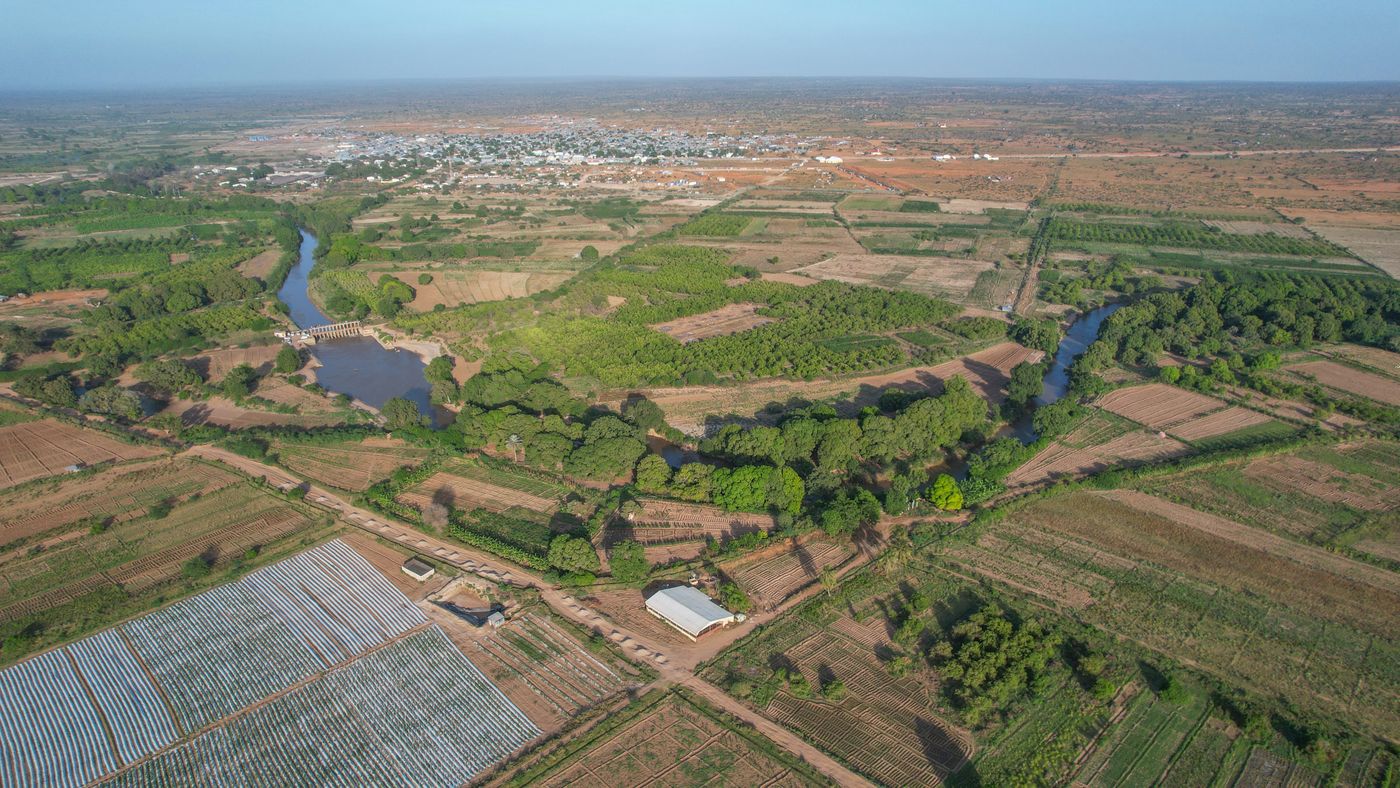
Drip kits and rain guns get most of the attention, but a great deal of Kenya's irrigated food is still grown the oldest way: water led along channels and let into furrows or basins on the ground. The rice paddies of Mwea are basin irrigation. Many tomato, onion and kale growers along rivers pump into a channel and open the furrows one by one. It needs no emitters to clog and no pressure to maintain, and it can be run from a river, a water pan, a borehole or a gravity canal.
Done badly, though, surface irrigation wastes a lot of water. The top of the furrow floods while the bottom stays dry, water ponds and runs off the end, and the crop at the low corner of the field yellows from waterlogging while the high corner wilts. The difference between good and bad surface irrigation is not equipment. It is levelling, furrow length, stream size and timing.
This guide explains when furrow and basin irrigation make sense, how to lay out the field, how to deliver water with lay-flat hose, siphons or a channel, how to judge the right amount, and when it is time to move to sprinklers or drip. If you are still deciding between systems, our comparison of drip and sprinklers covers the pressurised options, and our guide to irrigation scheduling explains how much water a crop needs.
Furrows, Basins and Borders: What Is the Difference?
Furrow irrigation runs water down small channels between crop rows. The water soaks sideways and down into the ridges where the plants grow. It suits row crops such as maize, tomatoes, onions, potatoes, cabbages, kale and beans, and crops that dislike water on their stems or leaves.
Basin irrigation floods a level plot surrounded by low earth bunds. Water spreads across the whole basin and soaks in. It suits rice, which grows in standing water, as well as pasture, fodder and tree crops, where each tree can have its own small basin. Small basins are also a simple way to water vegetable beds by hose.
Border irrigation is a long, gently sloping strip between two bunds, used for pasture and close growing crops on larger farms. Most Kenyan smallholders will use furrows or basins, so this guide concentrates on those.
Is Surface Irrigation Right for Your Farm?
Surface irrigation fits when several things line up: your land is fairly flat or can be levelled; your soil is a loam or clay that lets water spread before it soaks in; you have a fairly large flow of water for part of the day, such as a river pump or a canal turn; and your crop is a row crop, rice or pasture.
It is a poor fit on sandy soil, where water sinks near the top of the furrow and never reaches the bottom, on steep or very uneven land, and where water is scarce and every litre counts. FAO's irrigation training material gives typical field application efficiencies of around 60 percent for surface irrigation, 75 percent for sprinklers and 90 percent for drip. In plain terms, well run drip puts far more of the water you pay to pump into the root zone. Where water is cheap and plentiful, surface irrigation can still be the sensible choice because the equipment cost is low.
Levelling and Slope: Get the Ground Right First
Water goes where the ground is lowest, and in surface irrigation the ground is the distribution system. A furrow with a hump in the middle stops the water halfway; a basin with one low corner floods that corner and leaves the rest dry. Time spent levelling pays back every single irrigation.
Furrows need a small, even fall along their length. FAO's training material puts suitable furrow slopes roughly between 0.05 and 0.5 percent, that is between 5 centimetres and 50 centimetres of fall per 100 metres, with gentler slopes on sandy or easily eroded soils. Steeper than that and the water scours the furrow; flatter and it moves too slowly and ponds. Basins should be as level as you can make them across their whole area.
These drops are far too small to judge by eye. A clear water level pipe lets you peg the furrow ends and check for humps and hollows. Fill the hollows with soil from the high spots using a jembe and a rake, and run a test irrigation to see where water stalls before you plant.
Laying Out Furrows
Length. The right furrow length depends mainly on soil. On sandy soil water soaks in fast, so furrows must be short or the far end never gets wet. On clay, water travels further before it soaks in, so furrows can be longer. Smallholder plots in Kenya often use furrows of a few metres up to a few tens of metres. If the bottom of your furrows stays dry while the top is soaked, shorten them.
Spacing. Furrows are usually spaced to match the crop rows, with closer spacing on sandy soil, where water spreads less sideways, and wider spacing on clay. After an irrigation, dig a small hole in the ridge halfway between two furrows. If the soil there is moist to root depth, the spacing is right.
Direction. On a gentle slope, run the furrows across the slope at the chosen gradient rather than straight down it. That keeps the fall within the safe range and reduces erosion.
Getting Water Into the Furrows
Water is delivered to the top of the field by a head ditch, a pipe or a hose, and released into each furrow in turn. There are several ways to do it.
Cutting the ditch bank with a jembe is the traditional way. It is free, but each cut tends to grow, so flows into different furrows become uneven, and the bank erodes over a season.
Siphon tubes are short curved pipes that lift water over the ditch bank into each furrow. Every tube of the same size and head gives about the same flow, so furrows get an even share.
Lay-flat hose from the pump outlet laid along the top of the field is the most common modern option on small farms. You can move the open end from furrow to furrow, or make small outlets along the hose so several furrows run at once. It needs no ditch, loses little water to seepage on the way, and rolls up after use. Our guide to lay-flat and braided hose covers sizes and pressure ratings.
How Much Water, and When to Stop
The aim is to wet the root zone evenly along the whole furrow without sending water off the end or deep below the roots. Two habits make the biggest difference.
Get the water to the end quickly. If water creeps slowly down the furrow, the top soaks for hours while the far end barely wets. Use the largest stream that does not erode the furrow, so the front reaches the end in a reasonable time. If it still takes too long, the furrow is too long for your soil.
Then cut back. Once the water reaches the end, reduce the stream so it just keeps the furrow wet while the soil soaks it up. With lay-flat hose this means moving the open end on to the next furrows while leaving a smaller outlet running, or partly closing the outlet.
Check your work with your hand. The day after irrigating, dig into the ridge at the top, the middle and the far end of a few furrows. Moist soil that holds together when squeezed down to root depth means the irrigation reached. Dry soil at the far end means a longer set or shorter furrows. Soggy, smelly soil at the low end means too much water, or a blocked outlet. Our irrigation scheduling guide explains how to estimate how often to irrigate.
Basins for Rice, Trees and Vegetable Beds
A basin works when its floor is level and its bunds hold. Compact the bunds well and repair rat holes and cracks before each irrigation, because a single leak can drain a basin overnight. Fill each basin quickly to the planned depth, then close the inlet. For trees, a ring basin around the trunk, kept a little away from the stem, concentrates water at the roots. For vegetable beds watered by hose or watering can, small sunken beds with a low lip hold water where the plants are instead of letting it run into the paths.
For rice, the depth of standing water and the timing of draining before harvest depend on the variety and the scheme's rules. Growers in schemes such as Mwea follow the water schedule set by the scheme, so talk to the scheme's extension staff before changing anything.
Common Problems and Quick Fixes
| Problem | Likely cause | Fix |
|---|---|---|
| Far end of furrow stays dry | Furrow too long for the soil, stream too small, or a hump | Shorten furrows, use a larger starting stream, relevel |
| Water runs off the end | Stream left on full too long | Cut back once the water reaches the end; block the furrow end |
| Furrows scour and deepen | Slope too steep or stream too large | Reduce the stream, run furrows across the slope |
| Low corner waterlogged | Field not level; no outlet for excess | Relevel, add a drain at the low end |
| Uneven flow between furrows | Ditch cuts of different sizes | Use siphons or hose outlets of the same size |
| Basin drains overnight | Cracked bund or rat hole | Repair and compact bunds before each irrigation |
Pumps and Hose for Surface Irrigation, With Prices
Surface irrigation needs volume more than pressure, so a pump that moves a large flow at low head usually suits it better than a high pressure pump. Our guide to pump sizing by head and flow shows how to match the pump to the lift and distance. These prices are from the Fuga price list at the time of writing; check the site or call a branch for current prices and stock.
| Item | Stock code | Price |
|---|---|---|
| Water pump 3*3 Ram G | 6444 | KSh 16,250 |
| WATER PUMP WP 20 | 6427 | KSh 15,000 |
| WATER PUMP 1HP SURFACE TWP17506 | TWP17506 | KSh 11,000 |
| FLAT LAY PIPE 2' | 6224 | KSh 250 |
| LEVEL PIPE 6MM*50M | 6288 | KSh 800 |
| JEMBE 3LB ALLIGATOR | 6256 | KSh 450 |
Level the ground, keep furrows short enough for your soil, get the water to the end fast and then cut back. When water gets scarce or the land is too uneven, it may be time to move part of the farm to drip; our irrigation kits and PVC lay-flat hose are a good place to start, and the full water and irrigation range is a WhatsApp away on 0716 961 018.
Key Takeaways
- Furrow and basin irrigation need no emitters or pressure and suit loam and clay soils, fairly flat land and a large flow of water.
- FAO training material gives typical field application efficiencies of about 60 percent for surface, 75 percent for sprinklers and 90 percent for drip, so surface irrigation suits farms where water is plentiful.
- Levelling is the distribution system: furrows need an even fall, roughly 0.05 to 0.5 percent per FAO guidance, and basins need a level floor.
- Keep furrows short on sandy soil and longer on clay; if the far end stays dry, shorten them.
- Use the cut back method: a full stream until water reaches the end, then a smaller one so it soaks in without running off.
- Check moisture by hand at the top, middle and far end of a few furrows the day after irrigating.
Frequently Asked Questions
What is the difference between furrow and basin irrigation?
Furrow irrigation runs water along small channels between crop rows, and the water soaks sideways into the ridges where plants grow. It suits row crops such as tomatoes, onions, maize and kale. Basin irrigation floods a level plot surrounded by low earth bunds, and suits rice, pasture, fodder and trees.
What slope should an irrigation furrow have?
FAO's irrigation training material gives suitable furrow slopes of roughly 0.05 to 0.5 percent, that is 5 to 50 centimetres of fall per 100 metres, with gentler slopes on sandy or easily eroded soils. Use a water level pipe to set and check the fall, because such small drops cannot be judged by eye.
How long should my furrows be?
It depends mainly on soil. On sandy soil water soaks in quickly, so furrows must be short or the far end stays dry. On clay soil water travels further, so furrows can be longer. If the bottom of your furrows stays dry while the top is soaked, shorten them or use a larger starting stream.
Is furrow irrigation wasteful?
It can be. Typical field application efficiency for surface irrigation is about 60 percent in FAO training material, against about 90 percent for drip. Good levelling, the right furrow length and cutting back the stream once water reaches the end make a big difference. Where water is scarce, drip is usually the better choice.
What pump do I need for furrow irrigation?
Surface irrigation needs volume more than pressure, so a pump that delivers a large flow at low head usually suits it better than a high pressure pump. Work out the lift from the water to the field and the pipe length, then match the pump to that head and the flow you need.