A farmer in Kirinyaga puts in drip on half an acre of tomatoes, and by the second season a third of the emitters are dead. The line looks fine. The pump runs. But the far end of each row is dry, the near end is waterlogged, and the crop tells the story in two colours.
Nothing was wrong with the choice of drip. What was missing was a KSH 2,000 filter and a decision nobody talked him through: whether his water, his soil and his crop actually suited drip in the first place.
Drip versus sprinkler is usually argued as though one is simply better. It is not that kind of question. It is a sequence of three decisions, and taking them in the wrong order is what produces expensive irrigation that does not work.
What each system does with a litre of water
Start with the one number that is genuinely settled. Application efficiency is the share of water you pump that ends up available to the plant rather than evaporated, blown sideways or drained past the roots.
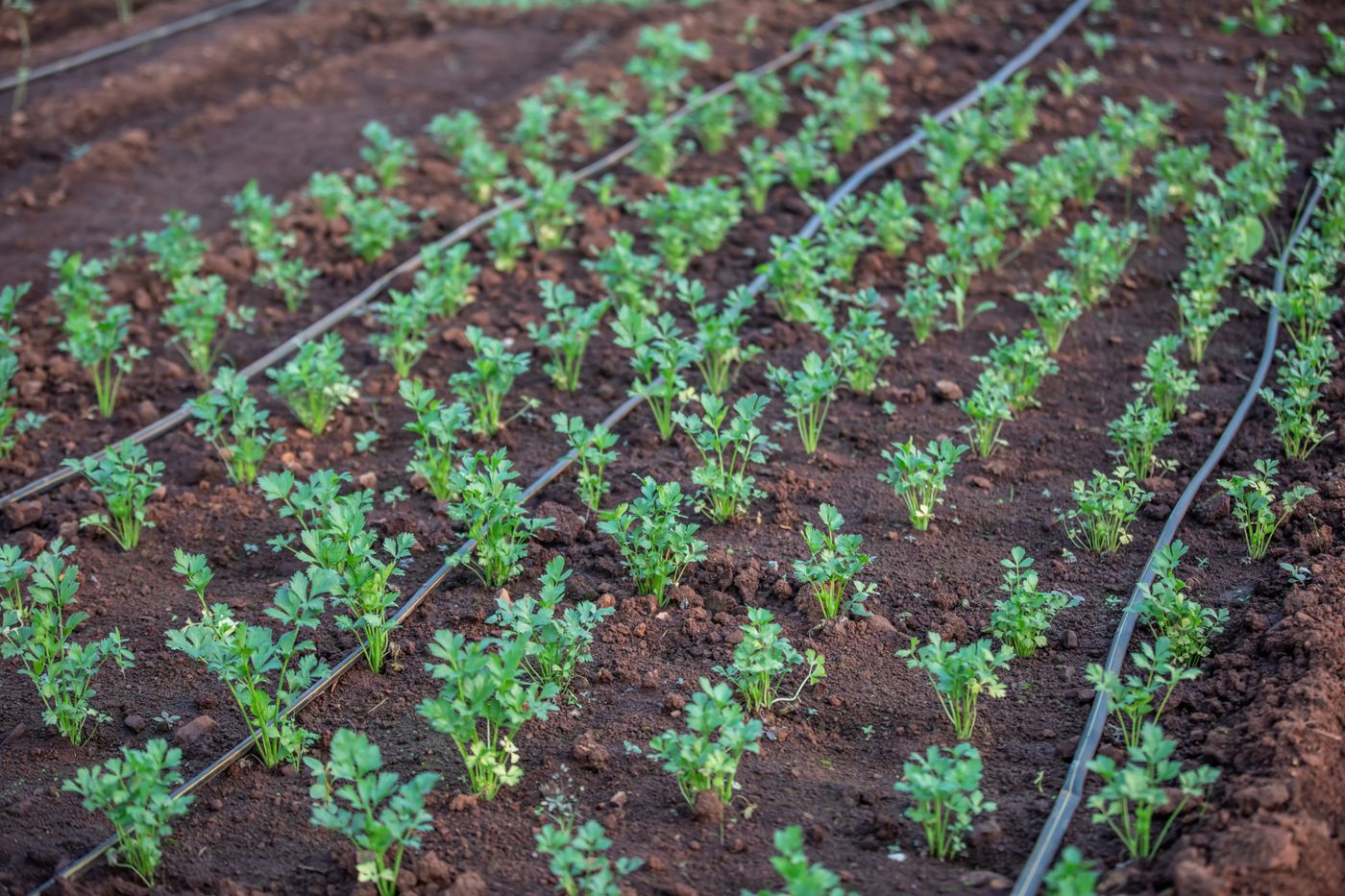
Drip wins on paper and usually in practice, because it puts water at the root and wets very little else. Two consequences follow that farmers notice more than the percentage. The soil surface between rows stays dry, so you weed less. And because the wetted strip is narrow, a given pump and a given borehole irrigate substantially more land.
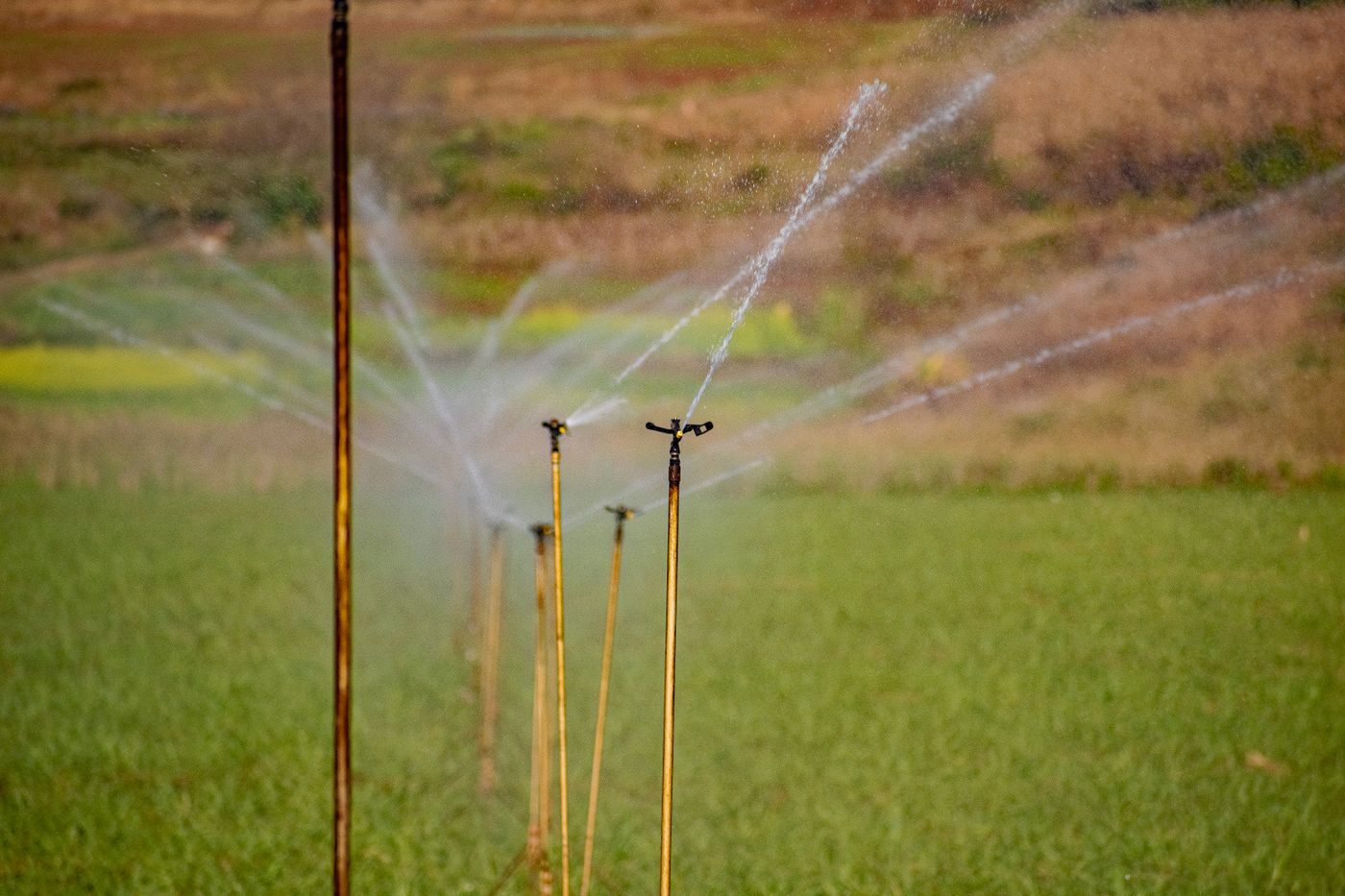
Sprinklers throw water through air over a wide circle. Some evaporates before it lands, more is carried off by wind, and the whole surface is wetted whether there is a plant there or not. That is not a fault, it is what the system is for. On a close-spaced crop there is a plant almost everywhere, so the "waste" is much smaller than the number suggests.
Your water decides before your crop does
This is the decision most people take last, and it should be first. Drip emitters have openings measured in fractions of a millimetre. Anything in your water that can build up will eventually close them, and once an emitter is blocked you generally do not get it back.
Three things block emitters in Kenya. Physical particles: sand and silt, common in river and pan water. Chemical scale: carbonates and iron, common in borehole water, which is the nastier problem because it precipitates inside the emitter rather than being caught by a screen. And biological growth: algae and slime from open storage tanks in sunlight.
A water filter at around KSH 2,000 handles the first category and is not optional. It is the single cheapest insurance on a drip system and the most commonly skipped. For iron and carbonate you are into treatment rather than filtration, which our guide to farm water treatment covers, and our piece on filters and fertigation goes further into sizing and flushing.
The honest rule. If you cannot filter your water, do not buy drip. Sprinklers pass sand and silt that would kill a dripline in a season, which is a genuine argument for sprinklers that price comparisons never mention.
Soil texture picks your emitter spacing
Assuming drip is viable, there is a choice most buyers make blind. Our drip line comes with double emitters at 150 mm or 200 mm spacing, both around KSH 7,438 a roll, and the right one is decided by your soil rather than your crop.
Water leaving an emitter moves down under gravity and sideways by capillary action, and the balance depends on texture. In sandy soil water goes almost straight down, so the wetted patches stay narrow and separate. Choose 200 mm spacing on sand and you get a row of isolated wet columns with dry gaps between them, and roots in those gaps. In clay, water spreads laterally, the patches join up, and the wider spacing is fine and cheaper per metre.
So: closer spacing on sandy soils, wider spacing on clay. If you are unsure, dig. Run the line for an hour, then dig a small pit beside an emitter and look at the shape of the wet zone. That ten-minute check is worth more than any specification.
Crop spacing is the second filter
Drip earns its efficiency by watering plants instead of ground, which means it needs plants in identifiable places. On widely spaced row crops, tomatoes, capsicum, onions, cabbages, watermelon, that is exactly what you have, and drip is usually the better system.
On a densely planted or broadcast crop, the logic inverts. Kale, spinach, wheat, fodder grass and pasture cover the ground, so wetting the whole surface is not waste. Running dripline through a close-planted bed also means a great deal of pipe per square metre, and the cost advantage disappears.
For larger blocks of close-spaced crop or pasture, a rain gun covers ground no hand-moved sprinkler can match. The plastic 1.5 inch unit is around KSH 5,625, and the larger 30 and 50 metre throw units run KSH 18,000 to KSH 19,000.
The disease argument nobody makes
Sprinklers wet foliage. Many of the fungal and bacterial diseases that matter most in Kenyan horticulture need a film of water on the leaf to establish, and splashing spreads spores from soil to leaf and plant to plant. Late blight on tomatoes and potatoes is the obvious one.
Drip keeps the canopy dry, which removes a whole disease pathway. On a susceptible high value crop that alone can justify the system, before any water saving is counted.
There is a second advantage that only drip offers: you can feed through it. Because the line delivers to the root zone, soluble fertiliser injected into the water goes where the roots are, in small doses matched to growth stage, rather than being broadcast and largely washed past them. That is fertigation, and on a high value crop it often returns more than the water saving does.
Where you are stuck with sprinklers on a susceptible crop, timing is the lever you have. Irrigate early in the morning so the leaves dry quickly in the sun, rather than in the evening, which leaves foliage wet all night. Evening irrigation loses the least water to evaporation and is the worst thing you can do for disease, which is a trade-off worth making deliberately rather than by habit.
What it actually costs to start
Sprinklers are cheaper to begin with, and that gap is real rather than an illusion.
- Ground micro sprinkler set, about KSH 125. Plastic sprinkler, large, about KSH 600.
- Braided hose, 3/4 inch: about KSH 3,500 for 30 m, KSH 5,500 for 50 m. Lighter zebra hose starts near KSH 600.
- Drip line, double emitter, about KSH 7,438 a roll, plus drip valves at around KSH 30 each.
- Water filter, about KSH 2,000, which is mandatory on drip and not on sprinklers.
A few hand-moved sprinklers and a hose will water a small plot for a fraction of a drip layout. The reason drip still wins on many farms is that the running comparison is different: less water pumped per hectare, less fuel or power, less weeding labour, and on the right crop, less disease. The purchase is where sprinklers win and the season is where drip does.
Do not compare sticker prices across different areas. Because drip is more efficient, the same borehole irrigates more land under drip than under sprinklers. Compare cost per irrigated acre at the yield you actually need, not cost per kit.
Pressure, and what it costs to pump
Drip runs at low pressure, typically around 1 to 1.5 bar. Sprinklers need considerably more to break the jet up and throw it, and a rain gun more again. Pressure is pump work, and pump work is fuel or electricity every hour you irrigate.
That has two practical consequences. A drip system can often run from a modest pump, or from gravity if you have a tank high enough, which removes the running cost almost entirely. And drip pairs unusually well with solar pumping, because a solar pump's modest, steady output suits a system designed to run long and slow.
If you are sizing a pump for either system, do it properly against head and flow rather than by horsepower, which our guide to pump sizing walks through.
Key takeaways
- Take the decisions in order: water quality first, then soil, then crop spacing. Most failed drip systems failed at step one.
- Drip reaches roughly 90% application efficiency against 70 to 75% for sprinklers, and it also cuts weeding because the surface stays dry.
- If you cannot filter your water, do not buy drip. Sprinklers tolerate sand and silt that would kill a dripline.
- Closer emitter spacing on sandy soil, wider on clay. Dig beside an emitter and look at the wetted shape rather than guessing.
- Drip for widely spaced row crops. Sprinklers or a rain gun for close-spaced crops, fodder and pasture.
- Drip keeps foliage dry, which removes a major disease pathway on tomatoes and potatoes.
- Sprinklers win on purchase price. Drip wins across a season on water, fuel and labour.
Frequently asked questions
Can I use both on the same farm?
Most farms above an acre end up doing exactly that, and it is usually the right answer rather than a compromise. Drip on the tomatoes and onions, sprinklers or a rain gun on the kale and fodder. One pump and one main line can feed both, provided the pressure is set for the drip zone and stepped up for the sprinkler zone rather than the other way round.
How long does dripline last?
It depends almost entirely on water quality and flushing discipline rather than on the pipe. Filtered water and regular end-of-line flushing gets you seasons of service. Unfiltered borehole water can block a line within a single season, and blocked emitters do not recover.
Is drip worth it on a quarter acre?
On a high value row crop, often yes, because the saving is in water, weeding and disease rather than in area. On a quarter acre of kale, no. The crop decides this more than the acreage does.
Why are my far-end plants always drier?
Pressure loss along the line, or partially blocked emitters near the start letting too much through early. Check the filter first, flush the line ends, and if it persists the run is too long for the pressure you have and needs splitting into shorter zones.
Ready to equip your farm or business?
Tell us your crop, your plot size and where your water comes from, and we will size a system rather than sell you a kit. We stock drip line, sprinklers, rain guns, filters and hose, everything carries a minimum one year warranty, and our team will tell you honestly when sprinklers are the better buy for what you are growing.