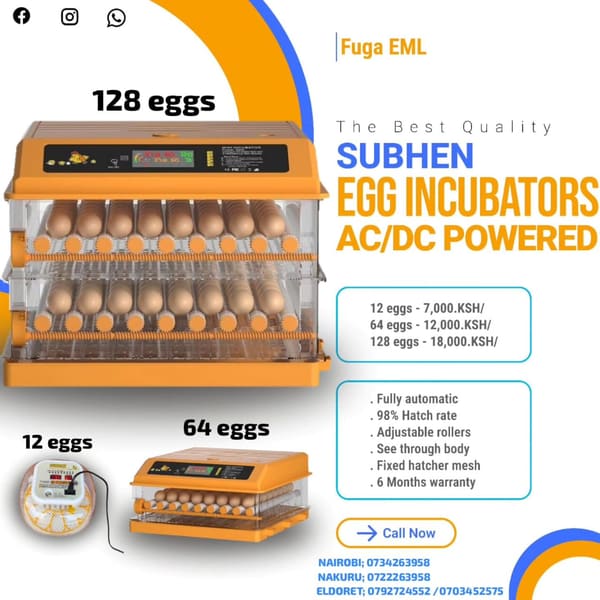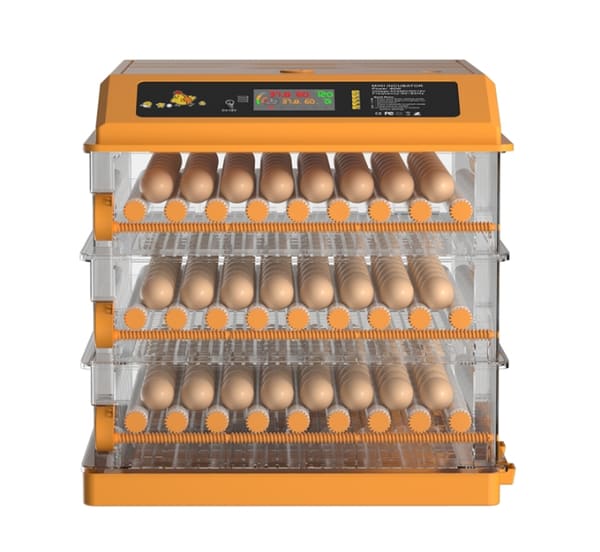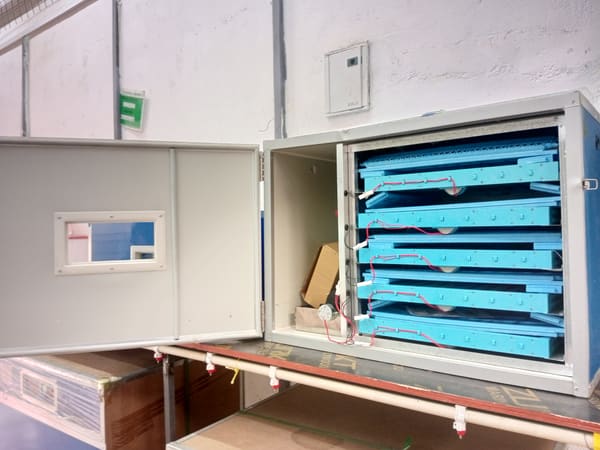
A cabinet incubator is for a farm that hatches its own stock or sells day-old chicks, and the first question is not the price but the arrangement: how many eggs go in the setter, how many in the hatcher, and how the machine copes with a power cut. Fuga lists Broody cabinet incubators of 300 to 2,112 eggs for hatcheries and groups.
Cabinet incubators are a big purchase and a big commitment: a full machine is hundreds or thousands of eggs, and a mistake in the first week costs a whole batch. This guide gives you the questions to ask, using what Fuga's egg incubator price page and the size pages say, and without prices.
What cabinet models does Fuga list?
The price page lists cabinet incubators across the sizes 176, 210, 264, 300, 350, 352, 528, 1,056 and 2,112 eggs. Many carry a name with two numbers, for example 264*264 and 264*88, or 1056*528. Fuga's pages say that models of the same capacity differ in build and in the hatcher arrangement, and that the price follows; they do not say what the second number stands for. Ask the branch to explain it for each model. For some sizes there is a page of its own: 176-egg, 264-egg, 352-egg and 2,112-egg.
What is the difference between a setter and a hatcher?
Fuga's 264-egg page puts it plainly: chicken eggs take 21 days, 18 in the setter and 3 in the hatcher. The setter is where eggs are warmed and turned; the hatcher is where they spend the last days and hatch. Larger operations use both so that one is always filling and the other is hatching. Our guide to setter versus hatcher explains why a separate hatcher helps, and our guide to lockdown on days 18 to 21 covers the last days.
| Question to ask the branch | Why it matters |
|---|---|
| What do the two numbers in the model name mean? | It tells you how the setter and hatcher capacities differ |
| How many eggs does the setter hold, and how many does the hatcher hold? | A hatcher smaller than the setter limits how often you can set |
| Is turning automatic, and can I see it running? | Turning failures are a common cause of poor hatches |
| What controller does it have, and is a spare in stock? | The controller ties the machine together; see our spare parts guide |
| What power does it need, and what happens in a cut? | A power cut can ruin a batch; plan backup power before you buy |
| What is the warranty, and who installs and services it? | Fuga says every machine has at least a one-year warranty and a technical team for installation and maintenance |
Write the answers down for each model you compare. A cabinet that looks cheaper may leave out a hatcher, a controller or a stand, so compare what is included, not only the headline.
How do I check my plan first?
Fuga's price page says to count the eggs you will set in one batch, choose the next size up, and that 300 eggs and above suits the Broody cabinet incubators. Before you spend, check three numbers. First, how many eggs you can gather each week: a big machine that you fill with old eggs hatches poorly. Second, your market: day-old chicks must be sold quickly. Our guide to starting a hatchery business covers the business side. Third, your power. Our guide to 300 to 350 egg incubators and the one on the 528-egg incubator and 1,056-egg incubator go through the size decision in more detail.
What site does a cabinet need?
A cabinet incubator needs a clean room with steady ambient temperature, good ventilation and a level floor. It also needs a safe mains connection fitted by a licensed electrician, water for humidity and a place to clean trays and baskets. Our guides on hatchery record keeping and farm biosecurity explain the habits that turn a machine into a hatchery that works.
What should I put in the quote?
- The exact model name and the capacity of setter and hatcher.
- Everything included: trays, baskets, controller, stand, cables.
- The delivery cost and timing to your town, which Fuga's pages say are confirmed for your order.
- The warranty in writing and who to call for service.
- The payment arrangements, which Fuga's product pages say are arranged with your branch when you order.
Prices for every size are on the price page as guide prices from Fuga's stock list; confirm them and the stock with your branch before you travel.
A worked example: a group planning weekly hatches
A farmers' group wants to hatch chicks every week for its members. They gather eggs from member farms twice a week, so a batch built from eggs of mixed age is a risk they must plan for: they agree to collect only clean eggs and to set within a short window, using the guidance in the egg handling guide. They look at a cabinet in the 300 to 528 egg range, because that is where their weekly egg count falls, and they ask the branch about the setter and hatcher capacities of two models of the same size. They also ask who will clean and run the machine, because a machine nobody owns is a machine that fails. The group puts the answers in a one-page plan and asks for a quote that lists the machine, the controller and the spares together.
What do I need to run a cabinet well day to day?
A person who owns the machine. Cabinets need a daily routine: check the temperature and humidity displays against a separate thermometer and hygrometer, check the water for humidity, listen for fan or motor noise, and write the readings down. They need a cleaning routine between batches and a place to wash trays and baskets. They need a plan for the days when the person is away. The best machine in the best room still fails when nobody is responsible for it, so decide who that person is before you order.
How Do I Get a Price or Stock Check From Fuga?
Bring your hatching plan to the branch: how many eggs you will set, how often, and how many days ahead you want to order. Ask to see the cabinet you are considering and which spares are in stock for it.
Fastest route: tap here to WhatsApp Fuga on 0716 961 018 with this guide's name already in the message, or call 0734 263 958. Tell the branch your town, what you want to do with the machine and, if you can, the power you have on site. Our full price list shows the stock list, and each product page shows a guide price you can confirm.
Fuga's product pages say that stock is held across six branches and that you should message to confirm the branch nearest you has the item before you travel. They also say equipment is sent to customers countrywide (tell your town on WhatsApp and the cost and timing are confirmed for your order), that every machine carries a minimum one-year warranty with a technical team for installation and maintenance, and that payment is arranged with your branch when you order. The six branches are:
- Nairobi Main, Ngara: City View Plaza, Musindi Rd · 0734 263958
- Nairobi, Haile Selassie Ave: Gogo Mall, Shop B51 · 0746 080808
- Eldoret, Uganda Road: Opp. Eldo-centre Quickmart · 0703 452575
- Eldoret, Langas: Sokoni, behind Langas Stage · 0792 724552
- Nakuru: Lee Njiru Rd, Wamotho House Rm 35 · 0722 263958
- Coast, Kanamai: Mombasa-Malindi Rd · 0780 263958
Key Takeaways
- Fuga lists Broody cabinet incubators from 176 to 2,112 eggs and says 300 eggs and above suits cabinets for hatcheries and groups.
- Model names carry two numbers, and Fuga's pages say models of the same capacity differ in build and hatcher arrangement: ask what each number means.
- Fuga's 264-egg page says chicken eggs take 21 days: 18 in the setter and 3 in the hatcher.
- Plan eggs, market, power and spares before you buy, and compare what each quote includes.
- Get the warranty, delivery and payment terms in writing.
Frequently Asked Questions
What is the difference between the 264*264 and 264*88 models?
Fuga's 264-egg page says models of the same capacity differ in build and in the hatcher arrangement. It does not explain the numbers, so ask the branch to show you both and explain what each number means.
How many days do eggs spend in the setter?
Fuga's 264-egg page says chicken eggs take 21 days, 18 in the setter and 3 in the hatcher.
Which size cabinet suits a small hatchery?
Fuga's price page says 300 eggs and above suits the Broody cabinet incubators. Count the eggs you will set in a batch and pick the next size up, and check your market and power first.
What happens in a power cut?
A short outage usually recovers; a long one can lose a batch. Plan backup power such as an inverter and battery, a generator or solar, and ask the branch to size it with you.
Does a cabinet incubator come with a warranty?
Fuga says every machine carries at least a one-year warranty, with a technical team for installation and maintenance. Ask for the terms in writing.