Rabbits are the easiest livestock in Kenya to start badly. A doe costs little, a carpenter will knock up a box in an afternoon, and within four months you can have thirty animals. That speed is exactly the trap: a unit that was built wrong multiplies its mistakes as fast as it multiplies its stock.
Walk onto a failing rabbit unit and you usually smell the problem before you see it. Ammonia at nose height, damp timber under the cages, and a doe breathing through a blocked nose. None of that was bad luck or bad breeding. It was a hutch that trapped air and held urine.
This guide takes the equipment first, because equipment is what you can control: hutch design, cage wire, feeders and drinkers, nest boxes, feed storage, manure collection, records and biosecurity. It ends with a plain look at what the market for rabbit meat in Kenya really is.
Ventilation and Drainage Beat Floor Space Every Time
Ask a new farmer how big a rabbit cage should be and you get a floor area. Ask how the air moves through it and you get silence. Yet respiratory disease, not crowding, empties most small rabbit units in this country, and the mechanism is simple. Rabbit urine is rich in nitrogen, and once it sits on timber, soil or a flat tray it releases ammonia, which irritates the airway lining and strips its defence against the bacteria behind the condition farmers call snuffles. The animal did not catch a cold. It was burned slowly by the air in its own house.
So design for airflow and drainage before you argue about centimetres. Raise the unit on legs so air passes underneath and you can sweep beneath it. Leave the long sides as wire rather than solid board, so a breeze crosses the cage instead of stopping at a wall. Overhang the roof and leave a gap under the eaves, because warm, ammonia-laden air rises and needs an exit above the animals.
Then deal with the liquid. A mesh floor lets droppings and urine fall straight through, and a tray sloped to one end carries urine to a jerrican instead of pooling under the cage. A flat tray is a false economy: it collects, it stagnates, and it gasses the animals it was meant to protect.
Only once air and water are handled does size matter: a doe with a litter needs room to stretch out full length, turn and get away from her kits, plus space for a nest box that does not fill the cage.
Cage Wire and Gauge: Where Cheap Becomes Expensive
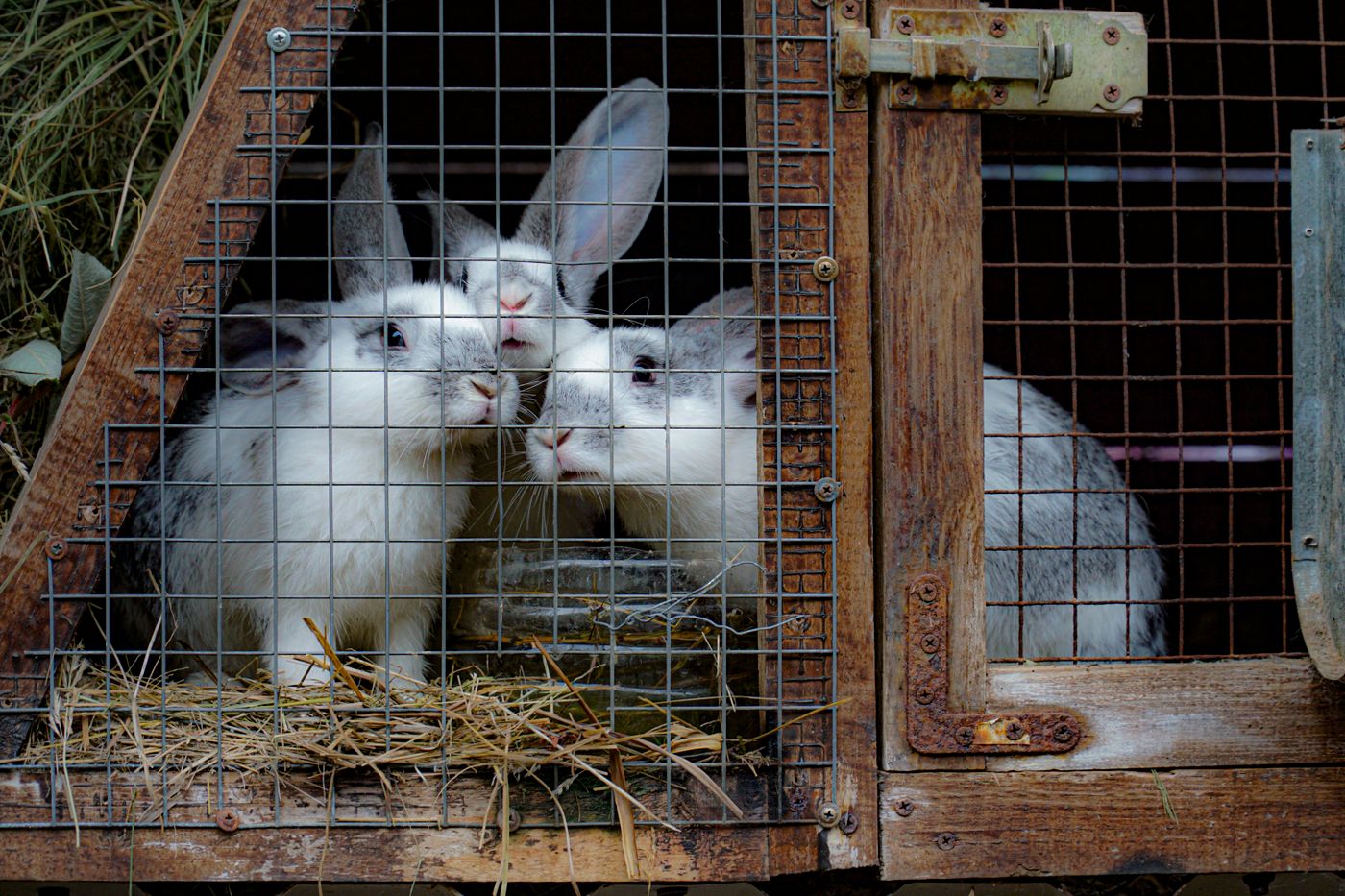
The most common build error in Kenyan rabbit units is hexagonal chicken netting used as a cage floor. It sags into a hammock under the animal's weight, the thin galvanising wears off at the flex points, and rust follows within a season. Rabbits then develop sore hocks, the pressure sores on the underside of the foot that come from resting on a damaged surface.
Use welded mesh, and use two meshes for two jobs. Floors need a fine rectangular mesh, commonly around 12.5 by 25 millimetres, small enough that a foot cannot drop through but open enough that droppings pass. Sides and tops take a coarser square mesh, commonly around 25 by 25 millimetres, which keeps kits in and predators out while letting air move.
Gauge is the wire thickness, and it is the number people skip. Thin wire flexes underfoot, and flex breaks the zinc coating and starts the rust, so ask for a heavier gauge on the floor panel than on the sides. Ask also whether the mesh is galvanised after welding, because welding burns the coating off at each joint, and coating applied afterwards protects exactly the points that fail first.
Timber belongs in the frame, the roof and the nest box, never under a cage, where it absorbs urine and becomes a permanent ammonia source that no cleaning undoes.
Feeders and Drinkers a Rabbit Cannot Foul
A rabbit will sit in a dish, kick litter into it and urinate in it, so open bowls on the cage floor waste feed, spread coccidiosis through faecal contamination, and make daily intake impossible to judge.
For dry feed, use a hopper feeder, often called a J-feeder, hung outside the cage wall with a lipped trough projecting inside. It refills without opening the door, the rabbit cannot stand in it, and only a small amount sits exposed at a time. A perforated trough base lets dust and fines fall through instead of collecting into a sour paste.
For water, choose between a nipple line and hanging bottles. Nipple drinkers, the same principle covered in our guide to poultry feeders and drinkers, keep water sealed from tank to mouth and scale well across a bank of cages. Bottles suit a handful of hutches, but check them by hand every day: a blocked nipple or air-locked bottle looks completely normal from two metres away, and a doe in milk that goes a day without water stops feeding her litter.
Nest Boxes and the Week Around Kindling
Rabbit kits are born blind, hairless and unable to regulate their own temperature. They survive on the nest their mother builds, and that nest depends entirely on the box you give her. Get the box wrong and you lose whole litters in the first three nights.
A nest box is a simple thing done precisely. Just big enough for the doe to turn in, with an entrance lip high enough that kits are not dragged out when she leaves and low enough for her to hop in without landing on them, a base that drains, dry bedding of clean hay or shavings, and a removable lid for inspection.
Timing matters as much as the box. Gestation runs around 31 days, so the box goes in about three days before the doe is due, long enough for her to arrange bedding and pull fur but not long enough to foul it. Inspect each morning: count the kits, remove any that have died, and write it on the cage card. A doe nurses only briefly, usually once or twice in twenty four hours, so do not read an absent mother as a rejecting one.
One handling rule saves a lot of trouble: carry the doe to the buck's cage, never the buck to hers, because does defend their own space and will attack an intruding buck. Record the service date at the moment you do it, since a date you intend to remember is a date you will guess at four weeks later.
Feed Storage, and the Pellets Versus Forage Question
Rabbits are herbivores with a hind-gut fermentation system that needs fibre to keep moving, and that biology sits behind the pellets versus forage argument. Neither extreme works well on a commercial unit in Kenya.
Pellets give a known protein and fibre content in every mouthful and let you calculate cost per kilo of gain. They are also the largest running cost you will carry. Forage such as sweet potato vines, lucerne, desmodium and good hay costs far less and is what most Kenyan smallholders rely on, but its protein content is variable and unmeasured, so growth is slower and finishing dates drift.
Most successful units run both: pellets as the measured base, particularly for does in milk and growers being finished, with forage supplying volume and fibre. Wilt fresh greens for several hours rather than feeding them wet from the shamba, and introduce new forage gradually, because a sudden diet change in a hind-gut fermenter causes digestive upsets that kill young rabbits quickly.
Storage is where feed budgets are quietly destroyed. Pellets absorb moisture, crumble, then mould, and mouldy feed is not merely wasted but actively toxic. Store on a raised pallet clear of the wall, in rodent-proof drums rather than open bags, and buy quantities you will finish in weeks. If you mill your own ingredients, our note on the economics of a feed pelletizer covers when on-farm pelleting starts to pay.
Urine and Manure: The Second Product
Rabbit manure is one of the genuinely good stories in this enterprise, and new farmers ignore it because it is not glamorous. Droppings arrive as dry, discrete pellets that are easy to sweep, bag and sell to horticulture growers, and they are far less likely to scorch young plants than fresh poultry or cattle manure. If you built a mesh floor and a tray, you are already collecting them cleanly.
Urine is the more valuable half and the more commonly wasted. It is high in nitrogen, and vegetable and coffee growers buy it as a diluted foliar feed. Collecting it costs almost nothing if you build for it: slope the tray, run it into guttering, and lead that to a sealed jerrican, sealed because an open container in the sun loses nitrogen to the air as ammonia.
Treat this as part of the plan, not a bonus: unlike rabbit meat, the demand for manure is local, year round and needs no licence.
Weighing and Records: How a Breeding Unit Actually Improves
Without a scale and a notebook you are not running a breeding programme, you are keeping rabbits. The difference shows in the second year, when one farmer knows which does wean big litters and which eat feed for eight kits and wean four, while the other still thinks all his does are fine.
The equipment is modest: a hanging or platform scale with fine graduations, and a card tied to every cage. Weigh at fixed points rather than randomly, so the numbers compare. Weaning weight and weight at sale tell you the most, and a doe's weight before service tells you whether she is fit to carry a litter.
Keep the card short enough that you will actually fill it in: doe and buck identity, service date, expected kindling date, kits born, kits weaned, weaning weight, treatments given. That is enough to cull the bottom does and select replacements from the best mothers rather than the prettiest animals. Handling and treatment kit is covered in our livestock handling and veterinary equipment guide.
Biosecurity on a Small Unit
Rabbits are dense stock in a small space, so a disease that gets in travels fast, and the controls are cheap and mostly behavioural. Quarantine every incoming animal for a couple of weeks and watch its ears, nose and droppings. Buy breeding stock from one known source rather than three market traders. Keep visitors from walking between cages, handle your youngest animals first each day and suspect ones last, and wash nest boxes between litters.
Three problems dominate small Kenyan units. Coccidiosis spreads through faecal contamination of feed and water, which is exactly what off-floor feeders and sealed drinkers prevent. Ear mange shows as crusts inside the ear, easy to treat early and miserable to treat late. Respiratory disease takes you back to ventilation and drainage. Know a veterinary officer before you need one at short notice.
The Market for Rabbit Meat in Kenya, Honestly
Here is the part the promotional talk leaves out. Kenya has been through more than one rabbit boom, and the pattern repeats: farmers are recruited with promises of guaranteed offtake, everyone breeds up at once, the buyer does not materialise or cannot absorb the volume, and animals that cost money to feed have nowhere to go. The biology is easy. The market is not.
Rabbit meat is a niche product here. It is not a staple in most Kenyan kitchens, few butcheries carry it, and reliable demand sits with specific outlets: hotels and restaurants with a particular menu, health-conscious urban buyers, direct customers ordering a dressed carcass, and the breeding stock trade. Formal sale also meets an infrastructure gap, because licensed rabbit slaughter and cold chain facilities are thin on the ground compared with poultry.
None of that makes rabbit farming a bad enterprise. It makes it a marketing enterprise with a production component rather than the reverse. The farmers who do well treat selling as the main job: named customers, dressed and chilled rather than live where they can, consistent quality, breeding stock sold locally, and the manure income banked. Start small, prove you can sell every animal you produce, and only then let the biology do what it does so easily.
Key Takeaways
- Ventilation and drainage decide rabbit health more than floor area does. Ammonia from pooled urine opens the door to respiratory disease.
- Raise the unit on legs, wire the long sides, overhang the roof with an open eaves gap, and slope every tray to a sealed container.
- Use welded mesh, not hexagonal netting: fine rectangular mesh for floors, coarser square mesh for sides, heavier gauge, galvanised after welding.
- Hopper feeders mounted outside the cage and nipple drinkers stop the fouling that spreads coccidiosis.
- Gestation runs about 31 days: nest box in around day 28, inspect every morning, and take the doe to the buck.
- Pellets as the measured base, forage for fibre and volume, greens wilted, diet changes gradual, feed stored dry and rodent-proof.
- Collect droppings and urine deliberately: they can carry part of the feed bill while your meat market is still forming.
- The market is thin in many parts of Kenya. Secure a buyer at small scale before you build for large scale.
Frequently Asked Questions
What wire mesh should I use for a rabbit cage floor in Kenya?
Use welded mesh, never hexagonal chicken netting. A fine rectangular floor mesh of roughly 12.5 by 25 millimetres supports the foot while letting droppings fall through, and a heavier gauge galvanised after welding resists the rust that starts at the weld points. Sides and tops can use a coarser square mesh of around 25 by 25 millimetres.
How long are rabbits pregnant, and when do I put in the nest box?
Rabbit gestation runs around 31 days. Put the nest box in about three days before the doe is due, with clean dry bedding, so she can build the nest without living in the box long enough to soil it. Inspect every morning from day one, counting kits and removing any that have died.
Are pellets or forage better for rabbits?
Both, in combination. Pellets give measurable protein and predictable growth, which matters most for does in milk and growers being finished. Forage is far cheaper and supplies bulk and fibre, but is variable, so growth slows on forage alone. Wilt fresh greens before feeding and change diets gradually.
Is rabbit farming profitable in Kenya?
It can be, but not automatically and not at the speed the promotional talk suggests. Rabbit meat is a niche product with thin butchery presence and limited licensed slaughter facilities, so the buyer, not the doe, is the constraint. Farmers who succeed sell direct to named customers, sell breeding stock locally, and earn from manure as well as meat. Secure your outlet before you scale.
What equipment do I need to start a small rabbit unit?
Raised cages with welded mesh floors and sloped urine trays, hopper feeders mounted outside the cages, nipple drinkers or bottles, one nest box per breeding doe, a dry rodent-proof feed store, a weighing scale, cage record cards and a basic treatment kit. For options and indicative pricing see our livestock and poultry equipment range and the price list, then confirm on WhatsApp, since stock and prices move.