
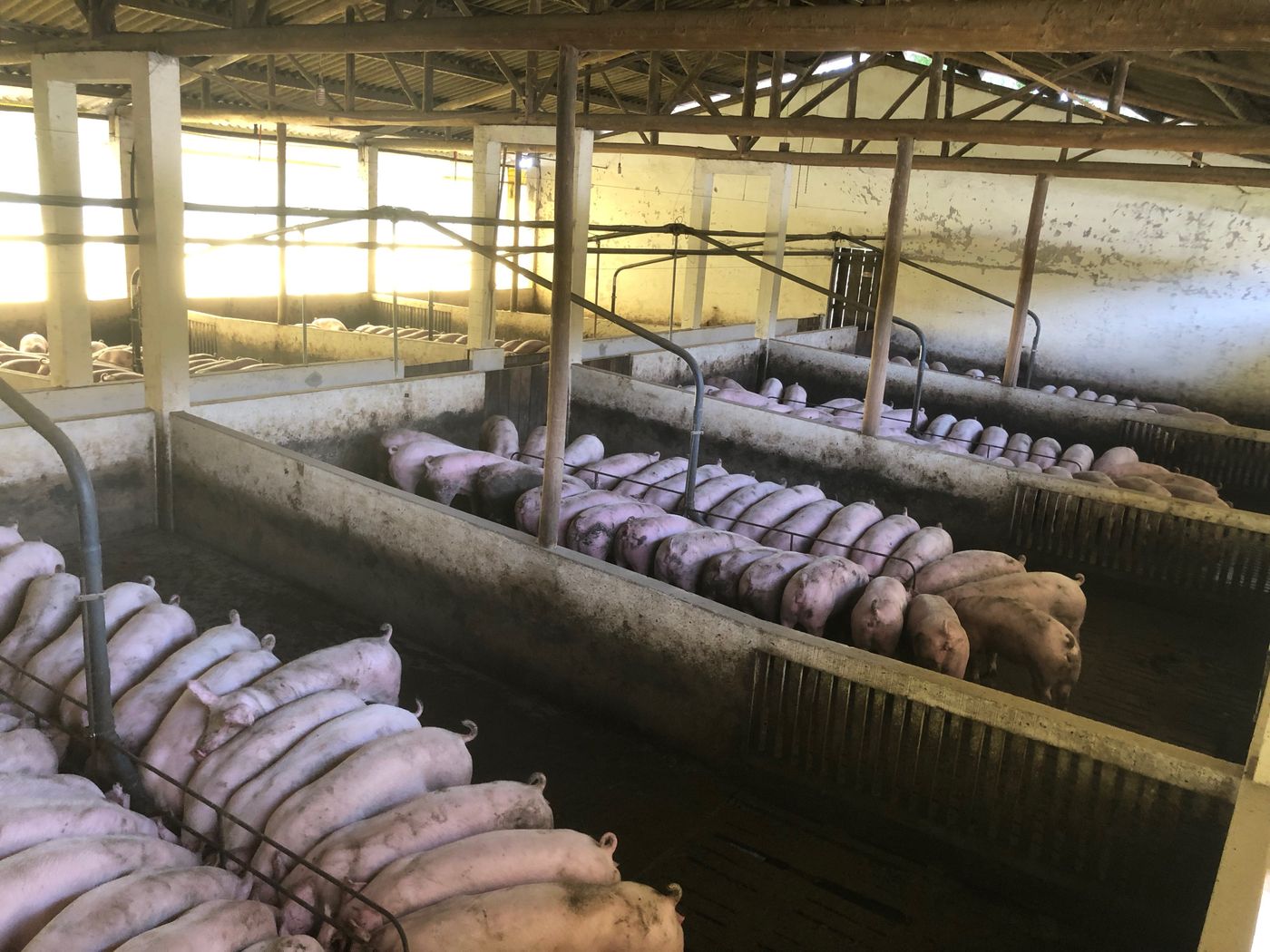
Walk onto two pig units in the same sub-county and you can predict the profit before anyone opens a record book. On the first, the pens are dry, the dunging corner drains to a channel outside the wall, and the finishers lie flat and quiet. On the second, the trough is a shallow puddle and every pig is standing, because there is nowhere clean to lie down.
Pigs convert feed into meat faster than almost anything else a Kenyan farm can keep, but that efficiency is fragile. Most of what damages a unit, from wasted meal to scours to crushed piglets, traces back to a physical detail: a floor that holds water, a drinker at the wrong height, a creep with no heat.
This guide takes the equipment view: housing, drainage, drinkers, farrowing creeps, feed, water, waste and weighing.
Read the Climate Before You Draw the Pen
Pigs cannot sweat. They shed heat by lying on cool surfaces, by panting and by wallowing, which is why a hot pig lies in its own dung if given nowhere better. That fact drives the housing design.
Altitude sets two opposite problems. Around Eldoret, Nakuru and the Rift, days are manageable but nights are cold, and draughts chill young stock. Near the Coast, the enemy is heat stress in heavy finishers and lactating sows, which eat less whenever the house stays warm all night.
The answer is the same building, tuned differently. Run the long axis east to west so the low sun strikes the short walls, keep the eaves high, and extend the overhang so rain cannot drive in. Open sides with a low solid wall and rails above give cross ventilation for free, and canvas curtains on the windward side, dropped at night and rolled up by mid-morning, control draughts without sealing the house. Iron sheets radiate heat downward by afternoon, so at the Coast a higher ridge and a ceiling board over the lying area repay their cost quickly.
Pen Layout: Work With the Pig, Not Against It
Given space, pigs divide a pen into three zones on their own: a dry bed, a feeding area, and a dunging area as far from the bed as they can get. A cramped or badly drained pen makes that impossible, and then the whole floor becomes the dunging area.
Make pens deeper than they are wide. Put the trough at the front against the service passage so you feed without entering, and the drinker and drainage fall at the back, so the wet zone is the far zone. Solid walls to chest height stop nose contact between pens, with rails above so air still moves.
Space allowance is the number people cut first and regret longest. Overcrowded pigs fight, tail bite, grow unevenly and foul their beds, so plan floor area by growth stage.
Floors and Drainage: Where Pig Disease Is Won or Lost
Concrete is the most valuable structure on a pig unit and the easiest to get subtly wrong. Cast it on compacted hardcore, thick enough for daily scraping, and finish with a wood float or light broom texture. Polished concrete is slippery, and slipping causes leg injuries and splay-legged piglets; gritty concrete abrades knees, hocks and a suckling sow's teats.
Give the floor a fall of roughly one in forty toward the dunging end so urine and wash water leave rather than pool, and discharge it into an open channel outside the pen wall, never across the passage where your boots walk. An open channel can be scraped and inspected. A buried pipe blocks, and nobody notices until the pens flood.
Partly slatted floors over the dunging area cut cleaning labour, but the slat gap must match the stock: a gap sized for finishers will trap a weaner's foot.
Feeders and Drinkers, Including Nipple Drinkers
Feed wastage is the quietest way to lose money, because nothing looks wrong: a pig that roots meal out of an overfilled trough and treads it into the floor has still been fed, on paper. The fix is trough design. A good trough has an inward-turning lip that throws rooted feed back in, a depth suited to the class of pig, and dividers so a boss pig cannot walk its length. Feeding by ration, allow every pig enough trough edge to eat at once. For ad-lib growers, a hopper feeder works well.
Water is where nipple drinkers change the game. An open bowl in a pig pen is a toilet within hours, and pigs will not drink freely from fouled water, while a cup nipple or bite drinker delivers clean water on demand and cannot be fouled.
Three details decide whether they work. Height: mount the nipple at the shoulder height of the smallest pig in the pen and raise it as the batch grows, because a drinker left low forces a finisher to kneel and it will drink less. Flow rate: a trickle frustrates a thirsty pig and a torrent soaks the floor. Position: site drinkers over the dunging end, where spillage lands on drainage. Fuga carries these and other livestock drinking equipment.
Water Supply: The Input That Sets Feed Intake
Water intake and feed intake move together: a pig short of water eats less and grows slower, and a lactating sow produces less milk. Weaners drink a few litres a day, finishers considerably more, and a lactating sow is the heaviest drinker on the farm, so size the supply for sows in the hottest week of the year.
Gravity beats mains pressure for consistency. A tank a few metres above the drinker line gives steady flow, keeps working through a supply cut, and lets you dose treatments into a known volume. Fit a filter ahead of the line, since grit jams nipple drinkers, and add a flush point at the end of each run. Our farm plumbing guide covers pipe sizing and joints that survive livestock.
Farrowing: Crates, Creep Areas and the Piglets You Keep
The first seventy-two hours after birth decide the profitability of a breeding unit. Piglets are born with almost no fat reserve and no way to keep themselves warm, and the two things that kill them, chilling and crushing, are equipment problems as much as management ones.
A farrowing crate holds the sow in the centre of the pen so she must lie down in a controlled way, with rails stopping her rolling onto a piglet. If a crate is beyond budget, a creep rail fixed a hand's width off the wall and above the floor still gives piglets an escape space.
The creep solves the temperature conflict at the heart of farrowing. A newborn wants a bed near body warmth, while the sow, carrying far more body mass, suffers in that heat. Room temperature cannot satisfy both, so hold the room at the sow's comfort and heat a small piglet corner with an infrared lamp or heat pad.
Hang the lamp from a chain rather than its flex, fit a guard, and keep the cable away from the sow. Then read the piglets, not the thermometer: a tight heap is too cold, piglets pushed to the edges and panting is too hot, a loose group in contact but not piled is right.
Feed Handling: Is Mixing Your Own Worth It?
Feed dominates the cost of a finished pig, so every serious producer eventually asks whether to mix their own.
Mixing works only when four conditions hold together: reliable ingredients such as maize germ, wheat pollard and oilseed cake; a hammer mill and mixer; dry, vermin-proof storage, since a tonne of meal spoiled by damp erases months of savings; and an accurate scale, because a home ration is only as good as the weighing behind it.
Three failures sink most attempts: cheap maize carrying aflatoxin, to which pigs are sensitive; skipping the premix, which starves the ration of the amino acids, vitamins and minerals that drive growth; and under-mixing, which gives some pigs a concentrated dose and others none.
As a rule of judgement rather than a formula: below roughly thirty to forty pigs on feed at a time, the savings rarely repay the equipment, labour and risk. Above that, with a steady supplier, milling starts to make sense, and our feed pelletizer payback analysis works through the same arithmetic. Whatever you feed, store it on pallets, clear of the wall, oldest first, in a dry room closed against rodents.
Waste Management and the Biogas Option
How you handle manure decides whether it is a liability or an asset. Separate the streams: scrape solids dry into a barrow before you wash anything, because every litre of water added to manure turns fertiliser into an effluent problem. Site the pit or composting bay downslope of the piggery, well away from and below any borehole or shallow well, and roof it so rain does not turn a heap into runoff.
Pig slurry is one of the best biogas feedstocks on a Kenyan farm, and a digester, fixed-dome masonry or tubular bag, turns a disposal cost into cooking gas plus liquid fertiliser. Size it on the weight of fresh manure you actually collect each day, measured over a week, rather than on a headcount. Then keep strong disinfectants and medicated wash water out, because they kill the bacteria doing the work, and treat digestate as a soil fertiliser rather than something to splash on vegetables close to harvest.
Weighing and Records: The Cheapest Upgrade on the Farm
You cannot negotiate the price of a pig you have not weighed, and every buyer knows it. A platform scale with a weigh crate, or a digital weighing scale for smaller stock and feed, pays for itself in a few sales. Without one, a heart-girth tape beats an eye guess.
Weighing also unlocks the one number that tells you whether your feeding works: feed conversion ratio, kilogrammes of feed used per kilogramme of liveweight gained. Without a weight in and a weight out, you can change ration or supplier and never know if it helped.
Keep one card per pen: date in, number of pigs, starting weight, feed issued, mortalities, treatments and withdrawal dates, then date out and weight out. It is the same discipline as in our livestock handling and veterinary equipment guide.
What a Small Unit Actually Needs
The magazine photograph shows stainless feed lines, slatted floors and automated ventilation, a system built for a labour cost and a scale most Kenyan units do not have. Copying its finish rather than its logic wastes a year's capital.
A sound starter unit is unglamorous: three or four well-drained pens with proper fall and an outside channel, one farrowing pen with a crate or creep rail and a heat lamp, nipple drinkers on a gravity line from a raised tank, a dry lockable feed store, a scale and a scraper. Biosecurity is equipment too. African swine fever has no vaccine and no treatment, so a single entrance, a charged footbath and boots that stay on the farm are the cheapest insurance you can buy.
Spend in this order: drainage, water, feed storage, farrowing, then automation. Costs move with materials, stock and the exchange rate, so treat any figure you read online as indicative. Start from the Fuga price list and ask us to quote your pen count.
Key Takeaways
- Pigs cannot sweat, so ventilation, roof height and shade do the cooling, especially at the Coast.
- Design pens so lying, feeding and dunging fall where the pig would put them anyway.
- Slope the floor about one in forty into an open channel outside the pen, never across the passage.
- Nipple drinkers stop fouling only if height, flow and position are re-checked as the batch grows.
- Heat the creep, not the room, and let the piglets tell you if the lamp is right.
- Below thirty to forty pigs on feed, bagged feed usually beats milling your own.
- Scrape manure dry before washing, and size any biogas digester on measured daily manure weight.
- A scale and a pen record card are the cheapest profit upgrades on a pig farm.
Frequently Asked Questions
How much space does one pig need in Kenya?
Plan by stage, not by an average. A weaner needs roughly 0.4 square metres of floor, a grower around 0.6 and a finisher about 1.0, while a dry sow needs roughly double a finisher and a boar needs a strong pen of his own. Build for the weight the pig will reach.
Are nipple drinkers better than water troughs for pigs?
Yes, in almost every case. An open trough is fouled within hours and pigs then drink less, which cuts feed intake and growth. Nipple and cup drinkers deliver clean water on demand. Mount them at the shoulder height of the smallest pig, raise them as the batch grows, and site them over the dunging end.
Is it cheaper to mix my own pig feed?
Only at scale and with discipline. You need a steady ingredient supply, a hammer mill and mixer, dry vermin-proof storage, an accurate scale and a proper premix. Below roughly thirty to forty pigs on feed, the equipment, labour and aflatoxin risk usually outweigh the saving.
What pig equipment does Fuga supply and what does it cost?
Drinkers including cup nipples, feeding and watering equipment, weighing scales, veterinary tools, water tanks and pumps. Prices move with stock and the exchange rate, so check the price list for guidance and confirm the current figure on WhatsApp at wa.me/254716961018, call 0734263958 or visit any branch.