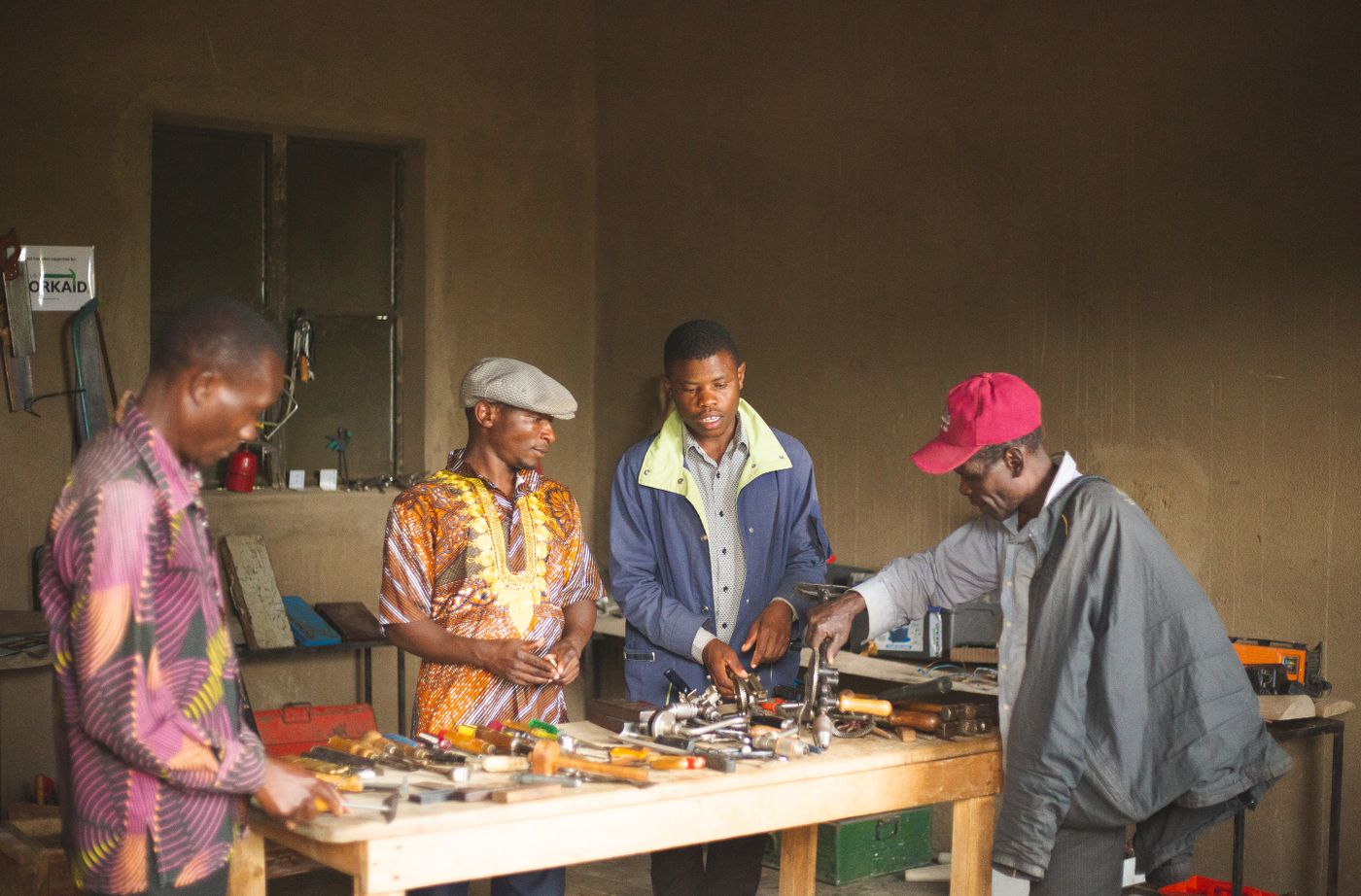
Every farm has a place where things get fixed. Often it is the back of the store, a corner of the veranda or a spot under a tree, and the "bench" is an upturned crate or the ground. A broken sprayer lance gets held between the knees while someone hacksaws it. A chaff cutter blade is sharpened while a second person holds it still. A gate hinge is welded flat on the soil. The work gets done, eventually, but it is slower, less accurate and far more dangerous than it needs to be.
A solid workbench with a properly mounted vice changes all of that. It gives you a third hand that never gets tired, a flat surface to measure and mark on, a place to bolt down a drill press or bench grinder, and a home for the tools so they are not lost in the grass. For a farm or a small jua kali shop it is probably the single most useful piece of workshop equipment that does not plug in.
This guide covers where to put the bench, how big and how high to make it, how to build a strong welded steel frame, how to choose and mount a vice, which clamps to add, and how to keep it all working through the short rains. The dimensions given are common practical starting points; adjust them to the people who will use the bench and the work they do.
Where to Put the Bench
Put the bench where the work naturally happens, under a roof, with good light and power within reach. Daylight from a window or open side is best for marking and filing; add a light over the bench for evenings and dull, rainy afternoons. A fixed socket near the bench is safer than a long extension lead trailing across a wet floor. Our guide to extension cables and electrical safety explains what to check if a lead is unavoidable.
Leave space around it. Long work, such as a length of pipe or a gate rail held in the vice, needs clear room at both ends. Welding needs a clear area free of hay, fuel and sawdust. A dry floor matters too: a concrete pad under the bench keeps your feet out of the mud and stops the legs rusting, and it is a good small job for the season if the workshop floor is still earth.
Size and Height: Build It for the People Who Use It
A bench that is too low makes you stoop over every job, which is tiring and leads to poor control. One that is too high puts your shoulders up around your ears when filing or sawing. Two common rules of thumb help.
For general bench work, many fitters set the top around the height of the user's wrist or slightly above it when standing with arms relaxed. For work in the vice, the traditional fitting-shop guidance is that the top of the vice jaws should be roughly level with your elbow when you stand upright at the vice. That puts a file or hacksaw stroke level and lets your body weight help rather than your wrists. Because the vice adds its own height on top of the bench, choose the vice before you fix the bench height.
For depth, a bench somewhere around 600 mm front to back lets you reach the back without leaning across, and a length of about 1.5 to 2 metres fits a vice at one end, a machine at the other and room to work in between. If several people of very different heights share it, set it for the person who uses it most and keep a sturdy, flat platform for shorter users rather than building it low for everyone.
Building a Welded Steel Frame That Does Not Wobble
A wobbling bench ruins accurate work and makes hammering in the vice dangerous. The fix is mass and triangles. A welded steel frame in heavy angle iron or square tube, with a full rectangular frame at the top, a second rectangular frame low down near the floor, and diagonal braces on the back and ends, will stay rigid for decades.
Cut all four legs together to the same length so the bench stands level. Tack the top frame first on a flat floor and check its diagonals: when the two diagonal measurements are equal, the frame is square. Then tack the legs on, checking each one with a square, before running full welds. Our guide to keeping welded frames square explains the tack sequence that stops the frame twisting as it cools. The low frame doubles as a shelf for heavy items such as a vice spare, a toolbox or offcuts, and that weight low down makes the bench even steadier.
For the top, two good choices suit most farms. Thick hardwood boards, bolted to the frame, are kind to tools and pleasant for woodwork, and can be replaced when worn. A steel plate top is ideal if you do a lot of welding and hot work, and can double as a welding table, though it rusts in damp weather unless kept oiled. Many shops use timber over most of the bench and a steel plate at the vice end. Whatever the top, bolt it down rather than nailing it, so the vice bolts have something solid to pull against.
Choosing a Bench Vice
Vices are sized by the width of their jaws. For general farm repairs, a mechanic's or engineer's bench vice with jaws of around 100 to 150 mm is a sensible range: big enough to hold a gate hinge or a section of pipe, small enough to mount on an ordinary bench. Look for these features:
- A solid body. Heavier vices made of good quality cast iron, or of steel, stand up to farm use. Cheap, light vices can crack under a hammer blow or a long lever.
- Smooth, square jaws. Close the jaws fully and hold them up to the light. They should meet evenly along their full width with no gap at one end.
- Replaceable serrated jaw plates that grip firmly and can be swapped when worn.
- A swivel base, which lets you turn the work to face the light or to clear the bench, then lock it.
- Pipe jaws under the main jaws, useful on farms where plumbing repairs are common.
A woodworking vice, which mounts flush under the bench edge with wide timber-faced jaws, is a separate tool. If you do a lot of joinery, fit one at the other end; for metalwork and general repairs, the engineer's vice comes first.
Mounting the Vice So It Stays Put
Mount the vice at a front corner of the bench, directly over a leg. Hammer blows then travel straight down the leg into the floor instead of flexing the top. Position it so the fixed jaw sits just beyond the front edge of the bench. That way a long bar or pipe held vertically in the vice can hang down past the bench edge instead of hitting it.
Fix the vice with bolts that pass right through the top, with large flat washers or a steel plate underneath, and nuts tightened hard. Screws into timber pull out the first time someone leans on a long lever. If the top is timber, a steel plate under the vice spreads the load and stops the bolts crushing into the wood. Use the drill press or a sharp bit to make clean holes; our drill press guide explains why a drill press makes this kind of accurate, square hole far easier.
Using the Vice Without Wrecking It, or the Work
A good vice lasts a lifetime if it is not abused. The commonest damage comes from a few habits:
- Never extend the handle with a pipe or hammer it tight. Hand pressure is enough. Extra leverage bends the screw or cracks the body.
- Hammer only on the anvil area, if the vice has one, and only for light work. Heavy forging belongs on a proper anvil.
- Use soft jaws on finished work. Covers of aluminium, copper, leather or hardwood slipped over the jaws protect threads, polished shafts and painted parts from the serrations.
- Hold work low in the jaws when sawing or filing, so it does not chatter, and support long work at the far end.
- Keep the screw clean and oiled. Brush off filings and grit, and oil the screw and slide regularly.
Clamps: The Rest of Your Third Hands
A vice holds small work. Clamps hold everything else to the bench. A small set covers most farm jobs: two or more G-clamps (C-clamps) for holding work to the bench top while drilling or welding; a pair of quick-release F-clamps or bar clamps for longer, lighter work and woodwork; and locking pliers, which grip and lock in one hand and are invaluable for holding parts during tack welding. Magnetic welding holders, at KSh 300 for the 3-inch and KSh 550 for the 4-inch at the time of writing on the Fuga price list, hold steel at right angles while you tack it.
Never hold work by hand under a drill press or while cutting with a grinder. A drill bit that catches can spin a sheet of metal like a blade. Clamp it every time; our workshop safety guide covers the rest of the basics.
Keeping the Bench Working Through the Short Rains
Damp air in October and November is hard on steel. Wipe the vice and any steel top with a lightly oiled rag at the end of the day, keep the bench under a sound roof, and lift tools off the bench onto a wall board where air can move around them. Hanging hand tools on a board with each outline painted behind it also shows at a glance when something is missing. Our guide to workshop tool storage and security covers rust prevention and keeping tools from walking away.
With the bench built, the next additions are the machines that bolt to it: a bench grinder for sharpening pangas, chisels and chaff cutter blades, covered in our bench grinder guide, and a drill press for accurate holes. For these and the hand tools to fill the wall board, see the workshop and industrial tools range, visit a Fuga branch in Eldoret, Nairobi or Nakuru, or WhatsApp 0716 961 018.
Key Takeaways
- Put the bench under a roof with good light, a fixed socket nearby, clear space at both ends and a dry floor.
- Set general bench height around wrist height, and the top of the vice jaws at roughly elbow height; choose the vice before fixing the bench height.
- A welded frame with top and bottom rectangles and diagonal braces, squared by checking diagonals, will not wobble.
- Choose a solid engineer's vice of around 100 to 150 mm jaw width with square-meeting jaws, and mount it at a front corner over a leg.
- Bolt the vice right through the top with a backing plate; never use screws, extend the handle or hammer heavily on the body.
- Clamp work for drilling and grinding every time, and oil the vice and steel surfaces through the damp short rains.
Frequently Asked Questions
How high should a workshop bench be?
A common rule of thumb is to set the bench top around wrist height for general work, and to have the top of the vice jaws roughly level with your elbow when you stand upright at the vice. Build it for the person who uses it most.
What size bench vice do I need for farm repairs?
An engineer's bench vice with jaws of around 100 to 150 mm wide suits most farm work, from gate hinges to pipe and sprayer parts. Choose a solid body, jaws that meet squarely, replaceable jaw plates and ideally a swivel base and pipe jaws.
Where should the vice go on the bench?
At a front corner, directly over a leg, with the fixed jaw just beyond the front edge. Hammer shock then goes straight down the leg, and long work held upright in the vice can hang past the bench edge.
Should a workbench top be steel or wood?
Hardwood boards are kind to tools and good for woodwork; a steel plate is best for welding and hot work but needs oiling against rust. Many shops use timber for most of the bench and a steel plate at the vice end.
Why does my vice not hold work tightly?
Worn or greasy jaw plates, jaws that no longer meet squarely, or grit in the screw are the usual causes. Clean and oil the screw, replace worn jaw plates, and never force it tighter with a pipe extension, which bends the screw or cracks the body.