The pickup came back from the wash bay with a bare patch of steel on the tailgate the size of a hand. Nobody had touched it with anything but water. The same afternoon the chaff cutter got its first wash in months, and two weeks later its bearing was screaming.
Both are pressure washer injuries, and both came from the same misunderstanding: that a pressure washer is a hosepipe with more push. It is a machine that puts a sheet of water onto a surface hard enough to break the bond between dirt and metal, and if the dirt happens to be paint, or the surface happens to be a seal, it breaks that bond too.
Used well, it is one of the most useful machines on a farm with sheds, vehicles and machinery to keep clean. This is what the two numbers on the box mean, when petrol beats electric, which nozzle goes on for which job, how to feed the machine without killing it, and the mistakes that cause most of the damage.
Bar Breaks the Dirt Loose, Litres per Minute Carry It Away
Every pressure washer is sold on two figures. Bar is pressure: how hard the water hits. Litres per minute is flow: how much water arrives to do the hitting and to flush what comes loose. One bar is roughly 14.5 psi, so a 150 bar machine is around 2,200 psi.
Marketing pushes bar because it is the bigger number. Cleaning is really the product of the two. Pressure breaks the bond between muck and surface; flow carries the broken muck away and keeps fresh water arriving. High bar with thin flow cuts a narrow, clean stripe and leaves the loosened dirt lying beside it. Modest bar with generous flow rinses a poultry house floor faster, because the litres do the moving.
Watch for the word maximum. Many cheap units quote a peak the pump touches for an instant when the trigger closes, then a much lower working pressure. The honest number is the rated pressure, and a machine that quotes 200 bar max and 130 bar rated is a 130 bar machine.
As a working guide, 100 to 130 bar with 6 to 8 litres a minute is a domestic tool for a car and a veranda. The 140 to 180 bar class with 10 to 15 litres a minute is where farm and workshop work starts, and 200 bar and above with 15 litres or more is commercial equipment for yards, lorries and daily shed washing. The machines in our machinery range sit across that spread, and the right one depends on what you wash and how often.
Electric or Petrol: Where the Socket Is Decides
An electric unit runs on single phase mains, is quiet, starts with a switch and needs almost no servicing. Its limits are the cable and the motor. It has to reach a sound socket, a long extension on thin cable drops voltage and cooks the motor, and a single phase motor tops out at roughly 150 bar and 10 litres a minute. Prefer induction motors over the small universal motors in the cheapest units; they run cooler and last years longer.
A petrol unit goes wherever a wheelbarrow goes, which on most farms is the point. The engine drives bigger pumps, so this is where 200 bar and 15 litres a minute live. The price is noise, fuel, and the discipline of clean petrol and pump oil changes on schedule. Where the poultry houses and the dairy are a long way from the workshop, a petrol machine on a trolley usually earns its keep, and an electric unit stays at the workshop for vehicles and tools.
Whichever you buy, look at the pump, not just the engine. Entry level pumps are axial designs with aluminium heads and simple seals; they are light, cheap, and they wear. Better pumps are triplex plunger pumps with brass heads and ceramic plungers, and under daily use they outlast the axial pump several times over.
Nozzle Angle Is the Real Pressure Control
The nozzle spreads the same flow across a wider or narrower fan, so angle sets how hard each square centimetre gets hit. The standard set is colour coded and the codes are worth memorising.
0 degree, red puts everything into a pencil jet. It cuts. Its only honest uses are caked concrete, rust scale and clearing a blocked drain, and it should never point at paint, timber, tyres or a person. 15 degree, yellow is the stripping nozzle, for stubborn crust on concrete and bare steel. 25 degree, green is the general farm nozzle, for floors, walls, chassis mud and machinery. 40 degree, white is the wide fan for vehicles, panels, glass and anything painted. Black is the low pressure soap nozzle, which drops the pressure enough to draw detergent through the injector.
Distance is the other control. Impact falls off quickly as the fan opens, so the same nozzle at 10 centimetres and at 50 centimetres is doing two different jobs. Start further away than you think and come in until the dirt moves. A turbo or rotary nozzle spins a 0 degree jet in a cone and cleans concrete very fast, but it carries the same warning as the red nozzle: not on anything whose surface you care about.
Vehicles, Poultry Houses, Dairy Parlours and Machinery
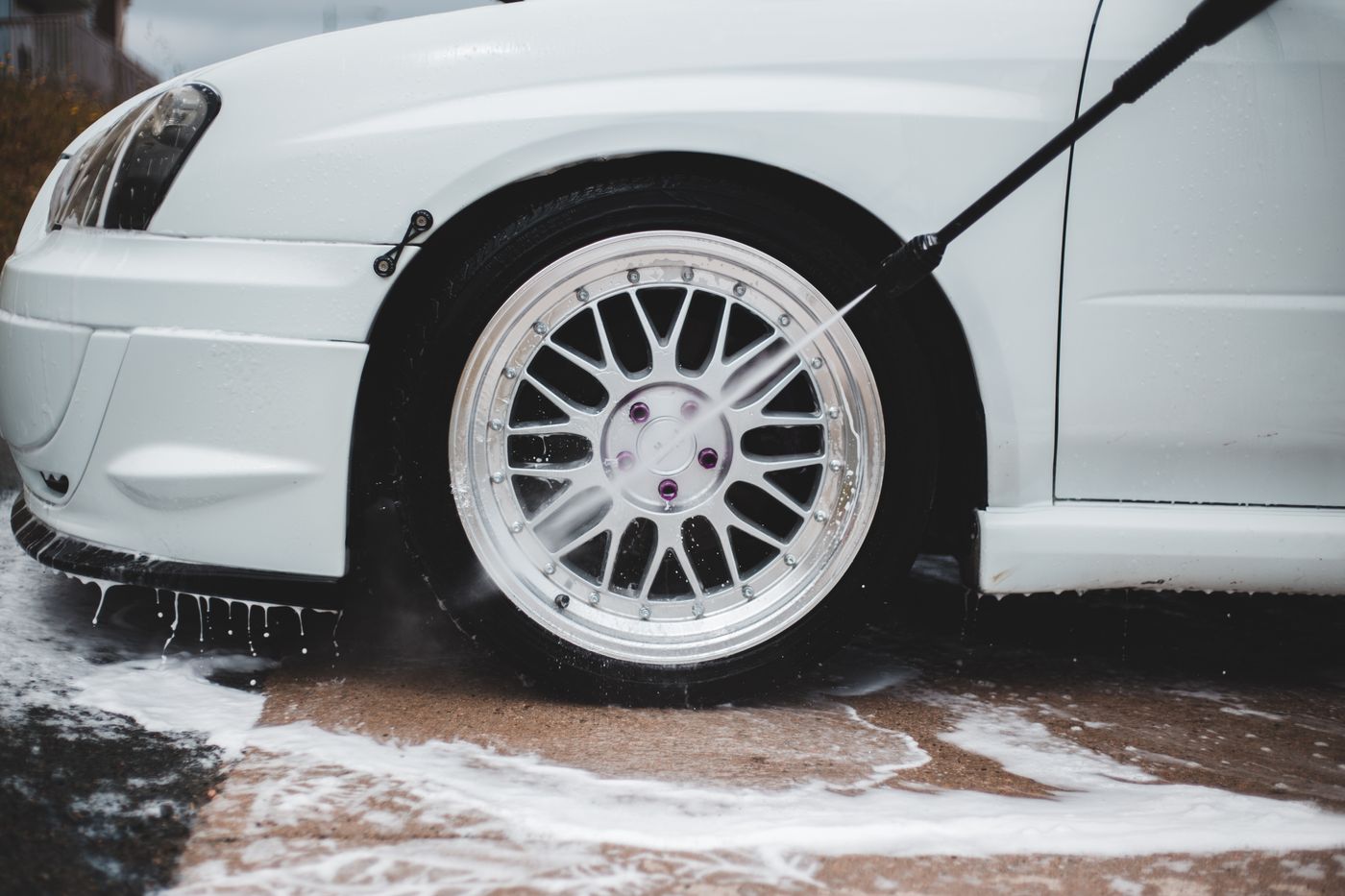
Vehicles. Rinse mud off with the 25 degree nozzle from a distance, apply detergent at low pressure from the bottom up so it does not streak, let it work but not dry, then rinse with the 40 degree nozzle from the top down, 30 centimetres or more from paint and moving all the time. Treat wheel bearings, door and window seals, badges, paint chips and every electrical connector with respect. If you are washing for money, our guide to starting a car wash business covers the bay, the water and the economics.
Poultry houses. A pressure washer is only one step. Litter, feeders and drinkers come out first and the house is dry cleaned, because water on a bed of litter makes mud, not a clean floor. Then the surfaces are soaked and a detergent applied to lift the organic layer. Only then does the washer come out, roof down so nothing already cleaned gets splashed, with the 25 degree nozzle on floors and walls. Rinse, let it dry, and disinfect a dry surface, because organic matter and dilution both defeat disinfectants. Our farm biosecurity guide explains why the order matters as much as the chemicals.
Dairy parlours. The enemy here is milk fat and protein, which cold water spreads rather than removes. A pressure washer is right for the standings, the yard and the outside of the pit, with an alkaline detergent to cut the fat. It is wrong for the milking machine. Never spray clusters, pulsators, the vacuum regulator, control boxes or the motor; those get the circulation wash and a cloth, and a jet into a pulsator ends the day's milking. Wash after the last milking, and rinse the floor completely so no detergent reaches the next cow's feet or the milk.
Machinery. Chaff cutters, power tillers, tractors and mowers gather a paste of sap, dust and grease that hides cracks and leaks and keeps the engine hot. Wash with the 25 degree nozzle at a distance, engine cold, and work across radiator fins straight on, because angled water folds the fins flat. Keep the jet out of the air intake, off the exhaust, off electrical connectors and, most of all, away from every bearing and shaft seal. Then let the machine dry and grease every nipple, so fresh grease pushes out any water that got past a seal. A wash without a grease afterwards is how the chaff cutter bearing was lost.
Detergent: The Chemical Does the Work the Pressure Cannot
Pressure breaks bonds by force. Detergent breaks them by chemistry, and on greasy or fatty dirt it is far more effective. Most machines draw detergent through a low pressure injector when the black soap nozzle is fitted, mixing it into the stream downstream of the pump. That is deliberate: chemicals should not pass through the pump, where they attack seals and plungers. A foam cannon on the lance does the same job with more contact time.
Match the chemical to the dirt. Alkaline detergents cut grease, fat and organic soils: machinery, dairy standings, poultry houses. Acid cleaners remove mineral scale and rust staining: water fittings and concrete. Never mix the two, never put bleach or chlorine through an injector or pump, and follow the dilution on the label, because too strong etches surfaces and too weak does nothing.
Contact time is the whole point. Apply from the bottom up, wait long enough for the chemical to work but never long enough for it to dry, then rinse from the top down. Dried detergent leaves a film that is harder to remove than the original dirt.
Water Supply and Filtration: The Pump Is Only as Good as What Feeds It
A pressure washer pump moves a fixed volume of water every revolution. If that volume does not arrive at the inlet, the pump draws air and cavitates: pressure surges, the machine pulses, and the plungers and seals take a hammering that shortens their life more than anything else you can do to them. The most useful test is a bucket. Time how long the supply takes to fill 20 litres, work out the litres per minute, and compare it with the pump's rated flow. The supply must win, with margin.
Many farm taps do not deliver the 10 to 15 litres a minute a mid range machine wants. The fix is a tank. A raised tank feeding downhill through a short, wide hose gives the pump a steady, slightly pressurised supply and decouples the washer from a weak mains. Most electric units lift water poorly from below their own level, so a drum on the ground is not a supply; a petrol unit with a proper suction hose and foot valve manages better. If the tank needs filling from a well or river, our guide to choosing a water pump covers that end.
Use at least a 19 millimetre feed hose, keep it short and unkinked, and check the couplings for air leaks, because a pump can draw air through a joint that never drips water. Hard water leaves scale in the pump and nozzle, so flush the machine with clean water at the end of a session, and never run it dry, even for a moment, to see if it starts.
The Mistakes That Strip Paint and Wreck Bearings
Paint comes off at edges and chips. A 40 degree fan at a sensible distance on sound paint is safe. A 25 degree nozzle brought in close to shift a stubborn mark lifts the paint from the edge of a stone chip, and once water is under the paint it peels. The pickup's bare tailgate came from exactly that: a bird dropping, a closer approach, and the nozzle dwelling on a chip. Keep the lance moving, keep it further away than feels necessary, and use detergent rather than proximity for stubborn marks.
Bearings die because a seal is built to keep splash out, not a jet in. Water past the seal emulsifies the grease, the bearing runs metal on metal, and it screams a fortnight later when the damage is already done. Wheel bearings, hub seals, chaff cutter shaft bearings and power tiller gearbox seals all sit in the firing line. Never point the jet at a shaft where it enters a housing, and grease after washing so fresh grease displaces any water that got in.
Electrics are the third casualty: connectors, alternators, sensors, the control box on a dairy plant. Water in a connector corrodes it over weeks, so the fault appears long after the wash. Cover or avoid.
The operator is the fourth. A jet at close range punctures skin and injects water and dirt deep into tissue, and an injury that looks like a small cut can be serious. Never point the lance at anyone, never hold what you are washing with your other hand, and wear boots and glasses. A wet floor and a lance that kicks when the trigger closes is how people fall.
The rest is care of the machine: never run it dry, never leave it in bypass, keep chemicals out of the pump, and release the pressure before disconnecting the hose. If the machine starts to pulse, stop and find the reason before the pump pays for it.
Key Takeaways
- Bar breaks dirt loose, litres per minute carry it away. Judge a machine on both, and on the rated pressure rather than the momentary maximum.
- Electric suits the workshop where a sound socket is close. Petrol goes to the sheds and yards and is where higher flow lives. Buy a triplex plunger pump if the machine will work daily.
- Nozzle angle and distance are the real pressure controls. Red and yellow strip, green cleans the farm, white is for paint, black applies soap.
- On vehicles and machinery, keep the jet away from bearings, seals, radiator fins at an angle and every electrical connector, and grease after washing.
- In poultry houses and dairy parlours the washer is one step in a sequence. Dry clean and detergent come first, and disinfectant goes on a dry, rinsed surface.
- Detergent goes in downstream of the pump, alkaline for fat and grease, acid for scale, never bleach, never allowed to dry on.
- Feed the pump more litres per minute than it uses, through a filter, from a tank if the tap cannot keep up. Never run it dry and never leave it idling in bypass.
Frequently Asked Questions
How many bar do I need for a farm pressure washer?
For vehicles, walls and general yard cleaning, a machine in the 120 to 150 bar range with a reasonable flow rate does the work comfortably. Caked manure in a poultry house or dairy yard, and greasy machinery, are easier at 150 to 200 bar with 10 litres a minute or more. Beyond that, extra bar mostly adds risk to paint and seals. Judge the machine on pressure and flow together, and ask whether the pressure quoted is a rated working figure or a momentary maximum.
Is an electric or a petrol pressure washer better for a farm?
Electric if you can bring a sound power supply to the wash point: it is quieter, cheaper to run and needs almost no servicing. Petrol if the wash point is far from a socket, if the supply is weak, or if you need the higher flow rates that single phase motors cannot drive. Many farms end up with an electric unit at the workshop and a petrol unit on a trolley for the sheds and yards.
Which pressure washer nozzle should I use on a vehicle?
The 40 degree white nozzle for paintwork, glass and bodywork, held 30 centimetres or more from the surface and moving all the time. The 25 degree green nozzle is fine for tyres, wheel arches and chassis mud. Never use the 0 degree red nozzle on a vehicle and keep every nozzle away from wheel bearings, door seals, badges, chipped paint and electrical connectors.
Can I run a pressure washer from a water tank?
Yes, provided the tank can deliver more litres per minute than the pump uses and the water reaches the pump with a little positive pressure. A raised tank feeding downhill through a wide, short hose works well. Fit an inlet filter, because tank water carries grit that scores plungers and blocks the nozzle. Most electric units lift water poorly from below their own level, so do not expect them to suck from a drum on the ground.
Why does my pressure washer pulse and lose pressure?
Almost always starved water: a supply that cannot keep up, a blocked inlet filter, a kinked hose, or air being drawn in at a loose connection. The pump then cavitates, pressure surges and the plungers and seals take damage. Stop, check that the supply fills a bucket faster than the machine empties it, clean the filter and purge the air by running the machine with the trigger open before fitting the nozzle.