
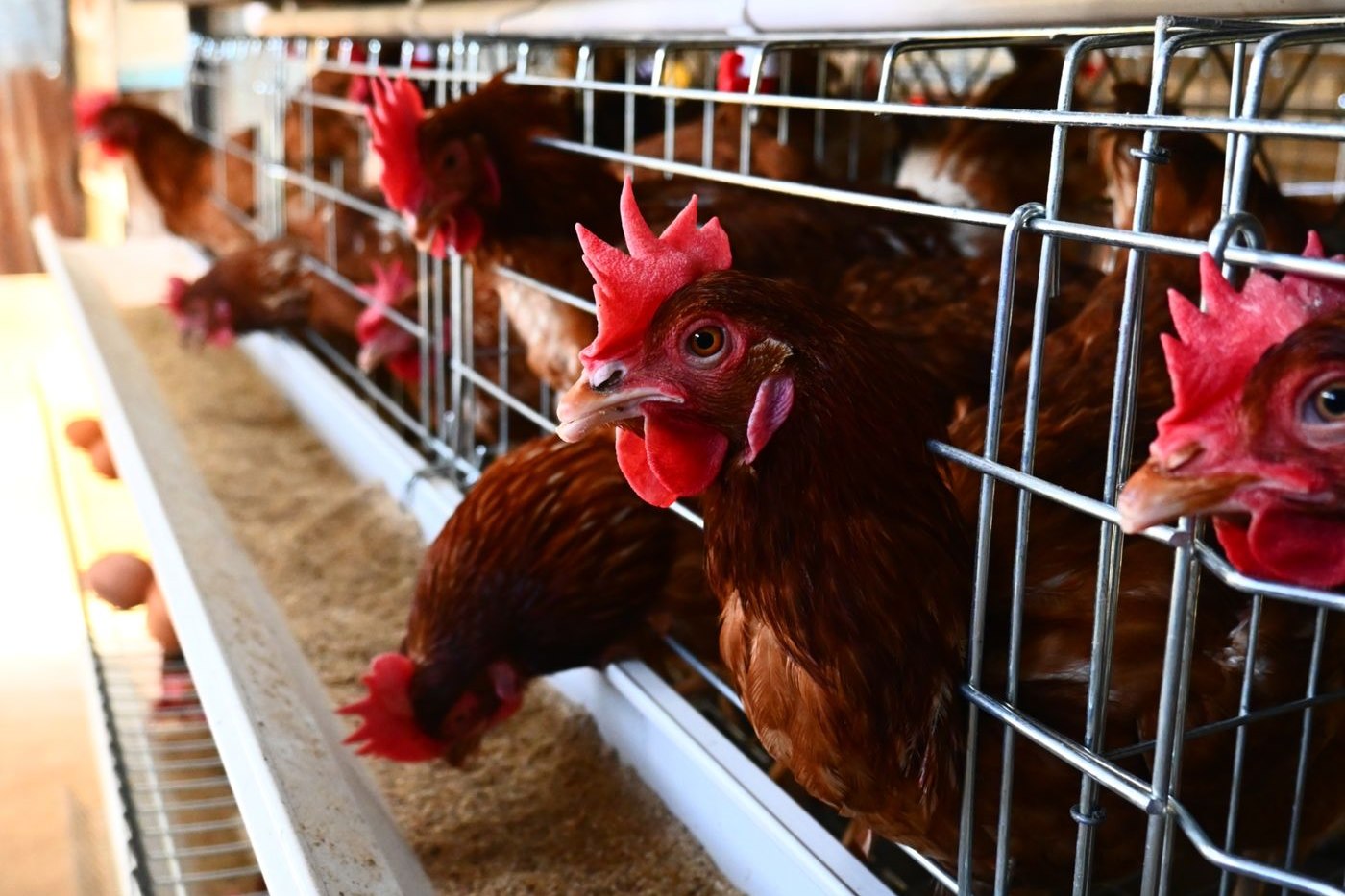
Two farmers in the same county start layers in the same month with the same breed of pullet. One builds a long, low house, spreads wood shavings, hangs feeders and drinkers and fits a row of nest boxes. The other builds a house a third of the size and fills it with tiered cages. A year later both are selling eggs, and both are convinced the other made the wrong choice.
Neither is wrong. Cages and deep litter are two honest answers to the same problem, and each one moves the difficult work to a different place: into the building, into the labour, into the manure or into the purchase price. The mistake is choosing on the strength of one factor, usually egg cleanliness or the cage price, without looking at where the rest of the work lands.
This article works through the two systems one factor at a time: space, egg quality, feed and water, labour, disease, manure, capital cost and welfare. It finishes with a straight recommendation for flocks of 200, 1,000 and 5,000 layers.
Space per Bird Is the Number That Drives Everything Else
Start with the floor, because the floor sets the size and cost of the building, and the building is usually the biggest single item in a layer project.
On deep litter, plan around five to seven layers per square metre, which is roughly 0.15 to 0.2 square metres per bird. That is the figure we use in our guide to poultry equipment by flock size. A thousand layers therefore need somewhere in the region of 150 to 200 square metres of floor, before you add a store, a walkway or a change area at the door.
In a conventional cage, each bird has somewhere in the region of 450 to 600 square centimetres of cage floor, a little less than a sheet of A4 paper. That sounds small, and it is, but it is only part of the story. Cages are stacked in two, three or four tiers along an aisle, so the same square metre of building floor carries several layers of birds. The result is that a cage house for a given flock is a fraction of the size of a litter house for the same flock.
The practical consequence is simple. If land or building money is your tight resource, cages let you keep more birds under the same roof. If land is plentiful and building is cheap where you are, that advantage matters less and the rest of the comparison decides.
Egg Cleanliness and Breakage: The Cage's Strongest Argument
An egg from a cage is usually cleaner than an egg from litter, and the reason is mechanical, not magical. A cage floor is wire mesh set at a slope. The moment the hen lays, the egg rolls forward, under the front of the cage and onto a collection rail, away from the bird. It is never stood on, never pecked and never laid in droppings, because the droppings fall through the mesh.
On deep litter, the egg is laid where the hen chooses. If she chooses a nest box, the egg sits on nest material until someone collects it. If she chooses the floor, a corner or under the drinker, it sits in litter that carries droppings and moisture. Floor eggs are the dirty and cracked ones, and every extra hour an egg spends in a nest is an hour in which another hen can climb in on top of it.
Litter eggs can be kept clean, but it takes management: enough nest boxes for the flock, clean nest material topped up regularly, collection at least twice a day and three times in hot weather, dim nests that hens prefer, and pullets trained to use the nests from the week before lay begins. Where any of those slips, the dirty egg count climbs. Our article on handling and storing eggs covers what to do with the eggs once they are in the tray.
Breakage tells a similar story but with a twist. Cages reduce breakage from trampling and pecking, but a cage with too steep a slope, a rough collection rail or a missing egg guard breaks eggs by letting them roll too fast or collide. Check the rail with a hand along its length before birds go in, and watch the first day's eggs for hairline cracks.
Feed and Water: Where the Fuga Kit Fits
Feeding and watering are the parts of the system we make ourselves, so we see how each house is actually equipped.
In cages, feed runs in a trough along the front of every tier. Birds reach through the wire to eat, so every bird has a fixed share of trough and cannot be crowded off it. Feed is either carried along the aisle and tipped into the trough by hand, or pushed along with a hopper on wheels. Water almost always comes from a nipple line along each tier, one nipple per cage or shared between neighbouring cages, fed from a header tank through a pressure regulator. Nipples suit cages because there is no floor to wet and no bird to knock a drinker over.
On deep litter, the same jobs are done with hanging tube feeders and bell drinkers, or with a nipple line suspended over the litter. Plan on 4 to 5 centimetres of feeder space and 2 to 2.5 centimetres of drinker rim per bird, or around 8 to 12 birds per nipple. Hang feeders and drinkers at back height and raise them as the birds grow, because a low drinker wets the litter and a low feeder fills with shavings. The trade-off between nipples and bells is covered in full in nipple versus bell drinkers.
We manufacture the drinkers and feeders used in litter houses, and we stock the nipples, cups and fittings that a cage line needs: the standard poultry screw nipple is 40 KSH and a double cup nipple is 180 KSH on our current price list. The full range is on the poultry equipment page.
Labour and the Daily Routine
Ask anyone who has run both, and they will tell you the labour is different in kind, not only in amount.
Cage labour is walking the aisles: feed along the troughs, check every nipple is dripping, collect eggs off the rails, pull dead birds, and scrape or rake the manure. Every bird is visible at eye level, so a sick or off-lay hen is spotted in minutes. One person can look after a large caged flock because the birds come to the aisle rather than the person going to the birds.
Litter labour is walking through the flock: filling feeders and drinkers, collecting from nest boxes and off the floor, turning wet patches of litter, topping up shavings, and catching birds to check them. Collection takes longer because eggs are spread across the house. Finding a sick bird in a flock of a thousand on litter is a real task.
None of this makes litter unmanageable. At 200 birds the labour is a family's spare hour, and the difference is invisible. At 5,000 birds the difference is a second or third worker's wages every month.
Disease and Parasite Pressure Move, They Do Not Disappear
Deep litter keeps birds in contact with their own droppings. That is the root of its two chronic problems: coccidiosis, which is picked up from oocysts in litter, and intestinal worms, whose eggs pass through droppings back into the flock. Both are managed with vaccination or medication, dry litter and routine deworming, but the pressure never goes away because the cycle is in the floor.
Wet litter is the amplifier. A leaking drinker, a roof drip or a house that cannot breathe turns shavings into a mat that releases ammonia. Ammonia irritates the eyes and airways, opens the door to respiratory disease and depresses lay. That is why litter houses stand or fall on air movement, which we cover in poultry house ventilation.
Cages break the droppings contact, so coccidiosis and worm pressure fall sharply. But they create their own problems. Manure collecting under the tiers is still in the house, still releasing ammonia and still breeding flies until it is removed. Red mite, the night-feeding parasite that hides in cracks by day, finds cage wire, egg rails and trough joints a perfect home, and it is difficult to reach with a sprayer. Birds standing on wire all their lives can also develop foot problems if the mesh is rough or the slope too steep.
Manure: The Job Nobody Plans For
A layer produces droppings every day for the whole of her laying life, and where they go is a design decision that gets skipped far too often.
On deep litter, manure is absorbed into the shavings and composts slowly in place. The litter is turned to keep it loose and dry, topped up during the cycle, and cleared out completely when the flock is sold. What comes out is a dry, crumbly, relatively low-smell material that gardeners and crop farmers will often collect or pay for. The handling is concentrated into one big clean-out rather than spread across the year.
Cages drop manure onto trays, boards or the floor beneath the bottom tier. It arrives wet, undiluted and continuously. Left for a week in warm weather it smells, attracts flies and releases ammonia into the tiers above. It must be scraped or raked out regularly, wheeled outside and either dried, composted or sold as fresh manure. Cage manure is a stronger fertiliser than litter, but it is heavier, wetter and more work to move every single week.
Plan the manure route before you plan the cages: where the barrow goes, where the heap sits relative to the prevailing wind and the house door, and who is doing the scraping on a Sunday. A good wheelbarrow and rake are the cheapest items in the project and the most used.
The Capital Cost Pattern, Without Inventing Prices
We are not going to quote a cage price here, because cage prices move with steel, tier count and where they are made, and a figure typed today would mislead someone reading next year. What we can describe honestly is the shape of the cost, because that does not change.
Deep litter spends its money on the building and very little on equipment. Feeders, drinkers, nest boxes and shavings are modest items, but the house has to be big, because every bird stands on the floor. The equipment wears out in a few years and is cheap to replace.
Cages reverse that. The equipment is the large item, paid per bird up front, and the building shrinks to a fraction of the litter footprint. A well-made galvanised cage lasts many years and many flocks, so the cost is spread over a long working life, but it all has to be found before the first pullet arrives.
The consequence is a crossover. For a small flock, the litter house is small and cheap anyway, so the cage outlay cannot pay back. As the flock grows, the litter house gets bigger and the labour bill grows with it, while the cage house stays compact and the labour barely rises. Somewhere between a few hundred and a few thousand birds, depending on your land, your building costs and your wages, the two lines cross. The only way to find where they cross for you is two written quotes: one for a litter house and its kit, one for a cage house and its cages.
Welfare, Stated Fairly
It would be dishonest to pretend the two systems are equal on welfare, and equally dishonest to pretend litter is automatically kind.
A conventional cage restricts the behaviours a hen is built to perform: she cannot dust-bathe, perch, stretch her wings fully or make a nest. Standing on wire all her life carries a foot-health cost. These are real limitations, they are the reason several countries have moved away from conventional cages, and a Kenyan farmer choosing cages should know that some buyers, particularly hotels and exporters, are beginning to ask about housing.
Litter gives the hen space, ground to scratch, a nest to lay in and the chance to behave like a hen. It also exposes her to coccidiosis, worms, ammonia from wet litter, feather pecking and cannibalism in an overcrowded house, and to the aggression of a large group. A badly run litter house is not a kind place either.
The fair statement is this: a well-run litter house offers the higher welfare ceiling, and a well-run cage house offers the more reliable welfare floor. Whichever you choose, welfare is decided more by stocking rate, air, feed, water and daily attention than by the housing type on its own.
Which System for 200, 1,000 and 5,000 Layers
200 layers. Deep litter, almost without exception. The house is small and cheap to build, one person can collect eggs from a row of nest boxes in a few minutes, and the money the cages would cost buys better drinkers, more nest boxes and a proper store. Keep the stocking rate honest, collect eggs three times a day and train the pullets to the nests, and the egg cleanliness gap nearly closes.
1,000 layers. This is the real decision. If your land is limited or your building costs are high, cages let you house the flock in a fraction of the space and cut the labour of collection. If land and building are cheap and labour is available, a litter house at this size is still very manageable and keeps your capital in your pocket. Ask two more questions: does your buyer pay more for consistently clean eggs, and who is going to scrape the manure every week? Then get both quotes.
5,000 layers. Cages are the default. A litter house for this flock is very large, egg collection across it needs a team, and finding sick birds in a flock of that size on the floor is hard. Cages put every bird at eye level in an aisle and every egg on a rail. The exceptions are farms with an explicit cage-free market, such as a buyer who specifies housing, and the land and labour to serve it. If that is you, litter at scale is done successfully, but it is a management job, not a shortcut.
Whatever the flock size, the building must breathe, the drinkers must keep up on a hot afternoon, and someone must own the manure. Get those three right and either system produces eggs.
Key Takeaways
- Deep litter runs at about five to seven layers per square metre. Cages stack birds in tiers, so the building shrinks to a fraction of the litter footprint.
- Cage eggs roll away from the hen in seconds and arrive clean. Litter eggs can be kept clean, but only with enough nests, frequent collection and trained pullets.
- Cages feed from a front trough and water from a nipple line. Litter houses use hanging feeders and bell drinkers or a suspended nipple line, sized per bird.
- Litter carries chronic coccidiosis and worm pressure and ammonia from wet litter. Cages remove those but add manure under the tiers, flies and red mite in the wire.
- Litter manure composts in place and comes out dry at the end of the cycle. Cage manure is wet, continuous and must be moved every week.
- Litter puts the money in the building; cages put it in the equipment. The two costs cross somewhere between a few hundred and a few thousand birds. Get written quotes for both.
- 200 birds: litter. 5,000 birds: cages by default. 1,000 birds: decided by your land, labour, buyer and manure plan.
Frequently Asked Questions
How many layers can I keep per square metre in cages compared with deep litter?
On deep litter, plan around five to seven layers per square metre of floor, which is roughly 0.15 to 0.2 square metres per bird. In a conventional cage each bird has somewhere in the region of 450 to 600 square centimetres of cage floor, and because cages are stacked in two, three or four tiers, a cage house holds several times more birds per square metre of building than a litter house. The saving is in the building, not in the equipment.
Are eggs from caged layers cleaner than eggs from deep litter?
As a rule, yes. A cage floor slopes so the egg rolls away from the bird onto a collection rail within seconds, so it is never stood on, pecked or laid in droppings. On deep litter the egg sits in a nest box until someone collects it, and any egg laid on the floor is likely to be dirty or cracked. Litter eggs can be kept clean, but it takes enough nest boxes, clean nest material, frequent collection and training pullets to use the nests.
Which system has more disease and parasite problems?
They have different problems. Deep litter keeps birds in contact with their droppings, so coccidiosis and intestinal worms are the constant pressure, and wet litter produces ammonia. Cages break that droppings contact, so those two fall away, but manure accumulating under the tiers releases ammonia and breeds flies if it is not removed, and red mite hides in cage wire and is hard to reach. Neither system is disease-free; each moves the work to a different place.
Is deep litter cheaper than cages?
The equipment is cheaper, but the building is bigger. Deep litter needs a few feeders, drinkers and nest boxes plus a larger floor, while cages are a substantial outlay per bird but shrink the house to a fraction of the size. For a small flock, litter almost always wins on total cost. As the flock grows, the extra building for litter and the labour of running it start to close the gap. Get written quotes for both before deciding; do not assume.