An inverter trips or shuts down when a motor starts because the motor briefly draws several times its running power, and that short surge can exceed the inverter's surge rating, pull the battery voltage down, or both. The fix is to size the whole system for starting watts, not running watts, and to give the inverter a battery and cables that can deliver the surge without sagging.
Picture the evening. The solar lights are on, the phone chargers are humming, and the inverter is quiet and happy. Then someone starts the borehole pump, or the fridge compressor kicks in, or the workshop welder strikes an arc. The inverter beeps, the lights go out, and a unit that was only carrying a few hundred watts has shut itself off.
Nothing is broken. The inverter was protecting itself from a load that, for a fraction of a second, asked for far more than the number on the box. Our guide to sizing an inverter for a farm or workshop shows how to add up your loads. This article explains the part that guide can only touch on: why motors ask for so much at the start, and what to do about it.
What Is the Difference Between Running Watts and Starting Watts?
Running watts (also called continuous watts) are what a load draws once it is up to speed. Starting watts, also called surge, peak or locked-rotor power, are what it draws in the first moments while it gets going. An inverter has both numbers: a continuous rating it can carry all day, and a higher surge rating it can carry only for a short time.
A kettle, a bulb or a heater has almost no surge. It draws the same power the moment it switches on. A motor is different. An induction motor must build up a magnetic field and accelerate a rotor and whatever it drives, such as a pump impeller, a compressor piston or a mill. At the instant of starting, the rotor is standing still and the motor behaves almost like a short circuit, so the current is far higher than at full speed. Once it spins up, the current falls to its running value.
How Big Is the Surge for a Motor?
It varies with the motor, but it is large. Motor makers mark many motors with a NEMA code letter that states the locked-rotor apparent power in kilovolt-amperes (kVA) per horsepower. The table of code letters tabulated by Engineering Toolbox lists, for standard three-phase motors, code L (9.0 to 9.99 kVA per hp) as typical for motors under 1 hp, code K (8.0 to 8.99) for about 3 hp, code J (7.1 to 7.99) for about 5 hp, code H (6.3 to 7.09) for 7.5 to 10 hp, and code G (5.6 to 6.29) above 15 hp. The page notes that smaller motors generally need more starting kVA per horsepower than larger ones.
Work one example through. Take a motor of about 1 hp in the first class. Nine to ten kVA at the instant of starting is roughly 40 amps at 240 volts, from a motor that delivers only about 0.75 kW of shaft power when running. Real motors vary, and the surge lasts a fraction of a second because the cable and the supply limit it. But it shows why a 1000 W label says little about whether an inverter can start a 1 hp pump.
Motor-control references commonly quote direct-on-line starting at roughly five to seven times the full-load current, and some compressor and capacitor-start motors fall outside that range. Treat any rule of thumb as a first guess only. The locked-rotor amps (LRA) or the code letter on the motor's rating plate, or the maker's datasheet, is the figure to size against.
Which Loads Cause Trouble and Which Do Not?
Sort your loads into three groups before you choose an inverter.
| Load | Starting behaviour | What to do |
|---|---|---|
| Bulbs, LED lights, phone chargers, router | Little or no surge | Add up the running watts; these rarely cause trips |
| TV, laptop, decoder | Small switch-on inrush from power supplies | Add running watts and leave a margin |
| Fridge and freezer compressors | Short surge each time the compressor starts | Check the compressor or fridge plate; size for the surge |
| Water pumps, borehole and booster pumps | Surge at start, often longer if the pump starts against pressure | Use the motor plate; size for the start, not the label watts |
| Welders | Heavy current drawn at arc strike and through the job | Use the input rating on the welder's plate; many exceed small inverters |
| Posho mills and other mill motors | Large motor, heavy load at start | Usually beyond a small inverter; see posho mill power options |
A useful habit is to write down every load on a sheet, with its running watts and, for motors, the starting figure from the plate. If a load has no starting figure and it has a compressor or a motor, treat it as a surge load.
What Happens Inside the Inverter When the Motor Starts?
Three things can happen, and the inverter's alarm usually does not tell you which.
First, overload. The starting current is higher than the inverter's surge rating, or it lasts longer than the inverter allows, so the inverter protects its power electronics by shutting off. Many inverters publish a surge figure, but not always how long they can hold it, so ask the supplier.
Second, low battery voltage. The surge pulls a large current out of the battery, and the battery and cable voltage sags for that moment. If the inverter sees the voltage drop below its low-voltage cutoff, even for a moment, it trips and may report a low-battery alarm, although the battery is not flat.
Third, output voltage sag. The inverter tries to hold its output and cannot, so the motor starts slowly, stays in the high-current stage longer and may stall. A stalled motor draws even more current, and the inverter shuts down.
Does a Pure Sine Wave Inverter Matter for Motors?
Often, yes. Induction motors, fridge and freezer compressors and many pump motors are designed for a smooth sine wave. On a rougher modified or square-wave output they commonly run hotter, hum louder and may start with more difficulty, and some will not start at all. Electronics such as TVs and chargers usually cope better.
Before you buy, ask what waveform the inverter produces, what its surge rating is, how long it can hold that surge, and whether the maker lists motor loads such as pumps and fridges as suitable. Our product pages give the wattage in each inverter's name but not its surge rating or waveform, so ask at a branch for those details before you commit.
Why Do the Battery and Cables Matter as Much as the Inverter?
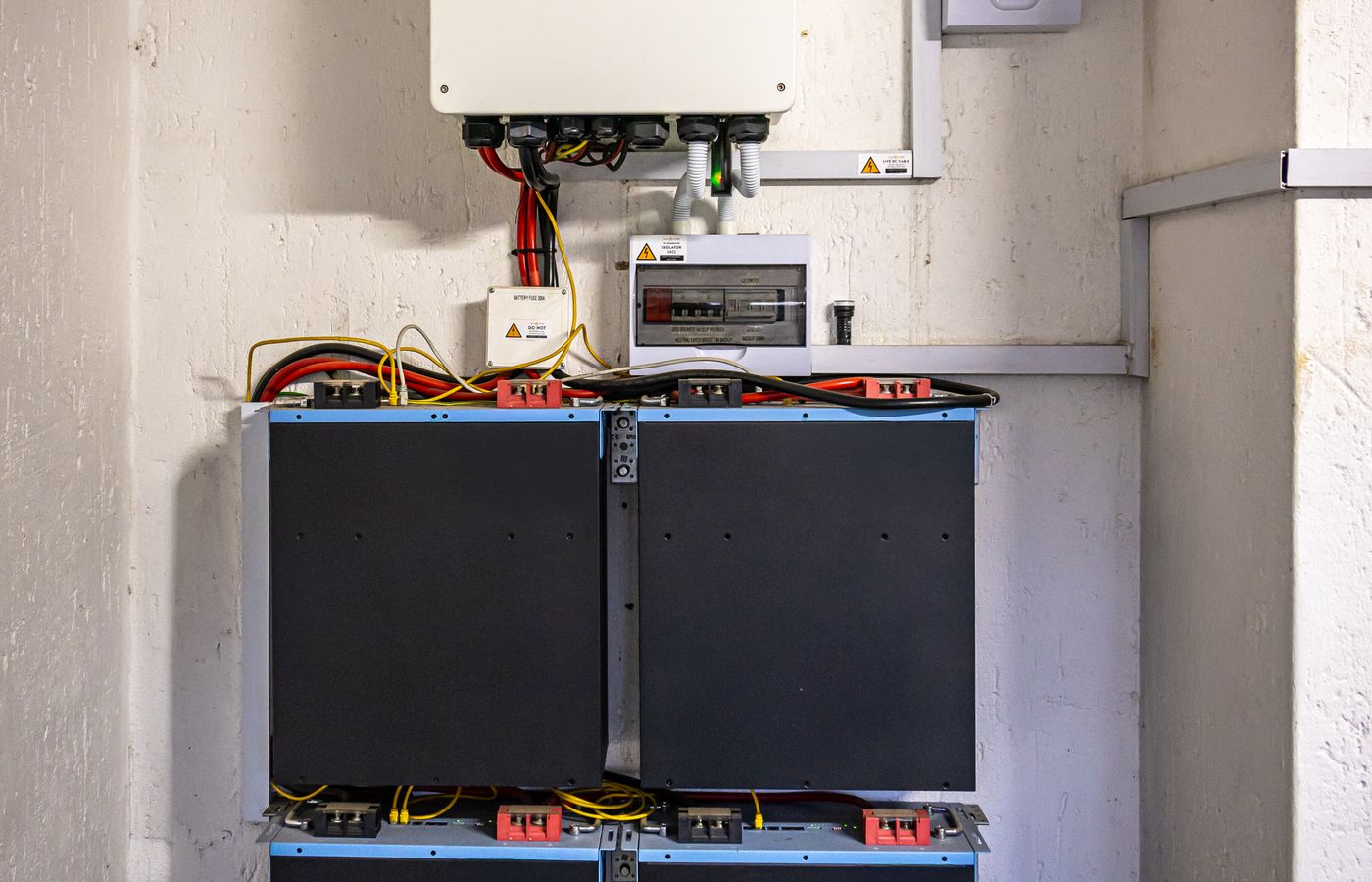
An inverter does not make power. It converts what the battery delivers, and at low battery voltage the current is large. As a simple example, a 1000 W load on a 12 V system needs more than 83 amps from the battery even before losses, and a 2000 W surge on 12 V is at least about 170 amps. On 24 V the same power needs half the current, and on 48 V a quarter.
Those currents flow in the cables between battery and inverter. A thin or long cable has resistance, and resistance turns current into voltage drop: the more current, the more volts lost along the way. At the moment of the surge the voltage at the inverter's terminals can fall below its low-voltage cutoff, even though the battery itself is fine. That is why short, thick, well-crimped cables with a correctly rated fuse or breaker are part of the specification, not a detail.
The same is true of the battery. A small or ageing battery, a lead-acid battery that is partly discharged, or a loose terminal cannot hold its voltage under a heavy short pull. Lithium batteries often hold their voltage better under load, but they have a protection board (a battery management system) that can cut off at its own current limit, so check that limit against the surge too. Our lithium versus lead-acid battery guide explains the trade-offs.
How Can You Stop the Trips?
Size up the inverter. For a motor load, choose an inverter whose surge rating covers the motor's start, with margin, and whose continuous rating covers everything that runs together. Buying one step larger than the running total is often cheaper than repeated trips and a damaged motor.
Start big loads one at a time. Do not start the pump while the fridge compressor is starting. Turn heavy loads on separately, with the biggest motor first while little else is running, and leave a few seconds between them.
Consider a soft starter or a drive. A soft starter or a variable-speed drive ramps a motor up so that the surge is smaller. They are fitted by an electrician and must suit both the motor and the inverter. Some inverter makers advise against certain types of soft starter, so check the inverter's manual first. Inverter-type (variable-speed) fridges and compressors often start more gently than old fixed-speed ones, which is one reason replacing an old fridge can help.
Reduce the load, not only the surge. A pump that starts against a closed valve or high pressure takes longer to get going. Make sure the pump is primed and the outlet is open, and keep a mill or welder off the inverter if its rating is simply too large.
Know when to use a generator. For large mill or welder loads, a generator sized for the starting current, or the mains, is usually the sensible supply. Our guide to generator versus solar backup for a small business compares the two.
What Should You Check When an Inverter Keeps Tripping?
| Symptom | Likely cause | What to check |
|---|---|---|
| Overload alarm only when a motor starts | Surge above the inverter's surge rating | Motor plate LRA against the inverter's surge rating and duration |
| Low-battery alarm at the same moment | Voltage sag from battery or cables | Terminals tight, cable thickness and length, battery age and charge |
| Works with the fridge alone, trips with fridge and pump | Two surges or a total load above the continuous rating | Start loads one at a time; re-add the running watts |
| Motor hums, runs hot or stalls | Waveform or low output voltage | Is the inverter pure sine wave; is the supply voltage steady |
| Cables or lugs hot to the touch | Cable too thin or a poor connection | Switch off and call a licensed electrician; do not keep running it |
Heat at a cable, a lug or a fuse holder is a warning, not a nuisance. Switch the system off and have a licensed electrician inspect it before you use it again.
Inverters and Solar Equipment to Look At
Prices and stock change, so we do not print them here. See each product page for the current price and branch availability.
| Item | Where it fits |
|---|---|
| 1000W Inverter (Solar Max) | Lighting, electronics and small loads; ask for the surge rating before connecting any motor |
| 1500W Inverter (Solar Max) | A larger step for mixed loads; confirm surge and waveform for motors |
| Solar equipment range | Inverters, batteries, panels and charge controllers to build the whole system |
List your loads, find the motor plates, and size for the surge, the battery and the cables, not for the running watts alone. Tell us on WhatsApp which pump, fridge or tool you want to run, with its plate details, and our team will help you match it to an inverter. See our solar equipment range or message 0716 961 018.
Key Takeaways
- A motor draws several times its running power for a moment when it starts, and that surge is what trips the inverter.
- The label on an inverter is its continuous rating; check its surge rating and how long it can hold it.
- Use the locked-rotor amps or code letter on the motor plate, not a rule of thumb, to size for the start.
- A low-battery alarm at the moment of a motor start usually means voltage sag in the battery or cables, not a flat battery.
- Short, thick, fused cables and a healthy battery matter as much as the inverter itself.
- Start heavy loads one at a time, and check the waveform: motors and compressors prefer pure sine wave.
- Have a licensed electrician size and fit the cables, fuses and any connection to the mains.
Frequently Asked Questions
Why does my inverter trip when the fridge starts?
A fridge compressor is a motor, and it draws a short surge when it starts that can be several times its running watts. If that surge is above the inverter's surge rating, or pulls the battery voltage below the inverter's cutoff, the inverter shuts down even though the average load is small.
Can a 1000W inverter run a 1 hp water pump?
Usually not reliably. A motor of about 1 hp delivers roughly 0.75 kW when running but can demand many times that at the instant of starting, so check the pump's plate and the inverter's surge rating and duration. Ask the supplier for those figures before you buy, and have an electrician do the installation.
What is the difference between running watts and surge watts?
Running watts are what a load draws once it is up to speed, and surge (starting) watts are the higher draw during the first moments of a motor starting. An inverter has a continuous rating it can carry all day and a higher surge rating it can carry only briefly.
Do I need a pure sine wave inverter for a pump or fridge?
It is usually the safer choice. Motors and compressors are made for a smooth sine wave, and on a modified sine wave they commonly run hotter and louder and sometimes will not start. Ask the inverter maker whether motor loads are listed as suitable.
Why does my inverter say low battery when the battery is full?
The surge pulls a large current, and a small battery, a loose terminal or thin cables can make the voltage drop for a moment. If the inverter sees that dip below its cutoff it trips with a low-battery alarm. Check the battery's condition, the terminals and the cable size with a licensed electrician.