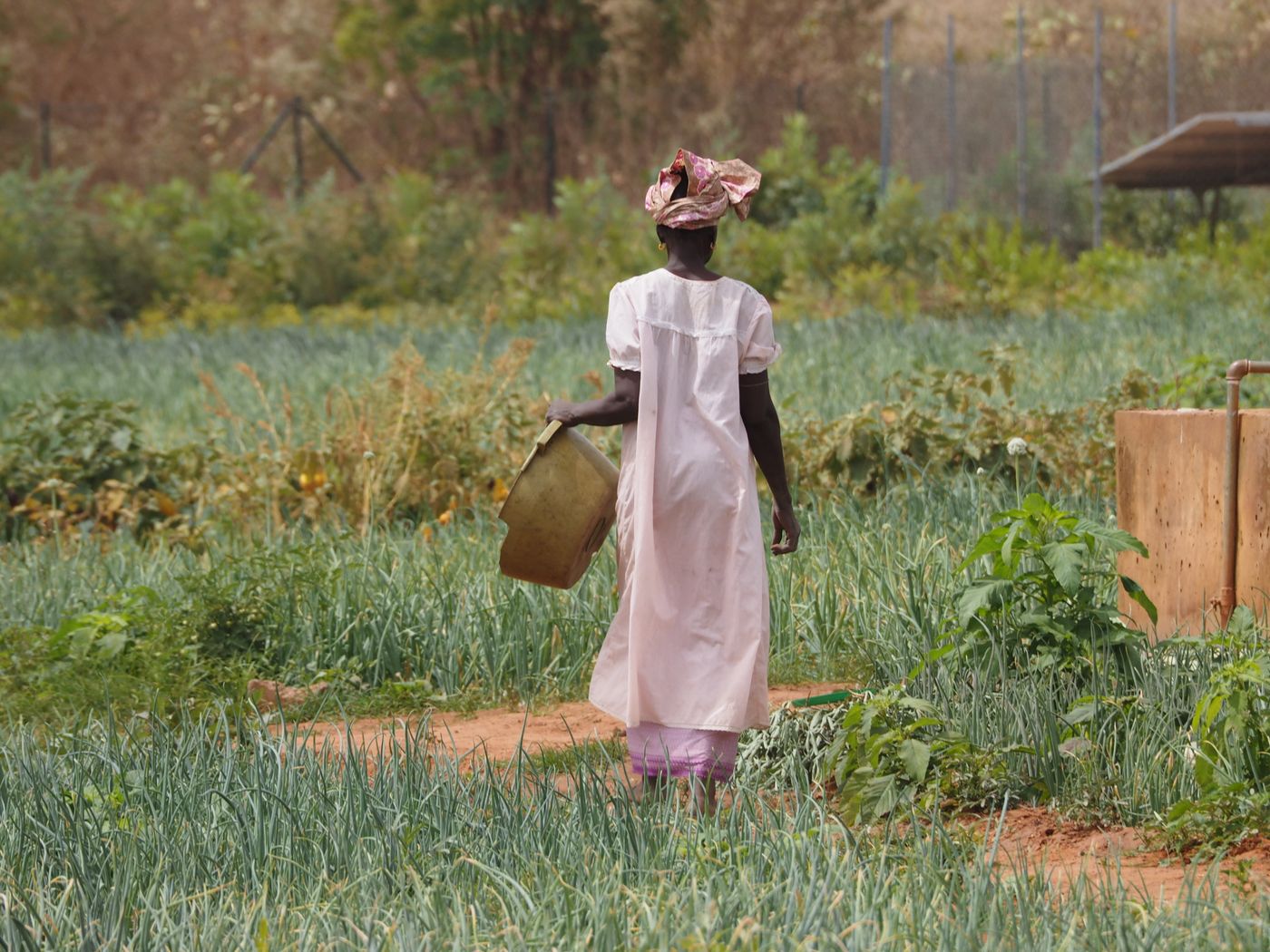
Watering a compound garden or a kitchen plot by hand with a hose, as in the photograph above, feels productive. In practice it is one of the least even ways to water. The person holding the hose gives the nearest plants a long soak, sweeps quickly over the far corner, and stops when the time runs out rather than when the soil is wet. An hour later the surface looks dark everywhere, but a few centimetres down some beds are still dry.
A sprinkler on the end of the same hose changes that for very little money. It throws water over a fixed circle at a steady rate, so the amount each square metre receives depends on how long you leave it, not on how patient you are. Two kinds are common on Kenyan farms and homes: the metal impact sprinkler, which ticks round in steps and throws a long jet, and the plastic spinner, whose arms whirl round on a flat base. Both are cheap. Both waste water if they are set up badly.
This guide explains how each type works, the pressure and hose they need, how to set an impact sprinkler to water a part circle along a wall or path, why a half circle waters twice as fast as a full one, how to move a sprinkler so the whole plot is covered evenly, and a simple tin test that tells you exactly how much water you are applying. For fixed nursery systems, see our guide to micro sprinklers; this article is about the sprinkler you carry from place to place on a hose.
Impact and Spinner Sprinklers: How Each One Works
An impact sprinkler has a single nozzle that shoots a jet of water at a low angle. A spring-loaded arm swings into the jet, is knocked away, and springs back, and each strike nudges the whole head round a few degrees. That is the ticking sound you hear. Because the water leaves as one strong jet, an impact sprinkler throws further than most other small sprinklers, and the arm breaks part of the jet into drops that fall nearer the head, so it waters the inner circle as well as the edge. Most can also be set to turn only through part of a circle, using adjustable stops on a collar below the head.
A spinner sprinkler has two or three arms with small nozzles angled sideways. Water leaving the nozzles pushes the arms round by reaction, the same push you feel in your hand when a hose jet is opened, and the spray falls in a full circle around the base. It works at lower pressure than an impact sprinkler, it is light, and it sits directly on the ground, so it is ideal for lawns and short crops. Its throw is shorter, and it waters only full circles, so it is less suited to strips beside walls and paths.
In short, the spinner is the simple choice for a small lawn or a patch of low vegetables, and the impact sprinkler is the better tool for larger areas, taller crops when raised on a riser, and any place where you need to keep water off a wall, a path or a neighbour's washing.
Pressure, Hose Size and What Comes Out of the Nozzle
A sprinkler's throw and pattern depend on the pressure at the sprinkler, not at the tap. Every metre of hose and every fitting takes some pressure as water moves through it, and a long, thin hose takes a lot. That is why a sprinkler that throws well on a short hose can dribble at the end of a long one. Our guide to hoses and friction loss explains the effect; the practical rule is that a wider hose and a shorter run leave more pressure for the sprinkler.
Impact sprinklers need more pressure than spinners because the jet must be strong enough to drive the arm. Below that, the arm stops striking reliably, the head stalls and water lands in one place. Check the working pressure the maker gives for your sprinkler. If a tap or a tank cannot supply it, the arm will tell you by stalling or turning in jerks; a small booster pump is the usual fix. A tank on a stand rarely runs an impact sprinkler well on its own, because each ten metres of height gives only about one bar.
Measure, do not assume. Set the sprinkler running where you plan to use it, walk out until the spray stops reaching the ground in useful amounts, and note that distance. That is your working wetted radius on your hose and your supply, and it is the figure every other decision in this article depends on.
Mounting: Height, Risers and Getting Above the Crop
A spinner sits on its own base on the ground, which suits lawns and seedbeds. An impact sprinkler needs something to hold it upright, usually a spike pushed into the soil or a short riser on a stand, with the hose joined below. The connection needs to be firm and leak-free: wrap the thread, push the hose fully onto its connector, and secure it with a hose clip so the pressure does not push it off.
Height matters for any crop taller than grass. A jet thrown at a low angle from ground level hits the first row of maize, beans or napier and stops there, leaving everything behind it dry. Raise the impact sprinkler on a riser so the jet clears the crop canopy. Keep it vertical, too: a sprinkler leaning to one side throws further downhill than uphill and the circle becomes lopsided.
Part Circles: Why a Half Circle Waters Twice as Fast
Setting an impact sprinkler to turn through a half or a quarter circle is how you water a strip along a house, a fence or a path without wetting the wall or the road. The stops on the collar set the two ends of the arc. When the head reaches one stop, a reversing lever flips it back the other way. Set the arc with the water running, standing behind the sprinkler, and adjust the stops until the jet sweeps just the ground you want.
Here is the physics that catches people out. The sprinkler delivers the same flow whether it turns through a full circle or a half circle, but in a half circle that water lands on half the area. The application rate, the depth of water applied each hour, therefore doubles. A quarter circle quadruples it. If you water a full-circle position for an hour and then a half-circle position along the wall for the same hour, the strip along the wall gets twice as much water.
Two consequences follow. Shorten the run time on part-circle positions in proportion to the arc: half the time for a half circle, a quarter of the time for a quarter circle. And watch the soil. A quarter circle on heavy clay can apply water faster than the soil can absorb it, so it ponds and runs off, especially on a slope. If you see water running, split the time into two shorter runs with a gap between them.
Moving the Sprinkler: Overlap and a Simple Pattern
No sprinkler waters its own circle evenly. Most of the water lands in the inner part, and the amount thins out towards the edge of the throw. If you move a sprinkler so each new circle just touches the last one, the edges between positions get far less water than the centres, and you will see it as stripes of paler, slower growth.
The standard rule, as for fixed sprinklers, is head-to-head spacing: move the sprinkler a distance equal to the wetted radius, so the new circle reaches the spot where the sprinkler last stood. Every point then receives water from at least two positions, and the thin edges are topped up. On a windy site, close the spacing up a little more.
Plan the positions before you start and mark them with a peg or a stone, so whoever moves the sprinkler follows the same pattern every time. Give each position the same run time. Along the edges, switch the impact sprinkler to a half circle and cut the time in half, so the edge strip does not get double the water.
The Tin Test: Measuring What You Actually Apply
Guessing how much water a sprinkler applies is how most plots end up over-watered in one corner and dry in another. The tin test removes the guess. Collect eight to twelve identical straight-sided tins or cups, the kind with vertical walls so the depth inside equals the depth on the ground. Set them out in a grid across the area one sprinkler position waters, from near the head to the edge of the throw.
Run the sprinkler for a fixed time, such as 30 minutes, then measure the water in each tin with a ruler in millimetres. The average tells you the application rate: if the tins hold an average of 3 millimetres after 30 minutes, the rate is about 6 millimetres an hour. The spread tells you how even the coverage is. Tins near the edge holding far less than those near the centre confirm why overlap matters. Repeat the test with the sprinkler moved one radius, and the tins between the positions should come closer to the average.
When to Water and When to Stop
Water early in the morning. The air is usually calm, so the spray lands where you aimed it rather than drifting, less water evaporates before it reaches the soil, and leaves dry within a few hours as the day warms. Evening watering leaves leaves wet all night, which is the condition leaf diseases need. Midday watering on a hot, windy afternoon loses more water to evaporation and drift than any other time.
Let the soil, not the clock, decide when to stop. Push a finger or a thin stick into the soil an hour after watering: the aim is moist soil down through the root zone, not a wet surface. In the rains, check before every run and skip watering when the ground is already moist. A sprinkler left on a timer whatever the weather wastes water and invites disease.
| Item | Stock code | Price |
|---|---|---|
| Zinc Alloy Sprinkler | 6440 | KSh 700 |
| PLASTIC SPLINKLER BLUE | 6335 | KSh 150 |
| ZEBRA HOSE PIPE 1/2*60FT | 6437 | KSh 600 |
| ZEBRA HOSE PIPE 3/4*120FT | 6438 | KSh 2,000 |
| BRAIDED HOSE PIPE 3/4*30M | 6136 | KSh 3,500 |
| HOSE CLIPS | 6259 | KSh 200 |
| 0.5HP BOOSTER PUMP (YELLOW) | 6594 | KSh 3,000 |
Prices are from our current price list and can change, so confirm before you buy. See the metal impact head on our zinc alloy sprinkler page and the plastic spinner on our sprinklers page. When the area outgrows a hose and one sprinkler, the next steps are a fixed sprinkler line, a rain gun for open fields, or drip for row crops.
Setting Up Your First Season
Choose the sprinkler for the job: a spinner for a small lawn or low beds, an impact sprinkler on a riser for larger plots, taller crops and edges. Use the widest and shortest hose that reaches, clip every joint, and measure the wetted radius at the place you will water. Mark out positions one radius apart, with half-circle positions along walls and paths.
Run the tin test once to find your application rate, then set a run time per position that gives the depth your crop needs, halving it for half circles. Water at sunrise, check the soil before each run, and keep the same pattern every time. A cheap sprinkler used this way waters more evenly than an hour of careful hand watering, and it gives you that hour back.
Key Takeaways
- A sprinkler on a hose waters far more evenly than hand watering, because the depth applied depends on run time, not patience.
- Impact sprinklers throw further and can water part circles; spinners work at lower pressure and suit small lawns and low beds.
- The pressure that matters is at the sprinkler; long, thin hose eats it, so use the widest and shortest hose that reaches.
- The same flow on a half circle applies water twice as fast as on a full circle, so cut run times in proportion to the arc.
- Move the sprinkler one wetted radius at a time so every point is watered from at least two positions.
- Straight-sided tins on a grid and a ruler give your real application rate in millimetres an hour.
Frequently Asked Questions
What is the difference between an impact sprinkler and a spinner sprinkler?
An impact sprinkler shoots a single jet that a spring-loaded arm strikes, turning the head in steps; it throws further and can be set to water part circles. A spinner has two or three arms pushed round by the water leaving them; it works at lower pressure, sits on the ground and waters full circles only.
Why does my impact sprinkler stop turning?
Usually the pressure at the sprinkler is too low for the jet to drive the arm. A long or thin hose, a partly closed tap or a low tank can all cause it. Use a shorter or wider hose, check for kinks and leaks, and if the supply itself is weak, a small booster pump is the usual fix. Also check the arm moves freely and the nozzle is clear.
How far should I move a hose sprinkler each time?
Move it a distance equal to the wetted radius, so each new circle reaches the spot where the sprinkler last stood. Measure the radius yourself on your hose and supply. Spacing at the full diameter leaves the thin edges of each circle under-watered, which shows up as stripes of slower growth.
Does a half-circle setting use less water?
No. The sprinkler delivers the same flow whatever the arc, so a half circle puts the same water on half the area and applies it twice as fast. Halve the run time on half-circle positions and quarter it on quarter circles, or those strips will get far more water than the rest of the plot.
How do I know how much water my sprinkler applies?
Do a tin test. Set out eight to twelve identical straight-sided tins in a grid across the area one position waters, run the sprinkler for a fixed time such as 30 minutes, and measure the water in each with a ruler. An average of 3 mm in 30 minutes means about 6 mm an hour, and the spread between tins shows how even the coverage is.