
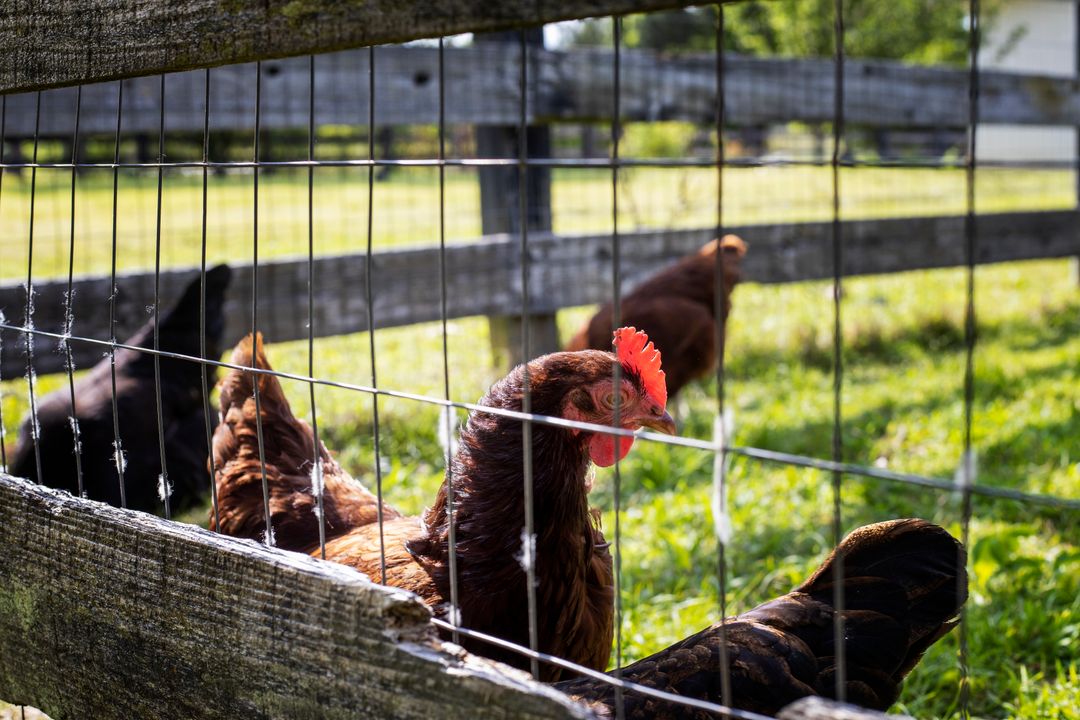
Use plastic mesh where you need to hold birds in, separate ages, shade or cover them, and use welded wire or hardware cloth where you need to keep predators out. For chicks, pick openings a day-old cannot squeeze through. For grown birds, 25 to 50 millimetre openings are common. For rats and snakes, plastic is the wrong material.
A farmer puts up a neat plastic mesh run, and for two months it works. Then one morning there is a hole the size of a fist at the bottom corner, and three birds are missing. The mesh was not badly fitted. It was simply asked to do a job that only metal can do.
Plastic mesh is light, cheap to handle, does not rust in the short rains and is easy to cut and shape. Used for the right jobs it is excellent. Used for the wrong ones it is a lesson learned at the cost of birds. This guide sorts the jobs: brooder guards, runs, overhead cover, nest and house openings, and floors, with the mesh size for each age. For the housing around it, see our guide to improved kienyeji housing.
What Is Plastic Mesh Good For, and What Is It Not?
Plastic mesh is a barrier against things that push, peck and flap: chickens that want to wander, chicks that want to leave the warm ring, and hawks that want to dive. It does not stop animals that bite or dig. Rats and mice gnaw. The University of Nebraska Extension guide on rodent-proof construction notes that the teeth of rats and mice struggle with anything harder than iron, which means softer materials, including plastic, can be gnawed through. A dog or a mongoose may also tear or push through a thin plastic panel.
The sensible rule is to match the material to the threat, and to use both where both threats exist.
| Job | Plastic mesh | Welded wire or hardware cloth |
|---|---|---|
| Brooder guard for chicks | Good, with a solid band against draughts | Good in hot weather, heavier to handle |
| Run walls against stray dogs and thieves | Weak on its own | Better; stronger on posts |
| Overhead cover against hawks and kites | Good: light and does not rust | Heavy; needs a strong frame |
| Keeping out rats and snakes | Not reliable | Right choice, with small openings |
| Floors that lift birds off wet litter | Good: does not rot or hold water | Hard on feet unless coated |
| Screening house vents and windows | Fine against birds and flying insects | Needed where rats can reach |
What Mesh Size Do You Need at Each Bird Age?
There is no published standard for mesh openings on kienyeji and broiler runs, so these are working rules of thumb from practice, and you should test them with your own birds. For chicks, the test is simple: hold a day-old at an opening and see if the head or body goes through. If it does, the mesh is too wide for that age, and a chick can get its head through and then be trapped or strangled.
| Bird age | Opening to use | What to watch |
|---|---|---|
| Day-old to 2 weeks | Up to about 12 mm | Heads and feet caught; chicks escaping to cold floors |
| 2 to 6 weeks | Up to about 25 mm | Chicks pushing through; hawks reaching in |
| Growers and adults | About 25 to 50 mm | Heads stuck in wider openings; birds flying over the top |
| Rat and mouse exclusion | About 12 mm or less, in metal | Plastic can be gnawed; use metal |
The Nebraska guide gives the other end of the scale. Rats need only slightly more than a half-inch gap to get in, about 12 millimetres, and mice only slightly more than a quarter inch, about 6 millimetres. It recommends hardware cloth of 19 gauge with half-inch openings to exclude rats. That is the figure to remember: a mesh that is safe for a hen is not safe against a rat.
How Do You Make a Brooder Guard From Mesh?
A brooder guard keeps chicks near the heat for their first days. The job is more than fencing, because the guard also stops floor draughts. The Mississippi State University Extension brooding guide recommends an 18 inch (about 45 centimetre) high, solid-type guard placed three to four feet from the edge of the heat source, expanded a little each day, until it is no longer needed after 7 to 14 days. It says hardware cloth or similar mesh may be used instead of a solid guard in hot weather.
That last point matters in a Kenyan short rains night. A mesh guard lets the draught through, so in cold or wet weather use a solid band of cardboard, hardboard or mabati around the lower half and mesh above it. In warm weather, mesh alone gives the ventilation the chicks need. Our guides to brooding equipment and to brooding in cold, wet weather give temperatures and ring sizes.
Practical points for mesh guards:
- Choose openings a day-old chick cannot get its head through, and test with a chick before the whole batch arrives.
- Form a ring, not a square. Chicks that panic crowd into corners, and a ring has none.
- Cut the ends flush and turn or tape the cut edges, since sharp mesh ends scratch chicks.
- Join the ends with soft ties or clips and check that the ring cannot spring open.
- Widen the guard with the chicks, and remove it when they stop huddling at its edge.
How Should You Build a Run That Lasts?
A run lets birds range safely in the daytime. Plastic mesh can make the upper walls and the roof, while metal does the work at the bottom, where predators dig and bite. A hybrid design uses each material where it is strong.
Height depends on the birds. Flighty kienyeji hens clear a low fence, so many keepers go to about 1.8 metres or cover the top. Heavier broilers and improved breeds fly less. If the run has a roof of netting, you can keep walls lower. Overhead netting also protects chicks from hawks and kites, which take young birds in the open.
Plastic mesh stretches and sags where metal does not, so fix it differently. Give it posts at closer spacing, run a line of strong wire along the top, middle and bottom and tie the mesh to those lines, and keep it taut. Use washers or wide-head fixings under the staples so the mesh cannot pull through. Corner and strainer posts still carry the whole fence, and our guide to farm fencing posts and wire explains how to set them so they do not lean.
Clear grass and bushes for a few metres around the house and run. A Standard Media article adapted from the KALRO app on kienyeji housing recommends clearing about 3 metres on all sides to deter rodents and reptiles, and keeping nests inside the house so eggs are not exposed to predators and thieves.
Which Predators Does Each Mesh Stop?
| Threat | How it gets in | What stops it |
|---|---|---|
| Hawks and kites | Dive from above into open runs | Overhead plastic net; cover and shelter under it |
| Stray dogs and thieves | Push, tear or climb over | Welded wire or chain link on strong posts; a lockable house door |
| Mongooses and genets | Dig under or squeeze through gaps at night | Wire skirt pegged along the ground; tight house door |
| Rats and mice | Gnaw and squeeze through small gaps | Metal mesh of about 12 mm or less on vents and low openings; feed in closed containers |
| Snakes | Enter through small gaps at night | Closed gaps, small metal openings, cleared ground around the house |
How Do You Protect Nests and House Openings?
Nests are where eggs and sitting hens are most exposed. Keep laying nests inside the house and not on open ground. Cover the vents and windows of the house with mesh so that air flows but animals cannot enter. The Nebraska guide recommends galvanised hardware cloth, hail screen or welded-wire mesh for vents and windows, and notes that mesh smaller than half-inch reduces airflow noticeably, so a half-inch metal mesh is a reasonable compromise between ventilation and rat control.
Use plastic mesh only where birds, not rodents, are the issue: to stop hens from roosting on the nest box roofs, or to screen a nest area from the open run. How many nests a flock needs is covered in our guide to laying nest boxes.
Where Does Plastic Flooring Mesh Fit?
Fuga's chicken plastic mesh product page describes plastic flooring mesh in 50 by 120 centimetre sheets that keeps birds off the litter. That is a floor product, not a fence, so we do not recommend it as a run wall or a guard. In the short rains, when litter turns wet, a floor that holds birds above the droppings helps keep feet dry, and it does not rot like timber. Our guide to plastic slatted floors covers framing and the disease reasons for lifting birds off the floor.
How Long Does Plastic Mesh Last in Kenyan Sun?
Plastic ages in sunlight. Ultraviolet light makes it chalky and brittle, and heat and tension make that worse. Suppliers of UV-stabilised HDPE netting commonly quote about three to five years for bird and insect netting and longer for heavy grades, but these are manufacturer figures, not independent tests, and they depend on the resin and the sun. Equatorial sun is strong, and an unstabilised mesh can fail much sooner.
Ask the seller whether the mesh is UV-stabilised, and do not assume a cheap roll is. Inspect your mesh at the start of every rainy season: if it cracks when you bend it, flakes white or tears with little effort, replace it before it fails with birds inside. Mesh that is out of the sun, as in a shaded house, lasts longer than mesh on an open run.
What Mistakes Cost the Most Birds?
Four mistakes repeat on farms. The first is using one mesh for everything, so a run built for hens is reused for chicks and the little ones walk straight through. The second is leaving a gap at the bottom, because a mesh that stops a hen from walking out does not stop a mongoose from walking in. The third is a sagging top, where loose mesh gives hawks a place to land and chickens a place to roost, from where they fly out. The fourth is forgetting the door, which is the weakest part of most runs: hang it tight, put a latch on it that a dog cannot lift, and count the birds in every evening.
Most of these are cheap to fix after the first scare. Walk the run once a month with a notebook, look for the lowest gap, the loosest corner and the oldest mesh, and mend them before the rains and before the December market, when a flock is worth the most.
Your Mesh Checklist
| Question | Check |
|---|---|
| Job | Is the threat birds pushing, hawks diving, or rats gnawing? Choose plastic or metal to suit |
| Opening | Tested with the youngest bird that will use it; metal at 12 mm or less where rats can reach |
| Height and top | High enough for your breed, or roofed with net against hawks |
| Fixing | Strong posts, wire lines, washers, taut; cut ends tidy |
| Base | Metal skirt pegged out or buried so diggers meet wire |
| Life | UV-stabilised mesh, checked every season, replaced when brittle |
Fuga Pages to Look At
Prices change, so we do not print them here. See each product page or the Fuga price list for current prices and stock.
| Item | Where it fits |
|---|---|
| Chicken plastic mesh | Plastic flooring mesh sheets, 50 by 120 cm, that keep birds off the litter |
| Livestock and poultry equipment | Feeders, drinkers, brooders and other poultry housing items |
Work out the threats first, then pick the mesh and size for each. Plastic overhead and high on the walls, metal low and around vents, and a tidy fixing will protect more birds than any single roll. WhatsApp us on 0716 961 018 with your flock size and where the problem is, and we will help you choose, or visit any of our six branches.
Key Takeaways
- Use plastic mesh to hold birds in and to cover them against hawks; use metal with small openings to keep rats, snakes and diggers out.
- Test the opening with the youngest bird that will use the mesh: if a day-old chick's head goes through, it is too wide.
- Rats can enter a gap of about 12 mm and mice about 6 mm, and they can gnaw plastic, so vents and low openings need metal.
- A brooder guard should keep out floor draughts: use a solid band in cold or wet weather and mesh alone only in hot weather.
- Build runs plastic high and metal low, with a skirt pegged along the ground so digging animals meet wire.
- Plastic ages in the sun, so buy UV-stabilised mesh, inspect it every season and replace it when it turns brittle.
Frequently Asked Questions
What size plastic mesh do I need for day-old chicks?
Use openings small enough that a day-old chick cannot get its head through, up to about 12 mm as a rule of thumb. Test with a chick before the batch arrives, because heads caught in wide mesh are a common cause of losses.
Can I use plastic mesh to keep predators out of the chicken house?
Only some of them. Plastic works against hawks when used as overhead net, but rats and mice can gnaw it and enter gaps of about 12 mm and 6 mm. Use metal mesh with small openings on vents and low openings, and keep plastic for the upper walls and roof.
How high should a chicken run be?
It depends on the breed. Flighty kienyeji hens clear low fences, so many keepers go to about 1.8 metres or roof the run with net, while heavier breeds fly less. Overhead net also protects chicks from hawks and kites.
How long does plastic mesh last in the sun?
Suppliers of UV-stabilised netting commonly quote about three to five years for bird netting, but these are manufacturer figures and depend on the resin and the sun. Unstabilised mesh can fail much sooner, so check it every season and replace it when it cracks or turns chalky.
Can I use a mesh ring as a brooder guard in the rainy season?
Not on its own. Mississippi State Extension advises a solid guard to stop floor draughts and allows mesh in hot weather, so in cold or wet weather put a solid band of cardboard or hardboard around the lower half and mesh above it.


