
Updated 4 November 2026. Checked against the clip our team sent on 31 October 2026, the Fuga price list and the Ross Broiler Pocket Guide (Aviagen).
Which chick feeder, and when? In our team's clip, day-old chicks start on a pan feeder. From day 4 you add a 1.5 kg feeder or a long trough and keep the pan. On day 7 the pan goes and the chicks carry on with the 1.5 kg feeder. At one month old they move to the 3 kg feeder.
Anyone who has put day-old chicks into a brooder knows the first worry: will every chick find the feed? Chicks are small, they have just left the hatchery, and a feeder built for bigger birds can be too deep, too tall or too far away. Chicks that cannot eat in the first days fall behind the rest of the flock, and a flock that grows unevenly is harder to manage and harder to sell.
The other half of the problem is the opposite one. A tray that suits a day-old chick is too small once the birds are a few weeks old, and feed ends up on the litter. So the real question is not only which feeder to buy. It is which feeder, at which age, and when to change.
Our team filmed a short clip on exactly that question: what type and size of feeder to use from a day-old chick up to one month old. This guide takes the clip step by step, checks it against a published breeder's handbook, and tells you plainly where the clip gives no figure. The video appears on this page, above the questions at the end, once it is on our YouTube channel. For the wider picture see our guides on chick and poultry feeder types and chick brooding equipment.
What does the clip show?
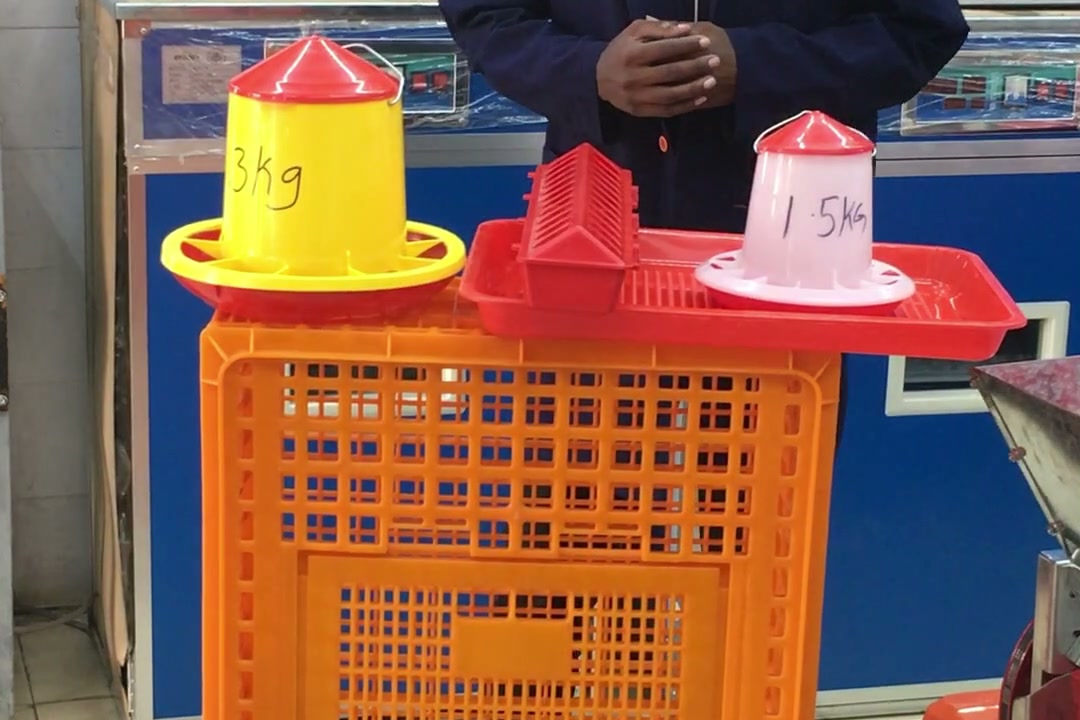
A member of our team stands behind an orange crate with four feeders on top. The on-screen text opens with the question: "Poultry farmers, ever wondered what type and size to use for your day old to one month old chick?" Four feeders are then named on screen, one after the other: the pan feeder, the 1.5 kg feeder, the long trough and the 3 kg feeder. He picks each one up as he talks. The clip ends with our four branch phone numbers and the Fuga logo.
The narration mixes Swahili and English. We transcribed it by machine and checked it against the captions. The English lines are clear: the pan feeder goes on day 7, the chicks continue on the 1.5 kg feeder, and the 3 kg feeder is for chicks that are one month old. The day 4 step and the reason given for the pan feeder come from our reading of the Swahili part, so treat them as our best reading and not as a printed rule.
What feeder does a day-old chick need?
The clip says the pan feeder is the one for day-old chicks, and gives the reason that it trains the chicks to feed. That matches what breeders recommend for the first days. The Ross Broiler Pocket Guide, from the breeder Aviagen, says to provide feed as a dust-free crumble or mini-pellet on feeder trays (one per 100 chicks) and on paper that covers at least 80 percent of the brooding area. It also says to place about 40 g of feed per bird on flat trays or paper when the chicks arrive, and to top it up at regular intervals through the first 3 to 4 days.
Two points to take from that. First, in the first days chicks learn to eat by seeing feed on a flat, open surface, which is why a shallow tray or pan works and a deep hanging feeder does not. Second, those first feeders must never run empty, because chicks that cannot find feed in the first hours are the ones that fall behind.
Start flat, then step up. A shallow pan feeder shows every chick where the feed is. The deeper tube feeders come in only after the chicks know how to eat.
How many feeders do I need for 100 chicks?
The clip does not give a number of feeders per 100 chicks, so we will not invent one. What we can give you is the published figure and a way to check your own pen.
The Ross Broiler Pocket Guide uses one feeder tray per 100 chicks, with the rest of the feed on paper. At 40 g a bird, a pen of 100 chicks starts with 4 kg of starter spread over those trays and the paper (our arithmetic: 40 g multiplied by 100). Those figures are for commercial broiler houses and for the standard chick tray used there. Our pan feeders come in different sizes, and the price list names them by size: a 500 mm round pan and a 520 mm by 350 mm pan are both listed. We have no published count of chicks per Fuga pan, so we cannot say that one of ours serves 100.
So use the pen as the test. If you stand and watch at feeding time and see chicks queueing or being pushed away from the feed, you need more feeders or more paper. If every chick finds feed within a minute or so and the litter under the feeders stays dry, you have enough. Put the feeders where the chicks gather, near the warmth but not directly under the heater, and keep the drinkers close by.
When do I add the 1.5 kg feeder or the long trough?
The clip says to bring in the 1.5 kg feeder or the long trough from about day 4, and to keep the pan feeder in place while you do. The sense of that is easy to see: the chicks meet the new feeder while the familiar one is still there, so none of them is left without a feeder they recognise.
Put the new feeder close to the pan, not in a far corner, and at a height the chicks can reach without stretching or climbing. The Ross guide says to adjust feeder height daily so the birds' breasts are level with the base of the feeder, and to let the birds clear the feeders once a day. The clip does not cover height, so this comes from the breeder's guide. Raise the feeder as the chicks grow, and check it every day or two in the first weeks.
Which one, the 1.5 kg feeder or the long trough? The clip offers both as the next step. A 1.5 kg feeder is a hanging or standing feeder with a hopper that holds a reserve and drops feed into a pan as the chicks eat. A long trough is a long, narrow channel along which many chicks can stand side by side. A tube feeder holds more than one meal, so it suits a farmer who cannot refill several times a day. A trough lets many chicks eat at the same moment, which suits a crowded pen. The clip offers both and does not say that one is better.
When does the pan feeder come out?
On day 7, according to the clip, the pan feeder is removed and the chicks carry on with the 1.5 kg feeder. The Ross guide independently says that birds should be on the main feeding system by 6 to 7 days of age, so the clip and the breeder's guide agree on the timing. Do not remove the pan on a fixed date regardless of what you see. Watch the chicks for a day first: if most are eating from the 1.5 kg feeders or the trough and the pan is mostly untouched, take it out. If a good number of chicks are still crowded round the pan, leave it another day.
If you want to remove trays gradually instead of all at once, that is a sensible variation and nothing in the clip rules it out. What matters is that no chick goes hungry in the changeover.
Change feeders by what the chicks do, not only by the calendar. Day 4 and day 7 are the clip's guide. Your chicks, your brooder and your weather decide the exact day.
When do chicks move to the 3 kg feeder?
At one month old, says the clip, the chicks move to the 3 kg feeder. The sense of the move is that a month-old bird eats more than a young chick, so a bigger hopper needs refilling less often. The clip gives no count of birds per 3 kg feeder, and the Ross guide's figure of 70 birds is for a 38 cm tube, not for this size, so check how the birds behave. If the 3 kg feeder is empty before you refill it, or birds are pushing to reach it, add another.
For the stages after one month, including feeder space per bird and feeder height up to point of lay, see our guide to raising pullets to point of lay, which quotes the Hy-Line space allowances, and our guide to feeders and drinkers for the whole poultry house.
Fact table: the clip at a glance
| Age | Feeder | What the clip says | What the Ross guide says |
|---|---|---|---|
| Day 1 | Pan feeder | Start here; it trains the chicks to feed | Feed on trays (1 per 100 chicks) and paper, about 40 g per bird |
| From day 4 | Add a 1.5 kg feeder or a long trough | Keep the pan feeder in place | Keep topping up trays and paper for the first 3 to 4 days |
| Day 7 | 1.5 kg feeder | Take the pan feeder away | Birds on the main feeding system by 6 to 7 days |
| One month | 3 kg feeder | Move up to the larger feeder | No figure for this feeder size |
Sources: the Fuga team clip sent on 31 October 2026; Aviagen, Ross Broiler Pocket Guide, 2015 edition, pages 10, 12 and 24 to 25, read on 4 November 2026. The Ross guide is written for commercial broilers. If you keep layers or kienyeji, ask your hatchery for the guide for your breed and use the clip's order as the starting point.
What goes wrong, and what to do
These are practical checks drawn from the breeder guide and common poultry practice, not figures from the clip. Read the pen before you change anything.
| What you see | Likely cause | What to try |
|---|---|---|
| Chicks are not eating | They cannot see the feed, or the brooder is too cold or too hot | Scatter starter on paper in the warm zone, and check feed, water and temperature an hour or two after placing the chicks |
| Chicks queue or push at the feeder | Too few feeding points | Add another feeder or more paper, and spread them around the brooder |
| Feed on the litter | Feeder filled too full, or hung too high or too low | Fill to about a third and set the height to the birds' breasts |
| Chicks ignore the new feeder | It is too far from the familiar one | Stand it next to the pan until they use it |
Keep feeders clean. Tip out stale feed each morning, brush the feeder dry and wash it with warm water regularly, and let it dry before refilling. Damp feed grows mould quickly, and mouldy feed can make young chicks sick. Our guide on how our poultry feeders are made explains why moulded plastic feeders wash easily and last.
Which Fuga feeders are in the clip?
Our team named four feeders in the clip, and we list the stock codes below. The clip does not show a code on any feeder, so the table gives every item on the price list with that name and size. When you order, say which one you saw in the clip and the branch will match it to the stock code. Our Fuga Center moulds poultry feeders in Kenya, and the chicken feeder page shows the range. The turbo feeders come in several capacities.
| Feeder in the clip | Price list name | Stock code |
|---|---|---|
| Pan feeder | Pan feeder round small | 6728 |
| Pan feeder | Pan feeder, 500 mm diameter | 6311 |
| Pan feeder | Pan feeder, 520 mm by 350 mm | 6312 |
| 1.5 kg feeder | 1.5 kg feeder local | 6104 |
| 1.5 kg feeder | Feeder, 1.5 kg | 6209 |
| 1.5 kg feeder | Feeder 1.5 kg, new | 6214 |
| Long trough | Trough feeder A | 6419 |
| Long trough | Trough feeder B | 6418 |
| 3 kg feeder | Feeder, 3 kg | 6210 |
| 3 kg feeder | Feeder 3 kg, new | 6215 |
Stock codes from the Fuga price list, checked on the live site on 4 November 2026. Prices change, so we do not print them here; the price list and each product page carry the current figure, and a branch will confirm stock before you travel.
How do I order?
Tell us your chick numbers and the age they will be at, and we will list the feeders by stock code for the branch nearest you. Use our contact page, or message us on WhatsApp on 0716 961 018. We deliver countrywide and stock the range across our six branches. You can also browse the poultry range first.
Key Takeaways
- Our team's clip gives the order: pan feeder for day-old chicks, add a 1.5 kg feeder or a long trough from day 4, remove the pan on day 7, move to the 3 kg feeder at one month.
- The clip gives no number of feeders per 100 chicks. The Ross Broiler Pocket Guide uses one feeder tray per 100 chicks plus paper, for commercial broiler houses.
- The Ross guide puts birds on the main feeding system by 6 to 7 days, which agrees with the clip's day 7 change.
- Change feeders by what the chicks do: if chicks queue at the feeder, add one; if the pan sits untouched, take it out.
- Keep the feeder height near the birds' breasts, adjust it often in the first weeks, and fill feeders only about a third full.
- Ask for the feeder by stock code at any Fuga branch or on WhatsApp 0716 961 018; prices are on the price list and are not printed here.
Frequently Asked Questions
Which feeder is best for day-old chicks?
In our team's clip the pan feeder is the one for day-old chicks, because it trains the chicks to feed. The Ross Broiler Pocket Guide agrees on the principle: give day-old chicks feed on shallow trays and on paper so that every chick can see it, and top it up through the first 3 to 4 days.
How many feeders do I need for 100 chicks?
The clip does not give a number. The Ross Broiler Pocket Guide uses one chick tray per 100 chicks, with the rest of the starter on paper, for commercial broiler houses. Fuga pan feeders come in different sizes, so watch your own pen: if chicks queue or are pushed away from the feed, add more feeders or more paper.
When do I remove the pan feeder?
On day 7, according to the clip, when the chicks continue on the 1.5 kg feeder. The Ross guide says birds should be on the main feeding system by 6 to 7 days. Watch the chicks first: take the pan out when most of them are eating from the other feeders.
When do chicks move to the 3 kg feeder?
At one month old, according to the clip. It gives no count of birds per 3 kg feeder, so check how the flock behaves and add another feeder if birds crowd it or it empties before you refill.
How high should I hang a chick feeder?
The Ross Broiler Pocket Guide says to adjust the feeder height daily so that the birds' breasts are level with the base of the feeder. Our own guides add that feeders should be filled only about a third full to cut spillage.
Where are the prices for the chick feeders?
On the Fuga price list and on each product page, under the stock codes listed in this guide. Prices change, so we do not print them in the article. Message a branch or WhatsApp 0716 961 018 to confirm stock and the current price.


