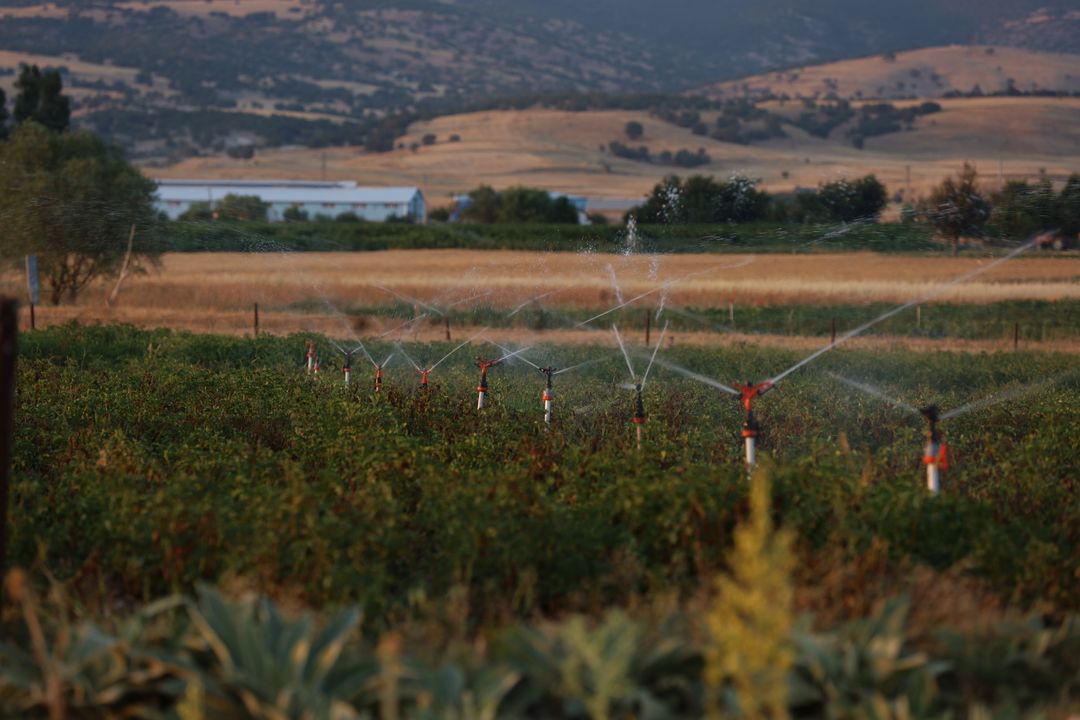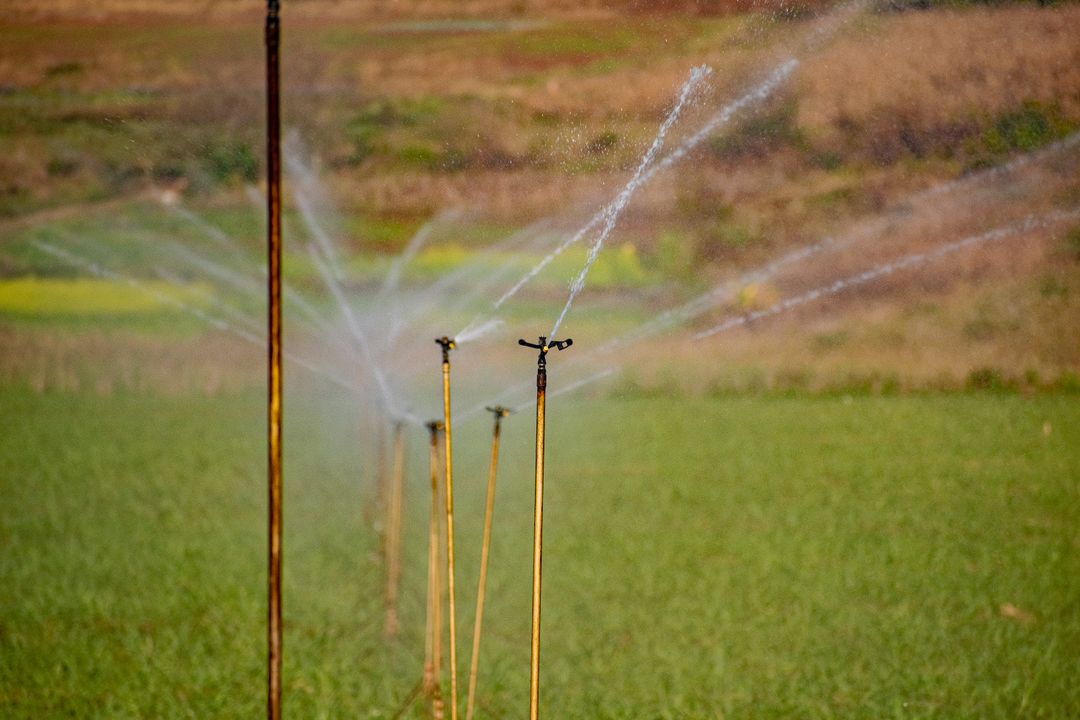
A rain gun or impact sprinkler that stops turning, or throws short, is usually short of pressure at the nozzle or has a worn, dirty or badly set arm. Check the pressure at the sprinkler first, then the nozzle and filter, then the arm, spring and bearing, and only then the pipe, pump and wind.
You set the gun on the pasture at dawn, switch on the pump and listen. Instead of the steady tick of the arm there is silence, or one hard knock and then nothing, and a rope of water drops ten metres short of where the last set landed. Half the field gets watered, half does not, and the dry spell will not wait.
We already explain how a rain gun works in our rain gun irrigation guide, how to measure your pattern in the catch can test guide, how small sprinklers behave in the impact sprinkler guide and how pipe size eats pressure in pipe sizing and friction loss. This guide is different. It starts from what you see the sprinkler doing and takes you through the faults in the order that saves the most time, with a test for each so you do not replace a part that was never broken.
Which Symptom Do You Have?
Rain guns and impact sprinklers fail in a handful of ways, and each points at a different suspect. Match what you see to the table before you start taking things apart.
| What the sprinkler does | Likely cause | Start with |
|---|---|---|
| Does not turn at all, jet steady | Low pressure, sand in the bearing, arm not hitting the jet | Pressure at the nozzle |
| Turns a few degrees, then stalls or reverses | Pressure too low or too high, weak or mis-set spring | Pressure, then the spring |
| Turns very slowly or in jerks | Worn bearing, dirty parts, low pressure | Strip and clean the bearing |
| Throws short all round | Low pressure, worn or wrong nozzle, blocked filter | Pressure, nozzle, filter |
| Ragged, splashing jet | Damaged or half-blocked nozzle, trash in the stream | Remove and inspect the nozzle |
| Wet in the middle, dry at the edge | Pressure too low for the nozzle | Gauge, then pump and pipe |
| Lopsided pattern | Stand not level, wind, stops set wrongly | Level the stand, check the wind |
What Is the Order to Check Things?
Work from the cheapest check to the one that needs the sprinkler stripped. Pressure comes first because low pressure produces nearly every symptom above, and because the other checks are wasted if the water arriving at the nozzle is not what the gun was designed for.
Is the Pressure at the Nozzle Too Low, or Too High?
Pressure drives everything. The jet speed sets the throw and also provides the force that pushes the arm. Maker guidance for impact sprinklers states that pressure that is too low or too high gives poor rotation and poor distribution. Too little pressure and the arm may fail to turn at all, or will rotate to one side and fail to return. Too much and the jet breaks into mist that the wind carries away, and in extreme cases the arm can swing hard enough to strike the back of the body and stand still or turn backwards. Rain gun makers also state that at extremely low pressure the gun may fail to rotate and that excess pressure makes the stream mist.
Do not guess the pressure at the nozzle from the pump label. Put a pressure gauge at the base of the sprinkler with the water running, and compare the reading with the maker's table for your nozzle size. A gauge is the cheapest instrument in irrigation. Fuga lists a Rain Gun (Various Pressures), Sprinklers and a Zinc Alloy Sprinkler; their product pages give availability and warranty but no pressure tables, so ask us on WhatsApp for the maker's table for the model you buy.
If the gauge reads low, move on to the pump and pipe checks below. If it reads high, the nozzle may be too small for the pump, a valve may be throttled, or the line may be partly shut downstream. Open the supply valve fully and adjust only with the pump control.
Is the Nozzle Worn, Blocked or the Wrong Size?
The nozzle is where the pressure becomes a jet. A nozzle that is blocked, chipped or dented throws a ragged, splashy stream that falls short and does not drive the arm. A nozzle that has worn larger passes more water, so for the same pump the pressure falls and the throw shrinks, and the sprinkler may begin to stall. A nozzle that is the wrong size from the start, perhaps swapped from another gun, will not match your pump at all. Check the number stamped on the nozzle against the table, remove it and look through it at the light: the bore should be round and clean, with no nicks or trash in the throat.
Clean the filter or screen upstream of the gun. A mesh half-blocked with leaves, algae or silt cuts the flow, and the gauge will show pressure falling behind it. Our nozzle wear guide explains the same mechanism for spray nozzles, and a gun nozzle follows the same logic: wear is gradual, and it is always in the direction of a bigger hole.
Could Sand and Silt Be Stopping the Arm?
Sand and mineral deposits are among the most common reasons maker troubleshooting guides give for a head that sticks or turns slowly. If you pump from a river, a pan or a shallow well after heavy rain, the water carries grit. Grit packs into the bearing, wears the bearing washers and the arm tip, enlarges the nozzle and scores the pump. Impact heads tolerate dirt better than some other designs because the water path is open, but they are not immune.
Flush the line before you connect the gun: run the pump with the end of the hose open until the water is clear. Fit a suction strainer, keep the foot valve off the bottom, and clean the bearing when the sprinkler turns slowly. Disassemble the parts as the maker instructs, wash them in clean water and replace any washer that is cracked, flattened or worn. Do not lubricate the bearing with oil: makers of impact sprinklers specifically name lubricants other than water as a cause of trouble, because oil collects grit and swells rubber washers.
What About the Arm, the Spring and the Bearing?
If pressure is right and the nozzle is clean, look at the part that does the turning. The drive arm should swing out freely, be knocked by the jet and spring back to strike the body. Watch it run. An arm that does not reach into the jet, or is bent, will not turn the gun. A spring that is too weak lets the arm return slowly or not at all, and maker guidance says tension may need increasing; a spring that is too tight, or rubs on the bearing or its own coils, holds the arm back. Rain guns often have a drive vane or trip lever instead: a chipped or loose vane cannot catch the water, and a stiff trip lever will not flip.
A worn bearing washer lets the head wobble and bind. If the sprinkler turns in jerks or stops at the same spot every revolution, suspect the washers or a bent arm. Replace worn parts as a set rather than one at a time. Spare arms, springs and washers are cheap compared with the sprinkler, and keeping a set in the toolbox turns a lost irrigation day into a ten-minute stop.
Is the Pump Head or the Pipe the Real Culprit?
Often the sprinkler is fine and the system is not delivering. A pump has a maximum head at zero flow, but the figure that matters is the head at the working flow of the gun. A worn impeller, a loose belt, a petrol engine running slowly, or suction lift that is too high will all deliver less than the label promises. Air in the line during start-up makes the arm stall or the pump surge until the air is cleared, so prime the pump and let the line fill slowly.
Friction in the pipe also costs you pressure. Long lay-flat hose, many fittings and small-diameter pipe consume head before the water reaches the gun, and kinks or crushed hose make it worse. If the gauge at the gun reads far below the gauge at the pump, the pipe is the problem and the answer is shorter runs, one size larger pipe or fewer bends. See our pipe sizing guide for the method.
Does the Tilt Angle or the Wind Change the Throw?
Rain guns and many impact sprinklers have an adjustable or fixed trajectory angle. A higher angle gives more height and, in still air, more reach up to a point. In wind the picture changes. A 1988 simulation study of sprinklers in wind, published in the ASCE Journal of Irrigation and Drainage Engineering, found that the angle giving the longest throw falls as wind speed rises, from about 29 degrees in still air to much lower angles in strong wind. Nelson Irrigation, a rain gun maker, also notes that varying the trajectory angle can increase a gun's ability to cope with wind. A gun set steeply and thrown into a breeze loses its jet to the air, while a flatter angle keeps it low and lets it reach further.
Check the stand as well. A gun or sprinkler that leans throws further downhill than uphill, and a gun on soft ground can sink or twist as the water hammers on, so peg or weight the stand and set it level. Irrigate when the air is calm, early morning or evening. Wind pushes the pattern downwind and leaves the upwind side short, which is why a pattern that is fine at dawn looks poor at noon.
Why Is My Pattern Uneven or Donut-Shaped?
A donut, wet at the middle and thin at the edge, is the usual sign of pressure too low for the nozzle, since the jet does not break up properly or carry. A lopsided pattern points to wind, a leaning stand or stops set badly on a part-circle gun. Streaks and heavy patches in the pattern suggest a damaged nozzle or a stuttering arm. Run the catch can test in our uniformity guide after you repair the fault, to prove the fix worked.
A Fifteen Minute Bench Routine
When a sprinkler misbehaves, do this in order. First, gauge the pressure at the nozzle with the pump at its normal speed and compare with the maker's table. Second, switch off, remove the nozzle and clean the nozzle and the filter. Third, look at the arm, spring and bearing for sand, wear and rubbing. Fourth, flush the pipe and check for kinks and loose fittings. Fifth, level the stand and set the angle for the day's wind. Write down the reading before and after: the log tells you whether the pump is slowly losing performance.
Which Spares Should I Keep, and When Should I Call Us?
Keep a spare nozzle in each size you use, a set of bearing washers, a spare arm spring, a spare screen or filter and the pressure gauge. Replace the sprinkler if the body is cracked or the bearing seat is worn away. If the gauge shows the pump cannot reach the pressure the gun needs, or you are unsure about the pump, send us the make, the nozzle size, the gauge reading and a photo on WhatsApp. A minimum one-year warranty applies on machines bought from us, and our technical team will help you work out the next step.
The next time your gun stalls, resist the urge to hit it. Put a gauge on it, clean the nozzle, check the bearing and look at the wind. Most rotation and throw faults are pressure, grit or a tired spring, and all three can be found before the sun is up.
Key Takeaways
- Put a pressure gauge at the sprinkler first: low or high pressure causes most turning and throw faults.
- A worn, wrong or half-blocked nozzle shortens the throw and can stall the arm; clean the filter upstream.
- Sand and silt wear the bearing and nozzle: flush the line, fit a strainer and do not oil the bearing.
- Check the arm, spring and bearing washers for wear, and replace worn parts as a set.
- If the pressure at the gun is far below the pump gauge, the pipe, lift or fittings are costing you head.
- Level the stand, use a flatter angle in wind and irrigate in calm early morning or evening.
Frequently Asked Questions
Why is my rain gun not rotating?
The usual causes are pressure that is too low or too high, a blocked or damaged nozzle, sand in the bearing, a chipped drive vane or arm, or a weak or mis-set spring. Check the pressure at the nozzle with a gauge first.
Why does my sprinkler throw water short?
Low pressure at the nozzle, a worn or wrong-sized nozzle, a blocked filter or too much friction in the pipe. Compare your gauge reading with the maker's table for your nozzle size.
Should I oil an impact sprinkler that sticks?
No. Maker guidance names lubricants other than water as a cause of trouble because oil traps grit and affects the rubber washers. Strip it, wash the parts in clean water and replace worn washers.
Why is my sprinkler pattern wet in the middle and dry at the edge?
That donut pattern usually means pressure is too low for the nozzle, so the jet does not break up and carry. Check the pump, the pipe size and the gauge reading at the gun.
Does wind really change how far a rain gun throws?
Yes. Wind pushes the pattern downwind and shortens the throw upwind. A flatter angle often holds up better against a headwind, and calm early morning or evening is the best time to irrigate.