Walk onto any site where the client and the fundi are arguing, and trace the quarrel back. It sounds like a dispute about money or workmanship, but it almost always starts with a measurement: a wall out of square, a door frame cut to the wrong opening, a slab that ponds water because nobody checked the fall, a quote built on a guessed floor area. The work was done with skill; it was laid out wrong before the first tool touched the material.
Measuring tools are the cheapest items in any toolbox and the ones that decide whether everything else earns money, because they prevent the rework that eats profit.
This guide covers the full measuring kit for a Kenyan fundi or farm workshop: tape classes, reading a tape properly (including the loose hook beginners return as faulty), spirit levels and the flip test, when a multi-line laser level pays for itself, laser distance measures for quoting, vernier calipers, and the care that keeps every tool telling the truth.
Why Errors Grow: The Mechanics of a Measurement Dispute
Measurement mistakes are rarely single big blunders. They are small errors that accumulate, because layout is a chain: each mark is measured from the last. Measure ten fence post spacings with a tape that reads 5 millimetres short per pull, and the last post lands 50 millimetres off the plan. Set out a room from a corner that is not square, and every course of blocks inherits the error.
The cure is procedural, not just better tools. Measure from one fixed datum instead of chaining mark to mark. Check diagonals when setting out rectangles: if they match, the corners are square. And agree the reference tools at the start of a job, because two tapes on one site can genuinely disagree, especially when one is a fibreglass tape stretched by years of hard pulling.
Tape Classes: A 5m Pocket Tape and a 30m Surveyor Tape Are Different Tools
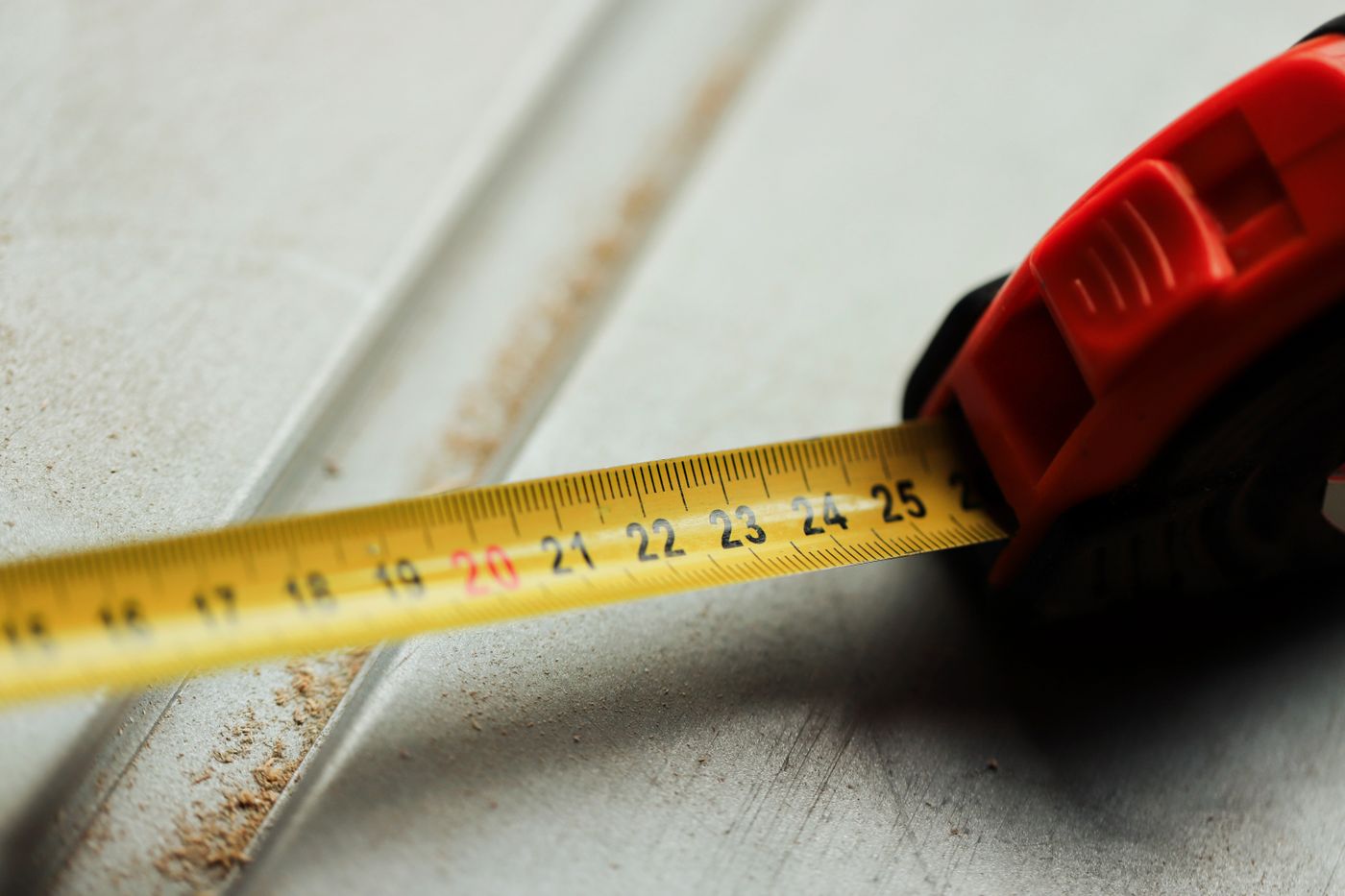
Tapes split into two families built for different jobs. The pocket steel tape, 3m, 5m, 7.5m or 10m, has a wide, curved steel blade. The curve is structural: it stiffens the blade so it can stand out unsupported (the distance it holds straight before folding is called standout), so one person can measure a ceiling height alone. This is the tape for carpentry, steelwork, masonry details, and anything measured to the millimetre.
The surveyor tape, 30m or 50m, usually fibreglass on an open or closed reel, is for distance over ground: setting out buildings, fencing lines, plot boundaries and irrigation runs. Fibreglass does not rust, does not kink, and survives being dragged through soil and wet grass, but it stretches slightly under hard pulling: a layout tool, not a precision one. Use it for metres and finish fine work with steel.
A 5m pocket tape measured end over end across a 30 metre plot accumulates an error at every re-mark, and a 30m reel tape used for joinery is clumsy and too coarse. A serious toolbox holds one of each; Fuga stocks tapes from 3m pocket sizes up to 50m reels, including the steel measuring tape, alongside the rest of our workshop and industrial tools range.
Reading a Tape Accurately, Starting With the "Loose" Hook
Every new tape owner notices the end hook rattling on its rivets and assumes a defect. It is the opposite: the hook is designed to slide by exactly its own thickness. Hook it over the end of a board and pull, and it slides out to measure from its inner face; push it against a wall and it slides in to measure from its outer face. That float compensates for the hook's thickness in both directions, so the tape reads true either way. A hook that has been bent, or glued solid by a well-meaning owner, reads wrong in one direction forever.
For fine work, do not trust the hook at all. Start your measurement at the 100 mm mark instead of zero, then subtract 100 from the reading; carpenters call this burning an inch. It removes hook wear from the measurement entirely.
Two more habits sharpen tape work. Read the blade straight on, not at an angle, because reading from the side shifts the apparent mark position (the error is called parallax). And over long unsupported spans, keep the blade taut and low: a sagging blade follows a curve, and a curve is always longer than the straight line you meant to measure.
Spirit Levels: Classes, and the Flip Test That Proves Truth
A spirit level tells you two things: level (horizontal, via the centre vial) and plumb (vertical, via the end vials). Length matters because a level only reports the surface it touches: a short level laid on one proud block reads level while the wall wanders. The pocket torpedo level, around 200 to 300 mm, suits plumbing and shelf brackets. The standard box level at 600 mm covers general fundi work, and a 1200 mm level is the walling and door frame tool, spanning enough blocks to average out local bumps. Straightness of the body matters as much as the vial, so re-check any level after a drop.
A spirit level can prove its own honesty in thirty seconds, with no other tool: the flip test in the figure below. Do it on the shop counter before you pay, after any drop, and whenever two levels disagree.
The logic is simple: flipping reverses any error in the vial but leaves the surface unchanged, so if the bubble sits the same both ways, vial error must be zero. If it moves, half the difference is the vial's lie and the other half is the surface. A level that fails the flip test is not a worse level to be used carefully; it is a random number generator, and it should be adjusted or replaced.
When a 16-Line Laser Level Pays for Itself
A laser level projects self-levelling lines onto the work: a pendulum inside finds true level by gravity, and the laser fans that reference across walls, floors and ceilings. A 16-line (4D) model wraps level and plumb lines around the whole room at once, with crossing points overhead for transferring marks from floor to ceiling.
For a fundi, the payback is labour and rework. Tiling a room by chalk line and spirit level means repeated marking, checking, and a helper holding the other end; a laser paints one continuous, always-correct reference on every wall, and it does not rub off or wander. The jobs that justify one are the ones fundis price by the room: tiling, gypsum ceilings and partitions, kitchen cabinets, door and window frames, and conduit runs that must cross a wall level. Indoors is its home ground; a bare line fades in full sunshine without a detector. If you hang ceilings or tile for a living, it typically repays itself within a few jobs in saved hours, before counting the callbacks you no longer get. Fuga stocks 16-line laser levels in the workshop range; ask on WhatsApp for current models and see the price list for today's figures.
Laser Distance Measures: Quote a Job Before Your Competitor Unrolls a Tape
A laser distance measure fires a beam at a wall and reads the distance in about a second, one-handed, from one end of the room. The TOTAL laser distance detector we stock reads from 0.5 m out to 60 m, far beyond any pocket tape, and calculates area and volume on board.
The business case is quoting. Pricing a paint job, tiling contract or ceiling means measuring rooms in an occupied, furnished house, and a tape means moving sofas and borrowing a hand to hold one end. With a laser measure you stand at the door, take length, width and height in seconds, and walk out with the areas done. You quote the same visit, and you never under-quote off a guessed dimension. In bright sun the dot washes out at range, one more reason the 30m fibreglass tape keeps its place outdoors.
Vernier Calipers: Workshop Precision, and How to Read One
Tapes measure to the millimetre; a workshop often needs better. A vernier caliper measures outside dimensions between its main jaws, inside dimensions with the top jaws, and depths with the rod at the end, and a standard 150 mm caliper reads to fractions of a millimetre. That is the difference between ordering the right bearing, matching a shaft to a bore, checking pipe wall thickness, and sizing a drill to a bolt by measurement instead of trial.
The vernier scale confuses people only until they see the trick. The sliding scale is deliberately made slightly shorter than the main scale it rides along, so only one of its lines can align perfectly with a main-scale line at a time, and which line aligns tells you the fraction. Read it in two steps: first take the main-scale value immediately to the left of the vernier's zero, then find the single vernier line that sits exactly opposite a main-scale line and add that fraction.
Before any reading, wipe the jaws, close them fully and confirm the scale reads zero, because a grain of grit is an error you will carry into every part. Hold the caliper square to the work and close it with light, consistent pressure: squeezing harder does not make the part smaller, it just bends the tool. Fuga stocks 150 mm vernier calipers in the workshop range; they earn a place in any workshop that also runs the machines in our power tools guide.
Caring for Measuring Tools So They Stay True
Measuring tools do not announce when they go wrong; they just start lying quietly. Care is therefore about protecting truth, not appearance. For tapes: never let a steel blade snap back at full speed, because the hook slamming home bends it and moves your zero; slow the last handspan by hand. Wipe fibreglass tapes clean of mud and water before reeling them in, since reeled-in grit abrades the markings, and never use a steel tape near live electrical work.
Levels ride on top of the toolbox, never underneath the hammers, and get a flip test after any fall. Laser tools are precision optics: keep them in their cases, off vibrating loads, and clean lenses with a soft cloth only. Calipers close with jaws lightly apart in a dry box, wiped after handling, because sweat rusts polished steel measuring faces. And once a season, check your tapes against each other over a few metres: any tape that disagrees with the rest is retired to rough work and marked so nobody quotes with it.
Key Takeaways
- Most site disputes trace to layout errors that accumulated; measure from a fixed datum and check diagonals to stop errors adding up.
- Run steel pocket tapes (3m to 10m) for millimetre work and fibreglass reel tapes (30m to 50m) for distance; they are different tools, own one of each.
- The loose tape hook is a feature: it floats by its own thickness so hooking and pushing both read true. For fine work, measure from the 100 mm mark and subtract.
- Prove any spirit level with the flip test: same reading both ways round means the vial is true. Test before buying and after every drop.
- A 16-line laser level pays for itself in tiling, ceilings, and partition work by holding a continuous level reference all shift.
- A laser distance measure turns quoting into a one-person, one-visit job, reading 0.5m to 60m with on-board area calculations.
- A vernier caliper reads in two steps: main scale left of the vernier zero, plus the one aligning vernier line. Zero it before every session.
- Care protects truth: no free-snapping tape blades, levels stored on top, optics in cases, calipers dry, and cross-check tapes each season.
Frequently Asked Questions
Why is the hook on my new tape measure loose?
It is built that way. The hook slides by exactly its own thickness so the tape reads true whether you hook it over an edge or push it against a surface. Do not glue or rivet it solid. If you suspect the hook has been bent, measure from the 100 mm mark and subtract 100 from the reading.
Which tape measure should a fundi buy first?
A 5m or 7.5m steel pocket tape covers most daily carpentry and masonry work; add a 30m fibreglass reel tape as soon as you take on setting out, fencing, or plot work. The two are complementary: steel for millimetres, fibreglass for metres.
How do I know if my spirit level is accurate?
Use the flip test: place the level on any firm surface, note exactly where the bubble sits, then turn the level end for end on the same spot. If the bubble reads the same both ways, the vial is true; if it moves, half the difference is the level's error. Check plumb vials the same way against a wall.
Is a laser level worth it for a small fundi business?
If you tile, hang ceilings, fit cabinets, or build partitions regularly, yes: a 16-line laser level replaces repeated chalk-line and helper work with one continuous reference, and it typically recovers its cost within a few room-priced jobs. For occasional DIY, a good 600 mm spirit level remains the sensible buy.
How much do measuring tools cost at Fuga?
Prices move with stock and the exchange rate, so check the price list or confirm the current figure on WhatsApp at wa.me/254716961018, or call 0734263958. Our team will help you build a full measuring kit, or you can visit any branch in Eldoret, Nakuru, Nairobi, or the Coast.