
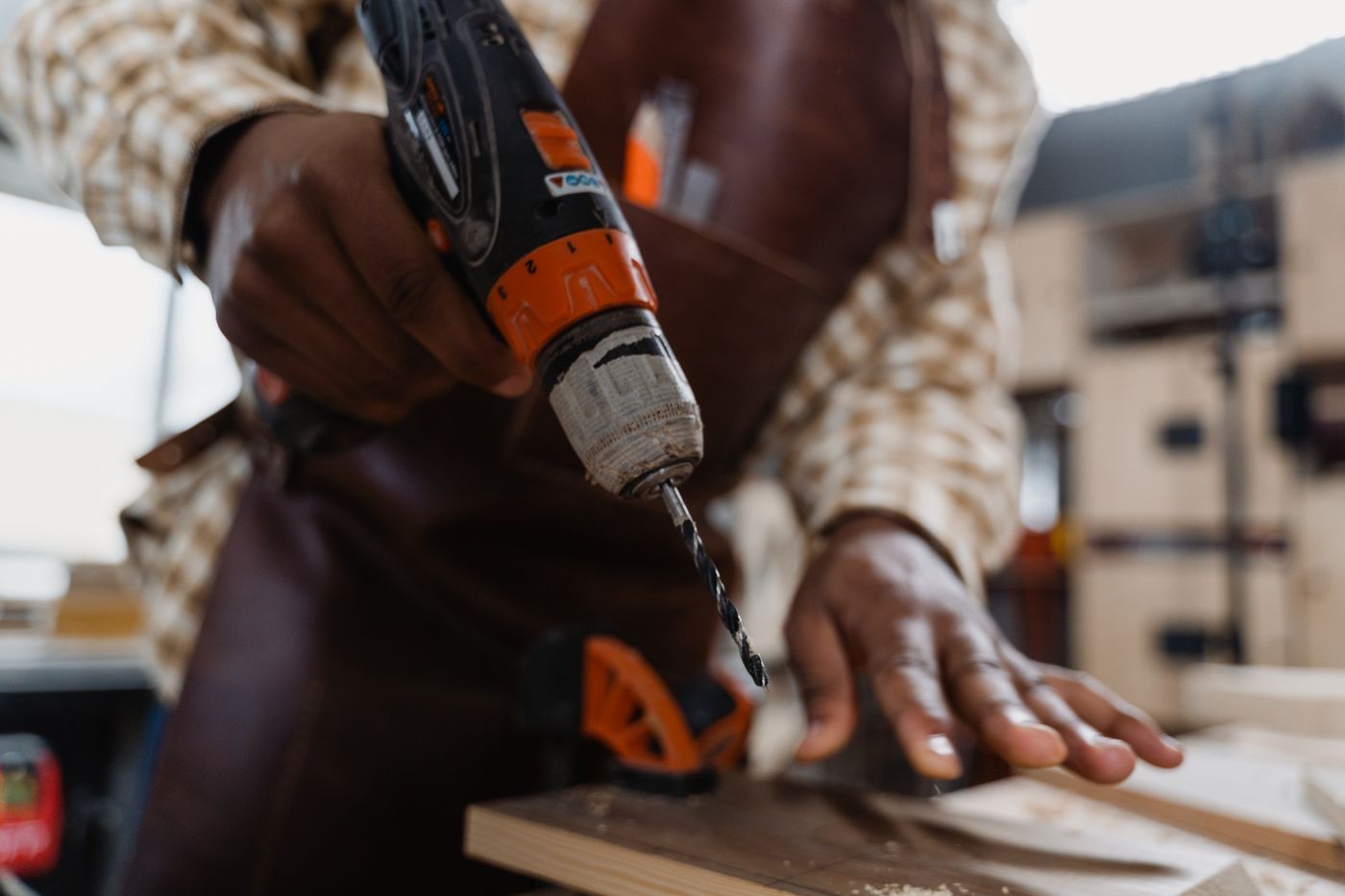
A fundi fitting a roof in Kitengela does not want a cable. The socket is forty metres away, the extension lead is a trip hazard on the scaffold, and the power went off at ten anyway. A cordless drill in that situation is not a luxury, it is the difference between finishing today and finishing tomorrow.
The same fundi, back in the workshop cutting angle iron for gates, would be mad to use a cordless grinder. The pack would be flat in minutes, the second pack would be flat before the first had charged, and the corded machine on the bench costs less than one spare battery.
Neither camp is right in general. The answer depends on the job, the power where you work, and how honestly you count the cost of batteries over the life of the tool. This article gives you the mechanism behind each, so you can decide for your own work.
You Are Buying a Battery Platform, Not a Tool
The first cordless tool you buy decides the next ten. Every manufacturer builds its packs to fit only its own tools, so the pack and charger that came with your drill will also run that brand's grinder, saw, blower and light, and nobody else's. The tool in your hand is the cheap part; the packs are the investment, and they only pay off if every future purchase shares them.
So the first question is not "which drill" but "which platform will I still be able to buy packs for in five years, from a shop I can reach". A platform that is common in Kenya is worth more than a technically better one nobody stocks, because a cordless tool with no available pack is scrap.
Once you are on a platform, buy bare tools, meaning the tool without pack or charger. Two or three packs shared across four or five tools is the setup that works, provided the packs are big enough for the heaviest tool in the set.
12V or 18V, and Why 20V Is the Same Thing
A lithium tool pack is a row of cells wired in series. Each cell sits at about 3.6 volts when it is working and about 4 volts straight off the charger. Three cells in series make a 12V pack (10.8V working, 12V peak). Five cells make an 18V pack (18V working, 20V peak). That is the whole story behind the 18V and 20V MAX labels: they are the same five-cell pack, one described by its working voltage and the other by its peak. Neither is more powerful.
What the voltage actually buys you is torque and current capacity. A higher voltage motor can deliver more mechanical power for the same current, which is why 18V tools can drill big holes, drive long coach screws and run grinders and saws, while 12V tools are built for drilling pilot holes, driving screws and working in tight spaces where the smaller body is the advantage.
For a fundi doing installations, fittings, electrical work and cabinetry, a 12V drill driver is often the better everyday tool: lighter, cheaper, and enough for the work. Our 12V cordless drill is on the price list at 7,000 KSH. For anyone drilling masonry, steel or timber beams, or who wants a cordless grinder or saw on the same packs, 18V is the platform, because the heavy tools do not exist at 12V.
The number to compare across packs is watt-hours, not amp-hours. Multiply voltage by amp-hours: an 18V 4Ah pack holds about 72 watt-hours; a 12V 2Ah pack holds about 24. That figure is the tank of fuel, and the next section is about how fast each job empties it.
Runtime Per Charge on Real Jobs
Runtime is not a property of the pack. It is the pack's watt-hours divided by how hard the tool is pulling, and that varies by a factor of ten between jobs. Driving a screw into softwood might average around 100 watts while the trigger is down. Drilling a 10 mm hole through steel plate is several hundred. A grinder cutting angle iron is pulling something close to the 700 to 900 watts that a corded grinder of the same size draws.
The figures in the chart are trigger minutes, and trigger minutes are not working hours. A fundi driving screws presses the trigger for two or three seconds at a time and spends the rest of the minute positioning, measuring and reaching for the next screw. Forty minutes of trigger time on a screwdriver spreads across most of a day. Six minutes on a grinder is six minutes, because when you are cutting, the trigger is down.
That is how to size packs: take the heaviest tool you will run cordless, estimate the trigger minutes that job needs before you can reach a charger, and buy the watt-hours for that. Keeping the 2Ah pack the drill came with, then adding a cordless grinder, is how people come to believe cordless tools do not work.
Charging Off a Generator or Solar
Cordless tools separate the moment you use the energy from the moment you draw it, which is genuinely valuable when the supply is on for part of the day. But the energy still has to come from somewhere, and on a site or farm with no grid at all, that means a generator or solar.
A generator is the easy case for capacity and the risky case for electronics. A tool charger draws far less than even a 1 kVA generator produces (our smallest, at 20,000 KSH on the price list), so the generator is never the limit. The risk is supply quality: a cheap generator without automatic voltage regulation can push spikes that damage a charger. Plug the charger through a surge protector, and do not charge while someone is starting and stopping a welder on the same set.
Solar is where the arithmetic matters. The charger needs mains voltage, so it plugs into an inverter, which draws from a 12V battery, which the panel fills through a charge controller. Every stage loses a little, and the battery loses more on the way in and out. In practice, budget on the order of 90 to 100 watt-hours from the 12V battery for every 72 watt-hour tool pack you fill.
Put that against a small system. A 12V 8Ah battery (1,500 KSH on our price list) holds about 96 watt-hours and should not be drained below half, so on its own it fills about half a tool pack. A 250W inverter (12,000 KSH) or 500W inverter (16,000 KSH) is ample for a charger. The fix is timing rather than a bigger battery: charge tool packs in the middle of the day, when the panel is feeding the inverter directly and the 12V battery is only buffering.
What Five Years Actually Costs
A corded drill or grinder is a one-time purchase plus a cable. A cordless tool is a purchase plus a charger plus packs, and packs are consumables. Lithium cells lose capacity with every full cycle and with every month spent hot, and a pack that is worked hard daily in a Kenyan workshop will need replacing well inside five years. Two packs, replaced once each over five years, is a realistic minimum for a tool in daily use, and the packs commonly cost more than the bare tool.
Set that against the corded price of the same capability. On our price list, a 680W impact drill is 3,200 KSH and an 850W impact drill 5,500 KSH; a 750W angle grinder is 4,500 KSH and a 900W grinder 5,000 KSH. A 12V cordless drill is 7,000 KSH with its pack, before any spare or replacement. The cordless tool is not worse value; it is buying something different, the freedom to work where there is no socket. The honest way to judge that price is to ask how many hours a year the cable would actually have stopped you.
Two things soften the cordless cost. Bare tools on an existing platform add no charger and no packs, so the second and third cordless tools are far cheaper than the first. And a pack that is looked after, which is the last section of this article, lasts a lot longer than one that is left in the sun.
Where Corded Still Wins Outright
Grinders doing real cutting. A cordless grinder is a superb tool for a few cuts on a roof or a fence line. It is the wrong tool for a workshop cutting and grinding steel for hours. The chart above shows why: a 4Ah pack is a few minutes of trigger time at grinder loads. A fabrication shop would need a stack of packs and a charger running all day to match one 900W corded machine that costs 5,000 KSH. Our angle grinder guide covers sizing the corded machine and its discs.
Anything that lives on the bench. A bench grinder, a chop saw, a pillar drill, a compressor or a welder never moves, so the cable costs nothing and the battery would buy nothing. There is no cordless version worth having. A 150W bench grinder at 6,000 KSH runs for a decade on the cable it came with.
All-day, continuous-load work. Circular saws ripping timber for a full shift, hammer drills sinking anchor holes in concrete all morning, planers and sanders on long runs. Cordless versions exist and are good, but continuous high load empties packs faster than a single charger can refill them, so the crew ends up waiting. Where there is a socket, the corded machine simply keeps going.
Heavy drilling. Our drill guide makes the same point: a corded impact drill gives constant torque through a run of holes in thick plate or old concrete, with no pack going soft two-thirds of the way through.
Cordless wins the mirror image: work away from a socket, work at height where a cable is a hazard, short bursts of drilling and driving through the day, and any job where the power will be off when you need it. Most fundis end up with both: a corded grinder and drill for the shop, a 12V or 18V driver for site work, and one platform for everything cordless.
Keeping Lithium Packs Alive in the Heat
Lithium cells age in two ways: cycle ageing, from being charged and discharged, and calendar ageing, from simply existing at a given temperature and state of charge. In a cool climate the first dominates. In Kenya the second can matter just as much, because heat speeds up the chemical reactions that eat capacity, and the worst combination is a pack that is both hot and full.
Keep packs out of the sun and out of vehicles. The cab or load bed of a pickup parked in the sun gets far hotter than the air outside, and a pack left there through a lunch hour is being cooked. Carry packs in a bag in the shade, and never leave them on the dashboard or the roof.
Let a pack cool before charging, and charge in the shade. A pack straight off a grinder is warm from work; charging it immediately stacks charging heat on top and ages it fastest. Good chargers refuse a hot pack, which is a feature, not a fault. Give it ten minutes in the shade, and once the charger shows full, take the pack off. Sitting full and warm is exactly the condition to avoid.
Store at part charge. A pack that will not be used for weeks should be left around half full in a cool, dry place and topped up every couple of months. Stored flat for months, a pack can drop below the level the protection circuit will let the charger recover; stored full and hot, it loses capacity fastest. Half is the sweet spot.
Do not run packs flat and leave them. The protection circuit cuts the tool at the cells' lower limit, but a pack left there keeps self-discharging. Charge a flat pack the same day.
Keep contacts clean and dry. Dust and sweat on the terminals cause heating and poor charging. Wipe them, keep the vents clear, and never leave packs on tools in a workshop that gets wet. There is no repairing a pack that has been submerged.
Whatever you choose, the tools, packs, chargers, extension cables and surge protectors are in the workshop and industrial tools range at all six branches, and staff at the counter can tell you which platforms they can keep supplying packs for.
Key Takeaways
- The first cordless tool commits you to a platform. Choose it for pack availability and price near you, then buy future tools bare.
- 18V and 20V MAX are the same five-cell pack. Compare packs by watt-hours (volts times amp-hours), not by the number on the label.
- Runtime is watt-hours divided by load. A 72 Wh pack is about 40 trigger minutes driving screws and about six minutes cutting steel. Size packs for the heaviest tool.
- A generator has plenty of capacity for a charger; the danger is spikes, so use a surge protector. On solar, charge packs at midday to skip the 12V battery losses.
- Over five years, packs and their replacements are most of the cost of going cordless. Corded tools are almost all paid on day one.
- Grinders doing real cutting, bench tools and all-day continuous work stay corded. Cordless wins away from sockets, at height and in short bursts.
- Heat plus full charge is what ages lithium. Keep packs out of vehicles, cool them before charging, take them off the charger when done, store at half charge.
Frequently Asked Questions
Is a 20V cordless tool more powerful than an 18V one?
No. Both packs are built from five lithium cells in series. Each cell sits at about 3.6 volts nominal and about 4 volts straight off the charger, so the same pack is 18V by its nominal rating and 20V by its peak rating. The number on the label is a marketing choice. Compare packs by watt-hours, which is voltage multiplied by amp-hours, and compare tools by what they do under load.
How long does a cordless tool battery last on one charge?
It depends entirely on how hard the tool is working. An 18V 4Ah pack holds roughly 72 watt-hours. At a light load of around 100 watts, such as driving screws, that is about 40 minutes of actual trigger time, which spreads over a morning because the trigger is only pressed for a few seconds at a time. At a heavy load of around 700 watts, such as cutting steel with a grinder, the same pack gives around six minutes of trigger time. Buy the pack size for the heaviest job, not the lightest.
Can I charge cordless tool batteries from a generator or solar?
Yes. A tool charger draws far less than even a 1 kVA generator produces, so the generator is never the limit; the risk is voltage spikes from a cheap generator without voltage regulation, so run the charger through a surge protector. From solar, the charger plugs into an inverter fed by a 12V battery. Every stage loses a little energy, so budget roughly 90 to 100 watt-hours from the 12V battery for every 72 watt-hour pack you fill, and charge in the middle of the day when the panel is doing the work.
Which power tools should stay corded?
Anything that runs at high load for long stretches or never leaves the bench. Angle grinders used for cutting and grinding all day, bench grinders, chop saws, pillar drills, compressors and welders all belong on the cable. A cordless grinder is excellent for a few quick cuts on site, but a fabrication shop cutting steel for eight hours would need a stack of packs and a charger running continuously to match one 900W corded machine.
How do I stop lithium batteries dying in the heat?
Keep them out of the sun and out of closed vehicles, because the cab of a pickup parked in the sun gets far hotter than the air outside. Let a pack cool before you charge it, since a pack that is hot from work and then charged immediately ages fastest. Do not store packs full or flat for months; leave them around half charged in a cool, dry place and top them up every few months. Keep the contacts clean and dry, and never leave a pack on the tool in a workshop that gets wet.