The lights go out at 7 pm, and two different compounds respond in two different ways. In one, somebody walks out with a torch, yanks a starter cord, and the whole plot listens to a generator hammer away for the next three hours. In the other, the TV never even flickers: an inverter switched over to a battery in a fraction of a second, silently, and the neighbours have no idea stima is off.
That second house is not richer. It simply matched the right technology to the right loads. An inverter and battery cannot do everything a generator does, but for the loads most households and small offices actually care about during an outage (light, information, communication, and a cold fridge), it does the job with no noise, no fuel runs, and almost no maintenance.
This guide explains what an inverter-battery pair can and cannot run, how hybrid inverters fold solar into the picture, how to size a system in three honest steps, where lithium beats lead acid and where it does not, why changeover switches matter more than most buyers realise, and when a generator is still the correct answer.
How an Inverter and Battery Actually Work Together
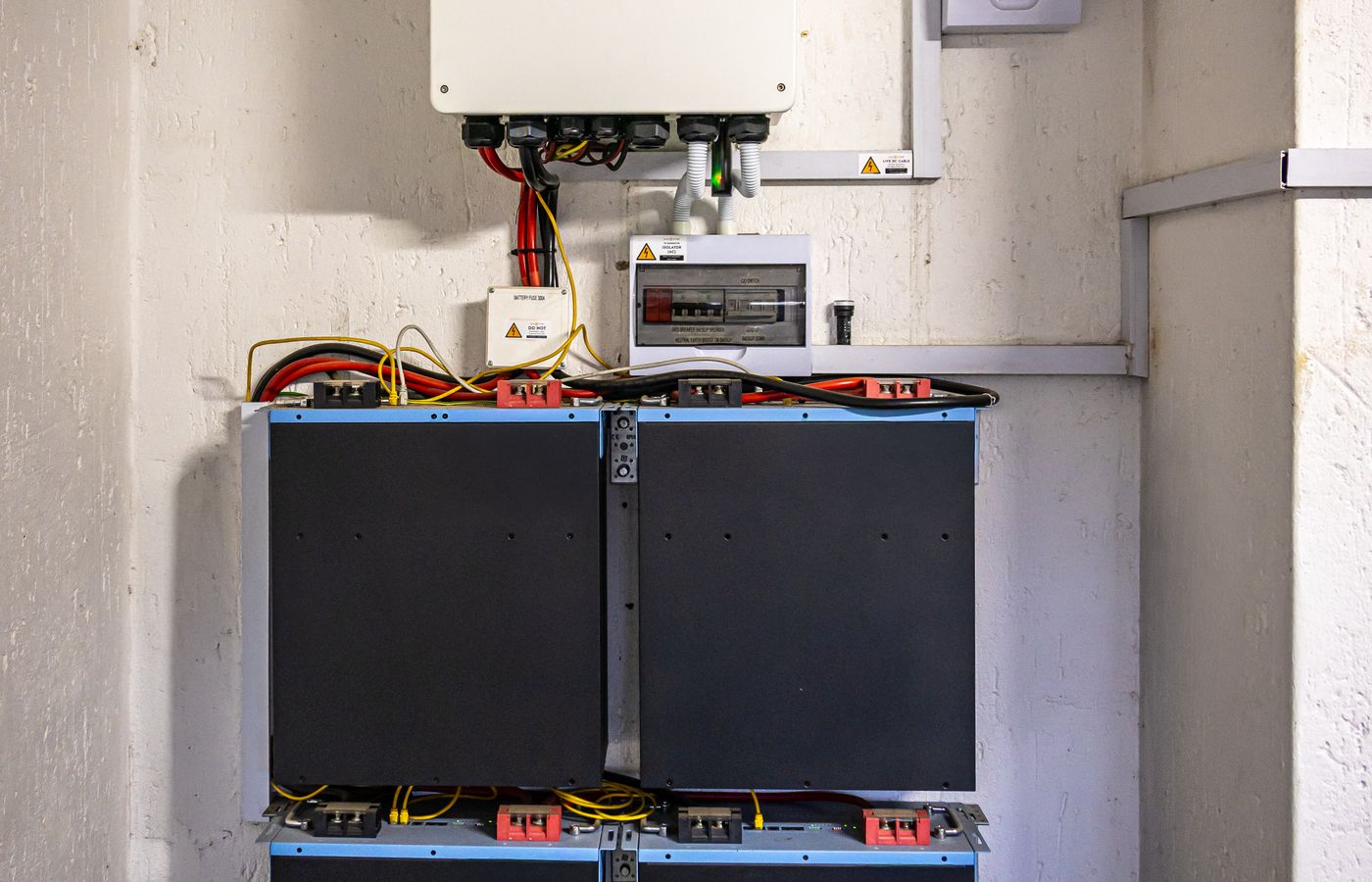
An inverter converts the direct current (DC) stored in a battery into the 240 volt alternating current (AC) your sockets deliver. On its own it is just a converter; paired with a battery it becomes a backup power plant. Most backup inverters also contain a charger: while mains power is on, the inverter charges the battery and passes stima straight through to your loads. When the supply fails, it switches to the battery so quickly that most electronics never notice.
Two numbers on the nameplate matter. The continuous rating, in watts or VA, is the load the inverter can carry all evening. The surge rating is what it can tolerate for a moment when a motor starts. And quality has a shape: a pure sine wave inverter produces the same smooth waveform as the grid, which fridges, laptops, and anything with a motor prefer. Cheaper modified sine wave units can make motors hum, heat, and age early. Fuga stocks pure sine units from 300W up to 2KVA, with the 1000W Solar Max and 1500W Solar Max the household favourites.
What It Can Run, and What It Honestly Cannot
Think of loads in three tiers. The first tier is what inverters were born for: LED lights, phone charging, the WiFi router, a TV and decoder, and laptops. These draw tens of watts each, so even a modest inverter carries all of them together for hours.
The second tier is "yes, with care". A fridge or freezer runs at a modest wattage, but its compressor is a motor, and motors draw several times their running power for the instant they start. An inverter sized only for the fridge's running watts will trip on that surge. Size for the surge (a generous continuous rating and a strong surge rating) and a fridge becomes one of the most valuable things a battery can protect.
The third tier is where you stop. Anything that makes heat (kettles, irons, water heaters, cookers) devours over a thousand watts continuously and will flatten a battery in minutes. Welders and large water pumps combine huge draws with brutal starting surges. These loads belong on the grid or on a proper generator, as we cover in the diesel generator buying guide.
Hybrid Inverters: Mains Charging Plus Solar Input
A standard backup inverter charges only from mains. A hybrid inverter, like the Solar Max models Fuga stocks, adds a solar input with its own charge controller built in, so the same box can charge your battery from panels by day and from stima whenever it is available, then prioritise whichever source you prefer.
This is the natural fit for the growing number of Kenyan homes running stima plus panels. During the day the panels carry the light loads and top up the battery for free; at night the battery carries the evening; mains fills any gap. Set to solar-first, the system quietly trims your monthly bill even in months with no blackouts at all, which is how a backup purchase turns into an energy investment. If you are adding panels, our guide to solar panel sizing and costs in Kenya walks through matching array size to your loads. For panel-only setups without a hybrid unit, a separate charge controller manages battery charging.
Sizing in Three Plain Steps
Sizing is arithmetic, not art. Step one: list your outage loads. Only the things you truly need when power is off, with the wattage from each appliance's nameplate or manual. Step two: add the watts. The total, plus surge headroom for any motor, sets your inverter size. Step three: multiply by hours. Watts times the hours you want to ride through gives watt-hours, and that sets your battery size, remembering that no battery should be drained to zero.
Here is a worked example with deliberately round numbers. This is a fictional illustration, not a quotation. Suppose a family lists six LED bulbs at 10W each, a TV at 100W, a router at 20W, and two laptops at 60W each: 300W total. A 1000W pure sine inverter carries that with room for a fridge's starting surge. For four hours of backup, 300W times 4 hours is 1,200 watt-hours. On a 12 volt system, that is 100 amp-hours of delivered energy (watt-hours divided by 12). To avoid deep-draining the battery, the family would look at a 200Ah lithium battery rather than a bare 100Ah, or accept shorter runtime on a 100Ah unit.
Lithium vs Lead Acid, Told Honestly
Lead acid batteries win exactly one argument: the price on the day you buy. Everywhere else, lithium (usually lithium iron phosphate, LiFePO4) has changed the mathematics of backup power.
The first difference is usable capacity. Manufacturers of lead acid batteries generally advise against routinely discharging below about half of capacity, because deep discharge shortens their life sharply. Lithium batteries tolerate much deeper discharge as a matter of routine design, so a lithium battery delivers far more of its nameplate amp-hours as usable energy. A "cheaper" lead acid bank can cost more per usable watt-hour than the lithium it undercut on the shelf.
The second is cycle life. Every manufacturer publishes its own figures and they vary widely with depth of discharge and temperature, so treat any specific number as a claim to verify on the datasheet. What is consistent across the industry is the direction: lithium chemistries are rated for several times more charge-discharge cycles than comparable lead acid units, which is why lithium usually wins on cost per year even after the higher purchase price.
Third, the practical points. Lithium is dramatically lighter for the same capacity, holds a steadier voltage as it discharges, charges faster, and needs no topping up with distilled water. Lead acid remains a fair choice for rarely-used standby setups on a tight budget. For daily-cycled solar hybrids, lithium is the honest recommendation, and Fuga stocks it from 100Ah to the 300Ah lithium solar battery for bigger households and offices.
Changeover Switches: The Safety Piece Buyers Skip
A changeover switch connects your house wiring to exactly one source at a time: mains or your inverter (or generator), never both. A manual changeover is a simple lever you throw yourself. An automatic changeover (ATS) senses the mains failing and transfers on its own, which is what gives you that seamless "the TV never flickered" experience.
Why is this non-negotiable? Without a proper changeover, backup power can flow out of your house and into the utility lines, a fault called backfeeding. Backfeeding can energise a line that a Kenya Power crew believes is dead, putting a technician's life at risk, and when mains returns it can meet your inverter's output head-on and destroy equipment. Plugging an inverter into a wall socket to "feed the house" is exactly this hazard and must never be done.
Stabilizers and Kenya's Voltage Swings
Mains voltage in Kenya does not fail only by disappearing; it also sags at peak hours and spikes when supply is restored. An automatic voltage stabilizer sits between the socket and a sensitive appliance and holds the output within a safe band, boosting sags and trimming surges. For fridges, TVs, and the inverter-charger itself, a stabilizer is cheap insurance: repeated brown-outs are a slow way to kill a compressor. Fuga stocks stabilizers alongside its solar range; sizes and current prices are on the price list.
Inverter or Generator: The Real Decision
The two technologies are not rivals so much as tools for different outages. An inverter-battery system is silent, instant, fuel-free, and nearly maintenance-free, but it stores a finite number of watt-hours, and heavy loads exhaust it quickly. A generator makes power for as long as you feed it fuel and will happily run pumps, welders, and a whole shop, at the cost of noise, fuel logistics, and a real maintenance routine.
So choose by load and duration. Evening household outages of a few hours, shops that need lights and tills, offices that need routers and computers: inverter, without question. Farms that must pump water, workshops that must weld, cold rooms and incubators that must run through a full day's blackout: generator, or generator plus inverter, with the battery bridging short cuts so the engine only starts for the long ones. That pairing, incidentally, is how businesses stop burning fuel for thirty-minute outages.
Key Takeaways
- An inverter converts battery DC to 240V AC and switches over in a fraction of a second; pure sine wave models are the safe choice for electronics and motors.
- Lights, TVs, routers, and laptops are easy loads; a fridge needs surge headroom; kettles, irons, welders, and big pumps do not belong on a battery.
- Hybrid inverters charge from both mains and solar panels, the right fit for stima-plus-panels households.
- Size in three steps: list loads, add watts (plus surge), multiply by hours for watt-hours, then buy battery capacity above the bare answer.
- Lithium costs more upfront but delivers more usable capacity, more rated cycles, less weight, and no watering; check exact figures on the datasheet, not adverts.
- A changeover switch prevents backfeeding, which endangers line crews and equipment; installation belongs to a licensed electrician.
- A voltage stabilizer protects fridges, TVs, and the inverter itself from Kenya's sags and spikes.
- Inverters win short, light-load outages; generators win long, heavy-load ones; the strongest setups layer both.
Frequently Asked Questions
Can an inverter run a fridge in Kenya?
Yes, with correct sizing. A fridge's compressor draws several times its running watts at start-up, so choose a pure sine wave inverter with a continuous rating well above the fridge's running load and a strong surge rating, commonly a 1000W to 1500W unit for a household fridge plus lights and TV. Confirm your fridge's nameplate figures before buying.
What is the difference between a hybrid inverter and a normal inverter?
A normal backup inverter charges its battery from mains only. A hybrid inverter, such as the Solar Max range, adds a solar input with a built-in charge controller, so panels and stima can both charge the same battery, and you can set which source the system prefers. If you have panels or plan to add them, buy hybrid.
How long will a battery run my house during a blackout?
Divide the battery's usable watt-hours by your load in watts. As a fictional round-number example, a battery delivering 1,200 usable watt-hours carries a 300W evening load (lights, TV, router, laptops) for about four hours. Doubling battery capacity doubles runtime; adding a heating appliance collapses it.
Is lithium really worth the extra cost over lead acid?
For systems cycled daily, especially solar hybrids, usually yes: lithium gives more usable capacity per amp-hour, is rated for several times more cycles, weighs far less, and needs no maintenance. For a standby system used a few times a year on a tight budget, lead acid remains reasonable. Compare datasheet cycle life at your intended depth of discharge, not shelf prices alone.
How much do Fuga's inverters and lithium batteries cost?
Prices move with stock and the exchange rate, so check the price list or confirm the current figure on WhatsApp at wa.me/254716961018, or call 0734263958. Our team will size the inverter, battery, and changeover for your actual loads, or you can visit any branch in Nairobi, Eldoret, Nakuru, or the Coast.