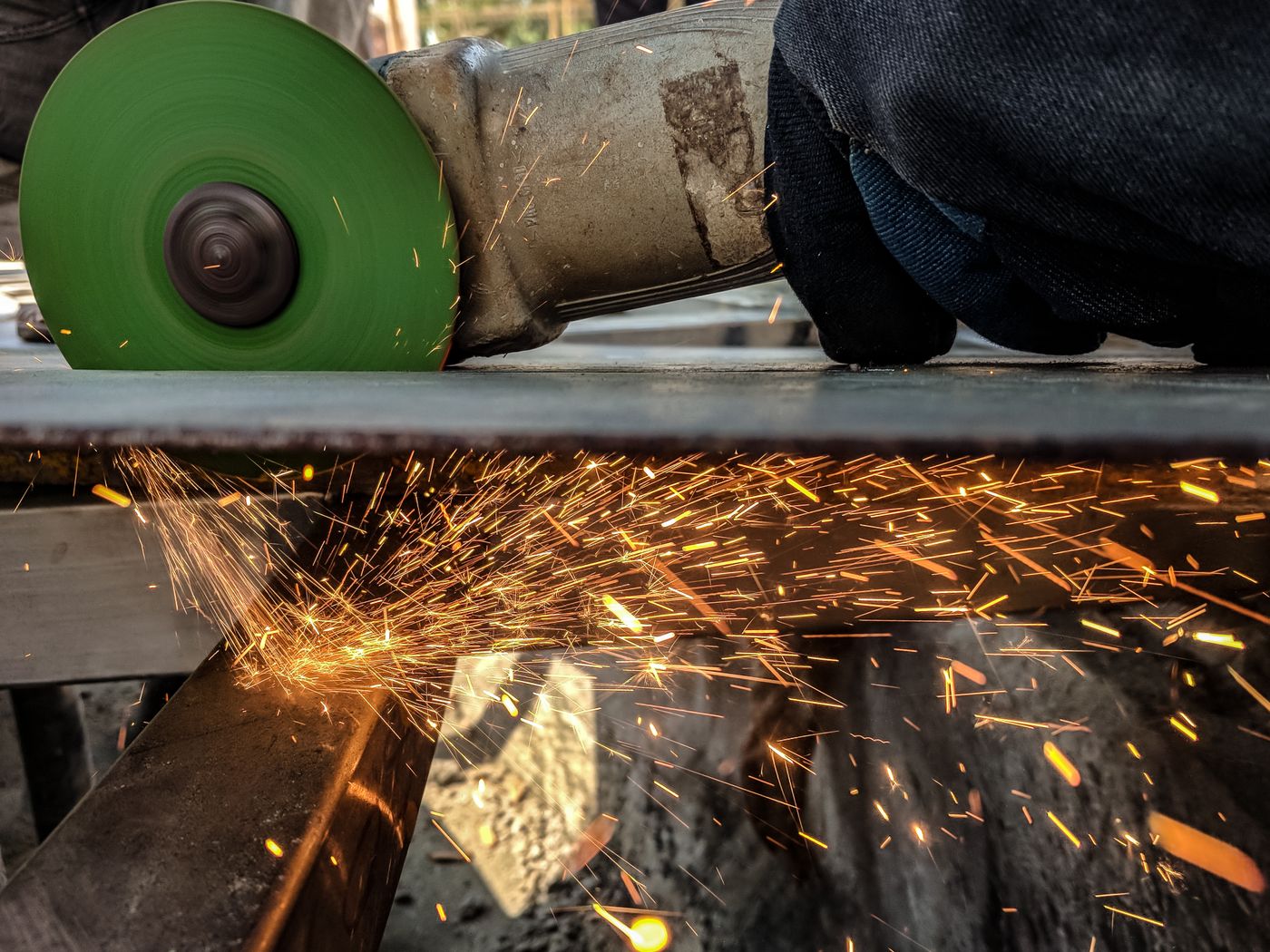
Walk into any jua kali yard in Kenya and you will hear an angle grinder before you see it. One machine cuts the rebar, shapes the gate, cleans the weld, sharpens the panga, and slices the veranda tile. No other power tool does as many jobs for as little money, which is exactly why it is the tool most often bought wrong and used wrong.
Two decisions determine everything: the machine, and the disc on it. Buyers agonise over the first and improvise the second, yet most grinder accidents and most wasted money trace back to the disc: wrong type, wrong size, or quietly gone bad in storage.
This guide covers both halves: what wattage actually buys you, why disc size dictates the machine, how to read the wall of discs at the shop, the one improvisation never to make, and the habits that keep the tool safe for years.
What Wattage Actually Buys You
An angle grinder's motor rating, in watts, is not a speed figure: small grinders all spin at similar no-load speeds. What wattage buys is torque under load, the ability to keep the disc at full speed while it is buried in steel. A low-powered machine cuts the same bar, but it slows in the cut, and a slowing disc rubs instead of cutting, overheats, wears fast, and grabs.
The second thing wattage buys is duty cycle. A 750 W machine making a few cuts with rests between will last for years; the same machine grinding welds continuously through a working day cooks its own windings, because a small motor has less copper and less cooling to shed the heat. Fabricators who grind all day burn out light grinders in months and blame the brand.
In practical classes: a 750 W machine handles repair work, light cutting, and occasional grinding, and its light weight makes it the easiest to control. The 1000 to 1400 W class is the fabrication workhorse for gates, grilles, and daily workshop use. Above 2000 W you are in 9 inch territory, machines built to swing a 230 mm disc through heavy section steel and masonry. Fuga stocks seven grinder models across this span, 750 W to 2200 W including Bosch, so you can match the motor to the workload: compare on the angle grinder page or the wider workshop and industrial tools range.
Disc Size Dictates the Machine: 4.5 Inch Versus 9 Inch
Grinders are named by the largest disc they accept: 115 mm (4.5 inch) and 125 mm (5 inch) machines are the compact class, 230 mm (9 inch) machines the heavy class. Disc size sets depth of cut: a 115 mm disc reaches roughly 30 mm into the work, covering rebar, square tube, angle line, and mabati sheet, while a 230 mm disc reaches roughly 65 mm for heavy posts, thick flat bar, and deep masonry chases.
Here is the mechanism most buyers miss: disc size and machine speed are engineered as a pair. A small grinder spins at around 11,000 to 12,000 rpm because a 115 mm rim can safely travel at that speed; a 230 mm machine spins at roughly 6,600 rpm because the bigger rim covers far more distance per revolution. Fit an oversized disc on a small, fast machine and the rim travels beyond the speed it was manufactured for, with no guard covering it. That is how discs burst. The maximum rpm printed on every disc must equal or exceed the speed on your grinder's nameplate, always.
So choose the disc size from your biggest regular cut, then buy the machine built for it. Most rural workshops are best served by a 115 mm or 125 mm machine daily, adding a 9 inch machine only when heavy cutting is a regular earner.
Reading the Disc Wall: One Grinder, Six Different Tools
The disc is the actual tool; the grinder is only the motor. Matching disc to job is where the machine earns money or gets ruined, so learn the taxonomy that confuses buyers at the counter.
Metal cutting discs are thin, flat, resin-bonded abrasive wheels, typically 1 to 3 mm: thin means fast, cool cuts. They cut on the edge only; never lean one over and grind on its side, which has no strength and can crack. Grinding discs are the thick (6 mm or more) depressed-centre wheels made for exactly that side pressure: weld dressing, bevelling, and stock removal at 15 to 30 degrees to the work.
Diamond discs are steel plates with diamond-charged rims for concrete, stone, brick, and tile. Segmented rims are the dry-cutting workhorse for masonry: the gaps between segments aid cooling and clear the dust. Continuous-rim discs give clean, chip-free tile edges and are designed for wet cutting, a job safest on a purpose-built wet tile cutter rather than a mains grinder around water. A dry-rated segmented or turbo-rim disc covers most Kenyan site work.
Flap discs carry overlapping cloth-backed abrasive flaps and bridge grinding and sanding: they strip rust, blend welds, and leave a finish a hard grinding disc cannot, with finer grits (80 to 120) preparing metal for paint. Polishing pads and wire wheels finish the family: pads for shine on stainless and paintwork, wire cups for stripping paint and scale before welding, always run below the wheel's marked speed limit.
The Wood Disc: The Most Dangerous Common Improvisation
Shops sell toothed wood-carving discs and chainsaw-tooth wheels that fit an angle grinder, and fundis fit circular saw blades with an adaptor. Understand that combination before you copy it. A circular saw runs its blade at around 5,000 rpm behind a riving knife, a full guard, and a flat base that holds the cut open. A small grinder spins more than twice as fast, hand-held, with no base, no riving knife, and a guard designed for abrasive dust rather than teeth.
Wood is fibrous and grabby. When a tooth snags the grain, the grinder does not stall politely: it climbs the work and throws itself in the direction the disc was turning, faster than any human reaction. Toothed discs on grinders are how experienced hands lose fingers. If you cut wood regularly, buy the tool built for it: a circular saw, jigsaw, or chainsaw, all covered in our workshop power tools guide. Even purpose-made abrasive shaping discs demand two hands, the guard on, and full face protection, and a saw is usually still the better tool.
Kickback: What It Is and How Work Position Beats It
Kickback on a grinder is the machine being thrown when the disc suddenly jams in the cut. The commonest cause is the kerf closing: you cut a bar supported at both ends, the two halves sag together, and they pinch the disc like a vice. The motor's energy has to go somewhere, so the grinder leaps back along the line of the disc.
Work position prevents almost all of it. Support the work so the kerf opens as you cut, letting the offcut fall away freely, never clamped on both sides of the line. Stand to one side of the disc's plane, so a kicking machine travels past your body and not into it. Keep both hands on, side handle fitted, and let the disc reach full speed before it touches the work: starting a grinder inside the cut is asking to be thrown. Cut with steady, modest pressure; if you are leaning on the machine, the disc is worn out or wrong for the material.
Guard, Handle and PPE Discipline
The guard is not packaging; it is the only barrier between a burst disc and your face, and fragments leave a grinder at motorway speeds. It rotates on the collar deliberately: set it between the disc and your body for each job, and never remove it to fit an oversized disc, the exact situation where a disc is most likely to burst. The side handle threads into either flank of the gearbox; a one-handed grinder cannot be caught when it kicks.
On your body, the non-negotiables are impact-rated goggles or, better, a full face shield over them, because grinding throws hot metal and grit continuously. Ear protection matters for anyone grinding daily. Wear snug gloves and fitted clothing: loose sleeves, dust coats, and jewellery are entanglement hazards beside a disc spinning eleven thousand times a minute. And watch the sparks: that orange stream is burning steel, and it will light dry grass, sawdust, or a fuel container metres away. Know where it lands before you pull the trigger.
Disc Storage: Why Damp Discs Shatter
Cutting and grinding discs are abrasive grains held together by a resin bond, and that bond is the disc's structure. Moisture attacks it. A disc stored on a damp floor or in an open shed through the rains absorbs water into the resin, and the bond weakens invisibly. At 11,000 rpm, a weakened bond does not wear out gracefully: it lets go all at once.
Store discs flat, dry, and off the floor, ideally in their original packaging in a sealed cabinet rather than the open workshop. Check the metal ring at the disc's centre: resin-bonded discs carry a stamped expiry date, and an expired disc should be scrapped, not finished off. Reject anything chipped, cracked, damp-stained, or dropped on a hard floor. A disc costs a few hundred shillings; treat suspicion as reason enough to bin it.
A Buying Path for the Rural Workshop
Put the decisions in order and the choice makes itself. First, name the biggest material you cut every week: that sets the disc size, and the disc size sets the machine class. Second, be honest about duty: minutes per day points to 750 W, hours per day to 1000 W and above. Third, check your power reality: long extension leads and small generators drop voltage and an underfed motor overheats, so far from good supply, favour extra wattage run well within itself. Fourth, buy where the consumables are: a grinder is only as useful as the discs, carbon brushes, and flange nuts you can buy on a Tuesday, which is why we stock the full disc range at every branch.
On budget, indicative pricing sits on our current price list; prices move with stock and the exchange rate, so confirm on WhatsApp before travelling. If the grinder joins a fabrication business alongside a welder, our rural workshop welding guide covers how the two tools pay for each other.
Key Takeaways
- Wattage buys torque under load and duty cycle, not speed: 750 W for repairs, 1000 to 1400 W for daily fabrication, 2000 W and up for 9 inch work.
- Disc size dictates the machine: 115 mm cuts to roughly 30 mm, 230 mm to roughly 65 mm, and a disc's marked rpm must equal or exceed the grinder's.
- Never fit an oversized disc on a small, fast machine: the rim overspeeds and the guard no longer covers it.
- Thin discs cut on the edge only, thick depressed-centre discs grind, segmented diamond cuts masonry dry, continuous rim suits wet tile work, flap discs sand and blend.
- Toothed wood discs on a grinder are the most dangerous common improvisation: buy a saw for wood.
- Beat kickback with position: support work so the kerf opens, stand beside the disc's plane, and reach full speed before touching the work.
- Guard on and correctly turned, side handle fitted, face shield over goggles, and a 30 second no-load run after every disc change.
- Store discs flat and dry off the floor: damp weakens the resin bond and a weakened disc shatters. Check the stamped expiry date.
Frequently Asked Questions
Is a 750 W angle grinder enough for home and farm use in Kenya?
Yes, if the work is repairs, light cutting, and occasional grinding with rests between jobs: a 750 W machine is light, controllable, and cheap to run. Move to the 1000 to 1400 W class the day grinding becomes daily work, because sustained load overheats small motors.
Can I use a 9 inch disc on my 4.5 inch grinder?
No, never. A small grinder spins far faster than a 230 mm disc is rated for, so the rim overspeeds and can burst, and the guard cannot cover it. If your work needs deeper cuts, buy a 9 inch machine, or cut from both sides with the correct disc.
Which disc do I need for cutting concrete or building stone?
A segmented-rim diamond disc rated for dry cutting: the gaps between segments cool the rim and clear dust. Use a continuous-rim diamond disc for clean tile edges, ideally on a wet tile cutter. Abrasive metal discs wear away almost instantly on masonry.
Why did my cutting disc break during use?
The usual causes: side pressure on a thin cutting disc, a kerf pinching closed, or a disc that was dropped, stored damp, or expired. Thin discs cut on the edge only, work must be supported so the cut opens, and any disc that is chipped, damp-stained, or past the date on its centre ring should be scrapped.
How much does an angle grinder cost at Fuga?
We stock seven models from 750 W to 2200 W, including Bosch, plus the full disc range. Indicative figures are on our price list, but prices move with stock, so confirm on WhatsApp at wa.me/254716961018 or call 0734263958, or visit any branch in Nairobi, Eldoret, Nakuru, or the Coast.