
The posho mill motor has burnt out and the replacement weighs more than two men want to carry. The tractor engine has to come out. The submersible pump is forty metres down the borehole. Somewhere on the farm, someone is about to throw a rope over a purlin, tie it to a diesel engine and get four people to pull.
Lifting is the one workshop job where a mistake does not cost a part or an afternoon. A falling engine does not bruise; it crushes. The people hurt worst are almost always the ones who stepped under the load for a second to guide it, because it had always held before.
This is a plain guide to lifting heavy things on a Kenyan farm or in a small workshop: which hoist to use, what rated capacity really means, how to choose and rig a sling, what counts as an anchor, what to inspect, and how to move an engine, a mill or a pump without anybody ending up in hospital.
A Chain Block Lifts, a Lever Hoist Pulls, and Neither One Is a Jack
A chain block, also called a chain hoist or chain pulley block, hangs from a fixed point by its top hook. You pull a light hand chain, a gear train multiplies your effort, and the load chain raises the bottom hook. A mechanical load brake locks the moment you stop pulling, so the block holds the load at any height. It lifts vertically, and it is the right tool whenever the load has to travel more than about a metre.
A lever hoist, or lever block, does the same job through a ratchet lever. Each stroke moves the load a few centimetres, but it works in any direction, so it can drag a machine across a floor or tension a fence line as well as lift. Its weakness is that a lever gives you no feel for the load. One arm can overload a lever hoist without noticing, which is why you never extend the lever with a pipe.
Both tools hold the load on a brake, unlike a hydraulic jack, which holds it on oil behind a seal. We wrote a whole article on why a jack raises a load and never holds it. The hoist version of that rule is just as blunt.
Rated Capacity Is the Ceiling, Not the Target
Every hoist and every sling carries a working load limit, abbreviated WLL and often stamped as SWL, the safe working load. That number is the most weight the item may ever be asked to lift. It is not what the item breaks at.
Between the working load limit and the breaking load sits the design factor. European lifting standards specify a minimum of 4:1 for alloy chain, 5:1 for wire rope and 7:1 for polyester webbing, so a one tonne webbing sling should not fail below seven tonnes when new. That is not six tonnes of spare capacity. The margin exists to absorb what you cannot see or measure: wear in the links, a nick in the webbing, the jerk as a load leaves the floor, a casting heavier than its nameplate, a sling angle wider than it should be. Use any of it on purpose and you have removed the protection it was there to give.
Two things eat the margin faster than anything else. The first is shock loading: a load snatched off the ground, dropped onto a slack chain or allowed to swing puts a force into the gear that can be several times its static weight. Take up the slack slowly, pause, then lift. The second is not knowing the weight. Engine and motor weights are on the nameplate; for anything else, weigh it. A crane scale hung between hoist and sling, such as the 500 kg unit in our workshop and industrial tools range, turns a guess into a number.
The smallest rated item in the lift sets the capacity of the whole lift. A two tonne chain block on a one tonne sling is a one tonne rig. Buy the hoist with room to spare, then treat its rating as a ceiling you never approach.
Webbing, Chain or Wire Rope: Matching the Sling to the Load
Polyester webbing slings are light, cheap and kind to the load. They do not scratch a painted pump casing or a machined engine face, and they grip a round shape well. They are colour coded by capacity: violet is one tonne, green two, yellow three, grey four, red five, brown six, blue eight and orange ten. Their weakness is the edge. Webbing is cut by a casting flange or an angle iron corner under load, and it is weakened by sunlight, heat and chemicals. Use corner protectors, or a folded sack at the very least, wherever webbing crosses an edge.
Alloy chain slings, usually grade 80 or grade 100, are the workhorse for rough loads. Chain shrugs off abrasion, heat and sharp corners, can be shortened with a grab hook to balance an awkward load, and is easy to inspect link by link. It is heavy and it marks whatever it touches. The trap is ordinary hardware chain: the mild steel chain sold by the metre for gates has no lifting rating and must never be used to lift. Lifting chain has its grade stamped on the links, and the sling carries a tag.
Wire rope slings sit between the two: strong for their weight and free of stretch, but they kink if bent sharply, corrode from the inside, and broken wires stab hands. For most farm and workshop jobs a pair of webbing slings and one chain sling cover everything.
How the sling is hitched matters as much as what it is made of. A vertical hitch uses the full rated capacity. A choke hitch, where the sling passes through its own eye and tightens on the load, grips well but bends the sling hard at the choke and typically cuts capacity to around three quarters of the vertical rating. A basket hitch, with both ends up to the hook and the load in the loop, can carry up to double the vertical rating if the legs are straight up, and less as they open out. Which brings us to the number most people have never met.
Sling Angles Multiply the Load
Hang a 1,000 kg engine from two sling legs that go straight up and each leg carries 500 kg. Spread the legs to reach lifting eyes at opposite ends of the engine and the load has not changed, but the legs now pull inward toward each other as well as upward, and that inward pull adds to the tension in every leg. The wider they spread, the worse it gets.
The arithmetic is simple trigonometry. At 60 degrees from horizontal, each leg carries about 577 kg. At 45 degrees, about 707 kg. At 30 degrees, each leg carries 1,000 kg, the full weight of the load, and at 20 degrees almost one and a half times it. That is why lifting standards forbid sling angles below 30 degrees, and why a sling rated comfortably for the job can part at a flat angle.
The practical rules fall out of that chart. Plan every two-leg lift at 60 degrees or steeper, never below 45. If the lifting points are far apart, use longer slings so the legs stay steep, or put a spreader bar between them so the legs rise vertically. The angle also squeezes the load together: a thin-walled tank or a mill hopper lifted in a basket hitch at a flat angle can be crushed inward by its own slings.
Anchor Points That Will Actually Hold
Every kilogram in the load goes up through the sling, through the hoist and into whatever the hoist hangs from. The hoist's rating means nothing if the anchor is a timber purlin, which was designed to carry roofing sheets as a spread load, not a concentrated tonne at one point, and which gives no warning before it lets go.
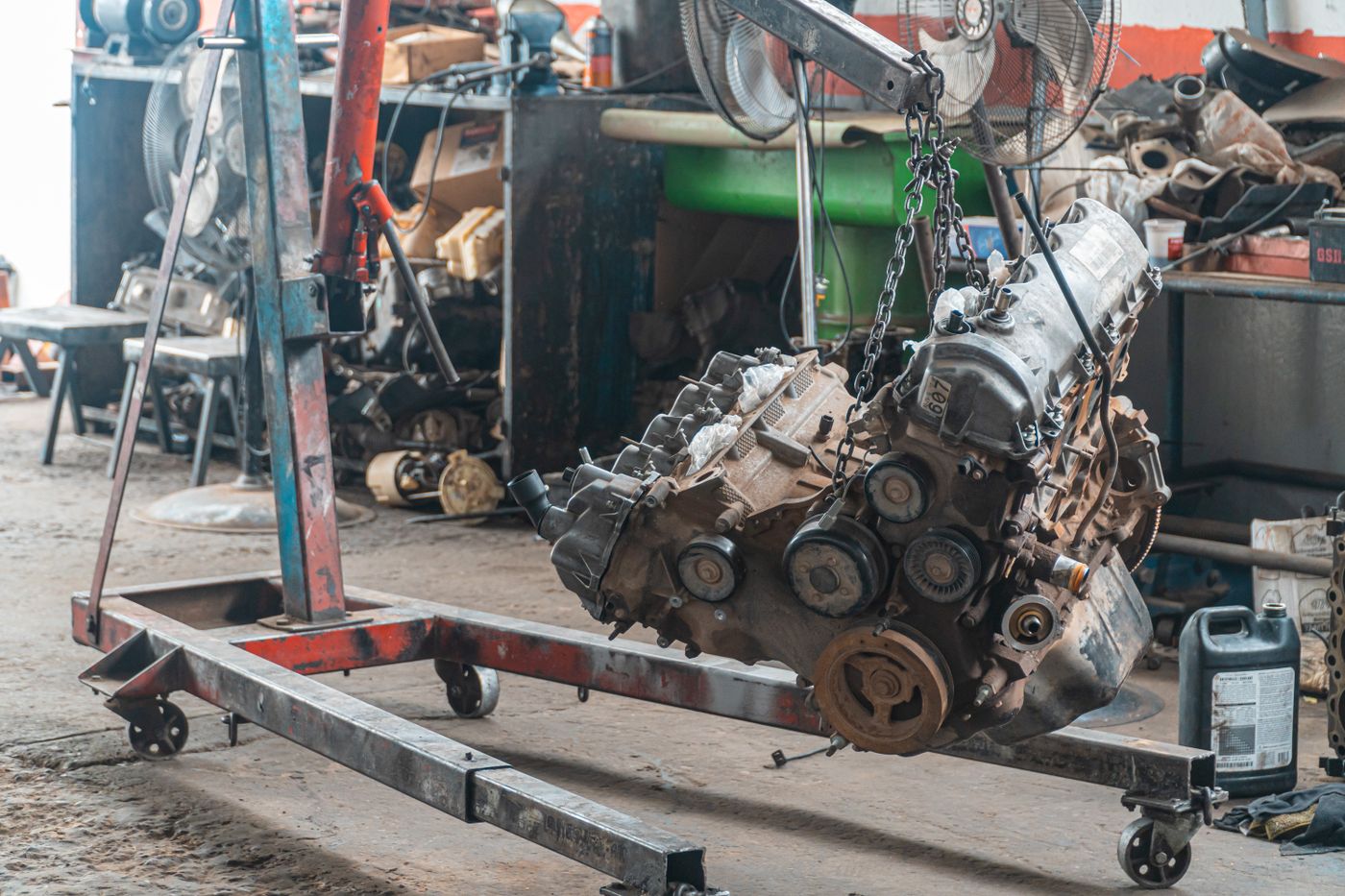
Real anchor points are few and specific. A steel I-beam or channel put there to carry a hoist, fitted with a beam clamp or beam trolley rated for the load, is the standard. A steel gantry or A-frame with its own rating is the movable equivalent. A wheeled engine crane, the folding type in the photo above, is rated at its shortest boom position and drops sharply as the boom extends, so read the plate for the setting you are using. A tree limb, a bolt in a block wall, a wooden truss and the rafters of a machinery shed are not anchor points, however many times they have held before.
The load has its own attachment point and it belongs in the same check. Engines have cast lifting brackets; use them, and use both. A posho mill is lifted by its frame, never by the hopper, the motor cover or the belt guard. A submersible pump comes up on its lifting rope or eyelet, never on its power cable, which parts inside the insulation where you cannot see it.
Inspection Before Every Lift
Lifting gear fails slowly and then all at once. The slow part is visible if you look, which is why the walk-round happens before every lift, not once a year. It takes two minutes.
On the hoist: look at both hooks for any opening of the throat, the sign of a hook stretched by overload, and check that the safety latch closes on its own. Run the load chain through a gloved hand and feel for worn, stretched, twisted or corroded links, especially where the chain enters the body. Pull the hand chain and confirm it runs freely without jumping the wheel. Then hang the load, raise it a few centimetres and stop: the brake must hold without creeping. On a lever hoist, work the ratchet both ways and confirm the pawl engages cleanly.
On webbing slings: cuts, broken stitching, holes, burns, chemical stiffening, faded colour, and knots, which halve the strength of any sling. On chain slings: stretched, bent or cracked links, gouges, heavy rust, and a master link or hook that is not the original. On wire rope: broken wires, kinks, crushed sections, strands opened into a birdcage, and corrosion at the ferrules.
Anything that fails the walk-round comes out of service on the spot. Gloves, boots and a helmet are part of the kit rather than an option, and our article on protection that actually gets worn covers the choices.
Moving Engines, Mills and Pumps Without Injury
A safe lift is mostly planning, and the plan is the same for a 60 kg pump and a 600 kg engine. Know the weight. Know where the centre of gravity is: an engine with the gearbox attached hangs tail down, a posho mill is heavy at the motor end, a diesel engine is heavier at the flywheel. Clear the path and the floor the load will land on before you lift. Decide who gives the instructions, and make it one person.
Rig the slings, check the angles, and take the slack up slowly until the load just begins to feel the hoist. Stop. Look at how it hangs, at the sling on every edge, at the anchor. Raise it a few centimetres and stop again. If it tilts, lower it and re-rig; do not chase it with a hand. Then lift only as high as you need, because a load kept low has less far to fall and less energy to swing.
Control the swing with a tag line, a rope tied to the load and held by someone standing clear, never by a hand on the engine. Keep hands out of every gap between the load and anything solid. On a wheeled engine crane, lower the boom and the load before rolling it: a high load on a high boom on a rough floor tips sideways with no warning.
Lower the load onto timber blocks or steel stands rather than straight onto the floor, so the slings come off without hands going underneath. Once it is down and stable, remove the slings, and only then move on. For the horizontal part of the journey, a proper trolley or platform truck is far safer than four people and a plank.
None of this needs expensive equipment. A one or two tonne chain block, a lever hoist, two webbing slings, a chain sling, a beam clamp and a crane scale will handle every lift a farm workshop meets. Ask at any of our six branches, or call 0734 263958, and we will put together the set that fits the loads you actually lift.
Key Takeaways
- A chain block lifts vertically over long distances; a lever hoist pulls in any direction over short ones. Both hold on a brake, and neither is a support.
- The working load limit is a ceiling. The design factor above it (4:1 chain, 5:1 wire rope, 7:1 webbing) is absorbed by wear and shock, not available for use.
- The smallest rated item in the load path sets the capacity of the whole lift, and an unrated anchor gives the lift no rating at all.
- Webbing is gentle but cut by edges; chain is tough but heavy; wire rope is strong but kinks. Never lift with hardware chain or rope.
- Sling legs at 30 degrees from horizontal each carry the full load. Plan for 60 degrees, never go below 45, and use a spreader bar when the lifting points are far apart.
- Inspect hooks, chain, brake and every sling before every lift. No tag means no rating, and retired slings get cut up.
- A hoist is not a jack. Lower the load onto stands before anyone works beneath it, and nobody stands under a suspended load, ever.
Frequently Asked Questions
What is the difference between a chain block and a lever hoist?
A chain block hangs from a fixed point and lifts vertically. You pull a hand chain, a gear train multiplies the effort, and a load brake holds the load at any height. A lever hoist does the same job through a ratchet lever, so it can be worked in any direction, including horizontal pulling, but each stroke moves the load a short distance and the lever gives you no feel for how heavy the load is. Use a chain block for lifts of more than a metre and a lever hoist for short lifts, pulling, tensioning and positioning.
Can I use a chain hoist to hold up an engine while I work underneath it?
No. A hoist is for raising and lowering a load, not for holding it while a person is beneath it. Lift the load, then lower it onto stands, blocks or the ground so that its weight is carried by something solid before anyone puts a hand or a body under it. The same rule applies to a hydraulic jack. Nobody stands, kneels or reaches under a suspended load, no matter how briefly.
Why does the angle of the sling matter?
Because the tension in each leg of a two-leg sling rises as the legs open out. With both legs vertical, each carries half the load. At 60 degrees from horizontal each carries about 58 percent, at 45 degrees about 71 percent, and at 30 degrees each leg carries the full weight of the load. Below 30 degrees the tension climbs so fast that the lift is not permitted. Keep sling angles above 45 degrees, ideally 60, by using longer slings or a spreader bar.
How do I know how much a lifting sling can carry?
Read the label. Every sling is sold with a tag stating its working load limit in a straight vertical lift, and usually in choke and basket hitches too. Webbing slings are also colour coded by capacity: violet for one tonne, green for two, yellow for three and so on. A sling with no legible tag has no rating and should not be used. Remember that a choke hitch reduces the capacity and that opening the legs of a two-leg sling reduces it further.
What should I check on a chain block before lifting?
Check the hooks for stretch, cracks and a working safety latch, the load chain for worn, stretched, twisted or corroded links, and that the hand chain runs freely without jumping. Then hang the load, raise it a few centimetres and stop. The brake must hold it without creeping. If anything is doubtful the hoist comes out of service until it is repaired or replaced. Do the same walk-round on the anchor point and the slings every single time.