
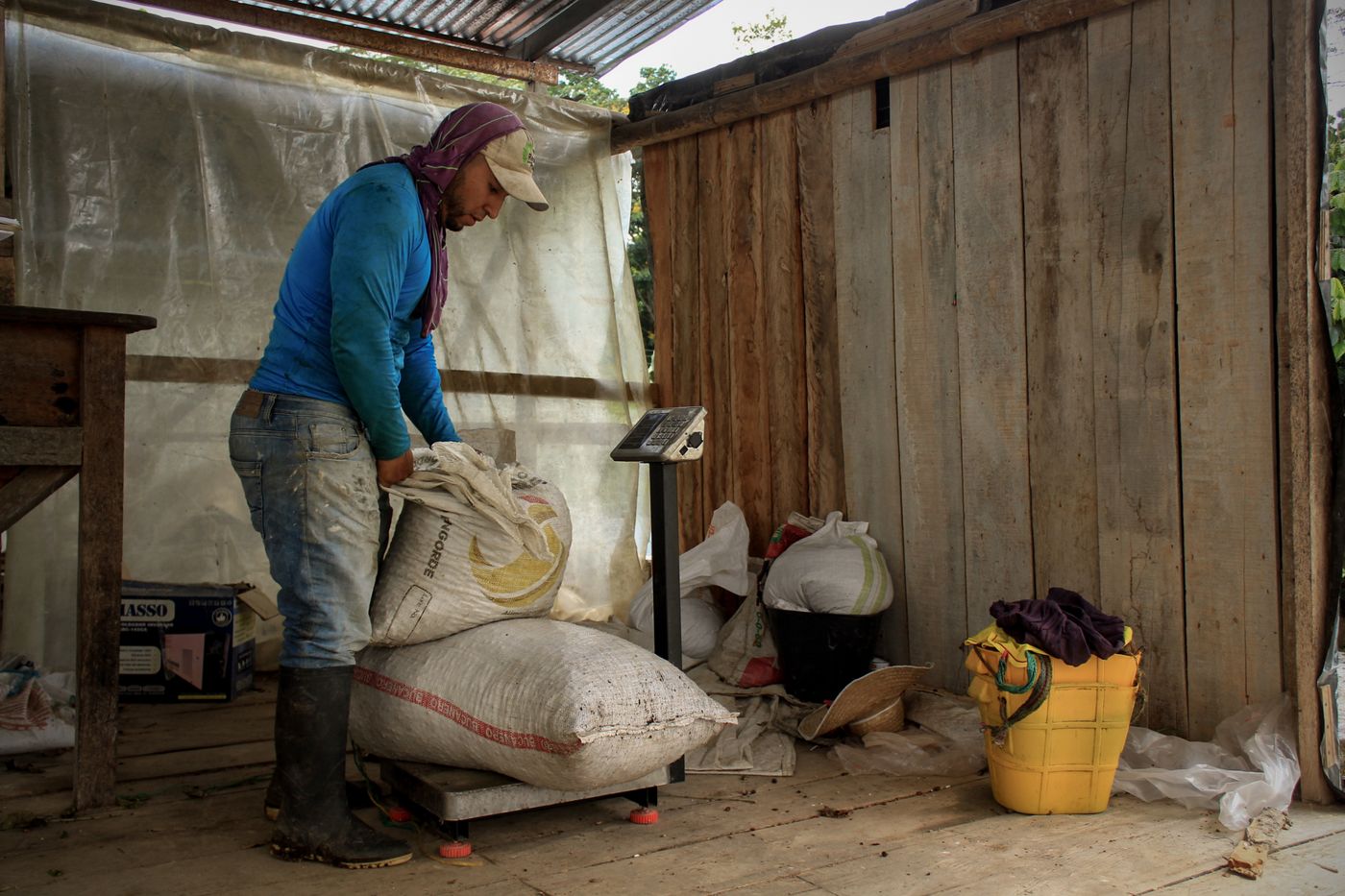
Every other machine on your farm makes money you can see. The chaff cutter fills the feed trough, the pump fills the tank, the sheller fills the bags. A weighing scale is different: it does not make anything. It only tells the truth. And that is exactly why it is the most underrated tool in Kenyan agribusiness, because everywhere the truth about weight is missing, money leaks quietly out of the farmer's pocket.
The leak has no drama. Nobody breaks in at night. It happens in polite daylight transactions: a bag that holds more than the bag is priced for, a broker's scale you cannot check, a dose of dewormer calculated from a guessed body weight. Each event costs a little. Repeated over every sale, every season, every animal, the total is real money that never appears in any record, because nothing was ever weighed.
This guide walks through where those leaks happen and how a scale of your own closes them: selling by the bag versus by the kilo, the farm-gate weighing game, which scale type fits which job, why capacity headroom matters, how to check accuracy with a known weight, and what weighing does for livestock. It ends with a brief note on verified scales for formal trade.
Selling by the Bag Versus Selling by the Kilo
Most farm produce in Kenya still changes hands by the container: the bag, the crate, the debe, the bunch. Container pricing survives because it is fast and needs no equipment. But a container is a unit of volume, not of weight, and the person who benefits from that difference is almost never the farmer.
Think about what a "bag" actually is at the point of sale. The buyer supplies or approves the bag, the bag gets filled, packed down, topped up and often extended above the rim, and the farmer is paid one price for whatever it now holds. Every extra kilo that goes in above a fair fill is produce the farmer grew, harvested and handed over free of charge. The buyer then sells onward by the kilo, because the wholesale and retail trade further up the chain runs on weight, not on bags.
That is the structural problem: the farm gate is often the only link in the whole value chain where nobody weighs anything. The moment you put a scale under the transaction, the conversation changes from "how much for the bag" to "how many kilos are in it", and price per kilo is a number you can compare across buyers, markets and weeks. You cannot compare bag prices, because no two bags hold the same amount.
The Farm-Gate Weighing Game, and How Your Own Scale Changes It
Where produce is bought by weight at the farm gate, the broker usually brings the scale. That single fact sets the balance of power. You are selling on an instrument you did not choose, cannot inspect, and will never see again, operated by the person whose profit grows with every kilo it under-reads. Most brokers are honest. The problem is that you have no way to know which ones are not, and the dishonest ones are drawn to exactly this situation.
The counter-move costs less than one season's leak: weigh your produce yourself before the buyer arrives. Now the negotiation starts from a number you both have to deal with. If the broker's scale reads meaningfully lower than yours, you can say so, re-weigh a bag on each scale side by side, and let the difference speak. A buyer who refuses to let his scale be compared with yours has told you everything you need to know, and you can decline the sale with confidence instead of doubt.
Your own scale also changes behaviour before any dispute happens. A seller who visibly weighs and records is a harder target, so the games simply move to another farm. And weighing before sale gives you one more advantage: you know your total harvest, so you can decide how much to sell now and how much to hold, rather than discovering your yield only through the buyer's arithmetic. If you store grain, that record links directly to the moisture and storage decisions we cover in our post-harvest grain storage guide.
Matching the Scale to the Job
There is no single farm scale, because weighing a sack of maize, a hanging carcass and a jar of honey are three different mechanical problems. Fuga stocks the full range at all six branches, and the matching logic is simple.
Platform scales (30 to 300 kg) are the general-purpose workhorse: a flat, low platform you load from any side. This is the scale for produce sacks, feed bags, milk cans, crates of vegetables, and small livestock stood or crated on the platform. A digital platform scale reads fast, shows the figure to both parties at once, and most models include a tare function, which subtracts the empty container's weight at the press of a button so you pay for produce, not sacks.
Crane scales (200 to 1000 kg) weigh loads that hang rather than sit: a 500kg crane scale hooks between a beam, tripod or hoist and the load beneath it. That suits slaughter and butchery work, where a carcass is already hanging, plus bulky or awkward loads like hay bales in a sling, and any weighing where a clean platform is impractical. Because the load hangs free, a crane scale also sidesteps the level-ground problem that platform scales face in the yard.
Manual Hanson-type dial scales are the spring-and-dial classics: no batteries, no electronics, nothing to charge. They give up a little readability compared with a digital display, but they keep working in places power and spares do not reach, which is why many buyers keep one as a backup even after going digital.
Kitchen and packing scales (5 to 20 kg) serve the value-addition side of the farm: portioning honey into jars, packing dried herbs, weighing mala and yoghurt into retail containers, or batching ingredients for feed premixes. Value-added products sell by the labelled weight, and a customer who once finds a jar light does not come back. Dairy sellers will find this pairs naturally with the hygiene chain in our milking equipment guide.
The 50 kg portable earns its place through movement: light enough to carry to the market stall, the milk collection point, or a neighbour's harvest, and big enough for a standard bag weighed in halves or a debe weighed whole.
One special case: cattle. A weigh band (weighing tape) estimates a cow's weight from its heart-girth circumference, and it is far better than eyeballing, which is why we recommend one in our livestock handling and vet equipment guide. But it is an estimate built on an average body shape, and individual animals deviate. Where real money rides on the number, at sale, or when dosing expensive products, an animal stood in a crate on a heavy platform scale gives you the actual figure rather than a formula's opinion.
Capacity Headroom: Why Weighing at the Limit Reads Wrong
Buyers often size a scale exactly to the heaviest load they expect: a 100 kg scale for 90 kg bags. That is the wrong instinct, for two reasons that come straight from how scales are built.
First, accuracy. A scale's load cell or spring behaves most predictably in the middle of its range. At the very top, the sensing element is at full stretch, small overloads push it past its calibrated behaviour, and readings drift and repeat poorly. Second, survival. Farm loads are dropped, not lowered: a 90 kg sack landing on a 100 kg scale delivers a momentary force well beyond 90 kg, and repeated shock loading at the limit is the classic way load cells die young.
The working rule: choose a capacity so your everyday heaviest load sits between roughly half and three quarters of the scale's maximum. For 90 kg bags, that points to a 150 kg or 300 kg platform, not a 100 kg one. The step up costs little at purchase and buys you accuracy where you actually weigh, plus a scale that survives the way loads really land. The same logic applies to crane scales: a 500 kg unit for carcasses and bales that mostly run 200 to 350 kg is sized correctly, not oversized.
Accuracy Checks: The Five-Minute Habit That Protects Every Sale
A scale is only worth owning if you can trust it, and trust is built with a known weight. Keep one reference object whose weight you established on a verified scale and which never changes: a sealed bag of cement kept dry, a barbell plate, a purpose-bought test weight. It does not matter what it is; it matters that it is always the same.
Then build the habit. Before serious weighing, put the scale on a hard, flat, level surface: soft ground, sloping yards and wobbling legs all corrupt the reading, because part of the load escapes sideways instead of passing through the sensor. Zero the scale, place your known weight, and note what it reads. A healthy scale returns the same figure every time, and returns to zero when unloaded.
The reading matters less than the trend. If your reference reads slightly high one week and slightly low the next, that is noise. If it walks steadily in one direction over weeks, that is drift, and drift is a warning that the scale needs recalibration or repair before it starts costing you money invisibly. A one-line log, date and reading, makes drift visible in seconds.
Livestock: Why Guessing Weight Misdoses and Hides Poor Growth
On the livestock side, the scale stops being about money leaking to other people and starts being about money leaking to biology. Nearly every animal health product, dewormers, antibiotics, acaricides, vitamins, is dosed per kilogram of body weight. Guess the weight and you guess the dose.
Both directions of the guess cost you. Underestimate the animal and you underdose: the treatment fails, the animal stays sick or wormy, and in the case of dewormers and antibiotics, surviving parasites and bacteria are exactly the ones most tolerant of the drug. Overestimate and you overdose: you waste expensive product at best, and risk toxicity at worst. A weighed animal gets the dose the label intended, which is the dose the product was tested at.
Weighing also turns growth into a number you can manage. Daily weight gain is the single clearest signal of whether feeding is working: weigh young stock on a schedule, divide the gain by the days, and compare pens, feeds or seasons. A pig or goat enterprise that weighs monthly spots a failing ration weeks before the eye does, because the eye adjusts to gradual change and the scale does not. And at sale time, the same platform scale that weighed your maize weighs your shoats, so the price negotiation starts from kilos of animal, not from a glance over the pen rail.
Formal Buyers and Verified Scales: What to Know
One last point for anyone growing beyond farm-gate sales. In formal trade, weighing equipment used for buying and selling is subject to verification under Kenya's weights and measures system, and institutional buyers, cooperatives, processors and aggregators may require transactions on verified and stamped scales. The rules on which scales need verification, how often, and what the stamping process involves are administered by the Weights and Measures offices under the Ministry of Trade, with county offices handling inspection in practice.
We will not summarise legal requirements here, because they are the regulator's to state. The practical advice is simpler: if you are entering contracts, supplying institutions or opening a buying centre, visit your county Weights and Measures office early and ask what your situation requires. For everyday farm management and farm-gate self-defence, an accurate, well-checked scale from a supplier who stocks spares is the tool that matters, and you can compare current options on our price list.
Key Takeaways
- Selling by the bag transfers free kilos to the buyer; selling by the kilo makes prices comparable across buyers and weeks.
- At the farm gate, whoever owns the scale owns the number. Weigh and record before the buyer arrives.
- Match the scale to the load: platform for sacks and crated animals, crane for hanging loads and carcasses, kitchen scales for value-added packing, a 50 kg portable for market rounds.
- A weigh band estimates cattle weight; a platform scale measures it. Use the tape for routine checks and the scale when money rides on the figure.
- Buy capacity headroom: everyday loads should sit at roughly half to three quarters of the scale's maximum, never at its limit.
- Check accuracy with one unchanging known weight on a hard, level surface, and log the readings so drift shows itself.
- Dose livestock from weighed kilos, not guessed ones: underdosing breeds resistant parasites, overdosing wastes money.
- Supplying formal buyers? Ask your county Weights and Measures office what verification your scales need.
Frequently Asked Questions
What size weighing scale do I need for selling maize and other produce?
For standard produce bags, a platform scale in the 150 to 300 kg class is the safe choice: your heaviest everyday bag then sits comfortably in the scale's accurate middle range, and the platform takes the shock of loads being dropped. A 100 kg scale weighing 90 kg bags lives at its limit and dies early.
Is a digital scale better than a manual dial scale for a farm?
Digital scales read faster, display the figure to both parties at once, and offer a tare button to subtract the container. Manual Hanson-type dial scales need no batteries and keep working anywhere. Many farms sensibly run one of each: digital as the main scale, dial as the power-free backup.
How do I know if a broker's scale is cheating me?
You cannot tell by looking, which is the point of owning your own. Weigh your bags before the buyer arrives, then compare: if his scale reads meaningfully lower, re-weigh one bag on both scales side by side and let the difference decide. A buyer who refuses the comparison has answered your question.
Can I weigh a cow without a heavy livestock scale?
A weigh band around the heart girth gives a usable estimate for routine management and is far better than guessing. For dosing expensive products or negotiating a sale, stand the animal in a crate on a heavy platform scale, because the band is a formula based on average body shape and individual animals deviate from it.
How much do weighing scales cost at Fuga?
Prices depend on type and capacity and move with stock, so confirm the current figure on WhatsApp at wa.me/254716961018 or call 0734263958. We stock platform scales from 30 to 300 kg, crane scales from 200 to 1000 kg, manual Hanson scales, kitchen scales from 5 to 20 kg and a 50 kg portable, or you can visit any branch in Eldoret, Nakuru, Nairobi, or the Coast.