At a collection point anywhere in Kiambu or Nyandarua at seven in the morning, the clerk does two things before your milk is accepted. He drops in a lactometer, and he squeezes a little of your milk into an alcohol gun. If it flecks, the can goes back on your bike. Nobody argues, and nobody explains.
Farmers who get that verdict usually blame the cow, the weather, or the buyer. Far more often the cause sits in the twenty minutes between the udder and the can: a bucket that was rinsed rather than washed, a cluster left on after flow stopped, or a full can standing in the sun. Equipment is part of that chain, but only part.
So this is not a list of things to buy. It answers the question underneath the question: when does your current setup start costing you more than the replacement would, and what do you buy first when it does? We sell everything mentioned here, which is exactly why we would rather you bought the right item than the expensive one.
The threshold is minutes, not cows
The usual rule of thumb is that you move to a machine at four or five cows. It is a poor rule: it ignores the two things that actually vary: how long each cow takes, and who is doing the work.
Hand milking a cow in decent lactation takes most people between eight and fifteen minutes, depending on the cow, the milker's hands and the time of year. Multiply by your herd, double it for twice-daily milking, and you have your real number. Three cows at twelve minutes is well over an hour a day. Six cows at twelve minutes is nearly two and a half hours, every day, at both ends of the day.
Now price that time. If you are paying a milker, you already know the figure. If it is your own labour, or your children's before school, it is not zero just because no money changes hands. It is the wage you could otherwise earn, or the fodder you did not cut.
The honest test. Write down your total daily milking minutes and what an hour of that labour is genuinely worth to you. If the annual figure approaches the price of a machine, you have your answer. If it does not, a better bucket and a better routine will do more for your milk than a machine would.
Milking buckets: what the price difference actually buys
A milking bucket looks like a solved problem, which is why most farms buy the cheapest one and never think about it again. The spread on our own milking buckets runs from about KSH 1,400 to KSH 3,908, and the difference is almost entirely material and finish.
The branded lightweight buckets sit at the bottom: a 10 litre is around KSH 1,800 and a 15 litre about KSH 1,900. Aluminium sits higher, at roughly KSH 3,779 for 15 litres and KSH 3,908 for 20. A 15 litre stainless steel bucket is around KSH 2,890.
What you are buying at the top of that range is cleanability over years, not capacity. Aluminium is soft. It dents, and every dent is a place a brush does not reach. It also reacts badly to the strong alkaline and chlorine cleaners that dairy hygiene actually requires, so the farms that clean aluminium properly tend to wear it out, and the farms that do not wear it out tend to have a bacterial count problem instead. Stainless steel takes the harsh cleaner and the daily knocks without pitting, which is why dairy processing uses it almost exclusively.
Buy a second one. A single bucket forces you to milk, empty, rinse and carry on, which is how rinsing quietly replaces washing.
Where a machine starts to pay for itself
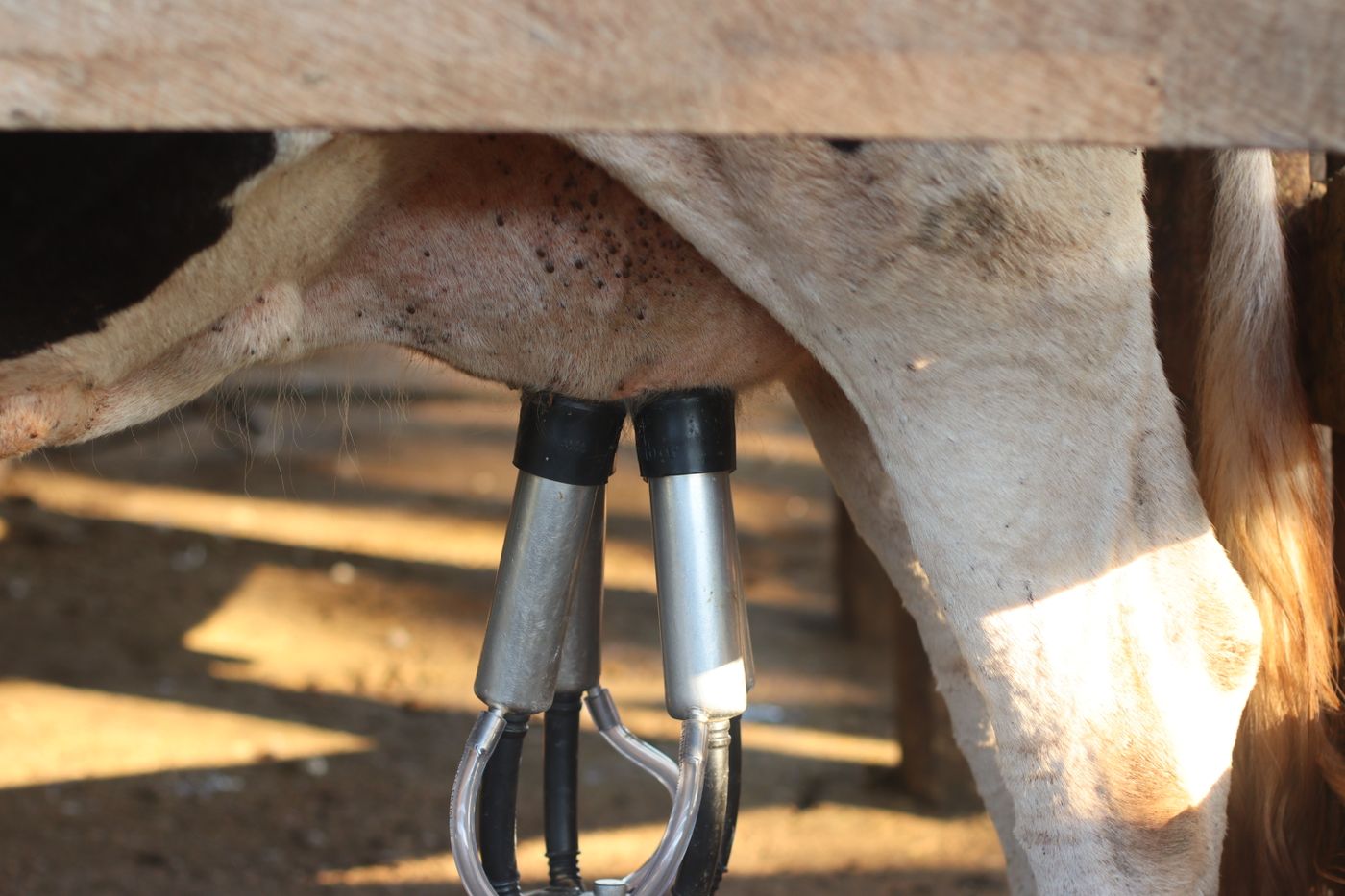
Our milking machines run from KSH 90,000 for a single bucket unit to KSH 120,000 for a double. The double is not twice the machine; it is one vacuum pump and motor driving two clusters, so it roughly halves the time again for a modest step up in price. On a herd of six or more, that step is usually the better buy.
A single bucket unit typically brings a cow down to four to six minutes of actual machine time. The saving is real but smaller than the brochures imply, because attaching, dipping and washing the plant do not disappear. Count on halving your milking time rather than eliminating it.
Two costs are routinely left out of that sum. The first is power: a milking machine needs it twice a day at fixed times, and on a farm with unreliable supply that is an argument for keeping the buckets rather than an argument against the machine. The second is wear parts. The pulsator, at around KSH 8,000, is the component that does the actual work of mimicking a calf, and it is a serviceable item, not a permanent fixture. Liners and rubberware wear out on a schedule too, so budget for them from day one: a machine running on tired rubber is worse for the udder than hands are.
Three settings that decide whether the machine helps or harms
A milking machine is not a gentler version of a hand. It applies steady vacuum to living tissue, and whether that is good or bad for the cow comes down to three numbers that most buyers never check.
Vacuum level. Working vacuum at the teat end generally sits around 40 to 50 kPa. Too low and the cluster slips and crawls up the teat; too high and you damage the teat end, which is the doorway mastitis uses. A vacuum gauge is the cheapest diagnostic on the farm and the least used.
Pulsation. The pulsator alternates a massage phase with a milking phase, roughly 60 cycles a minute at about a 60:40 ratio. That rest phase is not a pause in the work; it is what stops blood and fluid pooling in the teat. A failing pulsator often still milks, just slowly and harshly, so the symptom is a herd that starts taking longer and showing more teat end damage rather than a machine that stops.
Over-milking. This is the commonest and most expensive error, and it costs nothing to fix. Once flow stops, the cluster is pulling vacuum on empty tissue. Leaving it on for an extra two minutes per cow while you deal with something else is a slow, cumulative injury to every teat end in the herd.
Ask before you buy, not after. Ask any supplier, us included, what vacuum the unit runs at, what the pulsation rate and ratio are, and what a set of liners and a pulsator cost. A supplier who cannot answer the first two is selling you a box, and a supplier who is vague about the third has not thought about your second year.
The routine matters more than the machine
The single largest gain available to most Kenyan dairy farms costs about KSH 350 and takes ninety seconds. It is the milking routine, and it works the same whether you are using hands, a bucket or a machine.
Milk let-down is a hormonal event, not a mechanical one. Stimulating the udder triggers a release of oxytocin, and milk flow follows roughly a minute later, then holds for only a few minutes before fading. Attach too early and you are pulling vacuum on a teat that has not let down. Attach too late and you have missed the window and left milk in the udder, which is itself a mastitis risk.
Two pieces of equipment carry most of this. A strip cup lets you see the first few squirts against a dark surface, which is how subclinical mastitis is caught before the collection point catches it for you. A teat dip cup, at around KSH 350, applies disinfectant to every teat immediately after the cluster comes off, while the teat canal is still open. Post-milking teat disinfection has been a cornerstone of mastitis control since the classic five point plan was developed, and at that price it is the highest return item on this entire page.
One more thing that is free: milk your known infected cows last. Order of milking is a transmission control, and it costs nothing but attention.
For the machine itself, a set of proper milking machine brushes at around KSH 700 is what turns rinsing into washing. Milk residue in a milk line is a bacterial culture that you then pump fresh milk through twice a day.
Cooling and transport: where good milk gets rejected
Milk leaves the udder at body temperature, which is close to ideal for bacterial growth. Everything from that moment is a race, and on most smallholder farms the race is lost between milking and delivery rather than during milking.
This is where can choice stops being about price. Our milk cans run from about KSH 750 for a 4.5 litre to KSH 15,500 for a 50 litre; a 20 litre is roughly KSH 5,500 branded or KSH 8,450 in aluminium.
Plastic jerricans remain common and remain a bad idea for milk. Plastic scratches, and scratches hold fat and protein that no rinse removes, so the container itself becomes the source of the contamination. The Kenya Dairy Board has pushed the formal supply chain towards metal cans for exactly this reason, and a processor or cooperative is entitled to refuse milk delivered in one.
A milk measuring can, around KSH 850, earns its place differently: it gives you per cow yields, which tell you a cow is dropping before anyone notices, or that a change of feed worked. Without them you are managing a herd as a single animal.
What to buy, in order
- Under three cows: a stainless steel bucket, a teat dip cup and a strip cup. Total outlay is a few thousand shillings, and the dip cup alone will do more for your milk than anything else on this list.
- Three to five cows: the same, plus a second bucket and a measuring can, and start recording per cow yields. Move to a machine when your daily milking minutes justify it, not when you hit an arbitrary cow count.
- Five to eight cows: a single bucket machine at around KSH 90,000, with a spare pulsator and a set of liners bought at the same time.
- Eight or more, or a cooperative supply contract: the double bucket unit at around KSH 120,000. At this herd size the time saving compounds twice a day and the contract usually brings quality thresholds that reward a consistent routine.
Key takeaways
- Decide on total daily milking minutes and the real value of that labour, not on cow count.
- Stainless steel costs more because it survives the cleaning that dairy hygiene actually needs. Aluminium dents, and dents are where brushes do not reach.
- A machine roughly halves milking time. It does not eliminate the attaching, dipping and washing around it.
- Vacuum level, pulsation and over-milking decide whether a machine protects the udder or damages it. Ask about all three before buying.
- A KSH 350 teat dip cup, used at every milking, is the highest return purchase on this page.
- Budget for pulsators and liners from day one. They are consumables, not fixtures.
- Metal cans, not plastic jerricans, and get the milk cool quickly.
Frequently asked questions
How many cows do I need before a milking machine is worth it?
There is no fixed number, which is why the usual answer of four or five is unhelpful. Work out your total daily milking minutes across both milkings, price that labour honestly, and compare the annual figure to KSH 90,000 for a single bucket unit. Most farms find the crossing point somewhere between five and eight cows, but a farm paying a milker reaches it sooner than one milking with family labour, and a farm with unreliable power may not want to reach it at all.
Is a milking machine bad for the cow?
A correctly set and maintained machine is not. A machine running at the wrong vacuum, with a failing pulsator, or left attached after milk flow has stopped, causes teat end damage and raises mastitis risk. The machine is not the variable, the settings and the routine are.
Stainless steel or aluminium for buckets and cans?
Stainless steel for anything you clean daily with proper dairy chemicals, because it tolerates them and resists denting. Aluminium is lighter and cheaper to buy in larger can sizes and is perfectly acceptable for transport, provided it is genuinely washed rather than rinsed and replaced once it is badly dented.
Can I run a milking machine on solar?
Yes, but size it properly. The vacuum pump motor draws a significant surge on starting, and that surge, rather than the running load, is what determines the inverter you need. Talk to us about the motor rating before assuming an existing solar setup will carry it.
Ready to equip your farm or business?
Tell us your herd size, how often you milk, and whether your power is reliable, and we will recommend a specific unit rather than a price range. Everything mentioned here carries a minimum one year warranty, and electric machines come with installation and basic maintenance training so your team can strip, clean and reassemble the unit correctly from day one.