
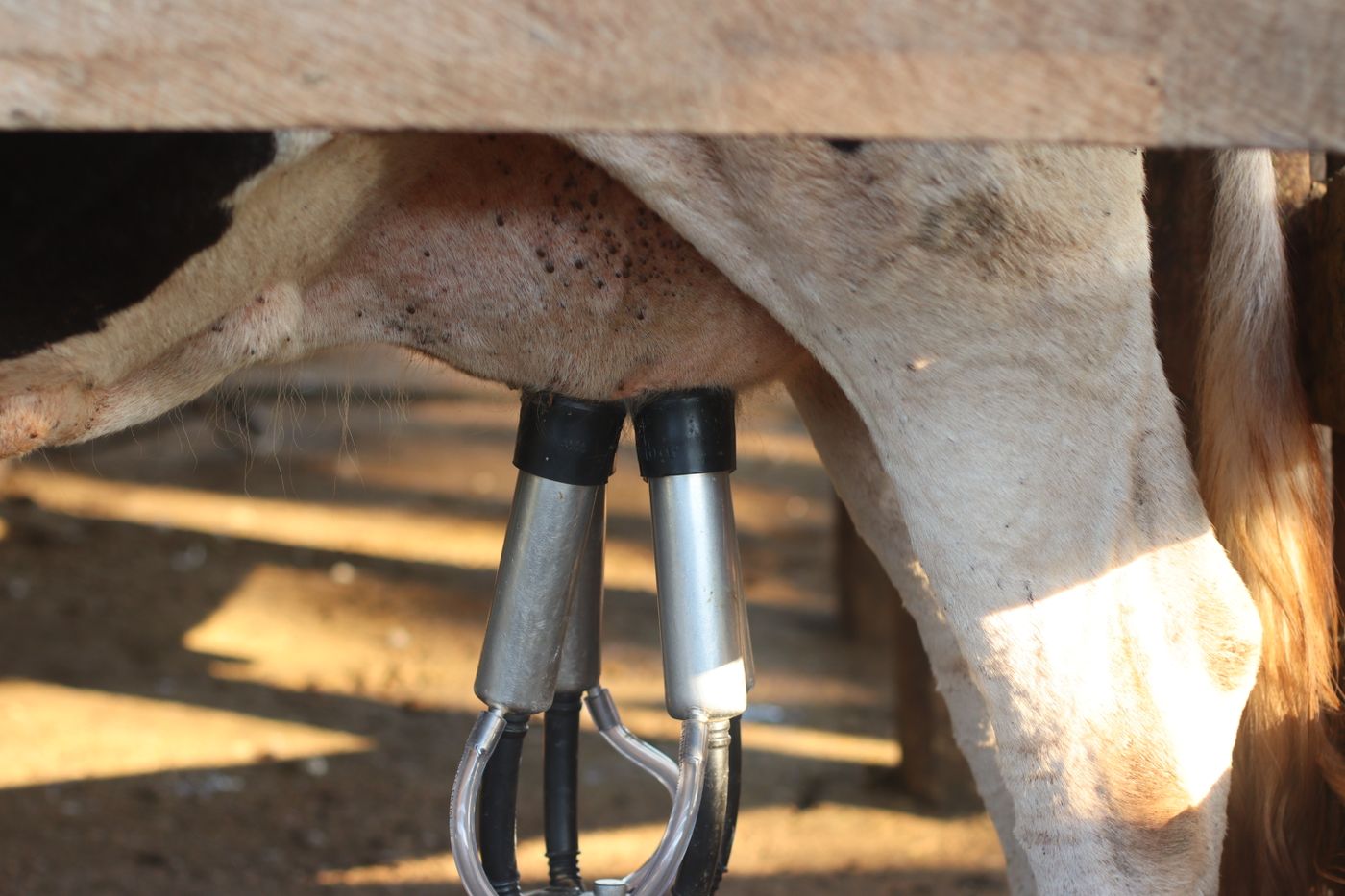
At two or three cows, hand milking is a pleasant routine. Somewhere between the fourth cow and the seventh, it quietly becomes the biggest constraint on the farm. The morning session stretches, the milker's hands tire, the last cow is milked less completely than the first, and the whole business now depends on one person's wrists turning up twice a day, every day, including Christmas.
That is the moment many Kenyan dairy farmers start asking about milking machines, and it is also the moment many buy badly. A bucket milking machine is not a magic box: it is a vacuum system whose performance lives or dies on a few shillings' worth of rubber and a twice-daily wash routine. Bought and run well, it milks faster, more consistently, and more gently than tired hands. Bought and run badly, it is slower than hand milking and harder on the udder.
This guide walks through the honest arithmetic of switching, how a bucket milker actually works, single versus double bucket sizing, why liners decide everything, the hygiene routine, teat awareness, cans and cooling, the used-machine trap, and a realistic adoption path for a 3 to 10 cow farm.
The Honest Arithmetic of Hand Versus Machine
Start with time. A bucket machine typically milks out a cow in around five to eight minutes, and the tenth cow takes about the same as the first, because the vacuum pump does not get tired. Hand milking is different: its limit is not the best case but the worst. Hands slow down, the later cows in the queue get a longer wait and a less complete milk-out, and an incomplete milk-out is milk left in the udder that gradually teaches the cow to give less.
Then labour reliability, which for most farms is the real trigger. A herd of six or eight cows usually means employing a milker, and skilled hand milkers are increasingly hard to find and keep. When the milker leaves, is sick, or travels, the cows still need milking at the same hours, and a delayed or rough session shows up in the evening's litres. A machine does not remove the need for a person, but it turns a scarce skill into a teachable routine that you, your spouse, or a farmhand can run to the same standard every session.
Third, consistency. Cows let their milk down in response to a familiar, calm routine: the same preparation, the same timing, the same feel. A machine applies exactly the same action to every teat of every cow at every session, which is precisely what let-down rewards. None of this makes the machine automatically profitable on a two-cow farm; it makes it progressively harder to do without as the herd grows past the point where one pair of hands can serve every cow promptly.
How a Bucket Milking Machine Actually Works
Strip away the pipes and a bucket milker has four working parts. The vacuum pump, driven by an electric motor or a small petrol engine, pulls air out of the system to create a steady, controlled vacuum. The pulsator is the machine's heartbeat: a valve that rapidly alternates between vacuum and normal air. The cluster is the set of four teat cups, each a stainless shell with a soft rubber liner inside, joined by a claw. And the bucket is a sealed stainless can that sits under vacuum and receives the milk.
The clever part is the space between the liner and its steel shell. Inside the liner, the teat sees steady vacuum, which draws milk out. Around the liner, the pulsator switches the pressure back and forth: when it applies vacuum, the liner hangs open and milk flows; when it lets air in, the liner collapses and gently squeezes the teat, massaging it and letting blood circulate. This open-squeeze cycle runs roughly once a second, which is why a healthy machine ticks with a steady rhythm you can hear. Without that rest phase the teat would be under constant suction, which is exactly what damages teat ends on faulty machines.
Timing matters as much as machinery. Prepare the cow calmly, clean and dry the teats, strip the first squirts by hand into a strip cup so you can see the milk, and attach the cluster within about a minute, while let-down is active. When the flow stops, take the cluster off promptly. Leaving cups on an empty udder, called overmilking, is the commonest beginner's mistake and the hardest on teat ends.
Single or Double Bucket: Match the Machine to the Herd
A single bucket machine runs one cluster, so it milks one cow at a time into one can. A double bucket machine runs two clusters from the same pump, so one operator can have two cows milking at once, attaching the second cluster while the first cow milks out. The double roughly halves session time, but it costs more, and it asks more of the operator, who must watch two cows and two buckets at once.
The honest sizing rule is session time. Up to about three cows, hand milking remains perfectly workable if the hands and the schedule are reliable, and the machine is a convenience rather than a necessity. From roughly three to seven cows, a single bucket machine keeps the whole session short enough that cows are milked promptly and the routine stays calm. Past seven or eight cows, and certainly into the teens, a double bucket earns its extra cost every single morning, because with a single machine the last cows are again waiting too long.
Fuga stocks milking machines in single and double bucket configurations, along with the pulsators, liners, and buckets that keep them running. If you are also planning the housing side, our zero grazing unit guide covers the shed layout that makes machine milking easy: a clean, level milking area with power or a place to stand the pump.
Liners Decide Speed and Udder Health
The liner is the only part of the machine that touches the cow, and it is a wear part in the same way a chainsaw chain or a tyre is. New, soft rubber seals gently on the teat, milks fast, and massages properly on every pulsation. As rubber ages it hardens, loses its shape, and develops invisible micro-cracks. A hardened liner slips and squawks during milking, milks slower and less completely, and slaps the teat instead of massaging it. The cracks are worse: they trap milk residue that no wash routine can fully reach, and they carry it from cow to cow.
This is why liner replacement is a discipline, not a repair. Liner manufacturers commonly work to a life of around 2,500 cow milkings or six months, whichever comes first, because rubber ages with time as well as use. On a small herd the six-month clock usually runs out first. Change all four liners of a cluster together, and keep a spare set on the shelf so a torn liner never tempts you to milk on with three.
Hygiene Is the Machine's Real Operating System
A milking machine moves warm milk through rubber and steel twice a day, and warm milk is a perfect growth medium. The machine that improves your milk quality and the machine that ruins it are the same machine; the difference is the twenty minutes after each milking. The routine has three stages, and the order matters.
First, immediately after milking, rinse the cluster, tubes, and bucket with clean lukewarm water until it runs clear. Not hot: hot water at this stage cooks milk protein onto the surfaces, exactly the film you are trying to avoid. Second, wash with hot water and dairy detergent, circulating it through the cluster and scrubbing the bucket, lid, and claw with proper brushes. Bottle brushes and teat cup brushes reach where cloths cannot, and a cloth wiped around a bucket rim is not a wash. Third, drain everything and hang the cluster and tubes to dry, because standing water is where bacteria multiply between milkings.
Even with a good routine, hard water and milk minerals slowly deposit a chalky film on steel called milk stone. It looks like harmless scale, but it is porous and shelters bacteria under a surface that feels clean. The answer is a periodic acid wash with a dairy descaler, weekly or as the water in your area demands, on the buckets and cans as well as the machine. If a can's inside has lost its shine to a grey-white film, it is telling you the acid wash is overdue.
Watch the Teats, and Know When to Call the Vet
Machine milking makes teat observation easier, not less necessary, because you handle every teat twice a day at eye level. Make three habits automatic. Strip the first squirts from each quarter into a strip cup and look at them before attaching the cluster: milk that looks abnormal in any way is a signal to stop and separate that cow's milk. Feel the udder as you clean it, so heat, swelling, or a hard quarter registers immediately against yesterday's baseline. And after the cluster comes off, look at the teat ends themselves: skin condition and colour tell you quickly whether the machine is being kind to the cow, and a teat dip cup used after every milking keeps the freshly milked teat protected while the canal is still open.
Where the line sits: observation and hygiene are husbandry, and they are yours. Diagnosis and treatment are not. If milk looks wrong, a quarter is hot or hard, or a cow suddenly resists milking, involve your vet or animal health assistant early rather than experimenting. Early professional attention is cheaper than a lost quarter, and nothing in a milking machine manual substitutes for it.
From Bucket to Can to Cooler
The machine only gets milk as far as the bucket; the next hour decides its grade. Transfer milk promptly from the milking bucket through a strainer into proper milk cans. Fuga stocks milking buckets and Lions Brand milk cans in aluminium and stainless steel: aluminium is lighter and cheaper for daily transport to the collection centre, stainless costs more but shrugs off acid washes and dents and lasts accordingly. Whatever the metal, the same rule applies as to the machine: rinse lukewarm, wash hot, descale on schedule, and store the cans upside down and open so they dry.
Cooling is its own subject, and we have covered it in depth in our guide to milk cooling and hygiene on a Kenyan dairy farm. The short version: bacteria double fastest in warm milk, so the sooner milk drops below the danger zone, the more grace time you have to reach the cooler or processor. And if you retain milk for value addition, our cream separators and churns guide picks up where the can leaves off.
The Used-Machine Trap, and a Realistic Adoption Path
Second-hand milking machines circulate constantly, and they are the one category where we urge real caution. The parts that make a machine safe for the cow are exactly the parts you cannot see working: a pump that still pulls its rated vacuum, a pulsator that still cycles cleanly, liners whose age nobody remembers. A used machine that "runs fine" can be milking at the wrong vacuum with a lazy pulsator, and the damage it does to teat ends accumulates invisibly for weeks before it shows up as slow, painful milkings. If you do buy used, budget for new liners and tubes on day one, have the pulsator and vacuum checked by someone competent, and confirm that spares for that model actually exist in Kenya. A bargain with no parts support is scrap with a motor.
For a 3 to 10 cow farm, the sensible path looks like this. First, tighten the routine you already have: fixed milking times, clean dry teats, strip cup, calm handling, because a machine amplifies whatever routine it joins. Second, buy the right new machine for the herd you will have in two years, usually a single bucket at the smaller end and a double from around seven cows, together with the spares that keep it honest: a spare liner set, brushes, dairy detergent and descaler, and a teat dip cup. Third, introduce it gently: run the pump for a few sessions so the cows learn the sound, machine-milk your calmest cow first, and expect a settling-in week. Fourth, keep your hand milking skills alive, because power cuts and breakdowns happen and cows cannot wait. Our comparison of milking equipment for Kenyan dairy farms and our price list are the next stops when you are ready to specify.
Key Takeaways
- The switch point from hand milking is usually labour reliability and session length, not raw speed: when the last cow waits too long or one milker is a single point of failure, it is time.
- A bucket milker is steady vacuum plus a pulsator: the liner opens to milk and squeezes to rest the teat about once a second, and that rest phase is what makes machine milking gentle.
- Single bucket suits roughly 3 to 7 cows; a double bucket earns its cost from about 7 cows upward by milking two at once.
- Liners are wear parts: plan replacement around 2,500 milkings or six months, change the set together, and keep spares.
- The wash routine is lukewarm rinse, hot detergent wash with brushes, drain and dry, plus a periodic acid wash against milk stone.
- Strip cup, udder feel, and teat-end checks are daily husbandry; anything abnormal goes to the vet early, not to trial and error.
- Move milk promptly from bucket to clean cans (aluminium for light transport, stainless for longevity) and get it cool fast.
- Treat used machines with caution: new liners, a checked pulsator and vacuum, and confirmed spares support are non-negotiable.
Frequently Asked Questions
At what herd size does a milking machine make sense in Kenya?
As a working rule, hand milking remains manageable up to about three cows if labour is reliable. From three to seven cows a single bucket machine keeps sessions short and consistent, and from about seven cows a double bucket machine is worth the extra cost. The stronger trigger is labour: if your dairy income depends on one milker's availability, a machine de-risks the farm at any size in that range.
Can one person operate a double bucket milking machine?
Yes, and that is the point of it. One operator preps and attaches the second cow while the first is milking, leapfrogging down the line so the pump never waits. It takes a week or two of practice to run two clusters smoothly, so start with the machine's single-cow rhythm first, then add the second cluster once the routine is calm.
How often should milking machine liners be replaced?
Manufacturers commonly rate rubber liners for around 2,500 cow milkings or six months, whichever comes first, because rubber hardens and cracks with age even when lightly used. On small herds the six months usually arrives first. Replace all four liners in a cluster at the same time, and replace immediately at any sign of cracking, roughness, or persistent slipping.
Does machine milking hurt the cow or cause udder problems?
A correctly set up machine with good liners is gentle: the pulsator squeezes and rests the teat rhythmically instead of applying constant suction. Problems come from worn liners, faulty vacuum or pulsation, dirty equipment, and overmilking. Keep the routine and consumables right, watch teat condition daily, and involve your vet promptly if milk or udder ever looks abnormal.
How much does a milking machine cost at Fuga?
Prices depend on configuration and move with stock and the exchange rate, so confirm the current figure on WhatsApp at wa.me/254716961018 or call 0734263958. We stock single and double bucket machines plus pulsators, liners, buckets, brushes, teat dip cups, and Lions Brand milk cans, and you can visit any branch in Eldoret, Nakuru, Nairobi, or the Coast.