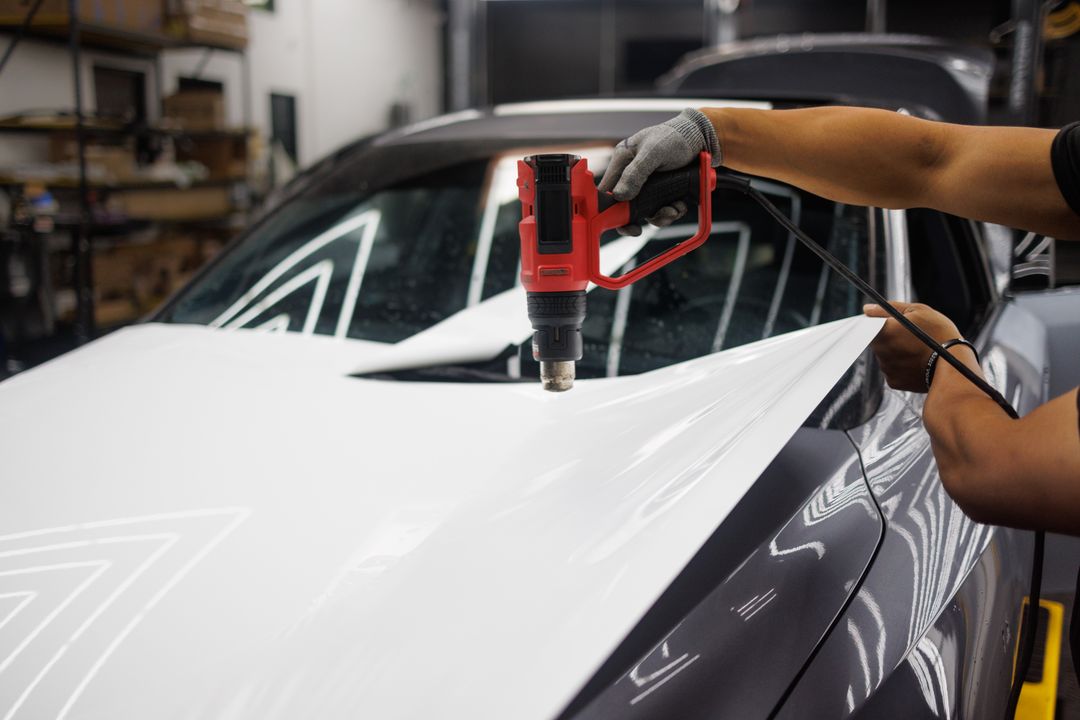
A heat gun blows hot air, from gentle warmth to several hundred degrees Celsius, to soften paint, release stickers, shrink tubing, shape small plastic parts and speed up drying. It is not a hair dryer and not a flame. Use the lowest setting that works, keep it moving, and clear the bench of anything that burns.
On a busy workshop floor the heat gun is the tool people borrow and nobody owns: someone needs a sticker off a door, a wire joint sealed, a layer of old paint softened off a gate hinge. It does all of that well, and it also starts fires, scorches hands and releases fumes when it is used like a magic wand instead of a tool with rules.
Our guide to farm and workshop safety equipment covers the kit you wear, and our guide to PPR plumbing on the farm covers the pipe-joining tool people sometimes confuse with a heat gun. This article is different: it is a practical list of what a heat gun is used for, what setting suits each job, what never to do, and how it compares with a hot-air station and a gas torch.
What Is a Heat Gun Used for in a Kenyan Workshop or on a Farm?
A heat gun is a hand-held electric heater with a fan. Air is pulled in at the back, passes over a heating element and leaves through a nozzle at the front. You aim the hot air at the work and the work warms up, without a flame and without touching it. That is why it is safer than a torch for many jobs, and why it is slower and gentler for the others.
These are the uses that earn their keep in a jua kali workshop, a farm store or a small garage:
- Paint removal. Heat softens old paint so a scraper lifts it off a metal gate, a door frame or an old wooden stool without chemicals. See the lead warning below before you start on anything old.
- Stickers, labels and old adhesive. Warm the label, lift a corner and peel. This works on equipment plates you are replacing, price stickers on tools and sign-writing on a matatu panel, and it leaves less residue than scraping a cold sticker.
- Heat-shrink tubing. Slide a tube over a wire splice or a cable end, warm it evenly, and it shrinks to seal and insulate the joint. This is one of the most common reasons electricians and solar installers carry a heat gun. Strip the wire first, then let the heat gun finish the job.
- Softening plastic to shape or straighten it. A warped plastic part, a trim strip or a small piece of conduit can be warmed until it flexes, then shaped and held until it cools. This needs care and is covered in its own section below.
- Drying and curing. Quick drying of paint, filler or a wet joint before the next coat, and warming a cold adhesive or sealant so it spreads and bonds.
- An aid to soldering and de-soldering. Warming a larger joint before soldering helps the solder flow, and warm air can release small components. For delicate electronics a dedicated hot-air station is the better tool.
- Loosening rusted or glued parts. Warming a stuck fitting a little can free a bond.
One use you may hear about is not on the list: warming chicks or a brooder. A heat gun is not a brooder. Its heat is concentrated and uneven, it has no thermostat for a pen, and it is a fire and burn risk around bedding and birds. Use a proper brooder for that, and ask the Fuga team about the brooders we list if you are choosing one.
How Hot Should I Set a Heat Gun?
Many hobby and workshop guns come with two fixed settings, low and high, and some have a dial with a range from a warm breeze to several hundred degrees. Makers' guidance on tubing and paint varies, but the pattern is consistent: tubing wants gentle heat, paint wants more, and nothing wants the hottest setting held at one spot.
The simple method is to start low and work up. Test on a hidden corner or a scrap piece, watch what happens, and only raise the heat if nothing moves. Paint that bubbles and lifts is ready; paint that smokes is too hot. Tubing that shrinks snugly is done; tubing that blisters or splits has had too much. Plastic that flexes can be shaped; plastic that shines, droops or smells sharp is past it.
Your gun's own label and manual are the authority on its settings. Fuga's team can tell you what the unit we list offers if you message us on WhatsApp, because its product page gives branch availability and warranty terms but no temperature figures.
Which Nozzle Should I Use?
Many heat guns ship with a few simple attachments, and each one changes where the heat goes, so it is worth knowing what they do before you reach for the bare gun.
- A reducer or concentrator nozzle narrows the stream so the heat lands on a small spot. It suits a single joint, a small patch of paint or a sticker corner, and it is the one most likely to scorch if you hold it still.
- A wide or fishtail nozzle spreads the air into a flat band. It suits stripping a wider strip of paint and shaping a longer length of plastic evenly.
- A reflector or wrap-around nozzle surrounds the work with hot air, which is what you want for heat-shrink tubing, because the tube shrinks all the way round at once.
- A glass protector is a small shield that stops the hot air hitting a window pane or mirror next to the paint you are stripping, which can crack glass if it heats unevenly.
Can I Bend a PVC or Plastic Pipe with a Heat Gun?
Sometimes, but it is the use that most often goes wrong, so treat it as a careful, small-scale technique. Rigid PVC softens at a modest temperature, and a gentle, moving heat can let you bend a short length of conduit or a small piece of trim. The trouble is that PVC also releases hydrogen chloride, a harsh, irritating gas, if it is overheated or burned. A manufacturer's safety data sheet for CPVC pipe products lists it as a possible decomposition product, so the warning is not an exaggeration.
If you do bend plastic with a heat gun, do it outdoors or in a well-ventilated place, keep the gun moving, heat the whole bend zone evenly rather than one spot, and stop at the first acrid smell, surface blistering or browning. Never heat a pipe that is under pressure or that has held fuel, chemicals or pesticides. For anything that must stay straight, strong and leak-free, such as a farm water line, cut and join the pipe properly rather than heating it into shape.
Do not confuse a heat gun with a PPR welding machine. PPR joints are made by heating the pipe and fitting at the same moment on a heated plate tool, then pushing them together, which gives a fused joint. A heat gun cannot do that reliably. Our PPR welding machine and our plumbing guide cover the right tool for water pipe.
What Should I Never Do with a Heat Gun?
Most heat gun accidents are the same few mistakes. Read the list before the first job, and again before you lend the tool to a helper.
- Never use it near anything that burns. Dry timber, sawdust, paper, rags, cardboard, dry grass, fuel containers, paint thinner and spray cans are all wrong neighbours. Hot air can ignite things you cannot see the glow from. Clear the bench and keep a bucket of water or an extinguisher within reach.
- Never hold it on one spot. A heat gun does not need to touch the work to damage it. Keep it moving and stand back a hand's width or more, as the paint or tubing allows.
- Never use it as a hair dryer, a fire starter or a heater. It is not built to blow on people, to light charcoal or to warm a room, and it can reach temperatures that burn skin in a second.
- Never point it at fuel, at a painted fuel tank or at a gas cylinder, and never use it near spilled petrol or spray fumes.
- Never leave it switched on and unattended. A gun resting on a bench keeps blowing hot air at whatever it faces. Put it on a stand or switch it off.
- Never use it wet. Keep the cord and the gun dry, and do not use it in the rain or on a wet floor. Heat guns use a lot of current, so use a short, heavy extension cable fully unwound. See our guide to extension cables and electrical safety.
- Never block the air intake. The fan cools the element, and a blocked intake cooks the gun. Keep it clear of dust and cloth.
- Never touch the nozzle after use. It stays hot long after the fan stops. Wear heat-rated gloves and eye protection, and let the gun cool on a stand.
Heat Gun, Hot-Air Station or Gas Torch: Which Do I Need?
These three tools all make heat, but they are not interchangeable. The question is how much control, how much heat and how much fire risk the job can accept.
| Tool | How it works | Best for | Main risk |
|---|---|---|---|
| Heat gun | Electric element and fan, hot air from a nozzle | Paint and sticker removal, shrink tubing, shaping plastic, drying | Fire, burns, fumes from paint or plastic |
| Hot-air station | Small, temperature-controlled hot air, often with a digital display | Electronics repair, small components, soldering | Too delicate and slow for paint or large work |
| Gas torch | Open flame from a gas cylinder | Brazing, heavy bolts, large seized parts | Open flame, gas leaks, scorched coatings and fire |
A heat gun sits in the middle. It has more heat than a hair dryer and less than a torch, no flame, and good control when you keep it moving. A hot-air station is the better tool for circuit boards, and a gas torch is the right choice for brazing or a very large seized bolt. For everything else in a small workshop, the heat gun is the sensible first buy, and the one that causes the fewest fires when it is used with the checklist above.
Quick Job Guide
| Job | Start with | Watch for |
|---|---|---|
| Peeling a sticker | Low heat, moving | Scorching the surface underneath |
| Shrinking tubing on a wire splice | Low to medium, wrap-around nozzle | Blisters or a split tube from too much heat |
| Softening old paint | Medium, wide nozzle, moving | Smoke, lead in old paint, nearby glass |
| Shaping a small plastic part | Low, even heat | Acrid smell, shine or drooping |
| Drying paint or filler | Low, well back | Blisters and runs from holding it too close |
| Warming a seized fitting | Medium, small nozzle | Heating nearby seals, plastic or fuel lines |
How Do I Look After a Heat Gun?
A heat gun is a simple machine, and most failures are neglect. Heat the element and the fan runs the motor, so the care is about airflow, the cord and cooling.
Let the gun cool with the fan running before you switch it off, if your model allows it, and then put it on a stand with the nozzle up and clear of anything. Never wrap the cord round a hot gun or stow it hot in a toolbox. Check the cord for cuts and the plug for loose pins before each session, and keep the air intake free of dust, cloth and sawdust with a dry brush. If the fan sounds rough or the gun smells of burning plastic when it should not, stop and have it checked. Our guide to power tool servicing and carbon brushes explains what to look for inside a corded tool, and the same habits of dust control and cord checks apply here.
The Heat Gun We List
Fuga lists a Heat gun under workshop and industrial tools, along with a glue gun, a different tool that melts a glue stick rather than blowing hot air. The heat gun's product page gives its product code, branch availability and the warranty terms, but no wattage, temperature range or list of nozzles, so ask the team on WhatsApp what it includes before you buy. A minimum one-year warranty applies on machines bought from us. Prices change, so we do not print them here; see the product page or the Fuga price list.
Pick one job, clear the bench, try the gun on a scrap, and work from low to high. Used that way, a heat gun removes stickers, seals wire joints and softens stubborn paint without drama, and the safety rules above keep the one lazy moment from becoming a fire.
Key Takeaways
- A heat gun is a hot-air tool, not a hair dryer and not a flame: use the lowest setting that works and keep it moving.
- Its best jobs are removing stickers and paint, shrinking tubing on wire joints, shaping small plastic parts and speeding up drying.
- Test on a hidden patch first, start low and work up, and stop at smoke, blisters, shine or a sharp smell.
- Never use it near timber, rags, fuel or spray cans, never on old paint of unknown content, and never leave it running unattended.
- Do not heat plastic pipe in a closed space: overheated PVC releases hydrogen chloride, a harsh gas.
- A heat gun is not a PPR welding machine and not a brooder; pick the right tool for pipe joints and chicks.
Frequently Asked Questions
What is a heat gun used for in a workshop?
A heat gun is used to soften paint and stickers, shrink heat-shrink tubing on wire joints, warm plastic so it can be shaped, and speed up drying of paint or filler. It blows hot air without a flame, which makes it gentler than a gas torch for many jobs.
Is a heat gun the same as a hair dryer?
No. A heat gun reaches far higher temperatures than a hair dryer and can burn skin and ignite materials in seconds. Never use it on people or animals, and do not expect a hair dryer to do heat gun jobs such as stripping paint or shrinking industrial tubing.
Can I use a heat gun to remove old paint?
Yes on small patches, but old paint on gates, buildings and machinery can contain lead. If you do not know what is in the paint, do not heat it. Scrape it wet and wear a proper dust and fume respirator, and keep children away.
Can I bend PVC pipe with a heat gun?
You can soften a short piece with gentle, moving heat, but overheated PVC releases hydrogen chloride, which is harmful to breathe. Work outdoors, keep the gun moving and stop at any sharp smell or blistering. Do not use heated pipe for pressure lines such as farm water.
Can I use a heat gun to keep chicks warm?
No. A heat gun is not a brooder. Its heat is concentrated and uneven, it has no thermostat for a pen, and it is a fire and burn risk around bedding and birds. Use a proper brooder with its own controls instead.