Forty roof members, all supposed to be the same length. The carpenter marks each one from a tape, cuts freehand with a circular saw, and by the time the last one is done the pile spans eleven millimetres from shortest to longest. Every joint downstream now needs packing or trimming.
The same forty cuts, made against a stop on a mitre saw, come off within a millimetre of each other and take less than half the time. Not because the second carpenter is better, but because one tool measures once and repeats, and the other measures forty times.
That is the whole distinction, and it is not about which saw is superior. These are different machines solving different problems, and knowing which problem you actually have is worth more than any specification comparison.
The Question That Settles It
Ask this: does the timber come to the tool, or does the tool go to the timber?
A circular saw is carried to the work. It cuts a sheet of plywood lying on trestles, trims a door in its frame, rips a board down its length, and cuts a rafter already up on the wall plate. It is portable, versatile, and entirely dependent on your ability to guide it along a line.
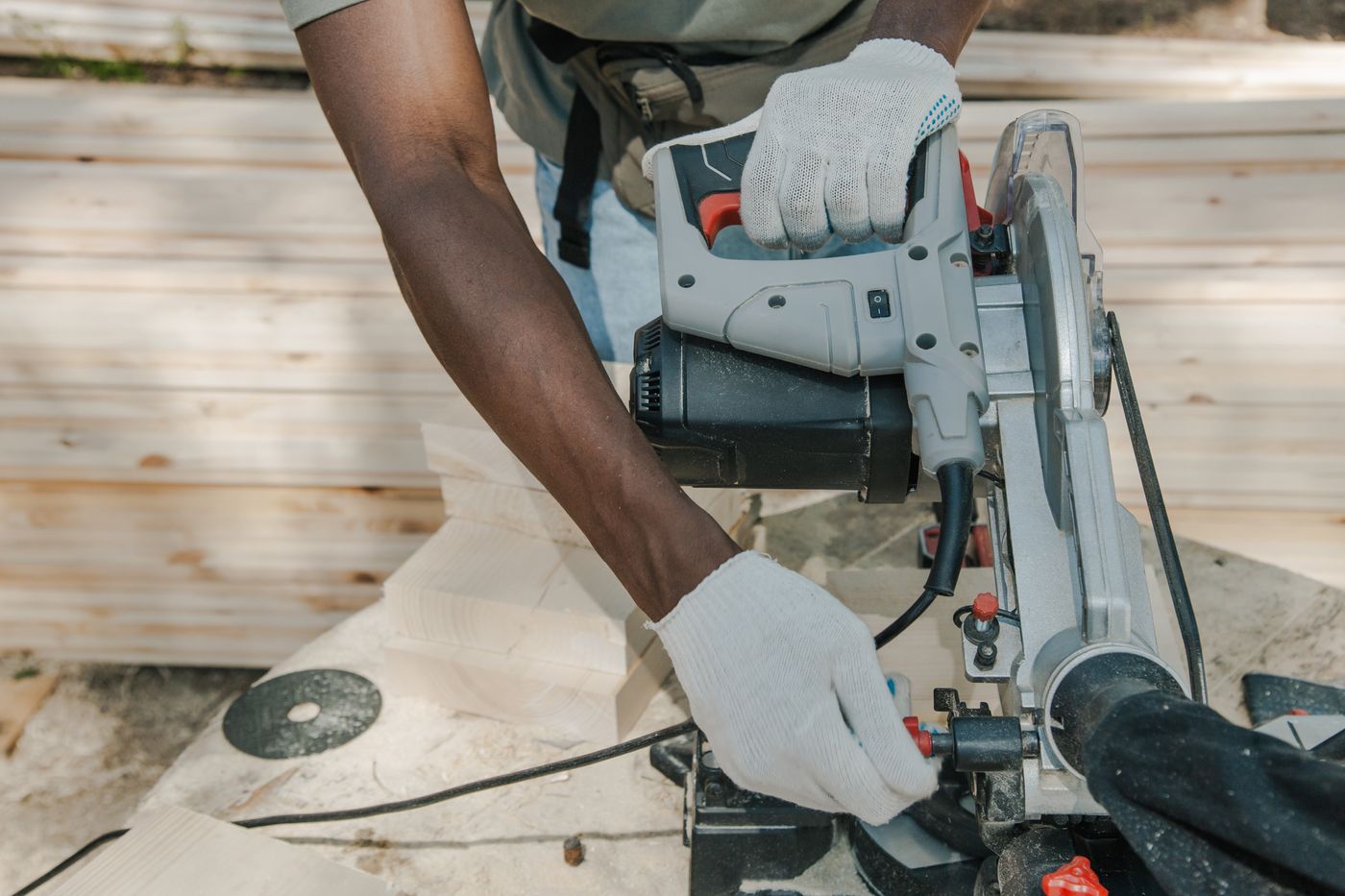
A mitre saw stays put and the timber is brought to it. The blade descends on a fixed arc against a fence, which means the angle is set by the machine rather than by your hand. Set a stop block and every piece comes out identical without measuring again.
From that difference everything else follows. A mitre saw cannot rip along a board and cannot cut a full sheet, because the cut length is limited by how far the blade travels. A circular saw cannot repeat an angle accurately forty times, because nothing is holding the angle but you.
If you can only buy one, buy the circular saw. It is the more versatile tool and it can do a passable job of the mitre saw's work with a guide clamped to the timber. The reverse is not true: no amount of skill makes a mitre saw rip a sheet of plywood.
The Blade Matters More Than the Saw
This is the part most buyers get wrong, and it costs them more than choosing the wrong machine would.
Timber cuts differently depending on direction. Cutting along the grain, called ripping, separates long fibres and produces long stringy waste. That waste has to be carried out of the cut, so a ripping blade has few teeth with large gullets between them to hold it. Around 24 teeth on a 185mm blade is typical.
Cutting across the grain, or through board materials like plywood and MDF, severs fibres rather than separating them. That wants many small cutting edges taking a light bite each, so the surface is not torn. Forty to sixty teeth is the range, and the finish difference is dramatic.
Use the coarse ripping blade to cut across plywood and you get the ragged, splintered edge that people wrongly blame on the saw. Use the fine crosscut blade to rip a long board and the gullets pack solid, the blade heats, and the cut slows to a crawl and starts smoking.
Kickback, and the Guard People Remove
Circular saws injure people in one particular way, and it is worth understanding the mechanism rather than memorising a rule.
The blade spins so that its teeth move backwards through the cut, pushing the saw forward against the timber. If the cut closes on the blade and pinches it, the blade cannot keep turning through the wood. Something has to move, and since the timber is heavy, the saw is what moves. It is thrown backwards along the line of the cut, towards the operator, very fast.
The usual cause is support. If you rest a board on two trestles and cut between them, the two halves sag as the cut deepens and close the kerf on the blade. The correct arrangement supports the timber so that the offcut can fall away freely rather than pivoting into the blade.
The riving knife, the thin plate sitting behind the blade, exists to hold that kerf open. It is the single most important safety feature on the tool. It is also the part people remove because it fouls an awkward cut, and a saw with no riving knife has had its main protection against kickback taken off.
Support both sides, let the offcut fall. Most kickback is a support problem wearing the disguise of a technique problem. Set the cut up so gravity opens the kerf rather than closing it, and keep the riving knife fitted.
Why Your Cuts Are Not Square
Almost everyone blames themselves. It is usually the machine, and it is usually adjustable in five minutes.
On a circular saw, the base plate pivots to allow bevel cuts, and its ninety degree position is set by a detent that is often not accurate from the factory. Put an engineer's square against the blade body, not the teeth, and check it properly. If it is out, adjust it and mark the correct position.
On a mitre saw, there are two separate things to check. The fence must be straight, and on cheaper machines the two halves are sometimes not in the same plane. The blade must then meet that fence at a true ninety degrees. Both are adjustable, and a machine that has been transported on a rough road is a machine worth rechecking.
Then there is the blade itself. A blunt blade wanders, because it stops cutting cleanly and starts following the path of least resistance through the grain. A bent blade cuts a kerf wider than itself and leaves a surface that is out of square through the thickness. Spin the blade by hand and watch the rim against a fixed point to spot a bend.
Set the depth so the blade projects only a few millimetres below the timber. This is not only safer, exposing less blade, but produces a cleaner cut because the teeth enter and leave the wood at a steeper angle and tear less.
What to Look For When Buying
For a circular saw, the base plate is the part to inspect first. A thin pressed plate that flexes under hand pressure will never give a straight cut no matter how careful you are, and this is where the cheapest machines save money. A rigid plate matters more than motor wattage.
Check that the blade guard retracts smoothly under light pressure and springs closed cleanly. A guard that sticks is a guard that gets tied back, and a tied back guard on a coasting blade is how serious injuries happen. Confirm the depth and bevel adjustments lock positively rather than creeping.
For a mitre saw, check the head has no side to side play when you rock it at the top of its travel, because that play goes straight into the accuracy of every cut. Check the detents at the common angles land crisply, and that the machine can be clamped or bolted down. A mitre saw walking across a bench is both inaccurate and dangerous.
For both, look at the cable where it enters the body. That is the flex point that fails first, and it is a reasonable proxy for how much care went into the rest of the assembly.
Which One, Honestly
If you build and repair generally, and the work moves around, buy a circular saw and a good pair of blades. It will handle sheets, framing, doors, formwork and site work. Clamp a straight edge to guide it and it will cut straighter than most people cut freehand.
If you make the same thing repeatedly, and the timber can come to a bench, the mitre saw pays for itself quickly in time and in wasted material. Furniture, roof members, framing components, anything cut to a schedule of lengths.
If you do both, buy the circular saw first and add the mitre saw when you notice yourself measuring the same length over and over. That is the moment it starts paying, and not really before.
We stock circular saws, mitre saws, blades in the common tooth counts, electric planers, angle grinders, drills and the rest of the workshop range across our branches. Tell us the work rather than the tool and we will point you at the right machine, including when a clamped guide and the saw you already own is the honest answer. The range is on the workshop and tools page, with current prices on the price list.
Key Takeaways
- A circular saw travels to the work and is the more versatile tool. A mitre saw stays put and repeats a cut exactly. Buy the circular saw first.
- A mitre saw cannot rip along a board or cut a full sheet. That is a design limit, not a shortcoming.
- Few teeth with big gullets for ripping, many teeth for crosscutting and board materials. The wrong blade causes most bad cuts.
- Kickback happens when the cut pinches the blade. Support both sides so the offcut falls free, and never remove the riving knife.
- Check the base plate against a square rather than trusting the ninety degree detent. Factory settings are often slightly out.
- Set blade depth to project only a few millimetres past the timber, for a cleaner cut and less exposed blade.
Frequently Asked Questions
Should I buy a circular saw or a mitre saw first?
A circular saw first, in almost every case. It is the more versatile of the two because it can rip a sheet down its length, cut across a board, and travel to the work. A mitre saw cannot rip at all and cannot cut a full sheet of plywood. The mitre saw is the second purchase, bought when repeated identical crosscuts start eating your day.
How many teeth should a wood cutting blade have?
Fewer teeth for ripping along the grain, roughly 24 on a 185mm blade, because each tooth needs a large gullet to clear the long fibres. More teeth for crosscutting and for board materials, 40 to 60, because more cutting edges leave a cleaner edge with less tearing. Using a coarse ripping blade to crosscut plywood is the usual reason for a ragged, splintered edge.
What causes kickback on a circular saw?
The cut closing on the blade and pinching it. The blade is still turning, so when it is gripped it drives itself backwards out of the cut towards the operator. It is caused by unsupported offcuts sagging and closing the kerf, by cutting on the wrong side of a support, and by a missing or removed riving knife. Support both sides of the cut, let the offcut fall free, and never remove the riving knife.
Why are my saw cuts not square?
Usually the base plate or the fence rather than your technique. Check the base plate is genuinely at ninety degrees to the blade with a square, because the factory setting is often slightly out and the detent can be trusted too readily. On a mitre saw, check the fence is straight and that the blade meets it square. A blade that is blunt or bent will also wander and produce a cut that is out of square in the thickness of the timber.
Can I use a wood blade to cut metal?
No. A wood blade run into steel will shed or shatter teeth, and those teeth leave at speed. Metal cutting needs either an abrasive cut off wheel on an angle grinder or a blade specifically rated for the metal you are cutting, run at the correct and usually much lower speed. This is one of the more dangerous shortcuts taken in small workshops.