Walk down any timber-yard lane in Eldoret or Gikomba and you will hear the difference between a well-set circular saw and a struggling one before you see either. One sings through the board and leaves an edge you could joint straight off the saw. The other screams, smokes, and spits a ragged edge that costs another twenty minutes of planing. Same class of tool, often the same wattage: the difference is almost always the blade on the spindle and how the cut was set up.
The circular saw is the fundi's production tool: a full roof's worth of rafters becomes a morning's work instead of two days. It is also the power tool most often bought wrong, run with the wrong blade, and used with the guard wedged back.
This guide covers what wattage and blade diameter actually decide, how TCT tooth counts work and which blade suits which material, why a wood blade must never touch metal, the honest case for cordless, sharpening economics, kickback and the safe ripping setup, and the point where a mitre saw or cut-off saw joins the workshop.
Wattage and Blade Diameter Decide Depth, Not Speed
The two numbers on the box, motor wattage and blade diameter, are widely misread. A 2200W saw does not cut twice as fast as a 1300W saw in the same board. What the bigger motor buys is torque under load: the ability to hold full blade speed through wet cypress, a knot in blue gum, or a full-depth rip. A bogging blade is slow and, as the kickback section shows, dangerous.
Blade diameter sets the maximum depth of cut, because only the part of the blade below the base plate reaches the wood. A common 185 mm saw cuts roughly 60 to 65 mm deep at 90 degrees, which handles all everyday timber up to a 2 by 3 on edge. A 235 mm saw reaches around 85 mm for heavy structural work, and needs the bigger motor to drive that much steel through the cut. Tilt the base to 45 degrees and every saw loses roughly a third of its depth, which is why bevel-heavy roofing work favours the larger sizes.
The Kenyan market clusters between 1300W and 2300W, and Fuga stocks the spread: Coofix, Juster, and Meakida at the value end, the KZUBR 1500W and KZUBR 2100W in the middle, and Bosch and Total for daily cutters. A 1500W, 185 mm saw covers most fundi work; move to a 2200W class saw when full-depth hardwood ripping is the daily job.
TCT Teeth Explained: What 24T, 40T and 60T Actually Mean
Nearly every blade sold today is TCT: tungsten carbide tipped, small blocks of carbide brazed onto a steel disc, holding an edge many times longer than plain steel. The number that matters on a TCT blade is the tooth count, stamped as 24T, 40T, 60T and so on for a given diameter.
Fewer teeth means bigger gullets, the valleys between teeth that carry sawdust out of the cut. A 24T blade takes big bites and clears chips fast, so it rips along the grain quickly, but each bite tears fibres and leaves a rough edge. More teeth means smaller bites: a 60T blade leaves a clean, almost polished edge, but it cuts slower and its shallow gullets pack with dust in thick, wet timber, making the blade heat up and the motor labour.
The working translation: 24T for ripping construction timber along the grain, 40T for general crosscutting and mixed site work, 60T for plywood, MDF, laminated board, and any edge the client will see. If the saw only ever wears one blade, make it the 40T; but blades change in under a minute, so the serious answer is to own the set and swap.
Matching the Blade to Timber, Board and Roofing Sheet
Solid timber follows the tooth-count rule above, with one addition: green or wet timber wants fewer teeth, because the wet dust packs high-tooth gullets and burns the cut. Boards behave differently. Plywood and melamine-faced board chip on the surface where the teeth exit, so run a 60T blade, cut with the good face down (a circular saw's teeth cut upward through the material), and score the line first if the face must be perfect.
Roofing sheet, the iron mabati that covers most of Kenya, is not a job for any wood blade. Thin sheet cuts cleanly with tin snips or a nibbler; steel bar, angle line, and pipe belong to a purpose-built metal cut-off saw, which spins an abrasive or dedicated metal disc inside a full guard at the speed the disc is rated for.
The reason a wood blade must never cut metal is mechanical. Its brazed carbide tips are designed for chip loads in fibre, not impact against steel: on metal the tips overheat, the brazing lets go, and carbide fragments leave the blade at rim speed like shrapnel. Even when the tips hold, the heat ruins the blade's temper, and the saw's guard was never designed to contain sparks. One blade, one material class. No exceptions.
Cordless Circular Saws: The Honest Assessment
The 20V cordless circular saw has earned a real place, and it is worth being precise about where. Its case is freedom: roofing work where a cord over a truss is a hazard in itself, fencing and repairs far from any socket, and quick trim cuts where unrolling a cable takes longer than the cut. A modern 20V saw with a sharp, thin-kerf blade crosscuts everyday timber all day on two charged batteries.
Its limits are equally real. Full-depth hardwood ripping drains batteries quickly and pulls the motor down exactly where a corded 2100W saw shrugs. Battery cost is the hidden half of the price, and a cordless tool with one battery spends half its day resting: the honest configuration is two batteries and a charger, with heavy ripping left corded. For a fundi already on 20V drills, sharing batteries across the platform changes the sums in cordless's favour, a point we develop in the workshop power tools guide.
Blade Economics: When to Resharpen, When to Replace
A blade tells you it is going blunt before the edge looks any different: cuts need more push, the motor note drops, edges start burning brown, and the saw wants to wander off the line. Pushing on regardless is the expensive response, because a blunt blade loads the motor, eats the day, and raises kickback risk.
TCT blades can be resharpened, but only by a service with a diamond wheel; a hand file will not touch carbide and a freehand bench grinder ruins the tooth geometry. The arithmetic is simple. A quality blade from a maker like Bosch carries enough carbide for several regrinds, so resharpening costs a fraction of replacement. The cheapest blades carry so little carbide that one regrind is marginal; treat them as consumables. Either way, retire any blade with a missing tip, a crack, or a bent plate, whatever it cost. Blade and saw prices move with stock, so check the price list or ask on WhatsApp before you budget.
Kickback: Why It Happens and the Ripping Setup That Prevents It
Kickback in a circular saw is the blade binding in the cut and the saw driving itself back toward you. The mechanism is nearly always pinching: the kerf, the slot the blade has just cut, closes on the back of the blade and grips it. Wrong support causes most of it: a plank held only at its two ends sags shut as the cut finishes, and the closing kerf clamps the blade. Twisted or tension-loaded timber, common in cheap sun-dried stock, does the same as internal stresses release mid-cut.
The safe ripping setup answers each cause in turn. Support the board so the offcut side can fall slightly away, never sag inward. Set the depth so the teeth clear the underside by only about a tooth; a deep-set blade presents more steel for the kerf to grab. Clamp a straight edge as a guide, because a wandering freehand cut curves the kerf onto the blade's flank. Let the saw reach full speed before entering the wood, and if the blade begins to bind, release the trigger and hold position; never lift a spinning blade out of a closing cut.
Guard discipline is the last line. The spring-loaded lower guard covers the blade the instant it leaves the wood; wedge it back and a saw set down while spinning will climb along whatever it touches. Retract it by its lever only for the first moment of a steep bevel cut. If it sticks with sawdust, clean it before the next cut rather than working around it, the same discipline we preach for the chain brake in the chainsaw guide. Eye protection is non-negotiable; a circular saw throws chips at face height all day.
Where the Mitre Saw and Cut-Off Saw Take Over
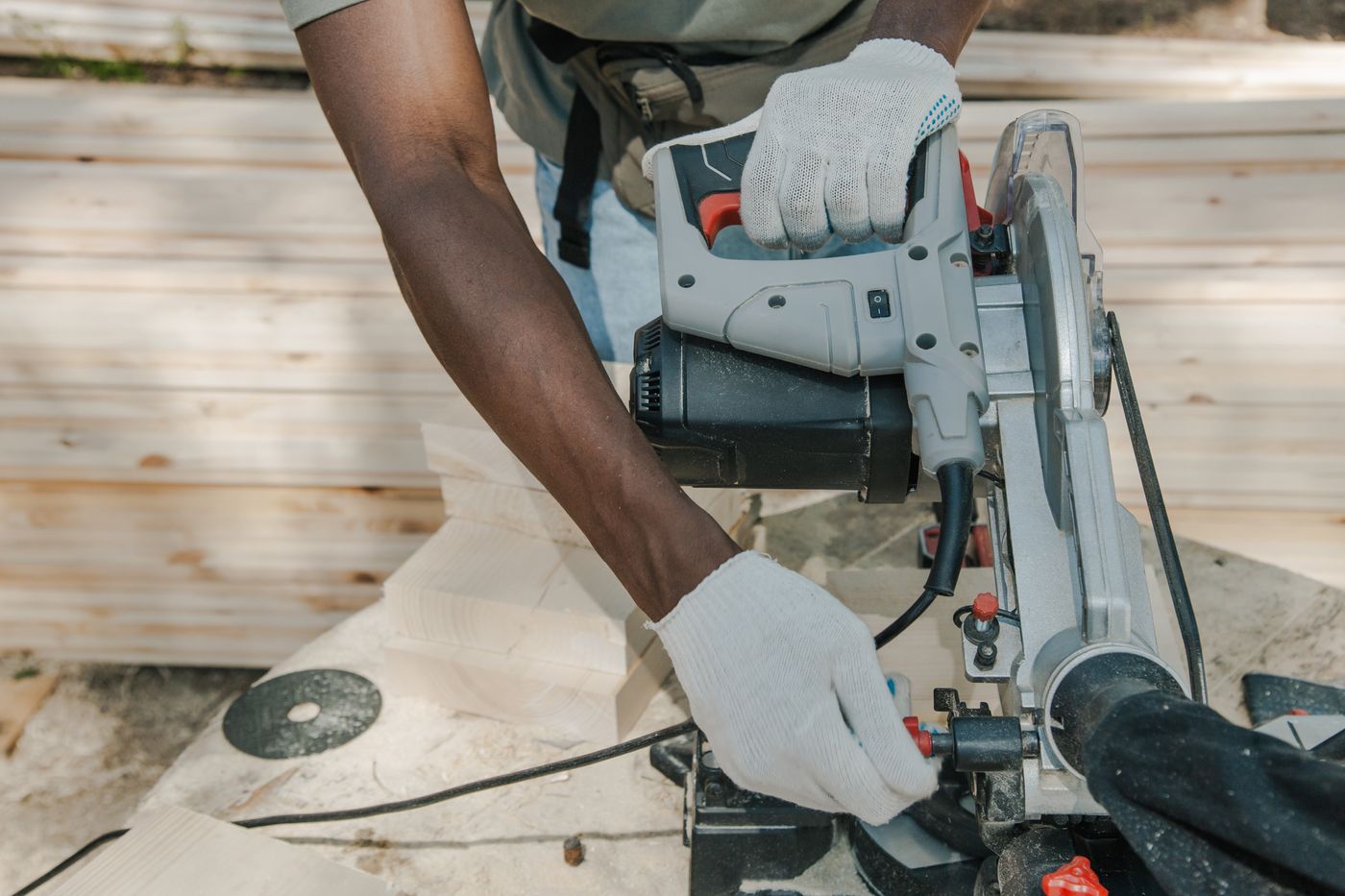
A hand-held circular saw brings the tool to the work. The mitre saw reverses this: work comes to a fixed blade that swings down at a locked angle, making the hundredth 45-degree cut identical to the first. For a fundi moving into doors, frames, and finish carpentry, that repeatability is what separates fitted work that closes properly from work that needs filler.
The metal cut-off saw is the same idea for steel: a fixed, fully guarded head, a vice clamping the stock, and a disc made for metal. Anyone fabricating gates, grills, or greenhouse frames alongside timber should treat it as the second stationary saw, not make one machine cut both material classes.
A Buying Path: From First Saw to Full Workshop
Buy in the order the work arrives, not the order the catalogue suggests. First, a corded circular saw in the 1500W, 185 mm class with a 40T blade: the widest capability per shilling in the range. Second, not a tool but blades, the 24T and 60T that unlock ripping and finish work on the saw you already own. Third, cordless with two batteries, once site work far from power is regular income.
Fourth, the mitre saw, when finish carpentry joins the offer; fifth, the cut-off saw, when steel enters the workshop. That path spends on capability only as each new class of work starts paying for it, and every step is stocked in our workshop and industrial tools range, with spares and after-sales support at all six branches.
Key Takeaways
- Wattage buys torque under load and blade diameter buys depth of cut; neither buys speed on its own.
- TCT tooth count is the speed-versus-finish dial: 24T to rip timber, 40T all-round, 60T for boards and visible edges.
- Cut boards good face down, and use fewer teeth in green or wet timber so the gullets can clear the dust.
- A wood blade must never cut metal: overheated carbide tips can detach at rim speed. Sheet goes to snips or a nibbler; bar and pipe go to the metal cut-off saw.
- Cordless 20V earns its place on roofs and remote sites with two batteries; heavy ripping stays corded.
- Resharpen quality TCT blades at a diamond-wheel service; treat the cheapest blades as consumables; retire any blade with a chipped tip or bent plate.
- Kickback comes from a pinched blade: support the kerf open, set shallow depth, clamp a guide, reach full speed first, and never tie back the guard.
- Upgrade path: corded 185 mm saw, then the blade set, then cordless, then mitre saw, then cut-off saw.
Frequently Asked Questions
What wattage circular saw should I buy in Kenya?
For general fundi and farm work, a corded saw in the 1500W class with a 185 mm blade covers everyday timber and board. Step up to 2100W or 2200W if you rip thick hardwood daily, and down to the 1300W class only for light, occasional cutting. The motor's job is holding blade speed under load, so buy for your hardest regular cut.
Which TCT blade tooth count is best for wood?
There is no single best: 24T rips fast along the grain with a rough edge, 60T crosscuts board and fine work cleanly but slowly, and 40T is the all-round compromise. If you own one blade make it a 40T; the better answer is to own all three and swap for the cut, since a blade change takes under a minute.
Can I cut mabati or metal with my circular saw?
Not with a wood blade, ever. Metal overheats the brazed carbide tips and they can detach at rim speed, and the saw's guard is not built to contain sparks. Cut thin sheet with tin snips or a nibbler, and cut steel bar, angle line and pipe on a purpose-built metal cut-off saw with a disc rated for it.
Are cordless circular saws worth it for site work?
Yes, for the right jobs: roofing, fencing, and repair work far from power, where a trailing cord is a cost and a hazard. Buy with two batteries so the saw never waits on the charger, and keep a corded saw for heavy ripping, which drains batteries fastest and is where mains power still wins clearly.
How much do circular saws and TCT blades cost at Fuga?
Prices move with stock and the exchange rate, so check the current figures on our price list or ask on WhatsApp at wa.me/254716961018, or call 0734263958. Bring your saw's blade diameter and bore size and our team will match blades, or you can visit any branch in Nairobi, Eldoret, Nakuru, or the Coast.