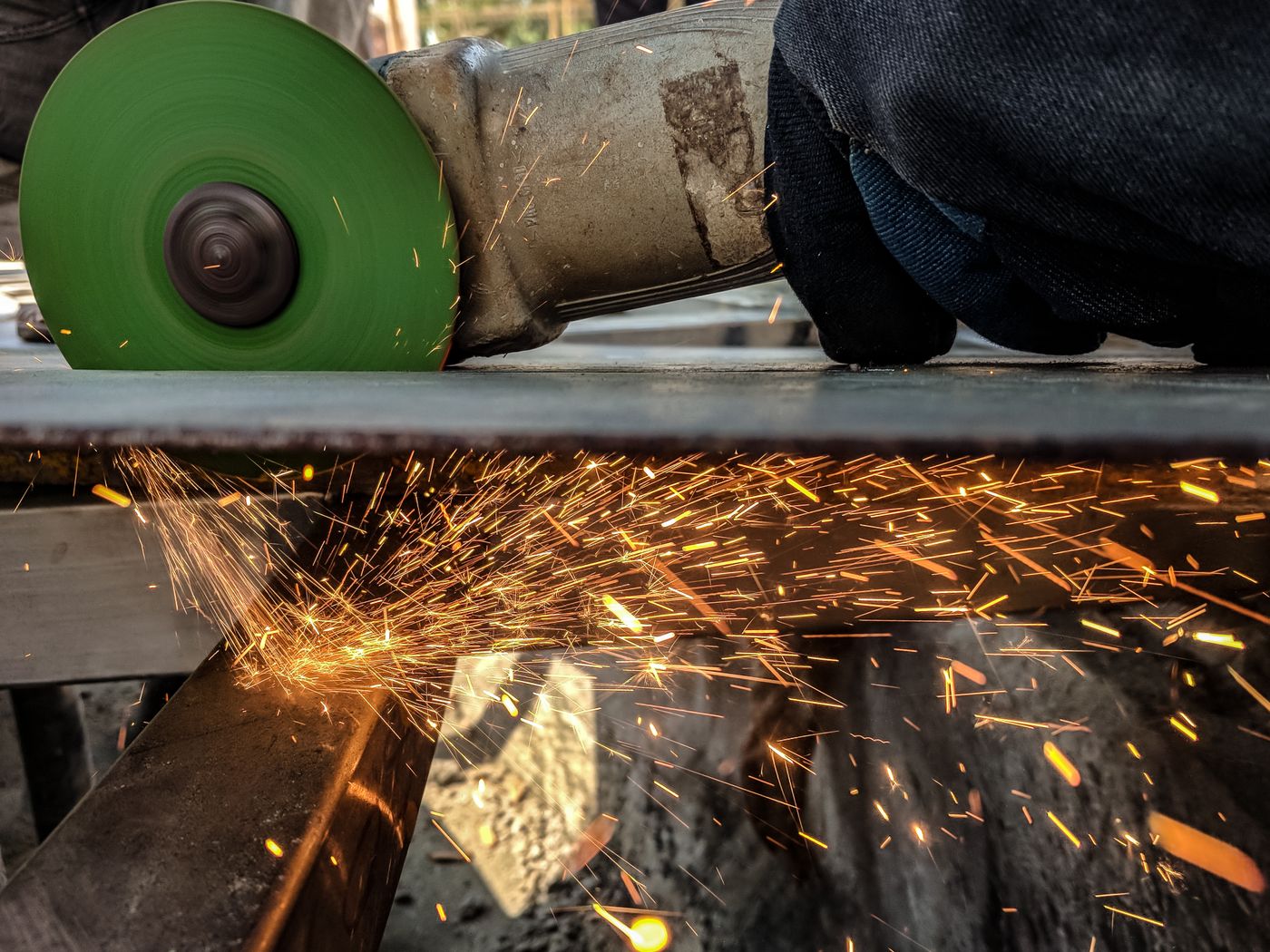
A fundi in a Nakuru fabrication shop reaches into a cardboard box of discs. They are all grey, all round, all the same 22 millimetre bore. He takes whichever is on top, drops it onto the spindle, tightens the flange nut and pulls the trigger. Sparks fly, the cut is made, the next job starts. Nine times out of ten nothing goes wrong.
The tenth time is why this article exists. The disc is the cheapest part of the whole operation and the part most likely to send someone to hospital. A thin resin-bonded disc spinning at eleven thousand revolutions a minute stores a surprising amount of energy, and when the wrong disc meets the wrong load it does not wear out gently. It shatters, and the pieces leave at the speed of a bullet.
None of that is bad luck. The disc that bursts, the cut that wanders, the wheel that lasts a morning instead of a week: each has a cause you can see and control at the moment you choose the disc. This guide covers which disc does which job, how to match the disc to steel, stone or tile, how to read the speed rating that keeps the disc in one piece, and how the guard, your stance and your technique turn a dangerous tool into a precise one.
Three Jobs, Three Discs: Cutting, Grinding and Flap
Almost every mistake with an angle grinder starts by confusing two operations that feel similar and are not. Cutting parts the metal along a line. Grinding removes metal from a face. The disc built for one is dangerous doing the other, and the difference is in the thickness.
The cutting disc, also called a cut-off wheel, is thin, typically one millimetre to three millimetres, and flat. It is designed to work on its edge, buried in a narrow slot, cutting a straight line through bar, sheet, pipe or bolt. Because it is thin it has almost no strength sideways. Push it flat against a surface to grind, and the bending load can snap it in an instant.
The grinding disc, often called a depressed-centre wheel, is thick, around six millimetres, with a raised hub that lets you work at an angle without the flange fouling the job. You hold it at roughly fifteen to thirty degrees to the surface and use the face to grind down welds, chamfer edges or clean castings. It is built to take side load. It is useless for a clean cut because its width tears a wide, ragged slot.
The flap disc is a different animal again: overlapping leaves of abrasive cloth bonded to a backing plate, sold in grits like 40, 60, 80 and 120 just like sandpaper. It grinds and finishes in one pass, removing weld spatter and leaving a smooth blended surface rather than the gouged one a hard grinding wheel leaves. As the top layer of flaps wears away, fresh abrasive underneath is exposed, so a flap disc stays cutting-sharp until it is used up.
The single rule that prevents most burst discs. Never grind with the flat face of a thin cutting disc, and never plunge-cut with a thick grinding wheel. If you find yourself leaning a cut-off wheel sideways to shave a high spot, stop and change the disc. That sideways load is exactly what a thin disc cannot survive.
Matching the Disc to the Material: Steel, Stainless, Stone and Tile
Thickness decides cut versus grind. The abrasive itself decides which material the disc belongs on, and here the box of grey discs hides real differences.
Mild steel, rebar and general fabrication take an ordinary aluminium-oxide bonded disc, the workhorse of every Kenyan workshop. Cut with a thin metal cut-off wheel, grind or blend with a grinding wheel or a flap disc, and keep the sparks streaming away from your body and from anything that burns.
Stainless steel needs a disc marked INOX, made free of iron, sulphur and chlorine. A normal steel disc leaves iron particles embedded in the stainless surface, and those particles rust weeks later and stain the whole job. On food, dairy or water equipment that contamination is not cosmetic, it is a hygiene failure. If you fabricate stainless milk cans or troughs, buy INOX discs and keep them in a separate box.
Stone, concrete, blocks and masonry are the opposite problem. A metal-cutting abrasive disc will cut concrete slowly while wearing away alarmingly fast and heating up, and the mismatch invites a burst. Use a diamond disc, whose rim carries industrial diamond grit brazed to a steel core, or a dedicated silicon-carbide masonry wheel. Diamond discs for stone and concrete have slots cut into the rim, the segmented look, to shed heat and dust.
Ceramic tile and porcelain want a diamond disc with a continuous, unslotted rim, which leaves a smooth edge instead of chipping the glaze. Porcelain is hard and brittle, so feed slowly and, where the disc is rated for it, use water to cool the cut and hold down the dust. Cutting tile dry with a metal disc simply shatters the tile.
Disc Thickness and the RPM Rating: the Number That Keeps the Disc in One Piece
Two numbers are printed on the paper label of every quality disc, and both matter more than the price. The first is thickness. The second is the maximum operating speed, and misreading it is how discs kill people.
Thickness is a trade-off. A thin cutting disc of one millimetre cuts fast, wastes little metal, throws less heat into the workpiece and leaves a cleaner edge, but it is fragile and wears quicker. A thicker cutting disc of two-and-a-half or three millimetres lasts longer and forgives a less steady hand, but it cuts slower, heats the job more and takes a wider bite. For thin sheet and box section, reach for the thin disc. For heavy round bar where the disc gets knocked about, a thicker one earns its keep.
The maximum speed is a hard safety limit. Every bonded abrasive disc sold to a recognised standard is built so that its rim never exceeds a peripheral speed of eighty metres per second under the European standard EN 12413, the figure most discs on the Kenyan market are made to. Because the rim of a bigger disc travels further with each turn, a bigger disc must spin slower to stay under that limit. That is why the maximum revolutions per minute printed on the label falls as the disc diameter rises.
The chart below shows the effect for the four common sizes. It is not an opinion or an estimate: it is the arithmetic of that eighty metre per second limit worked out for each diameter.
Here is where the danger hides. Every one of those discs shares the same 22.23 millimetre bore, so a large 230 millimetre disc rated for 6,600 revolutions per minute will physically slide onto a small 115 millimetre grinder that spins at eleven thousand. Fit it, and the disc is being driven at almost double the speed it was built for. The extra centrifugal force can tear it apart before it even touches the work. An over-speed disc is not a disc that is worn out, it is a disc being run faster than its rating, and it fails without warning.
Read one number before every disc goes on. The maximum speed printed on the disc must be equal to or higher than the no-load speed printed on your grinder. If the disc says 6,600 and the grinder says 11,000, that disc does not belong on that machine. The disc rating is a ceiling, never a target.
The Guard Is Not Optional
The guard is the curved steel shield that sits between the disc and your face. Its whole purpose is the burst scenario: if a disc does let go, the guard catches the fragments that would otherwise fly at your head and chest and deflects them down and away. A grinder used without its guard is a tool with its one passive safety feature removed.
Guards come off far too often in Kenyan workshops, usually because they get in the way of an awkward cut. That is a decision to trade a minor inconvenience for a major injury. If a guard genuinely blocks a cut, the honest fix is a different tool or a repositioned workpiece, not a bare disc. Keep the guard set so the open side faces the work and the closed side faces you.
Two more fittings belong in the same breath. The side handle gives your second hand real control and leverage against kickback, so use it and do not treat it as optional. And the flange and back-up nut that clamp the disc must be the pair that suit that disc type, seated clean and tightened firm but not brutal. A disc that is loose on the spindle wobbles, overheats and cracks.
Kickback: Why the Cut Throws the Tool Back, and How to Stop It
Kickback is the sudden, violent lurch of the grinder back toward the operator, and it is the most common way people get hurt short of a burst disc. It happens when the spinning disc suddenly binds instead of cutting. The disc wants to keep turning, so if it cannot chew through the metal it climbs out of the cut and drives the whole tool backward along the line of least resistance, which is often straight at you.
The classic cause is a pinched cut. As you cut across a bar or sheet that is not properly supported, the two sides sag and close on the disc like a pair of pliers. The instant the slot pinches, the disc jams and kicks. The cure is to support the work so that the cut opens rather than closes: clamp the off-cut side so it falls away, and never cut in the middle of a span that will bow inward.
The other cause is catching an edge, especially with the leading top quarter of the disc, which grabs and rides up. Cut with the correct part of the wheel, keep it square in the slot, and never twist or lever the grinder sideways to steer the cut. Let the disc track straight. If it starts to wander, ease off, let it recover full speed, and re-enter cleanly.
Your stance is your last line of defence. Stand slightly to the side so your body is out of the direct line of the disc's plane, hold the machine firmly with both hands, and keep a stable footing. Let the disc reach full speed in free air before it touches the metal, and lift it out of the cut before you release the trigger. These are the same habits that keep every workshop machine honest, and we set the wider routine out in our guide to farm and workshop safety and PPE.
Stand out of the line of fire. Both a burst disc and a kickback travel in the plane of the wheel. If your face and body are never in that plane, the two worst events an angle grinder can produce mostly miss you. Position first, cut second.
PPE That Actually Matches an Angle Grinder
An angle grinder produces three hazards at once: flying fragments, a stream of hot sparks and metal dust, and a great deal of noise. The protective equipment has to answer all three, and ordinary sunglasses answer none of them.
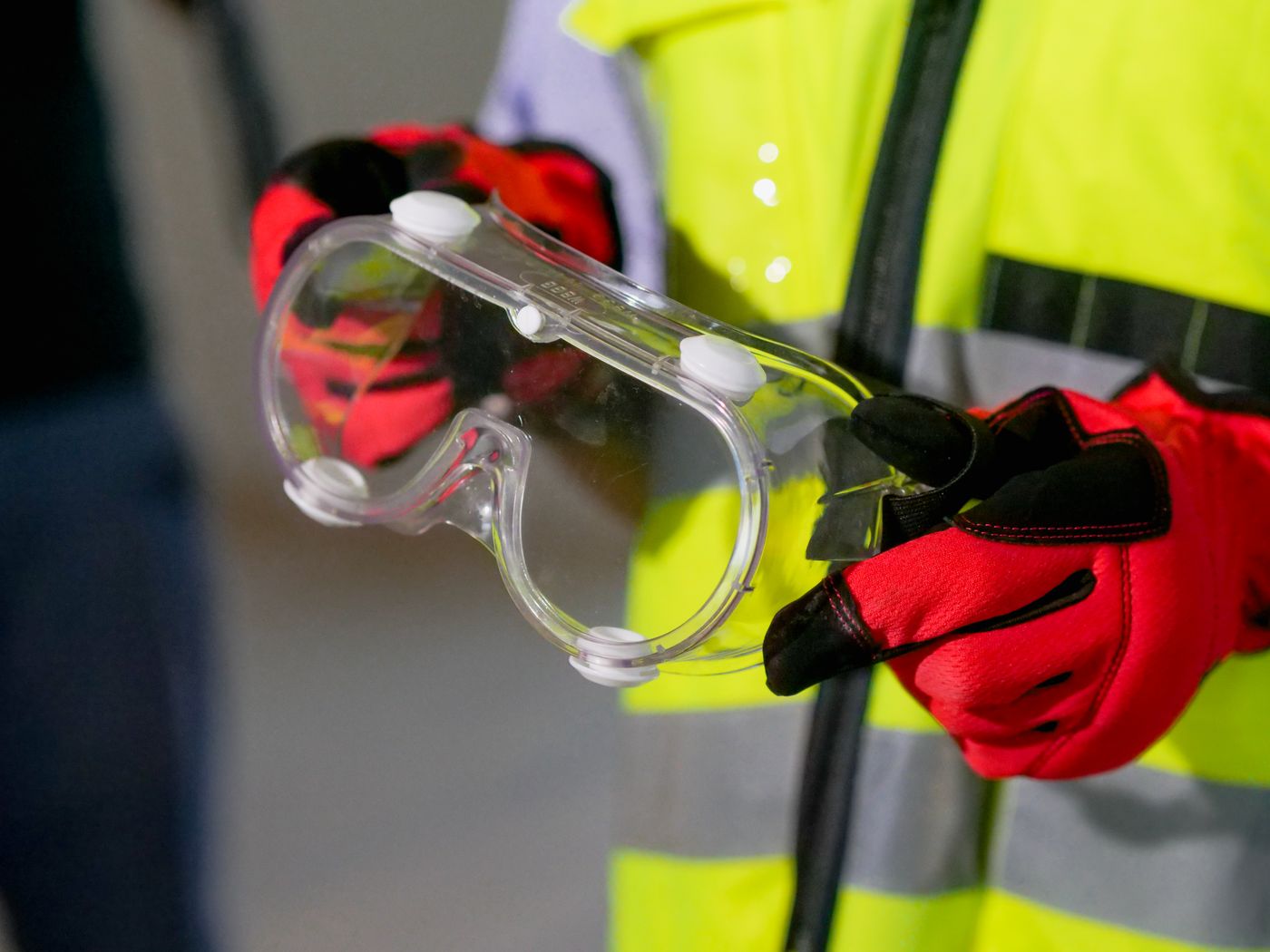
Start with the eyes and face. Impact-rated safety glasses are the minimum, but for cutting and grinding a full face shield worn over the glasses is the sensible standard, because it stops the larger fragments a burst throws. The face shield protects the whole face; the glasses behind it stop fine grit getting under the shield. Wear both for anything more than a quick touch.
Then the lungs. Cutting mild steel throws metal dust, and cutting or grinding stone and concrete throws respirable crystalline silica, the fine dust that scars lungs over years of exposure. A fitted dust mask or respirator is not optional on masonry work, and outdoors is better than a closed room. Ear protection matters too, because a grinder sits in the range that damages hearing with repeated exposure.
Finish with the body. Wear close-fitting flame-resistant clothing with no loose sleeves or dangling drawstrings that a disc could snatch, sturdy gloves for grip and heat, and closed boots. Tie back or cover long hair. None of this is expensive, and every piece is cheaper than the injury it prevents. You can build a sensible kit from our workshop and industrial tools range without overspending.
Clean Cuts and Long Disc Life
A disc that is chosen and used well does two things: it cuts cleanly and it lasts. Both come from the same handful of habits, and none of them cost money.
Let the tool do the work. The single most common technique fault is leaning on the grinder to force the cut. Excess pressure overheats the disc, glazes the abrasive so it stops cutting, slows you down and shortens disc life. Apply steady, moderate pressure and let the disc's own speed cut the metal. If it is not cutting freely, the disc is wrong, worn or glazed, not too gentle.
Keep it straight and let it cool. A cut-off wheel wants to run in a straight line in its own slot. Rocking or twisting to widen the slot wears the disc unevenly and risks a jam. On a long or heavy cut, come out periodically to let both the disc and the workpiece shed heat, which also keeps the metal from discolouring at the edge.
Store and inspect the discs. Bonded abrasive discs are damaged by moisture and by being dropped, so keep them flat, dry and away from the ground. Every quality disc carries a manufacturing date and an expiry, usually three years on, because the resin bond ages: an out-of-date disc is a weak disc. Before you fit any disc, look it over for cracks, chips or damp, and throw out anything that fails the look. A disc that has been dropped on a hard floor should be retired even if it looks fine.
Choosing the machine that spins these discs is its own subject, from the right power rating to paddle switches and restart protection, and we cover it in the companion angle grinder buying guide for Kenya. If your work is mostly joining rather than cutting, the same care over consumables applies to rods and wheels in our note on welding machines for the rural workshop.
Key Takeaways
- Thickness sets the job: a thin cut-off wheel parts metal on its edge, a thick grinding wheel removes metal on its face, and a flap disc blends and finishes. Never swap the roles.
- Abrasive sets the material: aluminium oxide for mild steel, INOX for stainless, and a diamond or masonry disc for stone, concrete and tile. A metal disc on stone or a steel disc on stainless is a mistake.
- Read the maximum speed on the disc and make sure it is at least the no-load speed of your grinder. A big slow disc on a small fast grinder can burst from over-speed alone.
- Keep the guard and side handle fitted, support the work so the cut opens not closes, and stand out of the plane of the disc so a burst or kickback misses you.
- Let the tool cut at its own speed, keep the disc straight and cool, and store discs flat, dry and in date. Pressure and moisture are what kill discs early.
Frequently Asked Questions
Can I use a cutting disc for grinding if I am careful?
No. A cutting disc is thin and has almost no strength across its face, so pressing it flat to grind bends it in a way it was never built to take, and it can shatter. Use a proper grinding wheel or a flap disc for grinding. If you only have a cutting disc and need to remove a high spot, stop and fetch the right disc rather than risk it.
How do I know if a disc is safe to fit on my grinder?
Check three things before it goes on. The maximum speed printed on the disc must be equal to or higher than the no-load speed printed on the grinder body. The disc diameter and bore must suit the machine. And the disc must be undamaged, dry and within its expiry date. If any one of the three fails, do not fit it.
Why does my cutting disc wear out so fast?
Usually too much pressure, the wrong disc for the material, or letting the disc rub instead of cut. Leaning on the grinder overheats and glazes the abrasive so it stops biting and simply grinds itself away. Let the disc run at full speed with moderate pressure, use a metal disc on metal and a masonry or diamond disc on stone, and keep the cut straight so the wheel wears evenly.
Do I really need a face shield, or are safety glasses enough?
For a quick, light job, impact-rated safety glasses are the bare minimum. For any real cutting or grinding, wear a full face shield over the glasses, because the shield is what stops the larger fragments if a disc bursts. Add a dust mask for masonry work and hearing protection for extended use. The kit is cheap and the injuries it prevents are not.
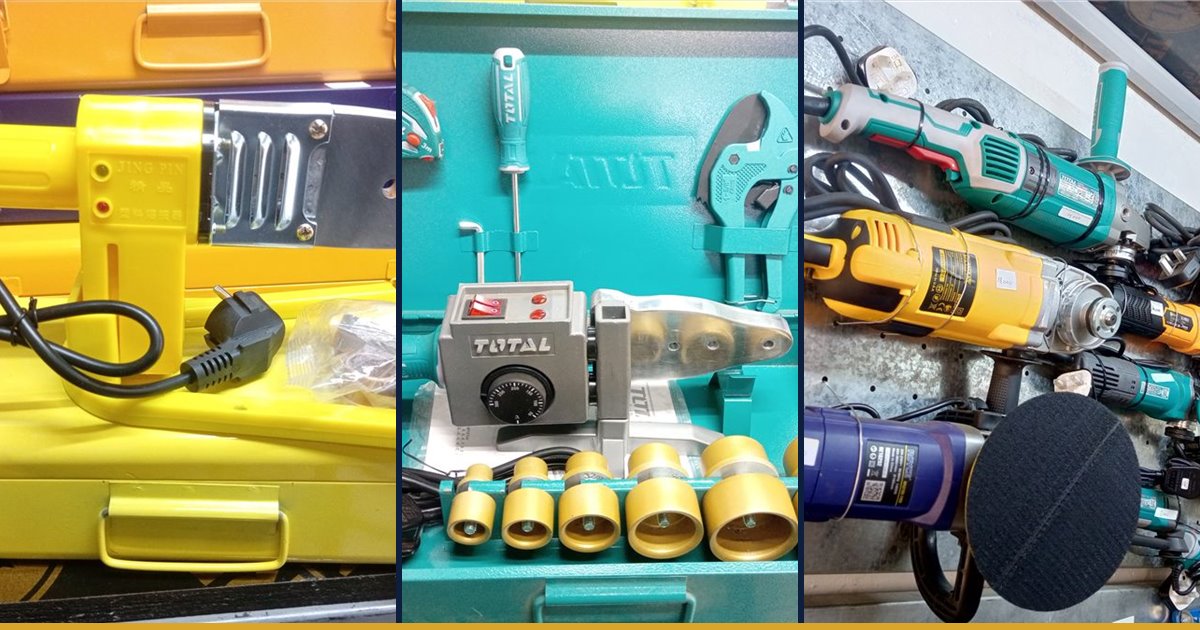
At Fuga we stock angle grinders and the full range of discs, cutting, grinding, flap and diamond, across our Eldoret, Nakuru, Nairobi and Coast branches, along with the face shields, gloves and dust masks that should go in the same basket. Tell us the material you cut and the size of your grinder and we will match you to the right discs rather than sell you the box on top of the pile. See the current price list, or bring the question to any branch and we will set you up safely.