Picture a smallholder spraying a maize plot on a bright, breezy afternoon. The mixture looks fine in the tank, the pump feels firm on the shoulders, and the job is finished in half an hour. Two weeks later, half the field is clean and the other half is crawling with the very pest he tried to kill. He blames the chemical, buys a stronger one, and sprays again. The problem was never the chemical. It was the sprayer, and the way it was used.
This is one of the most expensive quiet losses in Kenyan farming. Agrochemicals are not cheap, and a sprayer that puts out too much liquid in one pass and too little in the next wastes product, scorches leaves, breeds resistant pests, and leaves you paying twice for one job. Worse, poor equipment and careless handling put the operator and the family who eat that produce at real risk.
A knapsack sprayer is a simple tool, but choosing the right one and using it correctly is where the value lives. In this guide we walk through manual versus battery sprayers, why the little plastic nozzle matters more than the tank, how to calibrate so you apply the right rate, how to size capacity to your acreage, the safety rules that are not optional, and the cleaning habits that make a sprayer last for years instead of months.
Manual or Battery: Match the Sprayer to the Work
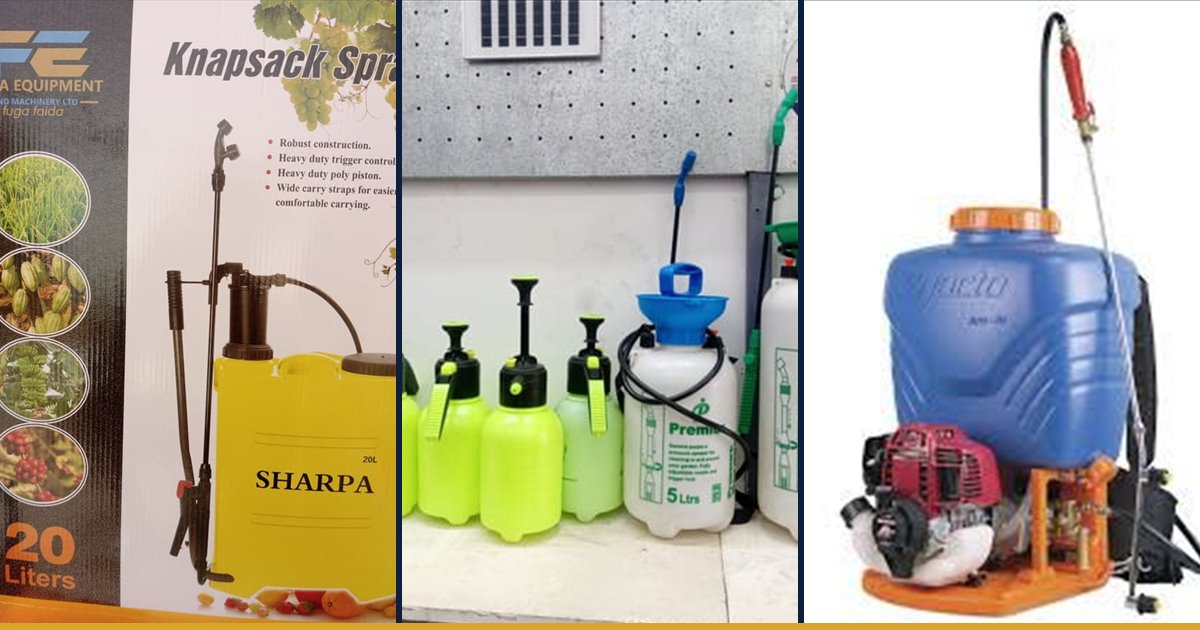
The first decision is power. A manual (lever) knapsack sprayer builds pressure by hand: you pump a lever as you walk, forcing liquid out through the nozzle. It is affordable, has few parts to fail, needs no charging, and can be repaired almost anywhere in Kenya. For a small kitchen garden, a coffee patch, or occasional weekend spraying, it is often all you need.
The catch is consistency. The pressure inside a manual tank rises and falls with every stroke of your arm. High pressure makes fine droplets, low pressure makes coarse ones, so the output changes across the field even when your walking speed does not. On a hot afternoon, arm fatigue also means you pump less near the end of the job, and the last rows get a weaker dose.
A battery (electric) knapsack sprayer runs a small 12-volt pump off a rechargeable battery, holding steady pressure without any pumping. That steady pressure is the real prize: uniform droplets, even coverage, and far less fatigue over a full day. For anyone spraying more than an acre regularly, or spraying often, a battery unit usually pays for itself in saved chemical and saved labour. Many models Fuga stocks are dual-purpose, with a manual lever as backup for the day the battery runs flat before the field is done.
Rule of thumb: if you spray occasionally on a small plot, a good manual sprayer is honest value. If you spray often, cover more than an acre, or need consistent results on high-value crops, a battery unit earns its keep quickly. When in doubt, buy the one with a manual backup.
The Nozzle Decides Your Spray, Not the Tank
Most buyers focus on tank size and pump type and ignore the one part that shapes every drop: the nozzle. The nozzle controls droplet size, spray pattern, and flow rate, and those three things decide whether your chemical lands where it should or drifts onto the neighbour's crop.
There are three patterns worth knowing. A hollow-cone nozzle produces fine droplets in a ring pattern and is the go-to for contact insecticides and fungicides, where you need the spray to coat leaf surfaces, including the undersides where pests hide. A flat-fan nozzle lays down an even band and is ideal for spraying herbicides on the ground or on weeds, because it gives uniform coverage across a strip without the heavy overlap that wastes product. A solid-cone or full-cone nozzle throws larger droplets over a wider volume and suits situations where you want penetration into a dense canopy.
Droplet size is the hidden lever. Fine droplets from a hollow-cone give excellent leaf coverage but drift easily in wind. Coarse droplets resist drift but can miss small targets and run off the leaf. This is why matching the nozzle to the job, and to the weather, matters as much as the chemical you pour in. Keep a small set of nozzle tips and swap them by task rather than spraying everything through whatever tip came in the box.
Watch for wear. Nozzles are made to a fixed hole size, but the hole widens as it wears, especially with abrasive wettable-powder mixes. A worn nozzle can put out 10 to 20 percent more liquid than a new one at the same pressure, quietly pushing up your dose and your cost. Nozzle tips are cheap. Replace them before they ruin an expensive batch of chemical.
Calibration: The Ten Minutes That Save a Season
Calibration simply means knowing how much liquid your sprayer actually puts on a known area, so you can mix the correct amount of chemical. Skip it and you are guessing, which is exactly how fields get over-sprayed on one pass and under-dosed on the next.
The mechanism is straightforward. Output on the ground depends on three things you can control: the nozzle flow rate, your walking speed, and your spray width (how wide a band you cover in one pass). Change any one and you change your application rate. Calibration pins all three down.
Here is a simple field method. Mark out a test area, for example 10 metres by the width you comfortably cover in one pass. Fill the tank with clean water only, pump to your normal working pressure, and spray that strip at your normal walking pace. Measure how much water you used to cover it, then scale that up to a full acre. Now you know your water volume per acre. Read the chemical label for the recommended rate per acre, and mix so that your measured water volume carries exactly that much product. Walk at the same pace and hold the same pressure when you spray for real, and the rate holds.
Do this whenever you change nozzle, change operator, or notice the job feels different. A new person walks at a different speed, and speed alone can swing your rate by a third. Ten minutes of calibration protects a whole tank of chemical.
Size the Tank to Your Land, Not the Shelf
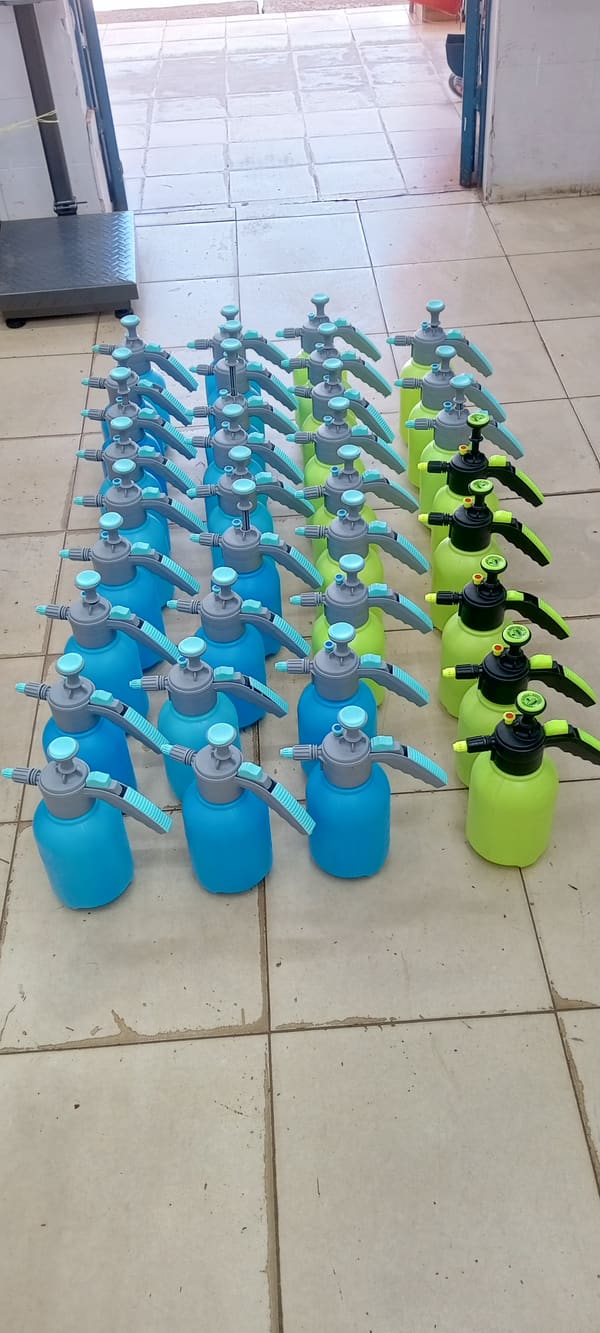
Knapsack tanks in Kenya commonly run from small handheld pressure sprayers of 2 litres up to 16 and 20 litre back-mounted units. Bigger is not automatically better. A full 20 litre tank weighs over 20 kilograms on your back, which is punishing on sloping or muddy ground and tiring long before the field is done.
Think in terms of refills. If you know your water volume per acre from calibration, you can work out how many tanks a field will take. A kitchen garden or nursery is well served by a 2 to 5 litre unit. A quarter to half acre suits a 16 litre tank comfortably. Anything above an acre, sprayed regularly, is where a 16 or 20 litre battery unit shines, because the steady pump lets you cover more between refills without wearing out your arm. Match the tank to the person carrying it and the ground they walk, not just the acreage on paper.
Safety is not optional. Before you touch any agrochemical, put on the protective kit: a long-sleeved overall, gloves, closed shoes or gumboots, goggles, and a proper mask or respirator. Never eat, drink, or smoke while spraying. Spray with the wind at your back so the mist blows away from you, not into your face. And never, ever clear a blocked nozzle by blowing it with your mouth. That draws concentrated chemical straight onto your lips and lungs. Carry a soft brush or a spare tip instead.
Handle Chemicals Like They Can Hurt You, Because They Can
Every pesticide and herbicide is a poison by design. Treating them with respect is what keeps you and your family safe. Read the label before you mix, and follow the stated rate and the re-entry and pre-harvest intervals, the waiting periods before people go back in the field or before produce is picked.
Mix in the open air, away from where children, animals, and drinking water can reach. Measure concentrate carefully rather than eyeballing it, since a splash of extra product does not improve control, it only raises cost and risk. When a container is empty, use the triple-rinse method: fill it about a quarter with clean water, cap it, shake, and pour the rinse into your spray tank so no product is wasted, then repeat twice more. Puncture the empty container so it cannot be reused for food or water, and dispose of it as the label directs. Wash your hands and face, and change out of your spraying clothes, before you eat or greet anyone.
If you keep animals, remember that drift and residues reach them too. Keep spraying well clear of grazing areas and water troughs, and if you are unsure how a product interacts with your livestock and poultry, ask before you spray, not after.
Clean and Maintain It So It Lasts
A knapsack sprayer that is rinsed and stored well can serve you for many seasons. One that is left with chemical drying inside will clog, corrode, and fail, usually in the middle of the next urgent job. The difference is a few minutes of care after each use.
After spraying, empty any leftover mix by spraying it out onto the treated crop rather than pouring it on the ground. Rinse the tank with clean water, run that rinse through the nozzle to flush the lines, and repeat. Remove and clean the nozzle and the filter, since these two small parts cause most blockages. If you have sprayed a herbicide, wash the tank especially thoroughly before using it for anything else, as herbicide traces can damage crops in a later spray. Check the seals, the lance, and the pump for wear, and replace worn washers early so pressure stays true.
Store the sprayer clean, empty, and out of direct sun, with the lid loose so it dries inside. For battery units, keep the battery charged and do not leave it fully flat for long spells. Fuga stocks the sprayers and spare parts, nozzles, seals, and lances that keep a good sprayer working, so a small failure never means buying a whole new machine.
Key Takeaways
- Choose manual for small, occasional jobs and battery for frequent spraying or more than an acre. A manual backup lever is a bonus worth paying for.
- The nozzle, not the tank, shapes your spray. Match hollow-cone, flat-fan, or solid-cone to the task, and replace worn tips before they inflate your dose.
- Calibrate with clean water so you know your water volume per acre, then mix to the label rate. Recalibrate when you change nozzle, operator, or notice a difference.
- Size the tank to the person and the ground, not the shelf. A full 20 litre tank is heavy work on slopes.
- Safety is non-negotiable: full PPE, spray downwind, triple-rinse containers, and never clear a blocked nozzle with your mouth.
- Rinse, flush the nozzle and filter, and store clean and dry so the sprayer lasts for seasons, not months.
Knapsack sprayer prices in Kenya (2026)
Guide prices from our current stock list. Prices are indicative and confirmed when you order.
| Type | Guide price (KSH) |
|---|---|
| Manual knapsack sprayers | from 1,375 |
| 16 L 2-in-1 sprayer | 5,000 |
| 20 L battery sprayer | 7,000 |
| Boom knapsack (3WF-30) | 16,250 |
| 20 L motorised (petrol) knapsack | 20,000 |
For orchard and tall-crop work see motorised mist blower sprayers, or browse the full price list.
Frequently Asked Questions
Is a battery knapsack sprayer worth the extra money?
If you spray often or cover more than an acre, yes. The steady pressure gives even coverage, saves chemical, and spares your arm. For a small plot sprayed a few times a year, a good manual sprayer is honest value. Many of our units include a manual backup lever, giving you both.
What size knapsack sprayer should I buy for my farm?
Match it to your land and the person carrying it. A 2 to 5 litre unit suits a kitchen garden or nursery, a 16 litre tank handles up to about half an acre comfortably, and a 16 or 20 litre battery unit is best above an acre. Remember a full 20 litre tank is heavy on rough ground.
How do I know how much chemical to mix?
Calibrate first. Spray a marked strip with clean water at your normal pace and pressure, measure what you used, and scale it to an acre. Then mix so that water volume carries the exact rate the chemical label states per acre. Guessing wastes product and risks crop damage.
My nozzle keeps blocking. What should I do?
Blockages usually come from unfiltered water or wettable-powder residue. Clean the nozzle and the in-line filter with a soft brush or spare tip, never your mouth, and strain your mix water. If a nozzle is worn or cracked, replace it. We stock nozzles and filters at all branches.
Can I use the same sprayer for herbicides and pesticides?
You can, but you must wash it thoroughly between the two. Herbicide traces left in the tank can damage the very crop you later spray with a pesticide or fungicide. Many farmers keep a separate, clearly marked sprayer for herbicides to remove that risk entirely.